Harmar AI: Revenue, team and how it was built
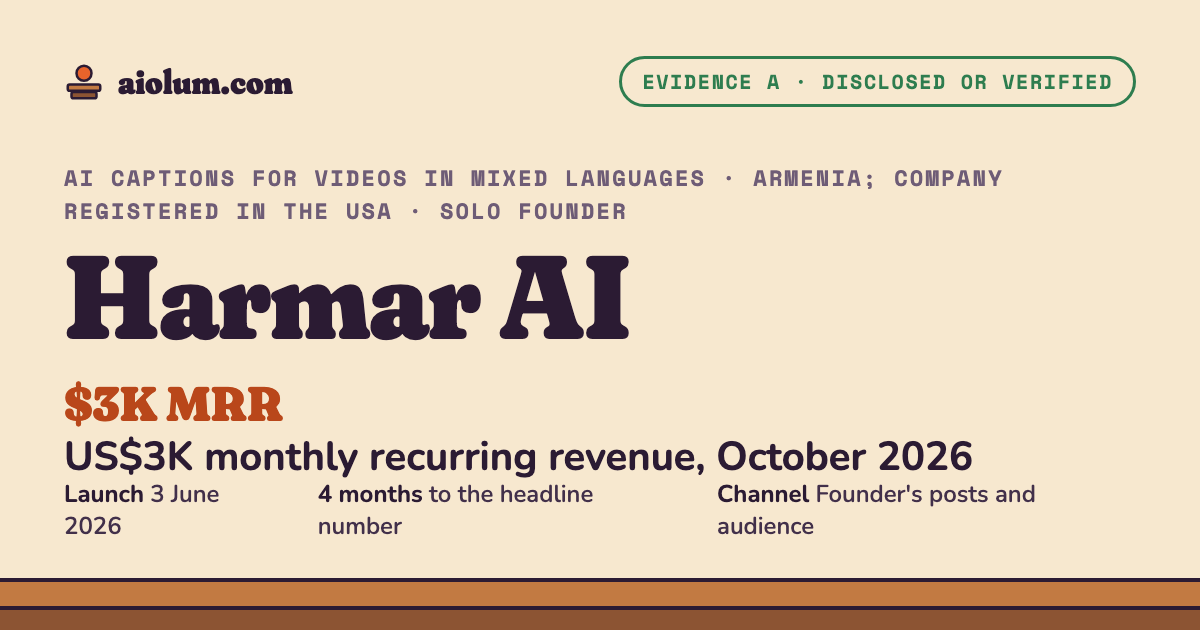
Harmar AI (AI captions for videos in mixed languages, Armenia; company registered in the USA): US$3K monthly recurring revenue, October 2026. Evidence grade A: disclosed by a company or a filing, or verified by a payment processor. Team: 1 founder, Aram, in Yerevan; the company calls Harmar a solo build. Launched 3 June 2026; still running, revenue growing.Added 26 October 2026
- Outcome
- US$3K monthly recurring revenue, October 2026Revenue growing
- Evidence
- A disclosed by a company or a filing, or verified by a payment processor
- Launch
- 3 June 2026
- Status
- Still running
- Team
- 1 founder, Aram, in Yerevan; the company calls Harmar a solo build
- Outside funding
- Bootstrapped (founder-entered on TrustMRR); listed for sale at US$150,000 on 26 October 2026
- Group
- Voice and audio
- Main channel
- Founder's posts and audience
Harmar makes captions for short videos: the spoken words shown as text on the screen, timed to the speech. Many people watch Instagram Reels, YouTube Shorts and TikTok videos with the sound off, so creators add captions. Harmar was built for Armenian creators, who often use code-switching: they change language inside one sentence, for example from Armenian to Russian or English and back. The company's blog says that most caption tools first ask for one language and then translate, drop or respell the words that do not fit. Armenian is also a low-resource language, a language with little recorded and written text available to train speech models. Harmar keeps each word in the language and the alphabet in which it was spoken.
The About page says the founder, Aram, lives in Yerevan, publishes AI education in Armenian on YouTube and Instagram, and built the product, the app and the API alone. TrustMRR, a site that reads revenue directly from a company's payment provider, shows Stripe revenue of US$789 in June 2026, US$1,413 in July, US$1,638 in August and US$2,888 in September. On 26 October 2026 it showed MRR (monthly recurring revenue, the subscription revenue of one month) of US$2,996 from 231 active subscriptions, and US$2,988 of revenue in the first 26 days of October.
The headline number is grade A, because it comes from the Stripe account. Two things on the page are less clear. The same Stripe account shows revenue before the founding date of 3 June 2026, including US$1,234 in November 2025, and no source says which product earned it. And the company's pages name two legal owners: a sole proprietorship in Armenia on the About page, and HARMARAVET LLC, a US company, in the terms and the privacy policy. The founder listed the business for sale on TrustMRR on 26 October 2026. The page also shows four failed companies that tried to make speech, translation or video editing cheap before AI models could do the work.
How much revenue does Harmar AI make?
Each row shows the evidence grade and the source numbers from the list at the end of this page. The grades are explained in How Aiolum verifies.
| Fact | Value | Grade | How we know | Sources |
|---|---|---|---|---|
| Monthly recurring revenue, 26 October 2026 | US$2,996 from 231 active subscriptions | A | TrustMRR metric snapshot, read from the Stripe account through an API key; revenue last synced on 26 October 2026 at 14:00 UTC. Stripe is not the merchant of record. TrustMRR shows MRR growth of 13.3% in the last 30 days. | [1] |
| Verified revenue, September 2026 | US$2,888 | A | TrustMRR monthly revenue timeline. The latest full month. | [1] |
| Verified revenue, 1 to 26 October 2026 | US$2,988 | A | A partial month, already 3.5% above September (calculated: 2,988 divided by 2,888). | [1] |
| Verified revenue, June, July and August 2026 | US$789, US$1,413 and US$1,638 | A | TrustMRR monthly revenue timeline. Each month is higher than the month before. | [1] |
| Growth from August to September 2026 | 76.3% | calc | Calculated: (2,888 minus 1,638) divided by 1,638. | [1] |
| Verified revenue, last 30 days to 26 October 2026 | US$3,554 | A | TrustMRR shows growth of 40.9% against the 30 days before. The daily table has a payment on every one of the 30 days; the largest day is US$310. | [1] |
| Average MRR per active subscription | about US$12.97 | calc | Calculated: 2,996 divided by 231. Between the Harmar 10 price of US$8.99 and the Harmar 60 price of US$16.99. | [1, 2] |
| Run rate from the October 2026 MRR | about US$35,952 a year | calc | Calculated: 2,996 times 12. | [1] |
| Verified revenue, November 2025 to May 2026 | US$2,848 in total | A | US$1,234 in November 2025 and US$1,237 in December 2025, then between US$24.63 and US$115 a month from January to May 2026 (sum calculated). All of it is before the founding date of 3 June 2026. No source this page read says which product earned it. | [1] |
| Verified revenue older than 12 months | about US$10,468 | calc | Calculated: all-time revenue of US$23,033 minus US$12,565 for the last 12 months. The Stripe account therefore had revenue before October 2025, long before the founding date. | [1] |
| Verified revenue, all time to 26 October 2026 | US$23,033 | A | Includes the revenue from before the founding date. June to October 2026 sum to US$9,716 (calculated). | [1] |
| Profit margin, last 30 days | 91% | C | TrustMRR snapshot. Revenue comes from Stripe, but the costs behind the margin are not shown as verified. | [1] |
| Founded date | 3 June 2026 | C | Typed by the founder into the TrustMRR profile. The About page gives 2026, and the terms and privacy policy are dated May 2026. | [1, 3, 4] |
| Time from the founding date to the headline figure | 4 months | calc | Calculated: June 2026 to October 2026. | [1] |
| Founder | Aram, based in Yerevan | C | Named by first name only on the About page, as founder for product, engineering and design. The page says he worked as a freelancer on Upwork for seven years from Spain and writes an AI newsletter in Armenian. | [3] |
| Team | 1 person | C | TrustMRR team size, founder-entered. The About page says the product, the app, the API and everything behind them are his own work. | [1, 3] |
| Legal owner | two names on the company's pages | C | The About page: Aram AI, an individual entrepreneur (sole proprietorship) registered in Yerevan. The terms and privacy policy: HARMARAVET LLC, United States, with Delaware law for disputes. TrustMRR lists the country as US. | [3, 4, 5, 1] |
| Outside funding | none | C | TrustMRR funding field: Bootstrapped, founder-entered. No source mentions investors. | [1] |
| Word error rate in the company's own test | 8.1% for Harmar, 34.5% for Whisper large-v3 | C | Mean over 57 languages of the public FLEURS speech data set, published by the company on 5 September 2026. Armenian: 9.3% against 38.7%. Whisper was better in English, 2.5% against 3.3%. Not an independent test. | [7] |
| Asking price on TrustMRR | US$150,000, listed on 26 October 2026 | C | TrustMRR shows a revenue multiple of 3.5. Calculated: 150,000 divided by (3,554 times 12) is 3.52. An asking price is not a sale. | [1] |
How to read this table: a grade A value comes from Stripe, the payment processor, through TrustMRR's connection to the company's Stripe account. A grade C value is a statement by the company on its own pages, or a value the founder typed into the TrustMRR profile. A "calc" value was computed on this page from the rows above it.
| Plan | Per month, billed yearly (US$) | Per month, billed monthly (US$) | Limit |
|---|---|---|---|
| Free | 0 | 0 | 5 minutes a month, videos up to 3 minutes, Harmar logo on the video |
| Harmar 10 | 7.49 | 8.99 | 10 minutes a month, no logo, SRT and VTT files, own fonts |
| Harmar 60 | 14.16 | 16.99 | 60 minutes a month, about 30 to 60 videos |
| Harmar 120 | 23.33 | 27.99 | 120 minutes a month, 4K export, transparent caption track, extra minutes for sale |
Plans are sold by minutes of video per month. The home page offers annual billing with 2 months free, and the About page says annual billing is twelve months for the price of ten, so the yearly column is the monthly price times 10, divided by 12 (calculated). The About page says subscriptions are billed in Armenian dram (AMD), and the structured data in the home page source lists 3,000, 6,000 and 15,000 AMD a month for the three paid plans. The developer API is sold separately as prepaid minute packs, with 10 free trial minutes. The terms also name a Lifetime plan that is granted to selected users such as partners and cannot be bought.
When did Harmar AI launch, and how did it grow?
From a founding date in June 2026 to US$2,996 of monthly recurring revenue in October 2026. Each entry carries its grade.
- Before October 2025AThe Stripe account that TrustMRR reads already has revenue: about US$10,468 earlier than the last 12 months (calculated). No source says from which product. [1]
- November and December 2025AUS$1,234 and US$1,237 of verified revenue, before the founding date. Revenue then falls to between US$24.63 and US$115 a month from January to May 2026. [1]
- May 2026CThe terms of service and the privacy policy take effect, naming HARMARAVET LLC as the company behind Harmar. [4, 5]
- 3 June 2026AFounding date entered by the founder on TrustMRR. Revenue that month is US$789. [1]
- 13 June 2026CThe English blog publishes a guide on adding Armenian subtitles to Instagram Reels. [9]
- July and August 2026AUS$1,413 and US$1,638 of verified revenue. [1]
- 4 and 5 September 2026CBlog posts on why caption tools fail when speakers switch languages, and a benchmark against Whisper in 59 languages. [8, 7]
- September 2026AUS$2,888 of verified revenue, 76.3% more than August (calculated). [1]
- 26 October 2026AMRR of US$2,996 from 231 active subscriptions. The founder lists the business for sale on TrustMRR at US$150,000 on the same day. [1]
Why did Harmar AI work?
Four causes, in the order they mattered. Each one is a reusable lesson.
One badly served language first
The About page says the tools that Armenian creators used, such as CapCut, Instagram's automatic captions and caption apps built on Whisper, did not support Armenian or did not support it well enough, so creators typed captions by hand. A product that is clearly better for one group can win that group without competing with the large tools in English, where the company's own test shows Whisper is better.
Mixed-language speech as the main case
Most transcription models are asked for one language per video. Harmar keeps each word in the language and alphabet in which it was spoken, writes spelling rules for borrowed words per language, and fixes the alphabet for a whole video. The company says it measured 7.9% word error rate on mixed Hindi and English speech, against 42.4% for Whisper large-v3; word error rate is the share of words that are wrong, missing or added.
A founder who already had the audience
The founder published AI lessons in Armenian on YouTube and Instagram and an Armenian AI newsletter before Harmar. The About page says the audience asked for the tool and that customers arrive through organic content, referrals and word of mouth, with no outbound sales.
Many small subscriptions
The Stripe data shows 231 active subscriptions with an average of about US$12.97 of MRR each (calculated), and a payment on every day of the last 30 days. Revenue is spread over many small customers; the About page says most of them are Armenian-speaking creators who publish short videos often.
How it was built
These details come from the company's own pages: the About page, the privacy policy, the API page and the home page source. They are grade C, except the payment provider, which TrustMRR confirms (grade A). [3, 5, 6, 2, 1]
- Google provides the sign-in and, in the words of the privacy policy, the AI models that produce the captions. No source names the model.
- Supabase, a hosted Postgres database with login, holds the accounts and the project data.
- Cloudflare R2 stores the uploaded files; the API returns signed upload links to R2. Source media is deleted once the captions exist.
- Railway and Vercel run the service. The home page source loads its scripts from a /_next/ path, the folder that the Next.js web framework uses.
- Stripe Checkout takes the subscriptions, and Brevo sends the transactional email. Users can also sign in with Telegram.
- A developer API sells prepaid minutes, and an npm package named harmar-ai is a command-line tool and an MCP server, so that AI coding agents and Claude can caption a video through it. MCP, the Model Context Protocol, is a standard way for an AI app to call tools in another program.
Tools named in the sources
Each one opens its page in the Tools tab, with every story that uses it.
Who tried this before Harmar AI, and why did they fail?
Four companies in the Loot Drop database tried to sell speech recognition, translation or easy video editing before AI models made these tasks cheap. The values below are from that database and are not independently verified.
Tellme
The promiseInformation and transactions over the phone by voice command, using automated speech recognition instead of human operators.
Why it diedSmartphone apps with screens replaced voice phone services, and large companies built better voice assistants. Microsoft bought it in 2007, but the integration had no clear direction.
TurboTranslations
The promiseFaster and cheaper translations from a marketplace of freelance human translators.
Why it diedNeural machine translation from Google in 2016 and DeepL in 2017 closed most of the quality gap, and a business built on human translators lost its reason to exist.
ReelSurfer
The promiseSimple clipping and sharing of video for people who do not know editing software, in a desktop tool.
Why it diedYouTube and Facebook added the same editing and sharing features, and mobile apps such as Instagram and Snapchat moved video creation to the phone.
Petalite
The promiseA voice assistant that runs on the device instead of in the cloud, for users who care about privacy.
Why it diedAmazon and Google sold their voice devices at or below cost, with more training data and their own ecosystems, and a venture-funded start-up could not match them.
The failed startups come from Loot Drop, a free database of dead startups, retold here in our own words. Loot Drop describes its entries as AI-assisted summaries of public sources, so these cards carry no evidence grade.
What changed
The predecessors had to build the hard part themselves or pay people to do it. Tellme raised US$238 million to make speech recognition work over the phone. TurboTranslations paid human translators. Petalite raised US$12 million to build its own language models and hardware. Each one then lost to large companies with more data, or to machine translation that became good enough.
Harmar rents the speech models from a cloud provider and builds only the parts around them: language rules for mixed speech, word timing, an editor, caption styles and exports. That is work one engineer can do. It also chose a group that large companies do not focus on, Armenian speakers who mix languages, and sold to them through an audience the founder already had. Stripe data on TrustMRR shows that this reached US$2,996 of MRR four months after the founding date.
Can one person copy Harmar AI now?
The method, yes. The niche, only if you know the language.
One person built and runs the product on rented models and hosted services, with almost no capital. The hard part is to know a language community well: how its speakers mix languages, which spelling they expect, and where they post videos. The founder's earlier Armenian AI audience did the selling. The risk is that the large caption tools add better support for small languages, and the company's own test shows the gap is small in major European languages.
Where it is still open: Other mixed-language groups that the company's own pages name: Taglish in the Philippines, Hinglish in India, Kazakh and Uzbek with Russian in Central Asia, and diaspora communities. A founder who speaks one of these mixes and has an audience in it can repeat the pattern.
- 1Pick a language, or a mix of languages, that the large caption tools handle badly and that you speak.
- 2Rent the speech model, and write the rules that the model gets wrong: alphabet, spelling of borrowed words, word timing.
- 3Publish your own accuracy test with the method and the languages where you lose, so customers can check it.
- 4Sell a free plan with a logo on the video and cheap monthly plans by minutes of video, then add an API for developers.
What could go wrong for Harmar AI?
The risks are the mirror image of the causes above.
Revenue from before the product
The Stripe account that TrustMRR reads shows US$1,234 in November 2025 and US$1,237 in December 2025, and about US$10,468 earlier than the last 12 months (calculated from the all-time and 12-month totals). The founding date is 3 June 2026. No source this page read says which product or service earned that money; the About page says the founder earlier ran an AI automation practice. This page uses only the figures from June 2026 on for the story.
Two different legal owners
The About page names Aram AI, an individual entrepreneur (sole proprietorship) registered in Yerevan, as the legal entity. The terms of service and the privacy policy name HARMARAVET LLC, United States, as the company and data controller. TrustMRR lists the country as US. The founder is named by first name only.
For sale
The founder listed the business on TrustMRR on 26 October 2026 at US$150,000, which TrustMRR shows as 3.5 times yearly revenue. A new owner could change the product, the prices or the team, and this page would then describe a different business.
The accuracy numbers are the company's own
The benchmark against Whisper large-v3 was run and published by the company on 5 September 2026. It uses public data and says where Harmar loses (English, Yoruba, Turkmen, Somali), but no independent party has repeated it. The privacy policy says Google provides the AI models, so part of the accuracy comes from a rented model that competitors can also rent.
The founder's own marketing
The sample project on the home page, titled Aram AI Reel, ends with the caption "follow me en instagram : @iamaram.ai", the founder's personal account. The About page says he builds Harmar in public, posting the process, the failures and the decisions, and links his Instagram, YouTube and Telegram accounts. This is promotion from the founder's own accounts; no source this page read shows bought reviews or fake accounts.
Sources
The grade next to each source is the best grade that the source can support. "Read in full" means that the text of the page was downloaded and the numbers were checked in it.
- A TrustMRR markdown profile: Harmar AI (Stripe API key, synced 26 October 2026)Read the markdown profile on 26 October 2026. The revenue tables, the MRR and the subscription count are grade A; the founded date, team size, funding, profit margin, tech stack and sale listing are founder-entered or listing data, grade C.
- C Harmar home page, read 26 October 2026Read in full, including the pricing section and the structured data in the page source. Source for the product, the plans and the AMD prices.
- C About Harmar, read 26 October 2026Read in full. Source for the founder, the solo build, the customers, the acquisition channels, the hosting providers and the Armenian legal entity.
- C Harmar terms of service, effective May 2026Read in full. Source for HARMARAVET LLC, the age limit of 16, the plans, the Lifetime plan and the API terms.
- C Harmar privacy policy, effective May 2026Read in full. Source for the service providers: Google, Supabase, Cloudflare R2, Railway, Vercel, Stripe and Brevo.
- C Harmar API documentation, read 26 October 2026Read the overview, the upload, job and export sections. Source for the API, the prepaid minutes, the npm package and the MCP connector.
- C Harmar blog, 5 September 2026: We Benchmarked Our Speech Recognition Against Whisper in 59 LanguagesRead in full. The company's own test; source for the word error rates.
- C Harmar blog, 4 September 2026: Why Caption Tools Break When You Switch Languages Mid-SentenceRead in full. Source for how the product handles mixed-language speech.
- C Harmar blog index, read 26 October 2026Read in full. Source for the dates of the English blog posts.
- C Loot Drop database export, 1,749 failed startupsLocal export. AI-written summaries, not independently verified. Source for the failed predecessors.