Letterbook: Product, team and how it was built
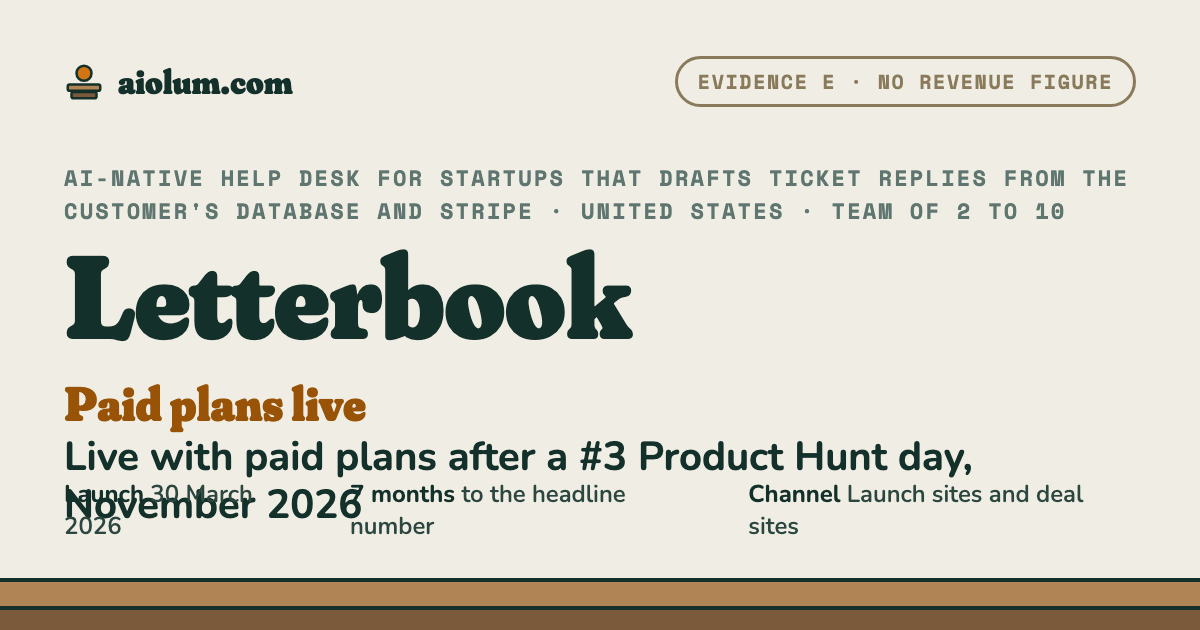
Letterbook (AI-native help desk for startups that drafts ticket replies from the customer's database and Stripe, United States): Live with paid plans after a #3 Product Hunt day, November 2026. Evidence grade E: no revenue figure was checked. Team: 2 people (Y Combinator profile); started in 2023 as Martin by a team of three, later led by Dawson Chen and Ethan Hou. Launched 30 March 2026; still running.Added 6 November 2026
- Outcome
- Live with paid plans after a #3 Product Hunt day, November 2026
- Evidence
- E no revenue figure was checked
- Launch
- 30 March 2026
- Status
- Still running
- Team
- 2 people (Y Combinator profile); started in 2023 as Martin by a team of three, later led by Dawson Chen and Ethan Hou
- Outside funding
- Y Combinator Summer 2023; US$2 million seed round for Martin AI, January 2025 (VentureBeat)
- Main channel
- Launch sites and deal sites
What is not verified
No revenue figure for Letterbook was found. We looked for a payment-processor profile, a founder interview with numbers and a press report about Letterbook itself; none exists in the sources read on 6 November 2026. The 100,000 Martin users rest on the founders' own launch post; VentureBeat reported over 10,000 early users in January 2025. The launch post says Letterbook has replaced other help desks for 'many fast-growing companies in YC' without naming them; the home page names one customer, a co-founder of the sleep app Stellar Sleep, in a testimonial. A reader could look for a Stripe-verified revenue profile or customer case studies. This story is grade E: the business is real and its product, price and customers are described from public pages, but no revenue figure was checked. Aiolum shows it as an idea worth studying, not as proof that it makes money.
Letterbook is a help desk, software in which a company receives, sorts and answers customer support requests, called tickets. Its AI agent does not answer from documents alone: the customer gives it a restricted API key, a key that lets one program read or change only chosen data in another, for its database and its Stripe account, so a draft reply can say which plan a customer has and can stage a refund that a person confirms with one click.
The company is DCWU, Inc., doing business as Letterbook, in San Francisco, a Y Combinator company of the Summer 2023 batch. It started as Martin, an AI personal assistant app; VentureBeat reported on 30 January 2025 that Martin AI raised US$2 million in seed funding. Letterbook was featured on Product Hunt on 30 March 2026, where it was third product of the day, and the founders posted its Y Combinator launch on 15 April 2026. In November 2026 it sells two plans with a 7-day free trial and a custom Enterprise plan.
No revenue figure for Letterbook was found, so this story is grade E: the product is live and sells plans, but its money is not verified. The page also shows earlier companies that tried to automate support answers or to sell chat tools against Zendesk and Intercom.
How much revenue does Letterbook make?
Each row shows the evidence grade and the source numbers from the list at the end of this page. The grades are explained in How Aiolum verifies.
| Fact | Value | Grade | How we know | Sources |
|---|---|---|---|---|
| Status, November 2026 | Live, with two paid plans, a free trial and a demo booking | C | Home and pricing pages read 6 November 2026: 'Try for Free', '7 days free. No credit card.' | [1, 2] |
| Product Hunt launch | #3 product of the day, 250 points, 30 March 2026 | C | Product Hunt product page: 'Day Rank' 3, 'Upvote • 250 points', featured on 30 March 2026; 612 followers and one review when read. The home page also says '#3 Product of the Day'. | [6, 1] |
| Team | 2 people | C | Y Combinator company page: team size 2, San Francisco. The launch post of 15 April 2026 is signed 'we're Dawson and Ethan, the founders of Letterbook.' | [3, 4] |
| Company | DCWU, Inc., doing business as Letterbook | C | Terms, privacy notice and data processing addendum. The terms are governed by California law. | [8] |
| Founded | 2023, Y Combinator Summer 2023 | C | Y Combinator company page: year founded 2023, batch Summer 2023. The same page lists the October 2023 launch of Martin under the Letterbook company. | [3] |
| Earlier product | Martin, an AI personal assistant; the founders say it grew to 100,000 users | D | Launch post of 15 April 2026: 'We grew our last product, Martin (an AI personal assistant), to 100,000 users.' VentureBeat reported 'over 10,000 early users' in January 2025. No other source checks the larger number. | [4, 5] |
| Funding | US$2 million seed round for Martin AI, January 2025 | C | VentureBeat, 30 January 2025, with investors including Pioneer Fund and FoundersX Ventures. No source mentions a round for Letterbook itself. | [5] |
| Prices | US$50 and US$200 a month; Enterprise on request | C | Pricing page. Plans are set by seats and tickets per month. | [2] |
| AI model providers | Anthropic and OpenAI | C | Data processing addendum, Annex C: 'Anthropic | AI model processing for support automation' and 'OpenAI | AI model processing for support automation'. Google Cloud and Microsoft Azure are listed for 'Cloud infrastructure and AI services'. | [8] |
| Integrations | Stripe, PostgreSQL, MongoDB, Supabase, Google Play; email, Discord, web form, mobile app | C | Home page channel and integration lists. | [1] |
| Time from launch to the November 2026 status | 7 months | calc | Calculated: 30 March 2026, the Product Hunt launch, to November 2026. | [6, 1] |
How to read this table: product values come from the Letterbook home, pricing, terms and data processing pages read on 6 November 2026; company facts from the Y Combinator company page and its embedded launch posts; the funding from VentureBeat; the launch rank from the Product Hunt product page. No value is grade A or B, and no value is revenue.
| Plan | Per month, billed yearly (US$) | Per month, billed monthly (US$) | Limit |
|---|---|---|---|
| Starter | 50 | 3 seats, 300 tickets a month, database and Stripe integration | |
| Growth | 200 | 10 seats, 1,000 tickets a month, all channels and integrations, priority support | |
| Enterprise | custom | custom | custom seats, 3,000+ tickets a month, SSO and SAML, dedicated account manager |
The pricing page lists monthly prices only, so the yearly column is empty. Both paid plans start with a 7-day free trial without a credit card. Enterprise is priced on request.
When did Letterbook launch, and how did it grow?
From a voice assistant app in 2023 to a help desk for startups in 2026. Each entry carries its grade.
- Summer 2023CThe company joins Y Combinator's Summer 2023 batch, the batch that its Y Combinator page lists for Letterbook today. [3]
- 2 October 2023CLaunch post for Martin, 'a better Siri with an LLM brain', a voice assistant app for iPhone, by three co-founders who dropped out of university. [3]
- 30 January 2025CVentureBeat reports a US$2 million seed round for Martin AI, founded by Dawson Chen and Ethan Hou, with over 10,000 early users. [5]
- 30 March 2026CLetterbook is featured on Product Hunt and finishes third product of the day with 250 points. [6]
- 15 April 2026DY Combinator launch post: Martin had grown to 100,000 users and 50 tickets a day, so the founders built their own AI-native help desk. [4]
- November 2026CLive with Starter and Growth plans, an Enterprise tier, and comparison pages against Zendesk, Freshdesk, Help Scout, Zoho Desk and Intercom. [1, 2]
Why did Letterbook work?
Four causes, in the order they mattered. Each one is a reusable lesson.
Account data inside every draft
The agent reads the ticket, fetches the customer from the connected database and the subscription from Stripe, and reads policies such as a refund policy before it writes. The company blog says this is the difference from a human agent who works from a static knowledge base.
A human approves, the AI prepares
Every reply and every staged action waits for a person. The founders' blog describes a founder who reviews 50 drafted tickets in about 10 minutes at the end of the day, and says the AI learns tone and policies from past resolutions.
Sold to the founder, not to a support department
Set-up takes minutes by the company's account: connect the support inbox, paste restricted keys, review the first draft. Prices are by seats and tickets, starting with a small Starter plan aimed at startups.
How it was built
These details come from the company's own pages. They are grade C. [8, 1, 4]
- Model providers: Anthropic and OpenAI, listed as subprocessors for 'AI model processing for support automation'.
- Cloud infrastructure on Google Cloud and Microsoft Azure, both also listed for AI services.
- Payments for Letterbook's own plans are handled by Stripe, according to the privacy notice; Stripe is also the main integration for customers' billing tickets.
- Customer data comes in through restricted API keys for Stripe and read access to PostgreSQL, MongoDB or Supabase databases.
- The public site is a Next.js application, visible in the page source.
Tools named in the sources
Each one opens its page in the Tools tab, with every story that uses it.
Who tried this before Letterbook, and why did they fail?
Three companies in our database of failed startups sold support automation or support chat into the market that Zendesk and Intercom dominate. The values below are from that database and are not independently verified.
Answerly
The promiseFAQ chatbots that would deflect support tickets so humans handle only the complex ones.
Why it diedThe language technology of the time could not resolve real questions, and the company was too late to beat Zendesk and Intercom.
Hipmob
The promiseCustomer support chat built into mobile apps and websites.
Why it diedIntercom and Zendesk added the same chat features, and Hipmob could not stand out with little funding.
RightHello
The promiseLive chat for online shops that turns visitors into buyers.
Why it diedIt had nothing structurally different from many competitors while Intercom raised far more money.
The failed startups come from our database of 1,749 dead startups, retold here in our own words. Its entries are AI-assisted summaries of public sources, so these cards carry no evidence grade.
What changed
Answerly tried to deflect tickets with FAQ bots when language models could not yet write a useful answer, and Hipmob and RightHello sold chat windows that the large help desks then copied. Letterbook's drafts are written by current models from Anthropic and OpenAI and contain the customer's own account and payment data, which an FAQ bot did not have.
The incumbents are still there: Product Hunt lists Zendesk and Crisp, which sells AI customer support, among similar products, and the support-agent group on this site already has many AI help desks. Letterbook's narrower bet is the startup that runs on Stripe and its own database and wants a person to approve every reply.
Can one person copy Letterbook now?
The idea, yes. The starting position, partly.
A solo founder can build a help desk that connects to Stripe and a database with today's model APIs. Letterbook started with Y Combinator, seed money and a first-hand problem from its own consumer app, which gave it a launch audience among other Y Combinator companies.
Where it is still open: The same draft-and-approve pattern for tickets that need other systems: app-store purchases, shipping, or usage logs.
- 1Pick one data source that support tickets always need, such as the payment processor, and integrate it deeply.
- 2Let the AI prepare both the reply and the action, and keep a person as the one who sends it.
- 3Price by seats and tickets so that the model cost grows with the price.
- 4Launch on Product Hunt and inside a founder network where the first buyers already know you.
What could go wrong for Letterbook?
The risks are the mirror image of the causes above.
What is not verified
No revenue figure for Letterbook was found. We looked for a payment-processor profile, a founder interview with numbers and a press report about Letterbook itself; none exists in the sources read on 6 November 2026. The 100,000 Martin users rest on the founders' own launch post; VentureBeat reported over 10,000 early users in January 2025. The launch post says Letterbook has replaced other help desks for 'many fast-growing companies in YC' without naming them; the home page names one customer, a co-founder of the sleep app Stellar Sleep, in a testimonial. A reader could look for a Stripe-verified revenue profile or customer case studies.
Founding team changed
The Martin launch post of October 2023 names three co-founders who studied at Yale, MIT and CMU. VentureBeat in January 2025 names Dawson Chen and Ethan Hou, from Yale and Berkeley, as founders. The Y Combinator page today lists a team of 2 and shows one founder profile, Ethan Hou, whose profile names another Y Combinator company, Blume Benefits, as his latest. The April 2026 launch post is signed by Dawson and Ethan.
Competition
Among similar stories on this site, Chatbase and My AskAI sell AI support agents with published revenue, and Orka Chat sells a shared inbox with an AI agent for founders; Letterbook's difference is the database and Stripe actions inside each draft. Product Hunt lists Crisp, Featurebase and Zendesk among similar products.
Dependence on model providers and on Stripe
The data processing addendum lists Anthropic and OpenAI for the AI work, and Google Cloud and Microsoft Azure for infrastructure and AI services. The staged refunds and plan changes run through customers' Stripe accounts with restricted keys, so a wrong draft that a reviewer approves can move real money.
Sources
The grade next to each source is the best grade that the source can support. "Read in full" means that the text of the page was downloaded and the numbers were checked in it.
- C Letterbook home page, read 6 November 2026Read in full. Source for the product, channels, integrations, the testimonial and the Product Hunt badge.
- C Letterbook pricing page, read 6 November 2026Read in full. Source for the plans, limits and the free trial.
- C Y Combinator company page: Letterbook, AI-native customer support platformRead in full, including the company data and the launch posts embedded in the page source. Source for the batch, year founded, team size, founder profile and the 2023 Martin launch post.
- C Launch YC, 15 April 2026: Letterbook - AI Customer Support Built for StartupsRead in full as the post text embedded in the Y Combinator company page; the launch page itself was not downloaded separately. Founders' own post.
- C VentureBeat, 30 January 2025: These Yale and Berkeley dropouts just raised $2 million to build an AI assistant that could rival OpenAIRead in full. Source for the seed round, the founders and the 10,000 early users of Martin.
- C Product Hunt: Letterbook, AI support platform built for startupsRead in full, with the launch data in the page source. Source for the launch date, day rank, points and followers.
- C Letterbook blog, 16 May 2026: How to Run Customer Support as a Founder Without Hiring Anyone, and 1 April 2026: welcome postRead in full, both posts by Dawson Chen. Source for the review workflow and the blog start date.
- C Letterbook terms, privacy notice and data processing addendum, read 6 November 2026Read in full. Source for the legal entity, the subprocessors (AI providers, cloud, Stripe) and the payment processing.
- C Database of failed startups, local exportLocal export. AI-written summaries, not independently verified. Source for the failed predecessors.
Run this company? Send corrections or a verified figure to aiolum@livyden.com