Looped In: Product, team and how it was built
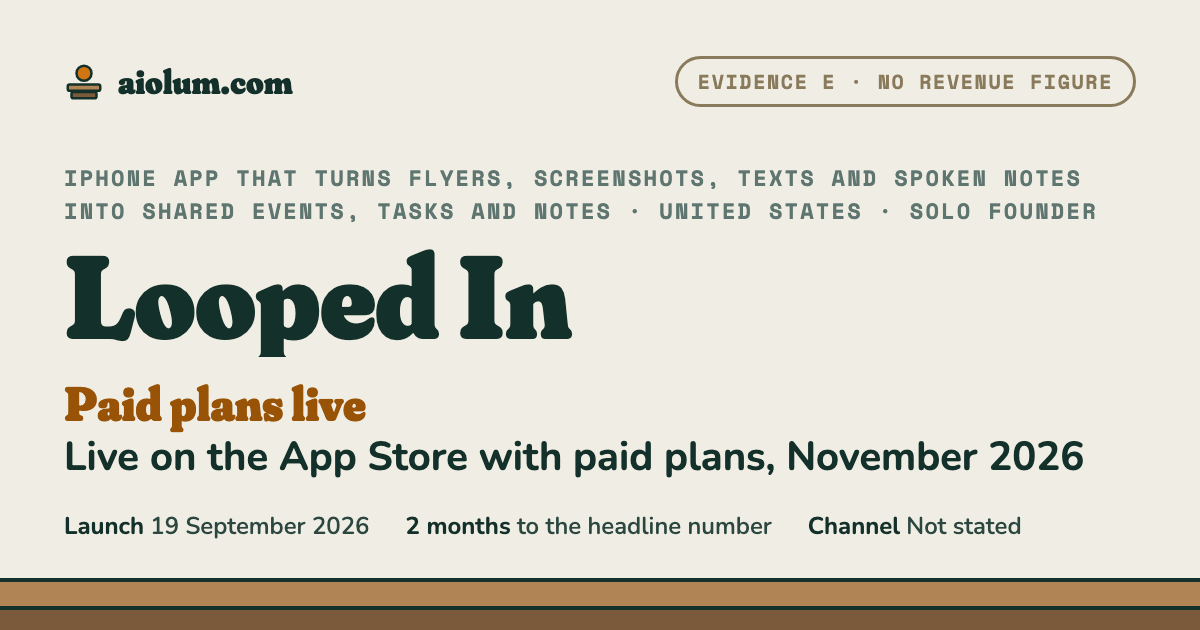
Looped In (iPhone app that turns flyers, screenshots, texts and spoken notes into shared events, tasks and notes, United States): Live on the App Store with paid plans, November 2026. Evidence grade E: no revenue figure was checked. Team: 1 founder, Alex Hansen, who says he built and runs it. Launched 19 September 2026; still running.Added 3 November 2026 · updated 4 November 2026
- Outcome
- Live on the App Store with paid plans, November 2026
- Evidence
- E no revenue figure was checked
- Launch
- 19 September 2026
- Status
- Still running
- Team
- 1 founder, Alex Hansen, who says he built and runs it
- Outside funding
- None reported
- Main channel
- Not stated
What is not verified
No revenue or subscriber figure was found. We looked for a payment-processor profile such as TrustMRR, a founder post with a dated figure, and App Store ratings, and found none: the listing has too few ratings to show a score and the Product Hunt launch had one vote when read. Only the launch date, the prices and the company details are checked. A reader could look for later App Store ratings or a founder update with subscriber numbers. This story is grade E: the business is real and its product, price and customers are described from public pages, but no revenue figure was checked. Aiolum shows it as an idea worth studying, not as proof that it makes money.
Looped In is an iPhone app for the person who keeps a family's or a group's schedule. Its assistant, Cue, does structured extraction: it reads free text, a photo or a transcribed sentence and returns separate records with fixed fields, here events with a date and time, tasks with an owner and a due date, and notes. The user checks each record and saves it into a shared list called a Loop. The privacy policy says the text goes through the company's server to OpenAI, while speech is transcribed and photos are read for text on the phone.
Version 1.0 went on the App Store on 19 September 2026 under the developer and seller LoopedIn Labs, LLC, which the privacy policy calls a Utah company. The about page is signed by Alex, who says he is a CPA (a certified public accountant) with about fifteen years in accounting operations; his Product Hunt launch post of 3 November 2026 gives his full name, Alex Hansen, and says he built the app with AI coding tools.
This story has no revenue figure. The App Store lists two subscriptions, Looped In Plus Monthly and Yearly, but the app had too few ratings to show a score, and the Product Hunt launch had one vote on the day it was read. The headline is therefore only that the app is live and sells a paid plan.
How much revenue does Looped In make?
Each row shows the evidence grade and the source numbers from the list at the end of this page. The grades are explained in How Aiolum verifies.
| Fact | Value | Grade | How we know | Sources |
|---|---|---|---|---|
| First release on the App Store | version 1.0, 19 September 2026 | C | App Store version history and the company changelog, which says "The first release of Looped In, on the App Store from today." | [1, 3] |
| Developer and seller on the App Store | LoopedIn Labs, LLC | C | Both the Developer and the Seller fields name the same company, as do the copyright line and the terms of service. | [1, 4] |
| Operator in the terms and privacy policy | LoopedIn Labs, LLC, a Utah company | C | Terms of service are governed by Utah law; the privacy policy says "a Utah company". The press page says "Alex is the founder of LoopedIn Labs, LLC." | [4, 5, 6] |
| Founder | Alex Hansen | C | The about page is signed "Hi, I'm Alex. I built Looped In, and I run it." The Product Hunt API lists Alex Hansen as the maker, and his launch post says "I'm a CPA, not an engineer, and I built it with AI coding tools." | [6, 7] |
| Team size | 1 person | C | Founder's own words on the about page; support email reaches him. The press page calls the company "a small company in Utah". No source suggests employees. | [6] |
| In-app purchases | Looped In Plus Monthly US$5.99; Yearly US$39.99 | C | App Store listing. The pricing page says the yearly price works out at US$3.33 a month, 44% less than monthly. | [1, 2] |
| Ratings on the App Store | not enough to show a score | C | The listing says "This app hasn't received enough ratings or reviews to display an overview." | [1] |
| Product Hunt launch | 3 November 2026, 1 vote and 1 comment when read | C | Product Hunt API extract read on 4 November 2026 UTC. | [7] |
| Updates after launch | 11, from 1.0.1 to 1.0.11 by 27 October 2026 | C | App Store version history and the changelog. | [1, 3] |
| Age rating and markets | 13+; United States and Canada | C | App Store rating 13+. Terms require 13 or older, with a parent's agreement for ages 13 to 17. Markets from the press page. | [1, 4, 5] |
| AI model | OpenAI, through the company's server; Apple's on-device model as a fallback | C | Privacy policy and the 1.0 changelog entry. The fallback works only offline or after the daily allowance, on iPhones with an A17 Pro chip or newer. | [3, 5] |
| Months from launch to the headline | 2 | calc | Calculated: September 2026 to November 2026. | [1] |
How to read this table: grade C is what the company writes on its own site or App Store page, or what the founder wrote in his launch post. A "calc" value was computed on this page. No value is grade A or B, and there is no money figure.
| Plan | Per month, billed yearly (US$) | Per month, billed monthly (US$) | Limit |
|---|---|---|---|
| Free | 0 | 0 | your first Loop, 3 saved Smart Captures a day, full use of Loops shared with you |
| Looped In Plus | 3.33 | 5.99 | US$39.99 a year; unlimited Loops, asking Cue, calendar switch, 50 Smart Captures and 100 Cue messages a day |
US prices; the App Store shows local prices in other countries. Every new account gets 7 days of Plus free with no card, and Apple also offers eligible new subscribers a 7-day free trial. One subscription covers an Apple Family through Family Sharing. People invited to a Loop use that Loop free, with no limit on how many. No ads on any plan.
When did Looped In launch, and how did it grow?
From the first App Store release to a Product Hunt launch, in about six weeks and eleven updates. Each entry carries its grade.
- 19 September 2026CVersion 1.0 on the App Store: Smart Capture, Loops, a calendar switch, Cue questions, free use for invited members, and Looped In Plus. [1, 3]
- 25 September 2026CVersion 1.0.1 gives every new account 7 days of Plus free with no card, and pauses Gmail import. [3]
- 8 to 18 October 2026CVersions 1.0.4 to 1.0.6: one input box for questions and captures, overlap warnings, multi-item plans from Cue, and an opt-in setting that lets Cue add items without asking. [3]
- 21 October 2026CVersion 1.0.8 adds steps for connecting outside assistants such as Claude. [3]
- 27 October 2026CVersion 1.0.11 sets the free plan at one Loop and three saved captures a day. [1, 3]
- 3 November 2026CLaunch on Product Hunt, with the founder's post on building the app with AI coding tools. [7]
Why did Looped In work?
Four causes, in the order they mattered. Each one is a reusable lesson.
Input in the form it came in
The app accepts a paste, a photo, a screenshot or speech, so the user does not retype. Cue proposes the records and the user confirms, which keeps mistakes from the model out of the calendar.
Free members, one payer
Only the organizer needs Plus. Everyone invited to a Loop uses it free, and one subscription covers an Apple Family, so each new member is a possible future subscriber without a price barrier.
A daily allowance on the free plan
Three saved captures a day let a user test Cue on a real flyer. More Loops, questions to Cue and the calendar switch need Plus, which is where the model cost is.
How it was built
These details come from the company's privacy policy, changelog and the founder's launch post. They are grade C. [5, 3, 7]
- Built by the founder, an accountant, with AI coding tools, as his Product Hunt post says. The tools are not named.
- Cue's requests go from the app to the company's server and on to OpenAI; the phone never contacts OpenAI directly.
- Speech is transcribed on the phone and photos are read for text on the phone. Apple's on-device model is a fallback when offline.
- Google Firebase and Google Cloud run sign-in, the database, storage, notifications, analytics and the server code. RevenueCat tracks App Store subscriptions. Cloudflare hosts the website.
- Cue's saved memory is encrypted with a key kept in the iPhone's Keychain.
Tools named in the sources
Each one opens its page in the Tools tab, with every story that uses it.
Who tried this before Looped In, and why did they fail?
Three companies in our database of failed startups sold a better calendar and failed. The values below are from that database and are not independently verified.
Hera
The promiseAn AI-enhanced calendar that looked better than Google Calendar, with suggestions and shared planning.
Why it diedIt charged where Google gave a calendar away, and too few free users moved to the paid plan.
Woven
The promiseOne smart calendar for personal and team schedules, with scheduling links and analytics.
Why it diedIntegrations needed constant repair, users were expensive to acquire, and few paid for features that free calendars had.
Kiko
The promiseA web calendar with drag-and-drop editing.
Why it diedGoogle Calendar launched free and took the market; the company was sold on eBay.
The failed startups come from our database of 1,749 dead startups, retold here in our own words. Its entries are AI-assisted summaries of public sources, so these cards carry no evidence grade.
What changed
All three tried to replace the calendar itself and lost to free calendars from Google. Looped In does not replace the calendar: it puts events onto the iPhone or Google calendar the user already has, and sells the step before it, turning a flyer or a text into records.
That step was not possible to automate cheaply before language models could read mixed text and photos. The founder also says he built the app himself with AI coding tools, so the cost of trying the idea was one person's time, not a funded team.
Can one person copy Looped In now?
Yes, it is easy to copy, which is also its risk.
Take one chore where information comes in messy forms, let a model turn it into records, and make the user confirm before saving. Charge the organizer and let the rest of the group join free.
Where it is still open: The same capture step for other groups: clubs, churches, volunteer committees and small offices, which the founder says a per-member plan will serve.
- 1Pick a job where people retype things they were handed: flyers, receipts, school emails.
- 2Accept every input form: paste, photo, screenshot, voice.
- 3Show the extracted records for confirmation, with undo.
- 4Let invited members join free and charge only the person who creates the shared space.
What could go wrong for Looped In?
The risks are the mirror image of the causes above.
What is not verified
No revenue or subscriber figure was found. We looked for a payment-processor profile such as TrustMRR, a founder post with a dated figure, and App Store ratings, and found none: the listing has too few ratings to show a score and the Product Hunt launch had one vote when read. Only the launch date, the prices and the company details are checked. A reader could look for later App Store ratings or a founder update with subscriber numbers.
Founder named only by first name on the site
The site's about and press pages say only "Alex". The full name Alex Hansen comes from the Product Hunt maker field of the launch post.
Paused Gmail reading
The privacy policy says version 1.0 could read a user's 20 newest inbox emails each time the app opened and send their text through the company's server to OpenAI. Version 1.0.1 paused Gmail import on 25 September 2026.
Easy to copy, and platform owners can add it
Apple and Google can add flyer-to-event extraction to their own calendars. The app depends on OpenAI for its main feature and on the App Store for every sale.
Sources
The grade next to each source is the best grade that the source can support. "Read in full" means that the text of the page was downloaded and the numbers were checked in it.
- C App Store: Looped In: Life Organizer, LoopedIn Labs, LLCRead in full on 3 November 2026, including the version history, in-app purchases, seller, age rating and ratings section.
- C Looped In home page and pricing pageRead in full on 3 November 2026, with the home page https://loopedinapp.io/.
- C Looped In changelogRead in full. Entries from 19 September to 27 October 2026.
- C Looped In terms of serviceRead the sections on eligibility, the operator, subscriptions and governing law.
- C Looped In privacy policy, version of 18 October 2026Read the sections on the operator, AI requests, service providers, Gmail and children.
- C Looped In about page and press kitRead in full, with https://loopedinapp.io/press. The founder's note and the company fact sheet.
- C Product Hunt API extract of the Looped In launch post, 3 November 2026Read the pipeline's saved Product Hunt GraphQL API extract (post 1294917, read 4 November 2026 UTC): maker name, votes, comments and the founder's launch post. The Product Hunt web page itself was not fetched.
- C Database of failed startups, local exportLocal export. AI-written summaries, not independently verified. Source for the failed predecessors.