Lunair: Revenue, team and how it was built
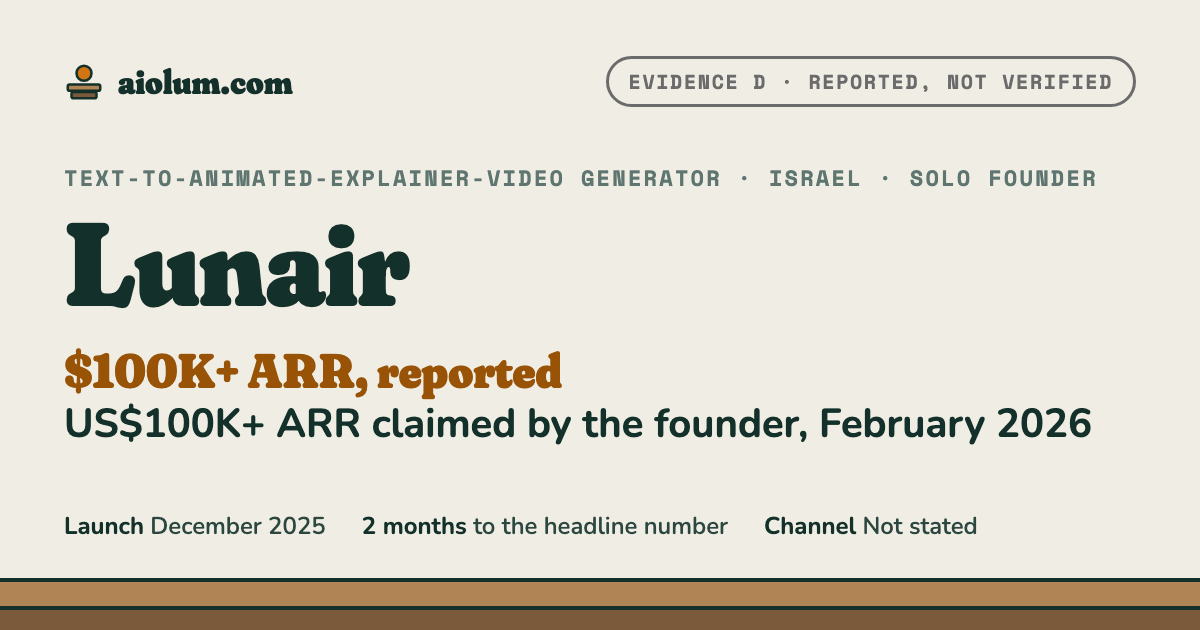
Lunair (Text-to-animated-explainer-video generator, Israel): US$100K+ ARR claimed by the founder, February 2026. Evidence grade D: reported, not verified. Team: 1 founder, who calls himself a solo founder and ran an animation studio for ten years before. Launched December 2025; still running, revenue growing.Added 3 November 2026 · updated 4 November 2026
- Outcome
- US$100K+ ARR claimed by the founder, February 2026Revenue growing
- Evidence
- D reported, not verified
- Launch
- December 2025
- Status
- Still running
- Team
- 1 founder, who calls himself a solo founder and ran an animation studio for ten years before
- Outside funding
- None reported; HUGE Magazine called it bootstrapped
- Group
- Video generation
- Main channel
- Not stated
What is not verified
The headline figure, more than US$100,000 ARR in February 2026, rests on one statement by the founder in his Product Hunt launch post of 15 February 2026, read here through the Product Hunt API. The earlier US$50,000 ARR figure comes from HUGE Magazine, which cites a LinkedIn post by an unnamed investor that this page could not read. The 5,000+ creators count is also the founder's own. No payment-processor profile, TrustMRR page or later dated figure was found. A reader could look for a revenue dashboard shared by the founder, a TrustMRR or Stripe-verified profile, or an interview with a dated figure from after February 2026. The headline number is grade D: one claim or one estimate, with no second source. Aiolum shows it because the story is useful, and marks it so that it is not mistaken for a verified figure.
Lunair is a text-to-video tool, a program that produces a video from a written description, made for one narrow kind of video: the branded, animated explainer video, a short cartoon-style film that shows what a company or product does. The user describes the idea; Lunair writes a script, generates a storyboard, a sequence of still pictures that plans each scene, applies the brand's logo and colors, and then animates the scenes with a synthetic voice and music. Changes are made by typing requests, not on a timeline, the track-by-track editing view of video software.
Guy Manzur, based in Israel, opened a waitlist in October 2025 and had a working app behind a login by December 2025, according to Internet Archive copies of the site. In his Product Hunt launch post of 15 February 2026 he wrote that he is a solo founder and that Lunair "grew to $100k+ ARR and 5,000+ creators within just 2 months". HUGE Magazine reported in its 19 January 2026 edition that he bootstrapped to US$50,000 ARR before the launch, citing a LinkedIn post by an investor.
This page gives the story the grade D, reported, not verified. The US$100,000 figure is one founder statement with one date, and the US$50,000 figure is a magazine's report of someone else's post, which this page could not read. The product, its prices and its operator are checked on the company's own pages and in archived copies.
How much revenue does Lunair make?
Each row shows the evidence grade and the source numbers from the list at the end of this page. The grades are explained in How Aiolum verifies.
| Fact | Value | Grade | How we know | Sources |
|---|---|---|---|---|
| Annual recurring revenue, February 2026 | more than US$100,000 ("$100k+ ARR") | D | Founder's Product Hunt launch post, dated 15 February 2026 in the Product Hunt API record: "we grew to $100k+ ARR and 5,000+ creators within just 2 months". One statement, one date; no payment processor confirms it. | [1] |
| Monthly equivalent of the February 2026 figure | about US$8,300 a month | calc | Calculated: US$100,000 divided by 12. ARR is a yearly figure built from current subscriptions, not money already received. | [1] |
| Annual recurring revenue before the Product Hunt launch | US$50,000 | D | HUGE Magazine, 19 January 2026 edition: "bootstrapped to $50K ARR before the launch, according to a LinkedIn post from an investor". The LinkedIn post was not read (this pipeline does not fetch linkedin.com), and the magazine does not name the investor. | [2] |
| Creators (users) | more than 5,000, February 2026 | D | Founder's launch post. HUGE Magazine called a 5,000-plus count self-reported and unverified. No such counter appears on the site copies read for this page (October 2025 to November 2026). | [1, 2, 5] |
| Founder and team | Guy Manzur, solo founder | C | Launch post: "I'm a solo founder who spent the last decade running an animation studio". HUGE Magazine: "reportedly built this solo". The privacy policy gives [email protected] as its contact address. | [1, 2, 4] |
| Location | Israel | C | HUGE Magazine: "Hebrew University, based in Israel". The privacy policy names no company or address. | [2, 4] |
| Operator named in the privacy policy | "Lunair" ("we," "us," "our"), contact [email protected] | C | Privacy policy, effective 1 September 2025. No legal entity is named; no separate terms page was found (lunair.ai/terms answers 404). The site footer says "Designed by Guyman Studio". | [4, 3] |
| Outside funding | none reported | D | HUGE Magazine calls the business bootstrapped. The same article cites "a LinkedIn post from an investor" without saying whether that person invested in Lunair. No funding round appears in any source read. | [2] |
| Waitlist page | online by 26 October 2025 | C | Internet Archive copy of 26 October 2025: "Get Early Access" and "Join Waitlist", no login. | [5] |
| Working app behind a login | by 23 December 2025 | C | Internet Archive copy of 23 December 2025 shows "Login" and links to app.lunair.ai. The founder's "within just 2 months" in February 2026 agrees with a launch around December 2025. | [5, 1] |
| Product Hunt launch | post created 15 February 2026; 480 votes and 158 comments when read | C | Product Hunt API record, read 4 November 2026. HUGE Magazine's 19 January 2026 edition already mentions a first-place Product Hunt finish; this page could not resolve the difference in dates. | [1, 2] |
| Prices, November 2026 | free; Starter US$29 a month; Pro from US$59 a month; Enterprise custom | C | lunair.ai pricing section, read 3 November 2026. Yearly billing gives two months free. | [3] |
| Built with | Base44, a no-code app builder | D | HUGE Magazine: "reportedly built this solo on top of Base44". Not confirmed by the founder in any source read. | [2] |
| Time from launch to the February 2026 figure | 2 months | calc | Calculated: December 2025 to February 2026. The founder's own words are "within just 2 months". | [1, 5] |
How to read this table: a grade D value appears in one source only and no payment processor or second dated report confirms it. A grade C value was read on the company's own site, its privacy policy, an Internet Archive copy of the site, or the Product Hunt API record. A "calc" value was computed on this page from the rows above it. No value is grade A or B.
| Plan | Per month, billed yearly (US$) | Per month, billed monthly (US$) | Limit |
|---|---|---|---|
| Free | 0 | 0 | 200 credits a month, about 40 seconds of video; watermark |
| Starter | 24 | 29 | 600 credits, about 2 minutes; downloads, no watermark, private videos |
| Pro, 1,200 credits | 49 | 59 | about 4 minutes; credits carry over; polish by a pro designer |
| Pro, 2,000 credits | 82 | 99 | about 6 minutes |
| Pro, 3,000 credits | 115 | 139 | about 10 minutes |
| Pro, 5,000 credits | 199 | 239 | about 16 minutes |
| Enterprise | custom | custom | custom credit volume, custom video styles |
Plans are paid in credits. The page's script counts 5 credits for each second of motion-graphics video, so 600 credits are about 2 minutes of video a month in total, split over any number of videos. Yearly billing gives two months free: US$288 a year for Starter and US$588 a year for the smallest Pro size. Pro can be sized up to 2,000, 3,000 or 5,000 credits; only Pro carries unused credits over and includes a polish by a human designer. The free plan has a watermark and allows 3 scene edits a day. In February 2026 the site instead sold seconds directly: a one-time top-up of 30 seconds at US$38.70 (US$1.29 a second) and a Creators subscription at US$29.70 a month (US$9 plus US$0.69 a second).
When did Lunair launch, and how did it grow?
From a waitlist page in October 2025 to a paid product with credit-based plans in November 2026. Each entry carries its grade.
- About 2015 to 2025CThe founder runs an animation studio for about ten years and, in his words, works with thousands of clients around the world. [1]
- 1 September 2025CEffective date of Lunair's privacy policy, which describes an AI-powered video generation service and sends user inputs to third-party AI providers. [4]
- 26 October 2025CThe site is a waitlist: "Vibe Directing is Finally Here", early access with a free credit pack. [5]
- 23 December 2025CThe site shows a login to the working app at app.lunair.ai. [5]
- 19 January 2026DHUGE Magazine features Lunair and reports US$50,000 ARR before launch, citing an investor's LinkedIn post. [2]
- 13 February 2026CThe site sells seconds of video: US$1.29 a second as a one-time top-up, or a US$29.70 a month Creators plan. [5]
- 15 February 2026DProduct Hunt launch post: the founder writes that Lunair grew to US$100,000+ ARR and 5,000+ creators within two months. [1]
- November 2026CThe site sells credit-based plans from US$29 a month, with a Pro plan that includes a human designer's polish. [3]
Why did Lunair work?
Four causes, in the order they mattered. Each one is a reusable lesson.
A studio process turned into a prompt
The founder wrote that he spent ten years running an animation studio. Lunair repeats the studio's order of work: script, storyboard, brand styling, animation, voice and music. A customer who would have paid a studio gets a draft in minutes and changes it by typing.
One narrow kind of video
Most AI video tools in 2026 aim at realistic footage or talking presenters. HUGE Magazine described branded animated explainers as the underserved middle lane. Lunair does only that kind of video, so its output can be tuned for one use, the landing page.
Edit by chat instead of a timeline
Changes to a scene, the narrator or the script are typed requests. The founder's launch post says the goal was no timeline to master and so no learning curve.
A human step in the top plan
The Pro plan lists a polish by a pro designer. That lets the product sell a result closer to studio work than pure generation, at a price per month instead of per project.
How it was built
These details come from the company's site and privacy policy (grade C) and from HUGE Magazine (grade D). The founder has not published a technical account in any source read. [2, 4, 3, 1]
- HUGE Magazine reported that the founder built Lunair alone on Base44, a no-code app builder.
- The privacy policy says user prompts, scripts and uploaded assets are sent to third-party AI service providers; it does not name them.
- Sign-in is by Google single sign-on, according to the privacy policy.
- The marketing site is a separate page from the app at app.lunair.ai; its footer credits Guyman Studio for the design.
- Usage is metered in credits, 5 credits for each second of motion-graphics video, according to the plan script on the home page.
- The founder posted a demo video and launched on Product Hunt; no source says which channel brought most customers.
Tools named in the sources
Each one opens its page in the Tools tab, with every story that uses it.
Who tried this before Lunair, and why did they fail?
Three companies in our database of failed startups promised to make animated or business video easy without a studio and failed. The values below are from that database and are not independently verified.
Fuzzwich
The promiseAnimated videos for casual users and small businesses, made by drag and drop with ready-made characters and scenes.
Why it diedWeak recurring revenue, a desktop product while users moved to phones, and better-funded animation tools.
ClearMix
The promiseProfessional business videos made quickly and cheaply through a network of videographers and editors.
Why it diedCanva and Adobe added video, AI editing tools automated its manual work, and the freelancer network was costly to scale.
Real Artists
The promiseA cloud platform for animation teams to collaborate without expensive software.
Why it diedLarge animation software makers added collaboration, and small studios could not pay enough to fund growth.
The failed startups come from our database of 1,749 dead startups, retold here in our own words. Its entries are AI-assisted summaries of public sources, so these cards carry no evidence grade.
What changed
Fuzzwich offered templates that customers had to arrange themselves, ClearMix relied on people for each video, and Real Artists sold tools to animators. Each one left either the work or the cost with the customer, and larger software makers then added the same features.
Lunair moves the whole studio process into generation: the customer writes one paragraph, and image, voice and music models do the work that animators did. Human work is kept only as an option in the top plan. The cost of building it was also small: one founder, no reported funding and, according to HUGE Magazine, a no-code builder. The risk that ended the predecessors remains: larger video tools such as Runway or HeyGen could add an explainer mode, as HUGE Magazine noted.
Can one person copy Lunair now?
The product, hard. The pattern, yes.
Few people have ten years of animation studio work behind them, and that experience is what shaped Lunair's output. The pattern is open to anyone with deep knowledge of one service business: take the steps a studio or agency follows for one common deliverable, generate each step with AI models, let the customer change it by chat, and keep a human polish as the top plan. The founder said this gave US$100,000+ ARR in two months; no second source confirms it.
Where it is still open: Other single deliverables that studios make for every company: product demo walkthroughs, pitch-deck animations, onboarding tutorials, social ad cut-downs and app store preview videos.
- 1Pick one deliverable that every company in a market needs and that agencies now make by hand.
- 2Write down the agency's steps in order and generate each one separately, so each can be corrected.
- 3Replace the editing timeline with typed requests.
- 4Sell credits for output, and put a human review in the most expensive plan.
What could go wrong for Lunair?
The risks are the mirror image of the causes above.
What is not verified
The headline figure, more than US$100,000 ARR in February 2026, rests on one statement by the founder in his Product Hunt launch post of 15 February 2026, read here through the Product Hunt API. The earlier US$50,000 ARR figure comes from HUGE Magazine, which cites a LinkedIn post by an unnamed investor that this page could not read. The 5,000+ creators count is also the founder's own. No payment-processor profile, TrustMRR page or later dated figure was found. A reader could look for a revenue dashboard shared by the founder, a TrustMRR or Stripe-verified profile, or an interview with a dated figure from after February 2026.
An investor is mentioned but no round
HUGE Magazine calls Lunair bootstrapped but cites "a LinkedIn post from an investor". No source says whether that person invested, and no funding round was found. The privacy policy names no legal entity, only the brand Lunair and the address [email protected].
A studio behind the solo founder
The founder ran an animation studio for ten years, the site footer says "Designed by Guyman Studio", and the Pro plan includes a polish by a pro designer. No source says who does that polish or whether studio staff work on Lunair. The software itself is described by the founder and HUGE Magazine as built by one person.
Dates that do not agree
HUGE Magazine's 19 January 2026 edition mentions a first-place Product Hunt finish, while the Product Hunt API gives 15 February 2026 as the creation date of the launch post that contains the US$100,000 claim. The site copies read for this page show no testimonials, user counters or countdowns, and no AI avatars or voice cloning: voices are chosen from a set.
Sources
The grade next to each source is the best grade that the source can support. "Read in full" means that the text of the page was downloaded and the numbers were checked in it.
- D Product Hunt: Lunair, Generate studio-quality explainer videos. Instantly. Launch post by Guy Manzur, created 15 February 2026Read through the Product Hunt API (GraphQL v2) on 4 November 2026 and saved as an extract (research/harvest-product-hunt-api-20261104/1/ph-api-1072464.txt); the HTML page itself was not fetched. Source for the US$100,000+ ARR and 5,000+ creators claim, the solo-founder statement, the studio background, the creation date, votes and comments.
- D HUGE Magazine, 19 January 2026 edition: One Guy, One Prompt, and a $50K ARR Argument Against the Entire Stock Footage IndustryRead in full, downloaded 3 November 2026. An analysis piece, not an interview. Source for the US$50,000 ARR report (attributed to an investor's LinkedIn post), Base44, Israel and the competitive view.
- C Lunair home page with plans, read 3 November 2026Read in full, including the plan data in the page's script (yearly prices, Pro sizes, credits per second). No testimonials, counters or countdowns found.
- C Lunair privacy policy, effective 1 September 2025Read in full. Source for the operator wording, the contact [email protected], Google sign-in and third-party AI providers. lunair.ai/terms and similar paths answered 404.
- C Internet Archive copies of lunair.ai: 26 October 2025, 23 December 2025, 20 January 2026, 13 February 2026Read each copy in full. Source for the waitlist stage, the first login to the app and the February 2026 per-second prices; no user counters or testimonials in any copy.
- C Database of failed startups, local exportLocal export. AI-written summaries, not independently verified. Source for the failed predecessors.