MyAudioJournal: Revenue, team and how it was built
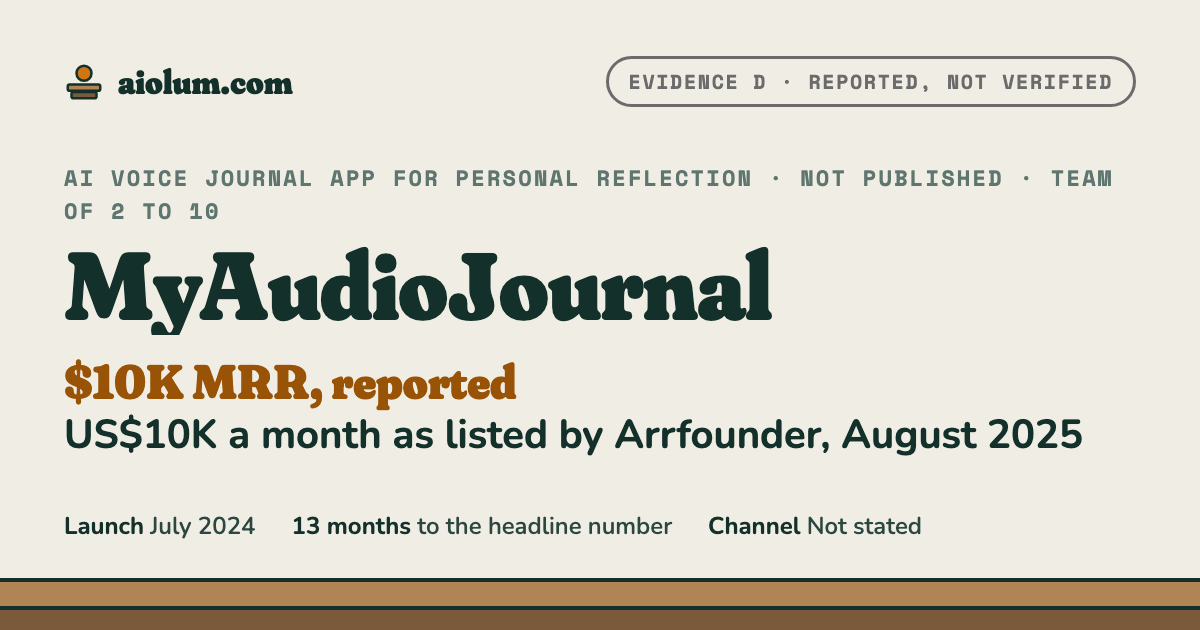
MyAudioJournal (AI voice journal app for personal reflection, Not published): US$10K a month as listed by Arrfounder, August 2025. Evidence grade D: reported, not verified. Team: 2 people named as authors in the site's page data (Samyak and Prashik); the company, Softpaper Labs, is described by Samyak in the first person; headcount not published. Launched July 2024; still running.Added 6 November 2026
- Outcome
- US$10K a month as listed by Arrfounder, August 2025
- Evidence
- D reported, not verified
- Launch
- July 2024
- Status
- Still running
- Team
- 2 people named as authors in the site's page data (Samyak and Prashik); the company, Softpaper Labs, is described by Samyak in the first person; headcount not published
- Outside funding
- Not published; no source read mentions outside investors
- Group
- Voice and audio
- Main channel
- Not stated
What is not verified
The headline of US$10,000 a month (US$120,000 a year) rests on one source: the Arrfounder directory, in a product record created on 21 August 2025 with its source marked "ai", linked to the X account @heysamyak, which Arrfounder marks as not verified. The original post was not found, and the same round US$10K figure appears for many products on that Arrfounder list. No payment-processor profile, filing or interview with a revenue figure was found. A reader could look for a Stripe-verified profile or a dated founder interview. The headline number is grade D: one claim or one estimate, with no second source. Aiolum shows it because the story is useful, and marks it so that it is not mistaken for a verified figure.
MyAudioJournal is an audio journal: a diary that the user speaks instead of types. The app sends the recording to speech-to-text, software that turns spoken words into written text, and then to unnamed AI service providers (in the words of its privacy policy) that find themes, write a weekly recap and suggest prompts, short questions that start the next entry. The company behind it is Softpaper Labs, a small app studio that its founder Samyak describes in the first person.
The first archived page of the product, from 18 July 2024, shows a private beta with a waitlist, a free plan with one minute of recording a day and a Pro plan at US$6 a month with 15 minutes a day. By April 2025 the page offered free sign-up and quoted two X users who praised the "AI audio journal" by @heysamyak. The directory Arrfounder lists the product at US$10,000 a month and US$120,000 a year, in a record created on 21 August 2025 and linked to the X account @heysamyak.
That revenue figure is grade D: a directory listing that Arrfounder says it collects mainly from founders' posts on X, here with the source marked "ai", no second source and no payment-processor check. This page also shows earlier journaling and private-writing products that did not last.
How much revenue does MyAudioJournal make?
Each row shows the evidence grade and the source numbers from the list at the end of this page. The grades are explained in How Aiolum verifies.
| Fact | Value | Grade | How we know | Sources |
|---|---|---|---|---|
| Monthly revenue, August 2025 | US$10,000 | D | Arrfounder product page, read 6 November 2026. The page data give mrr 10000 and arr 120000, extracted and created on 21 August 2025, with source marked "ai". Arrfounder says its data are "publicly disclosed by founders themselves and collected from various sources, primarily Twitter/X". The linked founder @heysamyak is marked verified: false. Many products on the same Arrfounder list show the same round US$10K figure. | [1] |
| Annual revenue in the same listing | US$120,000 | D | Arrfounder. It equals 12 times the monthly figure. | [1] |
| Time from the first archived product page to the August 2025 listing | 13 months | calc | Calculated: July 2024 to August 2025. | [3, 1] |
| Founder | Samyak (@heysamyak on X) | C | Arrfounder names the founder Samyak, @heysamyak. The home page data list the authors Samyak (linked to x.com/samyakr) and Prashik. The Softpaper Labs page is signed "— Samyak". | [1, 2, 7] |
| Team | 2 people named, headcount not published | C | Two authors in the home page metadata. The Softpaper Labs page says "i'm building an app studio that creates products people want". No source gives a headcount. | [2, 7] |
| Company | Softpaper Labs | C | Footer of the home page, terms and privacy policy: "© 2026 Softpaper Labs". The Softpaper Labs page lists two other products, homebrew and yapyap, and does not list MyAudioJournal. | [2, 6, 7] |
| Private beta | by 18 July 2024 | C | Internet Archive copy of 18 July 2024: "In Private Beta" with a "Join the waitlist" button. Earlier archive entries for the domain (2004 to 2019) belong to an older, unrelated site. | [3] |
| Pro plan price, July 2024 | US$6 a month | C | Internet Archive copy of 18 July 2024. No current price was found. | [3] |
| Platforms, November 2026 | web app, Android beta | C | Home page: "Join the MyAudioJournal Android Beta" through a Tally form; the FAQ refers to transcribing again "on web". A Google Play icon is shown without a store link. | [2] |
| Affiliate program | 20% of each referred signup | C | Home page FAQ: "Join our affiliate program and earn 20% from every signup you refer", run on Lemon Squeezy. | [2] |
| Minimum age | 13 | C | Privacy policy: "MyAudioJournal is designed for users aged 13 and older." | [5] |
| Outside funding | not published | C | No source read names an investor or a round. | [1, 7] |
How to read this table: a grade D value comes from one source that no one has checked, here the Arrfounder directory. A grade C value is the company's or a founder's own statement, here mostly the product's own pages. A "calc" value was computed on this page. No value is grade A or B.
| Plan | Per month, billed yearly (US$) | Per month, billed monthly (US$) | Limit |
|---|---|---|---|
| Basic | 0 | 0 | 1 minute of journal entries a day |
| Pro | not shown | 6 | 15 minutes of journal entries a day, chat with your journal, milestones |
The 2024 page showed monthly prices only. The terms read on 6 November 2026 say there are free and paid plans and a full refund within the first 30 days on request, but give no amounts, so current prices were not verified.
When did MyAudioJournal launch, and how did it grow?
From a private beta with a waitlist to a free web app with an Android beta in about two years. Each entry carries its grade.
- 18 July 2024CFirst archived page of the product: private beta with a waitlist, a free plan and a Pro plan at US$6 a month, "our AI will analyze them for you". [3]
- 24 April 2025CThe home page offers free sign-up, a chat with the journal entries and weekly summaries, and quotes two X users about the "AI audio journal" by @heysamyak. [4]
- 21 August 2025DArrfounder creates its listing at US$10,000 a month and US$120,000 a year, linked to @heysamyak. [1]
- 6 November 2026CHome page offers transcription, themes, personalised prompts, weekly reflections, an affiliate program and an Android beta; no prices are shown. [2]
Why did MyAudioJournal work?
Four causes, in the order they mattered. Each one is a reusable lesson.
Lower the cost of each entry
The product sells one change of habit: speak for a few minutes instead of writing. The home page puts it as "Talking is faster, more natural". Everything else (transcript, themes, recap) is produced after the user stops talking.
Give something back every week
A weekly recap every Sunday, a daily streak and reminders give the user a reason to come back. A journal that answers is the difference from a plain voice recorder.
Privacy as the main promise
The home page promises "End-to-end encryption" and "No ads, no tracking", and the privacy policy says entries are "never used for AI training". A diary holds the most private data a person has, so the buyer must trust the app first.
A free tier with a time limit
In 2024 the free plan allowed 1 minute of recording a day and the paid plan 15 minutes, so the price follows the transcription and model cost per minute.
How it was built
These details come from the product's own pages and their page code. They are grade C, and the AI providers are not named in any source. [2, 5]
- A Next.js web site; app images are stored on Supabase storage, according to the asset links in the home page code.
- Speech is transcribed to text, and "AI Service Providers" that the privacy policy does not name generate the insights; the policy says "Only necessary, non-identifying text is processed".
- Payments and the affiliate program run on Lemon Squeezy (myaudiojournal.lemonsqueezy.com/affiliates).
- The Android beta is offered through a Tally sign-up form.
- The privacy policy names a cloud storage provider and analytics providers without naming the companies.
Who tried this before MyAudioJournal, and why did they fail?
Three companies in our database of failed startups tried private journaling or simple private writing before. The values below are from that database and are not independently verified.
OhLife
The promiseEmail-driven journaling that promised to be as simple as replying to a friend.
Why it diedEmail prompts could not compete with app notifications, and users wanted more than a plain text diary.
Skiff
The promiseAn end-to-end encrypted productivity suite (email, documents, storage) as a privacy-first alternative to Google Workspace.
Why it diedPrivacy features were not enough to move mainstream users away from free incumbents with large networks.
Draft
The promiseA minimalist, cloud-based writing and editing tool for writers.
Why it diedIts narrow focus and freemium model could not compete with Google's general productivity tools.
The failed startups come from our database of 1,749 dead startups, retold here in our own words. Its entries are AI-assisted summaries of public sources, so these cards carry no evidence grade.
What changed
OhLife asked users to write a reply to an email every day, and users stopped. MyAudioJournal removes the writing: the user speaks, and speech-to-text and language models sold by API turn the recording into text and a weekly recap at a small cost per minute.
Skiff showed that privacy alone does not sell a product. Here privacy is a condition, not the product: the product is the summary and the prompts, and the privacy promise is what lets a user put a diary into it.
Can one person copy MyAudioJournal now?
Yes, one or two people can build it.
The parts are public: a recording screen, a speech-to-text API, a language model for summaries, a subscription checkout and a weekly email. The hard parts are keeping users coming back after the first week and earning trust with private data, and many apps compete for the same buyers.
Where it is still open: Spoken journals for one group with a clear routine, such as daily work logs for tradespeople or field notes for researchers.
- 1Limit free use by recorded minutes, so the price follows the per-minute model cost.
- 2Send something back on a schedule, such as a weekly recap, so the user has a reason to open the app.
- 3Write a privacy policy that says which data the AI providers receive, and make the home page say the same.
- 4Add an affiliate program with a stated commission once there is a paid plan.
What could go wrong for MyAudioJournal?
The risks are the mirror image of the causes above.
What is not verified
The headline of US$10,000 a month (US$120,000 a year) rests on one source: the Arrfounder directory, in a product record created on 21 August 2025 with its source marked "ai", linked to the X account @heysamyak, which Arrfounder marks as not verified. The original post was not found, and the same round US$10K figure appears for many products on that Arrfounder list. No payment-processor profile, filing or interview with a revenue figure was found. A reader could look for a Stripe-verified profile or a dated founder interview.
Health wording on the home page
The product is sold for "personal growth", but a "Backed by Science" section cites studies: "In a JAMA-published trial, asthma and arthritis patients who wrote about a stressful experience saw clinically meaningful improvement", a sleep study ("nine minutes faster") and a gratitude study ("fewer health complaints"). Topic tags include "anxiety" and "work stress", and the weekly recap shows "mood trends". The page does not claim that the app itself treats a condition.
Competition
The same idea is sold by Rosebud, an AI journal on this site, and spoken notes are the product of AudioPen and Audionotes, also on this site.
Depends on model providers
The privacy policy says insights come from "AI Service Providers" without naming them, and no source names the speech-to-text or language model. Price or term changes by those providers pass straight to the cost per recorded minute.
Privacy claims on different pages
The home page promises "End-to-end encryption" and "a strict no-tracking policy". The privacy policy describes "Encryption of data in transit and at rest", lists "Usage analytics (e.g., pages visited, features used)", and sends text to AI providers to generate insights. No source explains how end-to-end encryption works with server-side transcription.
Trust signals and audience
The home page says "Join thousands already using MyAudioJournal"; no source gives a user count. The 2025 page quotes two X users by name and handle, each repeated several times in a scrolling strip. The privacy policy admits users from age 13; no page markets the app to children.
Sources
The grade next to each source is the best grade that the source can support. "Read in full" means that the text of the page was downloaded and the numbers were checked in it.
- D Arrfounder product page: Myaudiojournal, $10K/moRead in full on 6 November 2026, including the page data (mrr, arr, created_at 21 August 2025, source "ai", founder verified false). Directory data collected mainly from founders' X posts; not verified.
- C MyAudioJournal home pageRead in full on 6 November 2026, including the FAQ answers and the author metadata in the page data.
- C MyAudioJournal home page, Internet Archive copy of 18 July 2024Read in full. Private beta, plans and prices.
- C MyAudioJournal home page, Internet Archive copy of 24 April 2025Read in full. Features and the two quoted X users.
- C MyAudioJournal privacy policyRead in full on 6 November 2026. Third-party services, encryption and the minimum age.
- C MyAudioJournal termsRead the sections on subscriptions, payments and refunds.
- C Softpaper Labs home pageRead in full on 6 November 2026. The founder's description of the studio and its listed products.
- C Database of failed startups, local exportLocal export. AI-written summaries, not independently verified. Source for the failed predecessors.
Run this company? Send corrections or a verified figure to aiolum@livyden.com