Pebblely: Product, team and how it was built
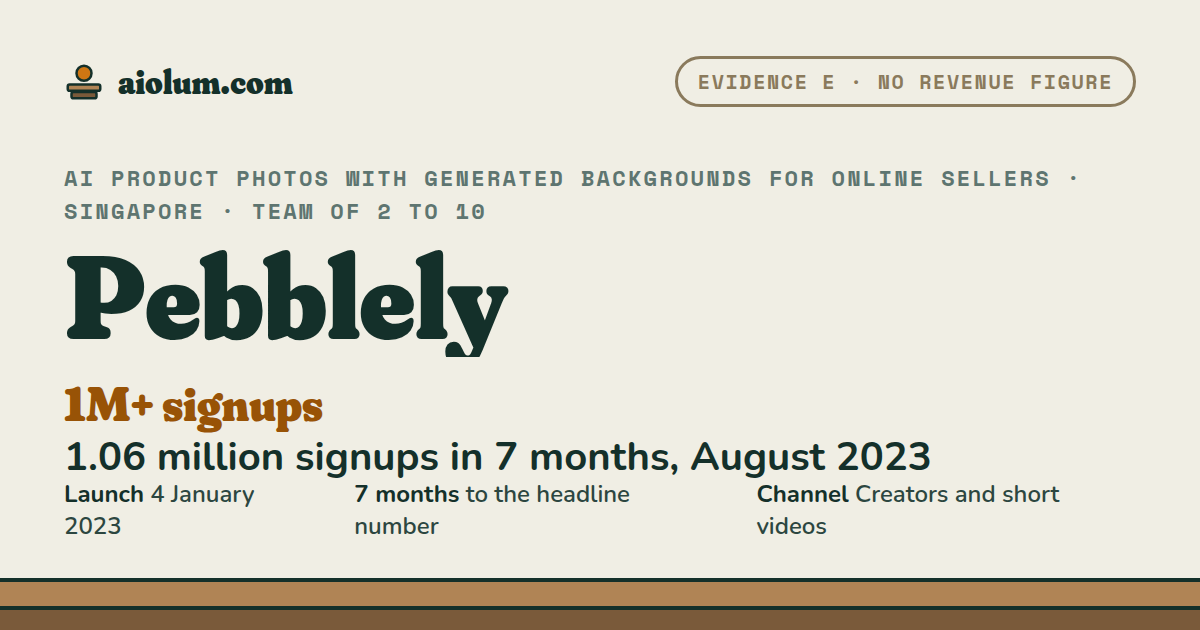
Pebblely (AI product photos with generated backgrounds for online sellers, Singapore): 1.06 million signups in 7 months, August 2023. Evidence grade E: no revenue figure was checked. Team: 2 co-founders at launch in January 2023; 3.5 team members in August 2023; headcount not published now. Launched 4 January 2023; still running.Added
- Outcome
- 1.06 million signups in 7 months, August 2023
- Evidence
- E no revenue figure was checked
- Launch
- 4 January 2023
- Status
- Still running
- Team
- 2 co-founders at launch in January 2023; 3.5 team members in August 2023; headcount not published now
- Outside funding
- None: the company's blog said in August 2023 that the founders used their own savings
- Group
- Photos and portraits
- Main channel
- Creators and short videos
What is not verified
No revenue figure was found, so the headline is a signup count that the company stated itself. The company blog, the founders' letters, a vendor's customer story and an interview give no revenue or profit amount. The founder says only that the company was profitable. A reader could look for a payment-processor profile or a founder interview with figures. The company says it has paying customers in 100+ countries and lists prices. No independent source confirms that these customers pay. This story is grade E: the business is real and its product, price and customers are described from public pages, but no revenue figure was checked. Aiolum shows it as an idea worth studying, not as proof that it makes money.
Pebblely is a web app that turns a plain product photo into a marketing image with an AI-generated background. The seller uploads one photo and either describes a scene or picks one of 40 or more themes. The AI adds a matching surface, shadows and reflections. The company behind it is Pebblely Pte Ltd, named in the site footer.
Alfred Lua and Swee Kiat started it. The company's blog said in August 2023 that they used their own savings and took no outside funding. They launched on 4 January 2023 with a post on LinkedIn. The same blog said on 23 August 2023 that Pebblely had passed 1,060,000 signups in seven months, with a team of 3.5 people.
No revenue figure was found, so the story is grade E. A signup is an account that someone created; it is not a paying customer. The company says that it has paying customers in 100+ countries and publishes no count of them. No outside party has checked the signup count.
Why did Pebblely work?
Four causes, in the order they mattered. Each one is a reusable lesson.
It launched when AI tools were new and many people wanted to try them
The founders say in the company blog that the success came from "fast moving water called AI". They say they were at the right place at the right time. In their words, they were lucky. Lists of top AI tools featured Pebblely, and the blog says people were more willing to pay for AI tools.
A basic interface built in two days let customers show the demand
The founders had the image technology in December 2022 and did not know if anyone wanted it. Cold emails found no buyers. They built a basic interface in two days and released it. Signups then rose to more than 10,000 a day at one point, and the servers crashed several times.
Videos by creators and by the founder brought users, not advertising
The company blog says the launch had no press campaign and no ads. It says Pebblely videos often became the most viewed video for many creators. One TikTok video by Alfred Lua reached 1.4 million views, according to the blog.
How it was built
These details come from the company blog, a vendor's customer story and the company's own pages. Each is a statement of the company or of its vendor. [4, 10, 3, 8]
- Supabase supplied the database, the API, realtime functions and sign-in. Alfred Lua says in the Supabase customer story that everything was running in two days.
- The founders moved sign-in from email and password to Google and magic links after people made many accounts to get around the free limits.
- Stripe stores and processes the payment data, according to the company's privacy policy.
- The August 2023 blog says the servers were later scaled to handle hundreds of thousands of images every day. The image model is not named in any source; the March 2026 blog says the new one is more capable than the older diffusion-based pipeline.
- The founders talk to customers. The company emails whoever cancels or downloads more than 100 images. The blog says it had 124 video calls through Calendly by August 2023.
Tools named in the sources
Each one opens its page in the Tools tab, with every story that uses it.
Who tried this before Pebblely, and why did they fail?
Three companies in our database of failed startups built image tools or tools for small online sellers and then closed. The values below are from that database and are not independently verified.
Snapjoy
The promiseGather personal photos from phones, social media and cloud storage into one library.
Why it diedThe record names the Dropbox acquisition and the cost of storing and processing large photo libraries among the causes. The page text is cut off.
Imgfave
The promiseA place to discover, save and share images.
Why it diedThe record says it did not differentiate itself from Instagram and Pinterest.
Admazely
The promiseRetargeting tools for small webshops, so that they could reach visitors who had left.
Why it diedThe record says it failed after "solid initial traction", through strategic missteps and market dynamics. The page text is cut off.
The failed startups come from our database of 1,749 dead startups, retold here in our own words. Its entries are AI-assisted summaries of public sources, so these cards carry no evidence grade.
What changed
The three predecessors sold image or marketing tools to consumers or small shops, and large platforms or high costs are named as causes. Imgfave met Instagram and Pinterest. Snapjoy faced storage and processing costs.
Pebblely differs in what its sources describe. The founders paid for it from savings, kept a team of 3.5 people in 2023 and listed a monthly plan in the first weeks. The company blog also says each image took 3 to 5 seconds to generate in August 2023. In March 2026 the blog says the product was rebuilt on a more capable model. These sources do not settle the risk that a larger tool copies it.
Can one person copy Pebblely now?
The launch method can be copied. The 2023 timing cannot.
The company's blog describes a small method: build a basic interface in two days, charge a monthly plan, and talk to customers. The founders call their timing luck, and the first months of 2023 will not return.
Where it is still open: Product categories that the site lists, such as furniture, pet products and watches, each need their own backgrounds and examples.
- 1Build the smallest interface that lets a stranger try the core job. Pebblely's took two days.
- 2Offer a monthly plan early. The company's blog of January 2023 already lists a plan of US$19 a month.
- 3Call customers who use the product heavily or cancel. The company reports 124 video calls by August 2023.
- 4Post short videos about one concrete seller problem. The company's blog says one TikTok video reached 1.4 million views.
How much revenue does Pebblely make?
Each row shows the evidence grade and the source numbers from the list at the end of this page. The grades are explained in How Aiolum verifies.
| Fact | Value | Grade | How we know | Sources |
|---|---|---|---|---|
| Launch | 4 January 2023 | C | The company's blog says the launch was a post on LinkedIn. The Supabase customer story also says the prototype launched in January 2023. | [3, 4] |
| Signups by August 2023 | 1,060,000+ in 7 months | C | Company blog, 23 August 2023. A signup is an account, not a paying customer. Supabase's customer story retells it as "over 1 million users". | [3, 4] |
| Paying customers | "Paying customers in 100+ countries" | C | Company blog, 23 August 2023. No count of paying customers is published. | [3] |
| Profit | "becoming profitable almost immediately" | C | Alfred Lua's annual review of 16 December 2023. He gives no amount. He also wrote that a target of US$200 by the end of January 2023 was passed within two days. | [6] |
| Team, August 2023 | 3.5 team members: 2 co-founders, 1 software engineer, 1 part-time AI researcher | C | Company blog. No source gives a headcount for 2026. In the Aspire interview Alfred Lua said the founders wanted to keep the team lean. | [3, 7] |
| Funding | none | C | Company blog, August 2023, and Alfred Lua's letter of 15 May 2025: no outside money, only the founders' savings. | [3, 5] |
| The founders' company started | about May 2022 | calc | Calculated: the letter of 15 May 2025 says that this week marks the third anniversary of leaving a full-time job to found a startup. | [5] |
| Earlier product of the same founders | Dashibase, a no-code tool for internal dashboards, shut down after 7 months | C | Aspire interview and a Wayback copy of the Dashibase home page of 7 September 2022. No earlier name for Pebblely was found. | [7, 14] |
| Company name and country | Pebblely Pte Ltd, Singapore | C | The site footer shows the name; a Wayback copy shows it in 2023. The Aspire interview says that Swee Kiat came back to Singapore. No incorporation date was found. | [1, 9, 7] |
| Prices, November 2026 | Lite US$9, Basic US$19, Pro US$39 a month | C | Pricing page of the company. In November 2023 the Wayback copy shows Basic US$19 with 1,000 images and Pro US$39 with unlimited images. | [2, 9] |
| Image counter on the home page | "More than 25,000,000 + images generated" | C | A counter on the company's home page, with no source and no date. | [1] |
| Time from launch to the signup count | 7 months | calc | Calculated: 4 January 2023 to 23 August 2023, counted in whole months. | [3] |
No row is grade A or B. Every figure is a statement of the company or of a founder, or it is a price read from the company's own pages.
| Plan | Per month, billed yearly (US$) | Per month, billed monthly (US$) | Limit |
|---|---|---|---|
| Lite | 9 | 30 images each month | |
| Basic | 15 | 19 | 200 images each month; bulk generation |
| Pro | 32 | 39 | 500 images each month; bulk generation |
The pricing page shows a yearly toggle with "2+ months free" but no yearly amounts. The yearly amounts come from the company's blog of 8 March 2026, which lists only Basic and Pro. The FAQ page still shows yearly prices of US$179 and US$379 and no Lite plan. The pages do not say which is current. A Wayback copy of November 2023 shows a free plan of 40 images each month.
When did Pebblely launch, and how did it grow?
From the founders' first company in 2022 to a rebuilt product in March 2026. Each entry carries its grade.
- About May 2022CThe two founders leave their jobs to start a company. Their first product, Dashibase, is shut down after seven months. [5, 7]
- December 2022CThe founders have the image technology but no interface. Cold emails to sell it as a service get no interest. [3]
- 4 January 2023CLaunch with a basic interface that took two days to build. The announcement is a post on LinkedIn. [3, 4]
- Late January 2023CThe company's blog says that more than 25,000 creatives used Pebblely in the three weeks after launch, and lists a plan of US$19 a month. [12]
- 23 August 2023CMore than 1,060,000 signups, paying customers in 100+ countries and a team of 3.5 people, all as the company's blog states. [3]
- 8 March 2026CThe company rebuilds the product on a different model. Users no longer remove the background first. [8]
What could go wrong for Pebblely?
The risks are the mirror image of the causes above.
What is not verified
No revenue figure was found, so the headline is a signup count that the company stated itself. The company blog, the founders' letters, a vendor's customer story and an interview give no revenue or profit amount. The founder says only that the company was profitable. A reader could look for a payment-processor profile or a founder interview with figures. The company says it has paying customers in 100+ countries and lists prices. No independent source confirms that these customers pay.
Home page counters, logos and testimonials have no outside source
The home page shows 16 testimonials, a row of five shop logos, a counter of 25,000,000+ images and a line about 1,000,000+ creatives. No source dates or checks the counters or the logo row. Each testimonial links to a shop site or a social profile, and some give only a first name. The 2023 blog names Homes of Rajasthan, Duckshop and Enzo Chehab as customers, and three testimonials fit them. The blog's Enzo Chehab link and the testimonial of Enzo Signature Co. lead to one shop address. That address answered with an error on 12 November 2026. A search for repeated quotations on other sites could not be run, so reuse elsewhere is not checked.
The product can place generated people in images and used brand images in a demo
The March 2026 blog says users can ask for "a woman holding this serum bottle". No source says that the product copies a real person. The January 2023 blog recreated ads of perfume brands from images taken from the brands' websites. The terms say there is "no assurance or guarantee that the images do not violate the intellectual property rights of others".
Other products of the founders and review credits
The founders' letter of May 2025 lists 14 products, among them Pebblely Fashion, Vispunk and Vispunk Motion, and says only Pebblely had significant traction. The Supabase story links to Vispunk Motion; vispunk.com showed an unrelated blog on 12 November 2026. The August 2023 blog offers reviewers an account upgrade and credits to test the product. It does not describe reviews as paid.
Sources
The grade next to each source is the best grade that the source can support. "Read in full" means that the text of the page was downloaded and the numbers were checked in it.
- C Pebblely home pageRead in full on 12 November 2026. Source for the footer name, the counters and the testimonials. The robots.txt answers with the home page and states no rules.
- C Pebblely pricing pageRead in full on 12 November 2026. Source for the three monthly prices and the image limits. Yearly amounts are not on the page.
- C Pebblely blog, 23 August 2023: From an App Built in 2 Days to 1,000,000 Signups 7 Months LaterRead in full. The company's own post by Alfred Lua. Source for the launch date, the signup count, the team, funding, channels and lessons.
- C Supabase customer story: Scaling securely: one million users in 7 months with Supabase AuthRead in full on 12 November 2026. A vendor's story that quotes Alfred Lua. It is undated. Source for the Supabase use and the 2022 start.
- C Alfred Lua's letter, 15 May 2025: 3 years of starting upRead in full. Source for the start of the founders' company, the 14 products and the lack of funding.
- C Alfred Lua's blog, 16 December 2023: My 2023 Annual ReviewRead in full. Source for the statement that the company became profitable and the early target. The robots.txt of this site answers 404, so it states no rules.
- C Aspire customer story: Growing an AI company to 1,000,000 Users and the Art of Finding Your Own PathRead in full. An interview with Alfred Lua on a vendor's blog. The page is dated 3 July 2025 but the text speaks of the launch eight months earlier. Source for Dashibase and the plan to stay lean.
- C Pebblely blog, 8 March 2026: Introducing the New Pebblely: Faster, Simpler AI Product PhotosRead in full. Source for the rebuild, the yearly prices of Basic and Pro and the generated people feature.
- C Wayback copy of the Pebblely pricing page, 29 November 2023Read in full. Source for the free plan, the 2023 prices and the 2023 footer name.
- C Pebblely privacy policyRead in full on 12 November 2026. Source for the payment processor.
- C Pebblely terms of serviceRead in full on 12 November 2026. Source for the minimum age of 16 and the statement on the rights of others.
- C Pebblely blog, 26 January 2023: AI Product Photography is Already Better Than You ThinkRead in full. Source for the early user count and the first plan price.
- C Pebblely blog, 23 January 2023: Recreating Product Images for Famous Perfume BrandsRead the opening and the method. Source for the use of brand images in a demo.
- C Wayback copy of the Dashibase home page, 7 September 2022Read in full. Shows the founders' earlier product in 2022.
- C Pebblely FAQ pageRead in full on 12 November 2026. Source for the yearly prices of US$179 and US$379 and the missing Lite plan.
- C Database of failed startups, local exportRecord pages read on the website on 12 November 2026. AI-written summaries, not independently verified. Source for the failed predecessors.
Run this company? Send corrections or a verified figure to aiolum@livyden.com