Ping Parrot: Revenue, sale and how it was built
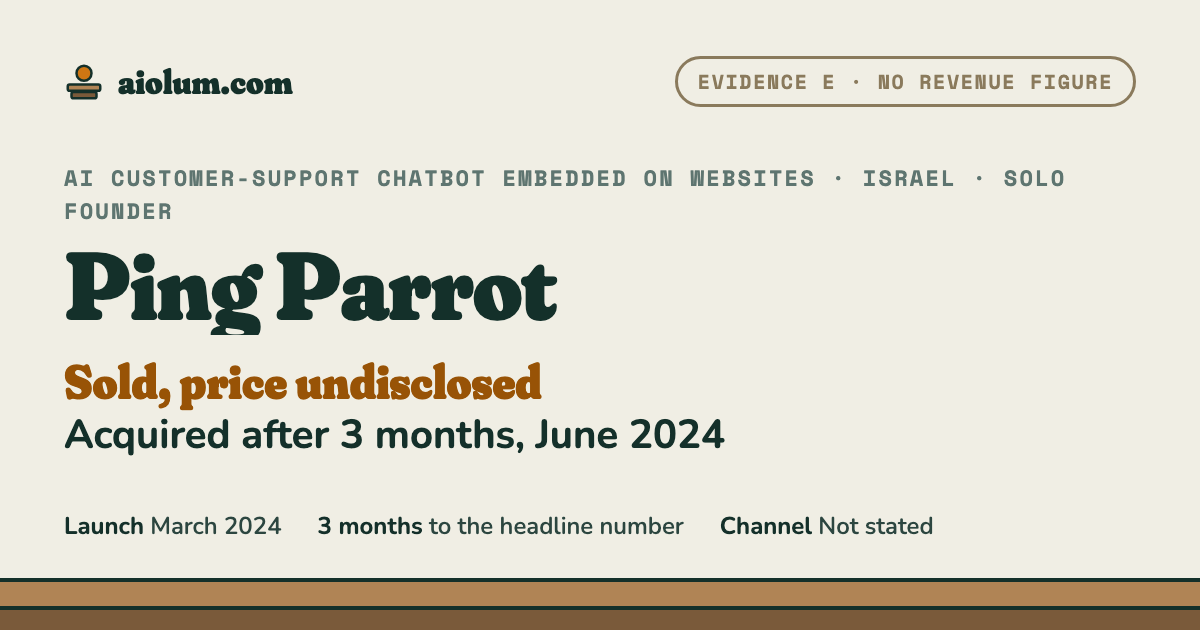
Ping Parrot (AI customer-support chatbot embedded on websites, Israel): Acquired after 3 months, June 2024. Evidence grade E: no revenue figure was checked. Team: 1 founder (Idan Masas); headcount not published. Launched March 2024; sold 3 months after launch.Added 7 November 2026
- Outcome
- Acquired after 3 months, June 2024
- Evidence
- E no revenue figure was checked
- Launch
- March 2024
- Status
- Sold, 3 months after launch
- Team
- 1 founder (Idan Masas); headcount not published
- Outside funding
- None reported
- Main channel
- Not stated
What is not verified
No revenue figure and no sale price were found. The sale rests on one source, the founder's own portfolio page, which marks Ping Parrot 'Acquired' with no buyer, price or exact date; a directory card on FounderSold that points to that page also lists the price as undisclosed. No payment-processor profile, founder post, interview or marketplace listing was found. A reader could look for the founder's posts on X from mid-2024 or a sale listing on an acquisition marketplace. This story is grade E: the business is real and its product, price and customers are described from public pages, but no revenue figure was checked. Aiolum shows it as an idea worth studying, not as proof that it makes money.
Ping Parrot was an AI support chatbot: a chat window on a company's website in which a program, not a person, answers customers' questions. The owner added knowledge sources, the pages and question-and-answer pairs that the bot reads before it answers, and the bot replied from them with a large language model, a neural network trained on large amounts of text that writes answers in plain language. Its pricing page, archived in May 2024, listed a free plan and three paid plans by the number of bots and message credits, the number of bot replies included each month.
Idan Masas, a software engineer whose portfolio lists 12 small products since 2022, ran it from March 2024 to June 2024, his portfolio site says, and marks it "Acquired". The site's terms were governed by the laws of Israel. Archive copies show the site still selling under the same name in August 2025; on 7 November 2026 the domain no longer resolved.
No revenue figure and no sale price were found, so this story is grade E: the product and its paid plans are documented, but its money is not. The page also shows earlier companies that tried to automate website support before large language models existed.
How much did Ping Parrot make, and what was it sold for?
Each row shows the evidence grade and the source numbers from the list at the end of this page. The grades are explained in How Aiolum verifies.
| Fact | Value | Grade | How we know | Sources |
|---|---|---|---|---|
| Status | listed as Acquired by the founder; buyer and price not given | D | Founder's portfolio page, read 7 November 2026: 'Ping Parrot · ( Acquired ) · March 2024 — Jun 2024 · 3 months'. No buyer statement or marketplace listing was found. | [1] |
| Founder's time on the product | March 2024 to June 2024, 3 months | D | Founder's portfolio page. His next product on the list, EasyShorts, starts in June 2024. | [1] |
| Team | 1 founder | C | The About page, May 2024: 'Hi, I'm Idan, the founder of Ping Parrot.' No other team member is named on any page read. | [4, 1] |
| Paid plans before the sale | US$19, US$99 and US$399 a month, plus a free plan | C | Pricing page in the Internet Archive copy of 8 May 2024. The home page of 6 May 2024 says 'No credit card required' for the free start. | [3, 2] |
| AI models | OpenAI models; GPT-4 and GPT-4 Turbo on the Standard plan | C | Pricing page: 'Option to choose GPT-4 and GPT-4-Turbo' and, on the Unlimited plan, 'Use your own OpenAI API key'. | [3] |
| Training data | the customer's website pages and FAQ entries | C | Home page FAQ, May 2024: the bot crawls the site, the owner selects pages, and a retrain button updates it; automatic retraining was 'in the process'. | [2] |
| Languages | 80+ | C | Company claim on the home page, May 2024 and August 2025. | [2, 5] |
| Launch | March 2024 | C | Founder's portfolio gives March 2024. The Internet Archive first records the product site on 28 March 2024 (a redirect) and first saves a full page on 24 April 2024. | [1, 6] |
| Earlier use of the domain | a domain-for-sale page asking US$280, December 2021 | C | Internet Archive copy of pingparrot.com from 18 December 2021. So the product itself started after 2022. | [6] |
| Legal home | terms governed by the laws of Israel | C | Terms of service, section 10, Internet Archive copy of 7 May 2024. | [4] |
| Site after the sale | still selling in August 2025; domain not resolving on 7 November 2026 | C | Archive copy of 2 August 2025 adds a blog, hand-off to a human agent and the line 'Trusted by 200+ companies everyday'. A download on 7 November 2026 failed with 'Could not resolve host'. | [5] |
| Outside funding | none reported | D | No page read mentions investors or a round. | [1, 2] |
| Time from launch to the listed sale | 3 months | calc | Calculated: March 2024 to June 2024. | [1] |
How to read this table: product values are what the Ping Parrot pages said in Internet Archive copies from May 2024 and August 2025; the sale and the dates are the founder's own portfolio page, read 7 November 2026. No value is grade A or B, and there is no money figure.
| Plan | Per month, billed yearly (US$) | Per month, billed monthly (US$) | Limit |
|---|---|---|---|
| Free | 0 | 1 chatbot, 20 message credits a month, 400,000 characters per chatbot | |
| Hobby | 19 | 2 chatbots, 2,000 message credits a month, lead capture | |
| Standard | 99 | 5 chatbots, 10,000 message credits a month, GPT-4 and GPT-4 Turbo option, live chat | |
| Unlimited | 399 | 10 chatbots, 40,000 message credits a month, own OpenAI API key |
Prices are US dollars a month as the page listed them. The page also offered yearly billing with '2 months free'; the yearly prices themselves were not in the archived copy, so that column is empty. Every paid plan includes the plans below it. The Unlimited plan removed the 'We run on Ping Parrot' label and let the customer use an own OpenAI API key. The site no longer resolves, so current prices, if any, could not be read.
When did Ping Parrot launch, and how did it grow?
From a domain-for-sale page in 2021 to a launched product in March 2024 and a sale three months later. Each entry carries its grade.
- December 2021CThe domain pingparrot.com shows only a domain-for-sale page. [6]
- March 2024CIdan Masas starts Ping Parrot, his portfolio says. The Internet Archive first records the site on 28 March 2024. [1, 6]
- May 2024CThe site sells a free plan and three paid plans, offers GPT-4 models, and names Idan as the founder on its About page. [2, 3, 4]
- June 2024DHis portfolio ends his time on Ping Parrot and marks it Acquired. No buyer or price is given. [1]
- August 2025CAn archive copy shows the site still selling, now with a blog, hand-off to human agents and a '200+ companies' claim. [5]
- November 2026CThe domain no longer resolves; the founder's portfolio still lists Ping Parrot as Acquired among 12 products. [1]
Why did Ping Parrot work?
Four causes, in the order they mattered. Each one is a reusable lesson.
Speed
The founder's portfolio lists 12 products from 2022 to 2026, most of them run for two to seven months. Ping Parrot took three months from start to the listed sale, and he started his next product, EasyShorts, in the same month.
A known product shape
Train a bot on the customer's pages, embed it as a chat window, and charge by bots and message credits: other website chatbots on this site use the same plan structure. That made the product quick to explain and quick to build on a model provider's API.
Usage-based plans over a free start
The free plan allowed 20 replies a month, enough to test the bot on a real site. The pricing page tied each paid step to a larger reply allowance (2,000, 10,000 and 40,000 replies a month), because every reply is a paid call to the model provider.
How it was built
Few build details are public. These come from the archived product pages and the archive's own list of saved files. [2, 3, 5, 6]
- The website was built with Next.js: the archive saved its files under /_next/static.
- Answers came from OpenAI models; the Standard plan offered GPT-4 and GPT-4 Turbo, and the Unlimited plan accepted the customer's own OpenAI API key.
- Training read the customer's website (the owner picks the pages) and a list of questions and answers; a manual retrain button refreshed it.
- The chat window could take the customer's colors, bot name, avatar, welcome message and suggested questions, and could go on any number of sites.
- In May 2024 the pricing page listed 'Live chat' on the Standard plan, while the FAQ said a person could not yet take over a conversation; the August 2025 copy describes that hand-off as available.
- No source names the hosting, database or payment provider.
Tools named in the sources
Each one opens its page in the Tools tab, with every story that uses it.
Who tried this before Ping Parrot, and why did they fail?
Three companies in our database of failed startups tried to automate or simplify website and app support before large language models. The values below are from that database and are not independently verified.
Answerly
The promiseFAQ chatbots on company websites that match customer questions to pre-written answers and pass only hard cases to people.
Why it diedThe language technology of the time could not handle real customer questions, and each customer needed long manual setup of answers and rules.
Hipmob
The promiseCustomer support chat built into mobile apps and websites.
Why it diedIntercom and Zendesk added the same chat features, and Hipmob could not give customers a reason to switch.
RightHello
The promiseLive chat for online shops, to turn visitors into buyers with timely conversations.
Why it diedIt needed human operators on the shop's side, and much better-funded chat companies took the market.
The failed startups come from our database of 1,749 dead startups, retold here in our own words. Its entries are AI-assisted summaries of public sources, so these cards carry no evidence grade.
What changed
Answerly needed someone to write the answers and rules by hand, and Hipmob and RightHello needed people to sit in the chat window. Ping Parrot's bot read the customer's existing pages and wrote its own answers with a large language model, so setup took minutes and nobody had to be online for the repeat questions.
What did not change is the competition. Intercom and Zendesk, which beat Hipmob and RightHello, sell AI answers of their own, and many small AI chatbots appeared at the same time. Ping Parrot did not try to win that market: its founder lists it as sold three months after he started it.
Can one person copy Ping Parrot now?
Yes, as a build-and-sell product; the market is crowded.
One developer can build a website chatbot on a model provider's API in weeks: a page crawler, a store of the customer's text, a chat window and usage-based plans. Standing out among the many similar products is the hard part, so the realistic outcome is a small sale or a narrow niche.
Where it is still open: Support bots for one industry or one platform, where the bot knows the industry's terms and connects to the tools those businesses already use.
- 1Let the customer add their own pages and FAQ, and answer only from that text.
- 2Ship an embeddable chat window with the customer's colors, name and welcome message.
- 3Give a free plan with a small reply limit, and price paid plans by bots and replies.
- 4Keep the code, the domain and the customer list clean, so the business can be transferred to a buyer.
What could go wrong for Ping Parrot?
The risks are the mirror image of the causes above.
What is not verified
No revenue figure and no sale price were found. The sale rests on one source, the founder's own portfolio page, which marks Ping Parrot 'Acquired' with no buyer, price or exact date; a directory card on FounderSold that points to that page also lists the price as undisclosed. No payment-processor profile, founder post, interview or marketplace listing was found. A reader could look for the founder's posts on X from mid-2024 or a sale listing on an acquisition marketplace.
Claims on the product pages
The home page called itself 'The #1 AI Chatbot for Customer Support' and showed an analytics picture with '11,236' conversations, which reads as an example screen rather than a count. It quoted two testimonials with full names and job titles, one from the CEO of TalkNotes. The August 2025 copy, from after the sale, adds 'Trusted by 200+ companies everyday' and percentages ('7 in 10', '96%', '28%') with no source. None of these could be checked.
Competition and model providers
Ping Parrot competed with many website chatbots; on this site Chatbase, SiteGPT and Chat Thing sell the same kind of product. Its pricing page shows it depended on OpenAI ('Option to choose GPT-4 and GPT-4-Turbo', 'Use your own OpenAI API key'), so model prices and terms set its costs. The pages read do not show how the chat window introduced itself to visitors; the product was sold as an AI chatbot.
Site gone and the founder's other products
The domain did not resolve on 7 November 2026; the last archive copy is from 2 August 2025, so the buyer's plans are unknown. The founder's portfolio lists 11 other products, among them SocialKiwi, EasyShorts and SkinScout (a CS:GO skin trading platform), all marked Acquired, and Formly, an AI form builder. The Ping Parrot pages read here do not link to any of them.
Sources
The grade next to each source is the best grade that the source can support. "Read in full" means that the text of the page was downloaded and the numbers were checked in it.
- C Idan Masas, personal portfolio (Ping Parrot, Acquired, March 2024 to June 2024)Read in full on 7 November 2026. The founder's own page and the original source behind FounderSold's exit card (foundersold.com/exits/ping-parrot, which links here). Source for the dates, the Acquired status and his other products.
- C Ping Parrot home page, Internet Archive copy of 6 May 2024Read in full. Source for the product description, the FAQ, the testimonials and the example analytics screen.
- C Ping Parrot pricing page, Internet Archive copy of 8 May 2024Read in full. Source for the plans, prices, limits and the OpenAI model options.
- C Ping Parrot About page and terms of service, Internet Archive copies of 7 May 2024Read in full; the terms are at https://web.archive.org/web/20240507163607/https://www.pingparrot.com/legal/terms. Source for the founder statement and the governing law.
- C Ping Parrot home page, Internet Archive copy of 2 August 2025Read in full. Source for the site after the sale: the 200+ companies claim, the percentages and the human hand-off feature.
- C Internet Archive capture list for pingparrot.com and its copy of 18 December 2021Read the domain-for-sale page and the CDX capture list (web.archive.org/cdx/search/cdx?url=pingparrot.com*). Source for the first capture dates, the earlier domain use and the Next.js file paths.
- C Database of failed startups, local exportLocal export. AI-written summaries, not independently verified. Source for the failed predecessors.
Run this company? Send corrections or a verified figure to aiolum@livyden.com