Quotain: Product, team and how it was built
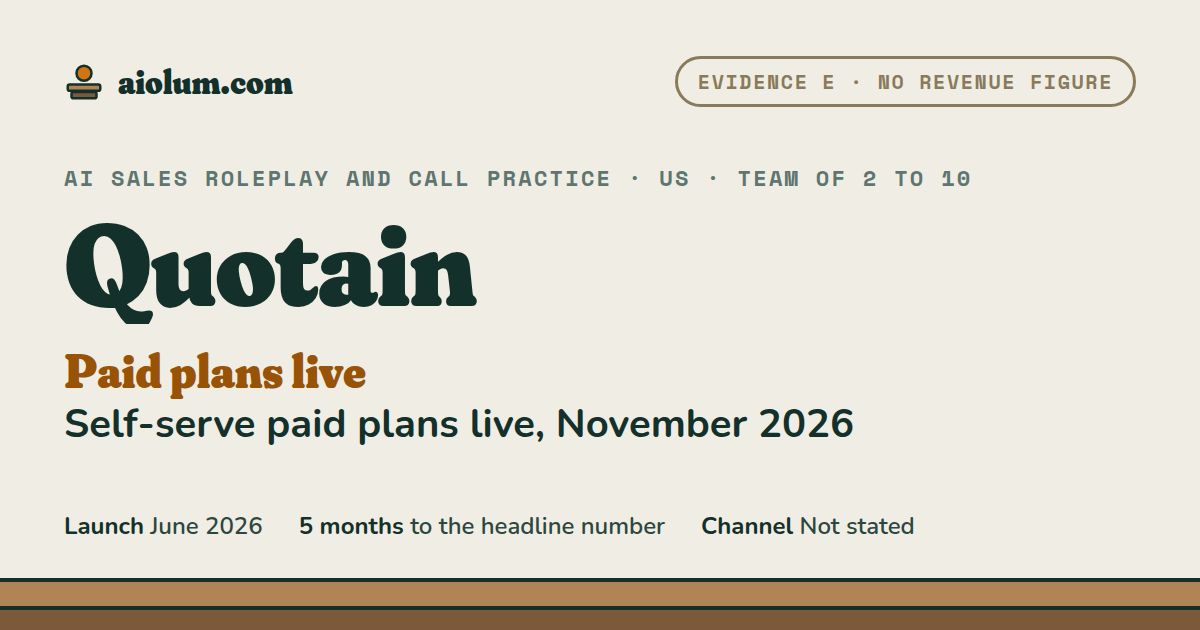
Quotain (AI sales roleplay and call practice, US): Self-serve paid plans live, November 2026. Evidence grade E: no revenue figure was checked. Team: 2 founders, per the Y Combinator directory. Launched June 2026; still running.Added
- Outcome
- Self-serve paid plans live, November 2026
- Evidence
- E no revenue figure was checked
- Launch
- June 2026
- Status
- Still running
- Team
- 2 founders, per the Y Combinator directory
- Outside funding
- Backed by Y Combinator (Summer 2025 batch); amount not published
- Main channel
- Not stated
What is not verified
No revenue figure, customer count or paid-customer statement was found. A payment-processor profile, a founder interview or a press article with a figure would settle it. The company's start of 2025 comes from the Y Combinator directory only, and the pages give no date for the Eden AI, Inc. entity. The company was earlier listed on Y Combinator under the name Eden, and its old directory address now opens the Quotain page. What the Eden listing sold was not read. The company says thousands of hours were practiced, with no date. This story is grade E: the business is real and its product, price and customers are described from public pages, but no revenue figure was checked. Aiolum shows it as an idea worth studying, not as proof that it makes money.
Quotain is AI sales roleplay software for revenue teams. A roleplay is a practice call in which the rep talks to a simulated buyer. The company says it builds that buyer from the team's playbook, past calls and deal context, and scores every session against the team's method. Managers see a readiness view per rep.
Two founders run it from New York. The Y Combinator directory lists it as founded in 2025, in the Summer 2025 batch, with a team size of 2. The company's pricing page lists a self-serve Starter plan at US$50 per seat per month. It lists a Pro plan at US$100, and both have a 7-day free trial that needs a payment card.
No revenue figure was found, so the story is grade E. The pricing page, the checkout link and the terms show that a plan can be bought, but no source states that a customer has paid.
Why did Quotain work?
Four causes, in the order they mattered. Each one is a reusable lesson.
The company says it builds the buyer from the team's own calls
The company says each buyer comes from a team's playbook, past calls and CRM context. It also says the assistant reads the web and a connected call recording to draft a buyer for a named meeting. This is the company's description. No source tests how close the buyer is to a real one.
It scores each call against the manager's method
Teams can set their own scorecards, and every score points to a line of the transcript. The company says managers use the scores to see readiness per rep and to assign drills. The single customer story says it does not show faster ramp or higher win rates.
It sells per seat with a pool of minutes
Each seat adds minutes to a team pool, and the plan sets how many. The company's pages do not state its costs.
How it was built
These details come from the company's own privacy policy, terms and pages. They are grade C. [8, 10, 11]
- The privacy policy lists Vercel, Neon and Cloudflare R2 for hosting. It also names the Vercel AI Gateway for model providers such as OpenAI and Anthropic.
- Voice and real-time practice use Deepgram, ElevenLabs and LiveKit, according to the same list.
- Buyer portraits are still images by default. The product page says animated video buyers are a paid add-on.
- The product connects to call sources such as Gong and Fathom, and to HubSpot and Salesforce for deal context.
- The public changelog on the company site has dated entries from 11 May to 29 September 2026.
Tools named in the sources
Each one opens its page in the Tools tab, with every story that uses it.
Who tried this before Quotain, and why did they fail?
Our database of failed startups has no record of a failed AI sales-practice product. Two failed companies with the nearest promises are listed: automated hiring conversations and on-demand skills training. The values are from that database and are not independently verified.
RoboHR
The promiseAutomate sourcing, filtering and interviewing candidates with AI.
Why it diedThe record says the gap between its AI promises and what it delivered led to customer dissatisfaction, and that it did not raise more money.
Leada
The promiseOn-demand courses that teach practical data science skills.
Why it diedThe record says it could not stand out against Coursera and edX, struggled to keep users, and did not raise enough money.
The failed startups come from our database of 1,749 dead startups, retold here in our own words. Its entries are AI-assisted summaries of public sources, so these cards carry no evidence grade.
What changed
Both predecessors promised a better way to build a work skill, with software that did the teaching or the interview. Each met a large, established competitor and a customer base that was not sure the software worked. Quotain faces the same test: a buyer must believe that a practice call changes live results.
What differs is the technology and the price point. The company says it uses current voice and language models. It sells a self-serve plan that a manager can try for seven days with a card. Whether that is enough is not shown by any source.
Can one person copy Quotain now?
Possible for a small team, but unproven here.
A small team can build a practice tool on hosted voice and language models, and sell it by seat with a free trial. Nothing in the sources shows that customers renew. The method is a pattern, not a proven result.
Where it is still open: Any job where people rehearse a hard conversation: customer support escalations, recruiting calls, collections and clinic front desks.
- 1Pick one conversation that teams already rehearse badly, such as a technical sales call.
- 2Build the practice buyer from the team's own documents and calls, not from a generic persona.
- 3Score each practice with the team's own checklist and show managers the result.
- 4Sell per seat with a time-limited trial, and measure whether practice minutes continue after the trial.
How much revenue does Quotain make?
Each row shows the evidence grade and the source numbers from the list at the end of this page. The grades are explained in How Aiolum verifies.
| Fact | Value | Grade | How we know | Sources |
|---|---|---|---|---|
| Company start | 2025 | C | Y Combinator directory: Founded 2025, batch Summer 2025. The legal entity named in the terms is Eden AI, Inc., a Delaware corporation doing business as Quotain. No page gives its date of incorporation. The older Y Combinator address ycombinator.com/companies/tryeden now opens the same Quotain page. So the same company was listed earlier under the name Eden, and its start is still 2025. | [3, 9] |
| Team | 2 | C | Y Combinator directory: Team Size 2. The about page names the same two co-founders. | [3, 5] |
| Founders | Alexander Talamonti (CEO) and Jason He | C | Y Combinator directory. The about page says Alex Talamonti was a software engineer at Datadog and then led operations at Phia. It says Jason He was a PM at Datadog and Reddit and earlier ran an AI-enabled recruiting company. | [3, 5] |
| Funding | Backed by Y Combinator | C | The about page says it. The amount is not published in any page that was read. | [5] |
| Public launch post | 16 June 2026 | C | Y Combinator launch page, dated by its own data. The post says the product creates a simulated prospect from shared context and public information. | [4] |
| Starter plan | US$50 per seat per month, US$40 billed yearly | C | Company pricing page, read 21 November 2026. 7-day free trial, 180 pooled minutes per seat. | [1] |
| Pro plan | US$100 per seat per month, US$80 billed yearly | C | Company pricing page. 480 pooled minutes per seat, Slack and Microsoft Teams apps, an analytics API. | [1] |
| Way to buy | Self-serve sign-up with a card; no card is charged during the trial | C | The pricing page says a card is added at checkout and nothing is charged until the trial ends. | [1] |
| Named customers | Three quotations on the page; none is stated to pay | C | Employees of Embedder, Midasoft and Monte are quoted. The Embedder story calls its source an evaluation session. | [6, 7] |
| Usage claim | "Thousands of hours of sales calls rehearsed" | C | The company's statement on its home and about pages, with no date and no user count. | [2, 5] |
| Languages | 32 call languages | C | Pricing page feature table. The home page says 30 or more. | [1, 2] |
How to read this table. Every row is a statement from the company's own pages or from the Y Combinator directory, grade C. No row is checked by a payment processor, a journalist or a buyer.
| Plan | Per month, billed yearly (US$) | Per month, billed monthly (US$) | Limit |
|---|---|---|---|
| Starter | 40 | 50 | 180 pooled minutes per seat each month; up to 50 seats |
| Pro | 80 | 100 | 480 pooled minutes per seat each month; up to 50 seats |
| Enterprise | custom | 50 or more seats; annual contract and invoice billing |
Prices are per seat. The page offers a 20% saving for yearly billing. Each seat adds a monthly pool of practice minutes that the whole team shares. Both self-serve plans have a 7-day free trial, and a payment card is added at checkout.
When did Quotain launch, and how did it grow?
From a Y Combinator batch in 2025 to published self-serve prices in 2026. Each entry carries its grade.
- 2025CThe Y Combinator directory lists the company as founded in 2025, in the Summer 2025 batch, with 2 people. [3]
- 11 May 2026CThe oldest entry on the public changelog page adds an assistant inside the product and passkey sign-in. [10]
- 16 June 2026CThe founders post the product launch on Y Combinator. [4]
- 31 July 2026CThe company publishes a customer story about a test session with Embedder. The story says the session does not show a measured change in ramp time, readiness, win rate or revenue. [7]
- 29 September 2026CThe newest changelog entry adds more call sources, such as Salesloft, and timed practice competitions. [10]
- 21 November 2026CThe pricing page lists Starter and Pro plans with a 7-day free trial. [1]
What could go wrong for Quotain?
The risks are the mirror image of the causes above.
What is not verified
No revenue figure, customer count or paid-customer statement was found. A payment-processor profile, a founder interview or a press article with a figure would settle it. The company's start of 2025 comes from the Y Combinator directory only, and the pages give no date for the Eden AI, Inc. entity. The company was earlier listed on Y Combinator under the name Eden, and its old directory address now opens the Quotain page. What the Eden listing sold was not read. The company says thousands of hours were practiced, with no date.
Camera signals about the user
If a user turns the camera on, the company says the browser derives expression and engagement signals such as estimated attentiveness or emotional tone. The privacy policy says video is processed on the device and not stored, but the derived scores are saved with the session. It says these numbers are shared with the foundation-model providers that produce the feedback. It also publishes a biometric retention schedule and says users can leave the camera off.
Simulated buyers built from public information
The launch post says Quotain creates a simulation that mirrors a real prospect, taking in "your shared context, their public info, their past objections, their tone, and more". No page read says the simulation copies the person's face or voice. The product page describes a still buyer portrait and a voice conversation. The company's privacy policy says users are responsible for having the rights to the information they bring.
Logos, a badge and quotations
The home page shows logo walls, for example Bidflow and ScentSatori. It also shows a ranking badge from a third-party site, a SOC 2 Type II item marked in progress, and three named quotations. No source states that these companies pay, and no source for the badge was read. The company's own Embedder story calls its source an evaluation session.
Sources
The grade next to each source is the best grade that the source can support. "Read in full" means that the text of the page was downloaded and the numbers were checked in it.
- C Quotain pricing page, read 21 November 2026Read in full. Source for the plans, the prices, the free trial and the checkout statement. Yearly prices come from the page's data, as the visible text shows only monthly prices.
- C Quotain home page, read 21 November 2026Read in full. Source for the product description, the logo wall, the badges and the quotations.
- C Y Combinator company page: QuotainRead in full. Source for the founding year, the batch, the team size and the founders' titles.
- C Y Combinator launch post: Quotain - The AI Sales Simulator for Revenue TeamsRead in full as data. Source for the launch date and the description of the simulated prospect.
- C Quotain about page, read 21 November 2026Read in full. Source for the founders, the backing by Y Combinator and the legal entity.
- C Quotain customers page, read 21 November 2026Read in full. Source for the three named quotations.
- C Quotain customer story: How Embedder tested realistic technical sales practice with QuotainRead in full. Source for the test session and for the page's own statement of what it does not show.
- C Quotain privacy policy, read 21 November 2026Read in full. Source for the camera signals, the subprocessors and the 18-year age limit.
- C Quotain terms of use, read 21 November 2026Read in full. Source for the legal entity.
- C Quotain changelog, read 21 November 2026Read the entries from 11 May to 29 September 2026. Source for the feature history.
- C Quotain product page: AI sales simulations, read 21 November 2026Read in full. Source for the buyer portraits and the animated buyer add-on.
- C database of failed startups, record pages of RoboHR and Leada, read 21 November 2026Record pages read on the website on the day of writing. AI-written summaries, not independently verified. Source for the failed predecessors.
Run this company? Send corrections or a verified figure to aiolum@livyden.com