Replicas: Product, team and how it was built
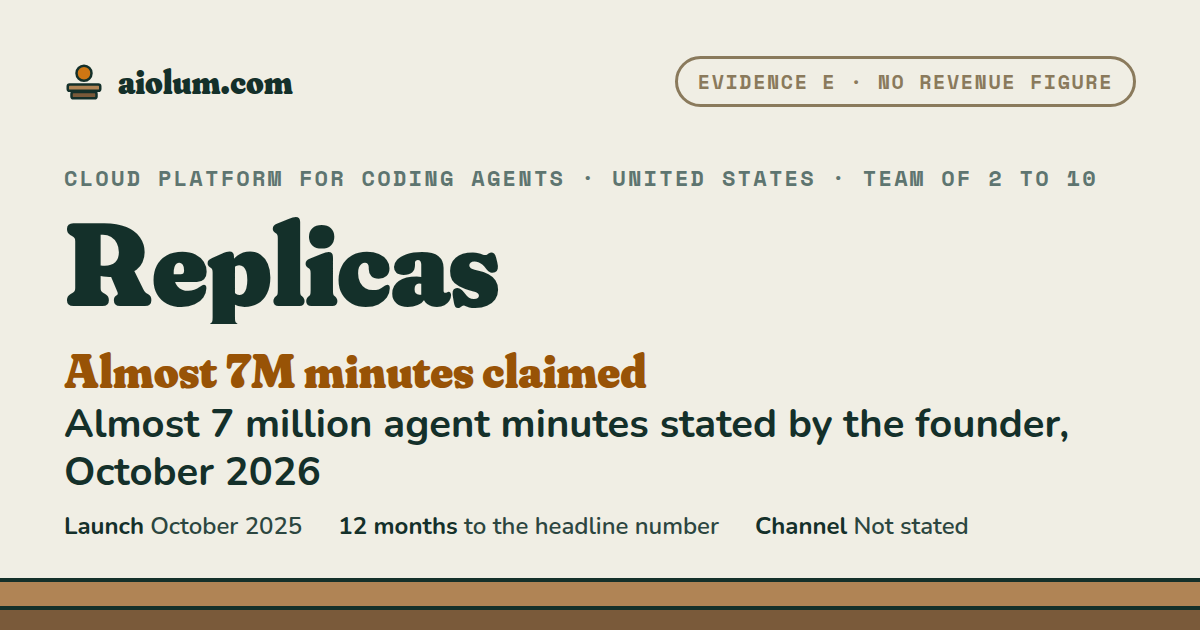
Replicas (Cloud platform for coding agents, United States): Almost 7 million agent minutes stated by the founder, October 2026. Evidence grade E: no revenue figure was checked. Team: 1 founder at the start by his own account, joined later by a cofounder; Y Combinator lists 2 founders and a team size of 2 in November 2026, and the company is hiring. Launched October 2025; still running, revenue growing.Added
- Outcome
- Almost 7 million agent minutes stated by the founder, October 2026Revenue growing
- Evidence
- E no revenue figure was checked
- Launch
- October 2025
- Status
- Still running
- Team
- 1 founder at the start by his own account, joined later by a cofounder; Y Combinator lists 2 founders and a team size of 2 in November 2026, and the company is hiring
- Outside funding
- Y Combinator Spring 2026; a seed round the founder announced on 13 October 2026
- Main channel
- Not stated
What is not verified
No revenue figure was found, so the story is grade E. The home page, pricing page, billing documentation, terms, blog and Y Combinator page were read. A reader could look for a press interview or a payment-processor statement. No source states that a customer has paid. The usage counts and the named customers are the company's own statements. The founder's seed round of US$4 million is his own announcement, and no investor confirmed it in a page read here. This story is grade E: the business is real and its product, price and customers are described from public pages, but no revenue figure was checked. Aiolum shows it as an idea worth studying, not as proof that it makes money.
Replicas is a platform for cloud coding agents: programs that write code and open pull requests without a person watching. Each task runs in its own virtual machine, a software-made computer with the customer's code and tools installed. The agent can run tests, start services and drive a browser there. The customer pays Replicas for machine minutes and pays the model maker separately.
Connor Loi and Saai Arora are listed by Y Combinator as founder and CEO and founder and CTO. The founder wrote in August 2026 that Replicas was created in late 2025 as a tool for his own work. The oldest copy of the site in the Internet Archive, dated 14 October 2025, offers early access through a waitlist. Y Combinator lists the company with a team size of 2 in November 2026.
No revenue figure was found, so the story is grade E. The headline is a usage count that the founder stated on 13 October 2026. A price list, billing terms and a self-serve sign-up exist. No source states that a customer has paid, and the customers the company names are its own statement.
Why did Replicas work?
Four causes, in the order they mattered. Each one is a reusable lesson.
Each agent gets a configured machine of its own
The company says each task boots a separate Linux machine that the team configures once with files, variables and start commands. The agent can then install dependencies, start a database and check its own work. The V1 blog presents this as the difference between a coding agent in a sandbox and an engineer. It is the founder's account.
It works with the customer's model account and any agent
The pricing page says model costs are not included and that Replicas does not resell model usage. Claude Code runs on a Claude subscription or an API key, and Codex on a ChatGPT account. Customers keep their existing accounts, and Replicas bills only for machine minutes.
It starts work where teams already assign it
The home page says tasks start from Linear, Slack, GitHub, GitLab, a dashboard, an API or a schedule. The Moda customer story says automations launched about 2,000 of its jobs in July. That count is the company's statement.
How it was built
These details come from the company's blog, privacy policy and documentation. They are grade C. [7, 13, 15, 3]
- The V1 blog of 18 March 2026 says the Linear and Slack integrations were the first things the founder built.
- The same blog says warm pools run set-up work on the machine beforehand, and that Replicas answers a Slack task within 15 seconds.
- The V1 blog says Daytona sandboxes were used. The privacy policy of 25 October 2026 says workspaces run on E2B or Tensorlake.
- The privacy policy says workspace settings and encrypted credentials are stored in Supabase, and that PostHog is used for product analytics.
- The company's blog of 22 October 2026 says agents check its own code. When a check fails or Greptile comments, an agent fixes it.
- Billing is a monthly subscription with included usage and per-minute overage, as the terms and the documentation state.
Who tried this before Replicas, and why did they fail?
Three companies in our database of failed startups built developer tools that ran in the cloud or wrote code with AI, and closed. The values below are from that database, were read on 12 November 2026 and are not independently verified.
Nitrous.io
The promiseInstant cloud development environments, a code-anywhere editor that removed local set-up.
Why it diedThe record says it was squeezed between AWS Cloud9, which Amazon could subsidize, and the bundling of developer tools into larger platforms.
Kite DevTool
The promiseAI code completion inside the editor, with a free and a paid tier.
Why it diedThe record says GitHub Copilot, built on large language models, outclassed its older models, and the paid tier never found enough buyers.
Sider
The promiseAutomated code review and static analysis for software teams.
Why it diedThe record says free open-source linters and larger security platforms covered the same need, so paying for a hosted service lost its point.
The failed startups come from our database of 1,749 dead startups, retold here in our own words. Its entries are AI-assisted summaries of public sources, so these cards carry no evidence grade.
What changed
The three records name the same pressure: a larger platform gave away or bundled what the small company sold. Nitrous.io met Amazon, Kite met GitHub and Sider met open-source tools. Replicas sits on the same ground. Claude Code and Codex also run in the model makers' own clouds, as the company's launch post says.
The launch post states the company's answer: those cloud versions lock a team into one agent and give little control over the environment. Replicas runs several agents and bills for machine minutes, not for the model. The sources do not show whether enough teams pay for that to last.
Can one person copy Replicas now?
The structure can be copied; the results are not shown.
A small team can sell the environment around other companies' coding agents and let customers bring their own model account. The sources show a price list, a usage count and named customers. They show no revenue. A reader should treat this as a pattern, not as proof that it earns.
Where it is still open: Other long-running agent jobs that need a full computer: data migrations, test suites, support triage and security checks.
- 1Run the agents that customers already use, and let them keep their own model accounts.
- 2Give each task its own machine that the team configures once.
- 3Start work from the tools where tickets already live: Slack, Linear and GitHub.
- 4Charge a monthly plan that includes usage, and bill the overage by the minute.
How much revenue does Replicas make?
Each row shows the evidence grade and the source numbers from the list at the end of this page. The grades are explained in How Aiolum verifies.
| Fact | Value | Grade | How we know | Sources |
|---|---|---|---|---|
| What is sold | Cloud workspaces in which coding agents run | C | The home page lists Claude Code, Codex, Cursor, OpenCode, Pi and Muse Code, each in its own Linux virtual machine. The pricing page says Replicas does not resell model usage. | [1, 2] |
| Start | Late 2025 | C | The founder's blog of 12 August 2026 says Replicas was created in late 2025. Y Combinator's page says Founded: 2026. The earlier date is used. | [6, 8] |
| Earliest page found | 14 October 2025 | C | A copy of replicas.dev in the Internet Archive offers Get Early Access and a waitlist. No earlier name or earlier product was found. | [12] |
| Company | Replicas Group Inc. | C | The footer of the pricing page reads "© 2026 Replicas Group Inc." The terms of service were last updated on 25 October 2026. | [1, 4] |
| Founders | Connor Loi, founder and CEO; Saai Arora, founder and CTO | C | Y Combinator's company page lists both as active founders. The seed blog is signed by Connor Loi as co-founder and CEO. His blog of 12 August 2026 says Replicas began as a tool for his own work and that a cofounder joined later. | [8, 5, 6] |
| Team size | 2 per Y Combinator; hiring | C | Y Combinator lists Team Size: 2 and two open jobs. The founder's August 2026 blog speaks of growing the team. No headcount was published. | [8, 6] |
| Funding | A seed round of US$4 million | C | The founder announced it on 13 October 2026 and named Y Combinator, Flex Capital and Founders' Co-op among the investors. No investor statement was read. | [5] |
| Agent usage by customers | Almost 7 million minutes by 13 October 2026 | C | The founder wrote that usage crossed 1 million minutes in May 2026, 2 million in July and 5 million in September. This is a company statement. | [5] |
| Prices | US$50 a month for Developer; US$200 a month and more for Team | C | The company's pricing page and billing documentation list these plans. Included usage equals the monthly price. | [1, 3] |
| How a plan is bought | Get started button; monthly subscription; upgrades apply at once | C | The billing documentation says upgrades apply immediately and the monthly price is charged at the start of each period. The terms say paid plans are billed monthly. | [3, 4] |
| Customers the company names | 16 companies on the home page; 5 customer stories | C | The home page lists Mintlify, Knowunity, Composio, Parrot, Moda and others. Knowunity, Moda and Parrot have stories on the company site. No independent source was found. | [2, 9, 10, 11] |
| Where the machines run | Daytona in March 2026; E2B or Tensorlake in the privacy policy | C | The V1 blog of 18 March 2026 says Daytona sandboxes were used. The privacy policy of 25 October 2026 names E2B or Tensorlake. | [7, 13] |
How to read this table. Grade C means the company, its founder or a directory states the value. No value here is grade A or B. No value is calculated on this page.
| Plan | Per month, billed yearly (US$) | Per month, billed monthly (US$) | Limit |
|---|---|---|---|
| Developer | 50 | US$50 of usage included; unlimited repositories, environments and automations; API access | |
| Team | 200 and more, in steps of 100 | Included usage equals the price; static egress IP; shared Slack support channel | |
| Enterprise | custom | Custom rates and limits; SOC 2 listed; contact sales or book a demo | |
| Small workspace, 2 vCPU, 8 GB | 0.004 a minute included | 0.006 a minute after the included usage | |
| Large workspace, 4 vCPU, 16 GB | 0.008 a minute included | 0.012 a minute after the included usage | |
| Ultra workspace, 8 vCPU, 32 GB | 0.016 a minute included | 0.024 a minute after the included usage |
Each plan includes usage equal to its monthly price. Usage beyond that is billed at an overage rate that the documentation puts at 1.5 times the included rate. Model costs are not included. Enterprise has no published price. New accounts get US$100 of free usage with no card, according to the page.
When did Replicas launch, and how did it grow?
From a waitlist page in October 2025 to a priced product with a seed round in October 2026.
- 14 October 2025CA copy of the site in the Internet Archive offers Get Early Access and a waitlist for agent workspaces. [12]
- 5 January 2026CThe founder writes that Replicas was wrongly presented as a tool for small tickets and announces an overhaul of the agent harness. [17]
- 18 March 2026CThe founder announces Replicas V1 with Environments, the way to configure each agent's machine ahead of time. [7, 8]
- May 2026CThe founder states that customer usage passed 1 million agent minutes. [5]
- 13 October 2026CThe founder announces a seed round of US$4 million and says usage is almost 7 million minutes. [5]
- 12 November 2026CThe pricing page lists Developer at US$50 a month and Team from US$200 a month, with US$100 of free usage for new accounts. [1]
What could go wrong for Replicas?
The risks are the mirror image of the causes above.
What is not verified
No revenue figure was found, so the story is grade E. The home page, pricing page, billing documentation, terms, blog and Y Combinator page were read. A reader could look for a press interview or a payment-processor statement. No source states that a customer has paid. The usage counts and the named customers are the company's own statements. The founder's seed round of US$4 million is his own announcement, and no investor confirmed it in a page read here.
Logo list, counters and security badge have no second source
The home page lists 16 customer companies and three counters. The counters match the company's own customer stories. The three customer quotations on the home page appear only on the company's own pages. The footer shows a SOC 2 mark with the text "Type I" and "Type II in progress". No audit report was read. The launch post says the product is used by "20+ YC startups", and no list of them was found.
The start date differs between two sources
Y Combinator lists Founded: 2026. The founder's blog of 12 August 2026 says late 2025, and an archived page is dated 14 October 2025. The story uses the earlier date. The company's blog of 5 January 2026 says it was presented in the month before as a tool for small tickets. The founder called that wrong.
The product depends on the model makers
Customers must bring a Claude, OpenAI, Cursor or other model account, and the model makers also sell cloud versions of their agents. The terms also bar routing automated work through interactive screens to avoid the metered billing of the API and automations.
Sources
The grade next to each source is the best grade that the source can support. "Read in full" means that the text of the page was downloaded and the numbers were checked in it.
- C Replicas pricing pageRead in full on 12 November 2026. Source for the plans, the per-minute rates, the free usage, the Get started buttons and the company name in the footer.
- C Replicas home pageRead in full on 12 November 2026. Source for the product description, the agents supported, the customer list, the counters and the SOC 2 mark.
- C Replicas documentation: BillingRead in full on 12 November 2026. Source for the plans, the overage rate, the billing period, upgrades and the free trial.
- C Replicas terms of service, last updated 25 October 2026Read the section on service and billing on 12 November 2026. Source for monthly billing and the rule on metered usage.
- C Replicas blog, 13 October 2026, by Connor Loi: Announcing Replicas' $4M seed roundRead in full on 12 November 2026. Founder's announcement. Source for the seed round, the investors and the usage counts.
- C Replicas blog, 12 August 2026, by Connor Loi: Why we refreshed the Replicas brandRead in full on 12 November 2026. Source for the late 2025 start and the growing team.
- C Replicas blog, 18 March 2026, by Connor Loi: Introducing Replicas V1Read in full on 12 November 2026. Source for Environments, warm pools and the use of Daytona sandboxes.
- C Y Combinator company page: ReplicasRead in full on 12 November 2026. Source for the founders, the batch, the year, the team size, the open jobs and the launch post.
- C Replicas customer story: KnowunityRead in full on 12 November 2026. The company's own story about a customer. Source for the July 2026 usage counts.
- C Replicas customer story: ModaRead in full on 12 November 2026. The company's own story. Source for the July 2026 usage counts and the automation share.
- C Replicas customer story: ParrotRead in full on 12 November 2026. The company's own story. Source for the July 2026 counters that the home page repeats.
- C Internet Archive copy of replicas.dev, 14 October 2025Read in full. Source for the waitlist page and the oldest date found for the product.
- C Replicas privacy policy, last updated 25 October 2026Read in full on 12 November 2026. Source for Supabase, PostHog, and E2B or Tensorlake.
- C Replicas blog indexRead in full on 12 November 2026. Source for the post dates, the earliest being 5 January 2026.
- C Replicas blog, 22 October 2026, by Saai Arora: What a software factory is and how we run oursRead in full on 12 November 2026. Source for the use of Greptile and Linear in the company's own work.
- C Database of failed startups, local exportRecord pages read on the website on 12 November 2026. AI-written summaries, not independently verified. Source for the failed predecessors.
- C Replicas blog, 5 January 2026, by Connor Loi: What Replicas is doing in 2026Read in full on 12 November 2026. Source for the January 2026 change of positioning.
Run this company? Send corrections or a verified figure to aiolum@livyden.com