Rowan: Product, team and how it was built
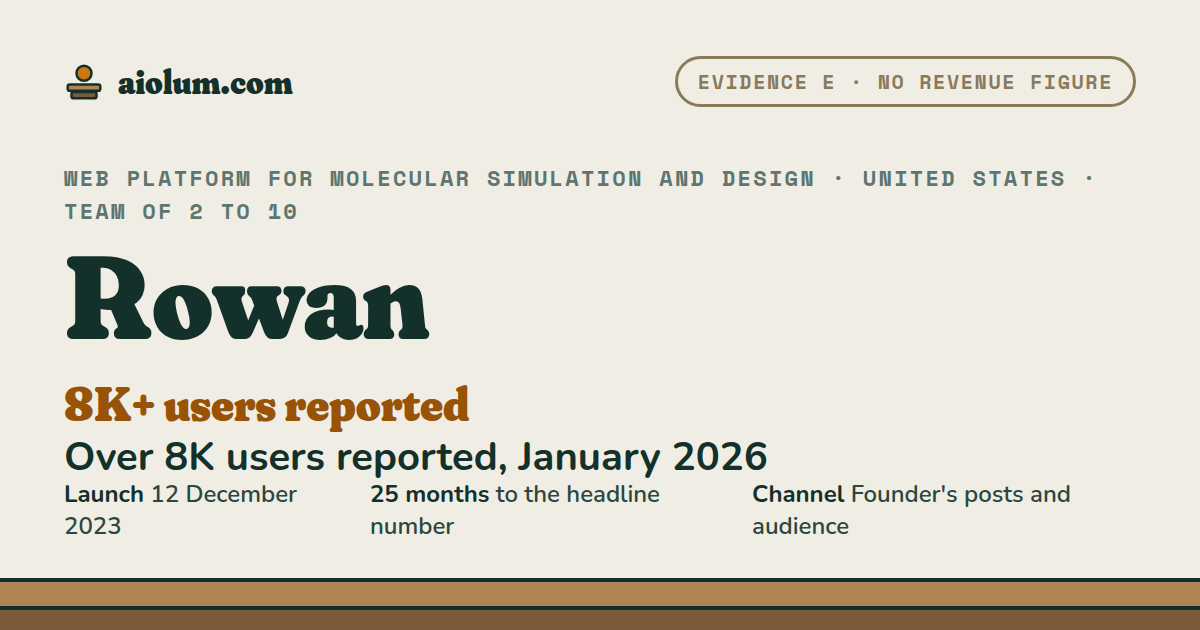
Rowan (Web platform for molecular simulation and design, United States): Over 8K users reported, January 2026. Evidence grade E: no revenue figure was checked. Team: 3 co-founders; 8 people listed in November 2026. Launched 12 December 2023; still running, revenue growing.Added
- Outcome
- Over 8K users reported, January 2026Revenue growing
- Evidence
- E no revenue figure was checked
- Launch
- 12 December 2023
- Status
- Still running
- Team
- 3 co-founders; 8 people listed in November 2026
- Outside funding
- US$2.1M pre-seed, December 2024 (press headlines)
- Main channel
- Founder's posts and audience
What is not verified
No revenue figure was found. The pages read were the company's site, its newsletter and its press page. No payment-processor profile, filing or interview with revenue was found. The pricing page shows a self-serve free plan, a credit price and billing terms, and the security page names Stripe. No independent source states that a customer has paid. The funding articles could not be read: one site refused automated access and others blocked the request. This story is grade E: the business is real and its product, price and customers are described from public pages, but no revenue figure was checked. Aiolum shows it as an idea worth studying, not as proof that it makes money.
Rowan is a cloud platform for computational chemistry, the use of computers to predict how molecules behave. A scientist uploads a molecule, picks a task such as a geometry optimization or a docking run, and gets results in the browser. The platform uses neural network potentials, machine-learned models that estimate the energy of a molecule much faster than quantum chemistry does.
The company lists three co-founders: Corin Wagen as CEO, Ari Wagen as COO and Eli Mann as co-founder and advisor. A public beta opened on 12 December 2023, billed by compute time. On 18 September 2024 the founders wrote that a US$200 a month subscription was launching. The about page lists eight people in November 2026.
No revenue figure was found, so this story has grade E. The best-supported fact is the CEO's January 2026 letter, which says that Rowan had over 8,000 users. Whether those users pay is not stated by any independent source.
Why did Rowan work?
Four causes, in the order they mattered. Each one is a reusable lesson.
The CEO knew chemistry software from years of academic research
The about page says Corin Wagen started Rowan to build the tools he wanted during his time in academia. He did a PhD at Harvard, finished in 2023. Another team member came from Schrödinger, a maker of chemistry software.
It added a subscription and changed credit prices step by step
The beta billed only compute time. The founders wrote in September 2024 that this discouraged people from running calculations, so they added a US$200 a month plan. They also raised the credit price from US$0.02 to US$0.05 and later cut it to US$0.04.
It publishes a newsletter and benchmarks that scientists read
The newsletter page shows over 10,000 subscribers. The CEO wrote in January 2026 that most user growth is organic. The company also runs a benchmarks site that compares chemistry methods. No source here measures which channel brought which customer.
How it was built
These details come from the company's own pages and posts. They are grade C. [6, 11, 10, 8, 9]
- A web app, a Python package and an API on one platform. The first post says the core scientific code was about 4,500 lines of Python in December 2023.
- Jobs run on cloud computers. The security page names Amazon Web Services, Modal and Microsoft Azure for compute, and Stripe for payments.
- The platform runs third-party models such as AIMNet2 and UMA, and its own neural network potential, Egret-1, released in 2025.
- Organizations, shared projects and API keys per organization were added in October 2026.
Tools named in the sources
Each one opens its page in the Tools tab, with every story that uses it.
Who tried this before Rowan, and why did they fail?
Two companies in our database of failed startups used machine learning to speed up research in biology or materials. The values below are from that database and are not independently verified.
Zymergen
The promiseMachine learning, automation and synthetic biology to engineer microbes that make new materials.
Why it diedThe record names premature scaling, no product-market fit and a collapse of the economic model. The record says each new product needed extensive strain engineering and fermentation work.
Spotlight Bio
The promiseA platform that finds drug targets from genomics and computational biology.
Why it diedThe record calls it the valley of death in computational biology: the record says predictions without experimental validation are science projects, not businesses.
The failed startups come from our database of 1,749 dead startups, retold here in our own words. Its entries are AI-assisted summaries of public sources, so these cards carry no evidence grade.
What changed
Both companies relied on laboratory or fermentation work before a customer got value. Zymergen made materials from microbes, and Spotlight Bio needed experiments to confirm its predictions. Costs grew with each new product, and the funding was large.
Rowan sells software. The security page says its jobs run on rented cloud computers, and the customer pays per credit. The press page lists a US$2.1M round, far below the two amounts above. The risk that remains is whether customers pay enough for the subscription.
Can one person copy Rowan now?
The structure, yes. The expertise, not without years of training.
A founder who has used scientific software for years can sell a simpler, hosted version to the same kind of user. The company combined a free tier, credits for extra use and a subscription for heavy users. The founders' own field knowledge is the part that is hard to copy.
Where it is still open: Other fields where experts stitch together several software packages and servers, such as materials, battery research or agricultural chemistry.
- 1Pick one scientific task that experts do by hand with several tools.
- 2Offer a free tier with a weekly credit allowance, so users can test the result.
- 3Sell extra credits and a subscription for people who run the task all the time.
- 4Publish benchmarks and a newsletter that show the method works.
How much revenue does Rowan make?
Each row shows the evidence grade and the source numbers from the list at the end of this page. The grades are explained in How Aiolum verifies.
| Fact | Value | Grade | How we know | Sources |
|---|---|---|---|---|
| Paid subscription launched | 18 September 2024, US$200 a month per user | C | The founders wrote this in their newsletter. The post says each user gets 1,250 credits a week, advanced workflows and priority support. | [5] |
| Users reported | over 8,000, monthly active users up more than 7 times in 2025 | C | Founder's year-end letter to investors, shared as a newsletter post on 1 January 2026. The post does not say how many of the users pay. | [8] |
| Counters on the home page | 19,000+ scientists, 2.5 million calculations, 60+ papers | C | The company's own page in November 2026, with no date and no definition of a scientist. The January 2026 letter gave over 8,000 users. | [1, 8] |
| Company start | 2023 | C | The site footer reads 2023 to 2026. A reviewer wrote in January 2024 that the company was only seven months old. The first product post is dated 12 December 2023. | [3, 10, 6] |
| Public beta | 12 December 2023, billed by compute time | C | Founders' newsletter post. There was no license fee, and the first 500 minutes were free. | [6] |
| Funding | US$2.1M pre-seed, December 2024 | C | Two headlines on the company's press page, dated 5 and 9 December 2024. The articles themselves could not be read. | [4] |
| Co-founders | Corin Wagen (CEO), Ari Wagen (COO), Eli Mann (co-founder and advisor) | C | The company's about page. Eli Mann is described there as a former director of machine learning. | [3] |
| Team size, November 2026 | 8 people listed | C | The about page. A newsletter listed on the press page called Rowan a startup of six in April 2026. | [3, 4] |
| Credit price | US$0.02 before September 2024, US$0.05 after, US$0.04 from 2026 | C | Founders' posts of September 2024 and December 2025. The pricing page in November 2026 says 4 cents per credit. | [5, 7, 2] |
| Named customers and partners | Ligo Biosciences, Until Labs, bioArena | C | Named by the CEO in the January 2026 letter as customers and partners the company may talk about. The home page also shows one named quotation. | [8, 1] |
| Payments and hosting | Stripe for payments; Amazon Web Services, Modal and Microsoft Azure for compute | C | The company's security page, read in November 2026. | [11] |
| Time from beta to the January 2026 user count | 25 months | calc | Calculated: December 2023 to January 2026. | [6, 8] |
How to read this table. Grade C is a statement by the company or its founders. A grade E story has no dated money figure, so no row here is a revenue number.
| Plan | Per month, billed yearly (US$) | Per month, billed monthly (US$) | Limit |
|---|---|---|---|
| Free | 0 | 0 | 20 credits a week, plus 500 on sign-up |
| Team | 2,000 credits a week; plans start at five seats; price not shown on the page as read | ||
| Enterprise | custom pooled usage; contact the company | ||
| Individual subscription, September 2024 | 200 | 1,250 credits a week; priced for new subscribers before the 2026 change | |
| Extra credits | 0.04 per credit | valid up to one year from purchase | |
| Free Academic | 0 | 0 | 100 credits a week |
| Team Academic | 500 credits a week; price not shown on the page as read |
The pricing page loads plan prices by script, so no Team price could be read. The September 2024 post gave US$200 a month for one user. A December 2025 post said that subscription prices would rise in 2026 for new subscribers. An October 2026 post says that individual subscriptions become five-seat Team subscriptions.
When did Rowan launch, and how did it grow?
From a company start in 2023 to a paid subscription and a funded team of eight. Each entry carries its grade.
- 2023CThe company starts. A reviewer calls it seven months old in January 2024. [3, 10]
- 12 December 2023CPublic beta of the cloud platform. The founders charge for compute time only and give 500 free minutes. [6]
- 18 September 2024CA paid subscription of US$200 a month per user launches, with an academic price one third of that. [5]
- December 2024CPress headlines report a US$2.1M pre-seed round. [4]
- 1 January 2026CThe CEO writes that Rowan has over 8,000 users and that subscriptions began at the end of 2024. [8]
- 5 October 2026CEvery user joins an organization. Team plans start at five seats, and the company lists a free tier with three seats. [9]
What could go wrong for Rowan?
The risks are the mirror image of the causes above.
What is not verified
No revenue figure was found. The pages read were the company's site, its newsletter and its press page. No payment-processor profile, filing or interview with revenue was found. The pricing page shows a self-serve free plan, a credit price and billing terms, and the security page names Stripe. No independent source states that a customer has paid. The funding articles could not be read: one site refused automated access and others blocked the request.
Counters and testimonials
The home page shows 19,000+ scientists, 2.5 million calculations and 60+ papers, with no date. The January 2026 letter gave over 8,000 users. The page shows the logos of 12 companies with no source. The January 2026 letter names two of them, Ligo Biosciences and Until Labs. The page also shows eight names in a quotation carousel, but only one quotation is in the page text. One search for that quotation found no copy elsewhere.
Names and team size
The footer reads Rowan Scientific Corporation. The login page and one press headline say Rowan Labs. The about page lists eight people, while a newsletter on the press page called Rowan a startup of six in April 2026. The two counts may use different rules.
AI is one part of the product, and services exist too
The workflows use physics-based quantum chemistry methods and machine-learned models. Rowan also sells a virtual screening service, in which its team runs the screen and coordinates synthesis and assays with partners. The pricing page also says the company occasionally takes consulting-style projects. The Free Academic plan is aimed at coursework and research, not at homework help.
Sources
The grade next to each source is the best grade that the source can support. "Read in full" means that the text of the page was downloaded and the numbers were checked in it.
- C Rowan home pageRead in full, 12 November 2026. Source for the counters, the named quotation, the product description and the founders' blog list.
- C Rowan pricing pageRead in full, 12 November 2026. Plan prices load by script and were not visible. Source for the credit price, free plans and the FAQ.
- C Rowan about pageRead in full, 12 November 2026. Source for the co-founders, the eight listed people and the footer years.
- C Rowan press pageRead in full, 12 November 2026. A list of headlines and dates. The linked articles on the funding could not be read.
- C Rowan Newsletter, 18 September 2024: You Can Now Subscribe to Rowan (And Why You Should)Read in full. Founders' post. Source for the US$200 a month plan and the credit price change.
- C Rowan Newsletter, 12 December 2023: Rowan's Beta LaunchRead in full. Founders' post. Source for the beta date and the compute-time billing.
- C Rowan Newsletter, 16 December 2025: Making Rowan Even Easier To UseRead in full. Source for the 2026 credit price of US$0.04 and the announced subscription changes.
- C Rowan Newsletter, 1 January 2026: 2025 in ReviewRead in full. Year-end letter by the CEO. Source for the user count, usage growth and named customers.
- C Rowan Newsletter, 5 October 2026: Organizations for EveryoneRead in full. Source for the Team and Enterprise plan description.
- C Macs in Chemistry, 27 January 2024: Looking at Rowan a web-native quantum chemistry packageRead in full. A reviewer's blog post. Source for the company age and the AIMNet2 model.
- C Rowan security pageRead in full, 12 November 2026. Source for Stripe and the compute providers.
- C Database of failed startups, local exportRecord pages read on the website on 12 November 2026. AI-written summaries, not independently verified. Source for the failed predecessors.
Run this company? Send corrections or a verified figure to aiolum@livyden.com