Userdoc: Product, team and how it was built
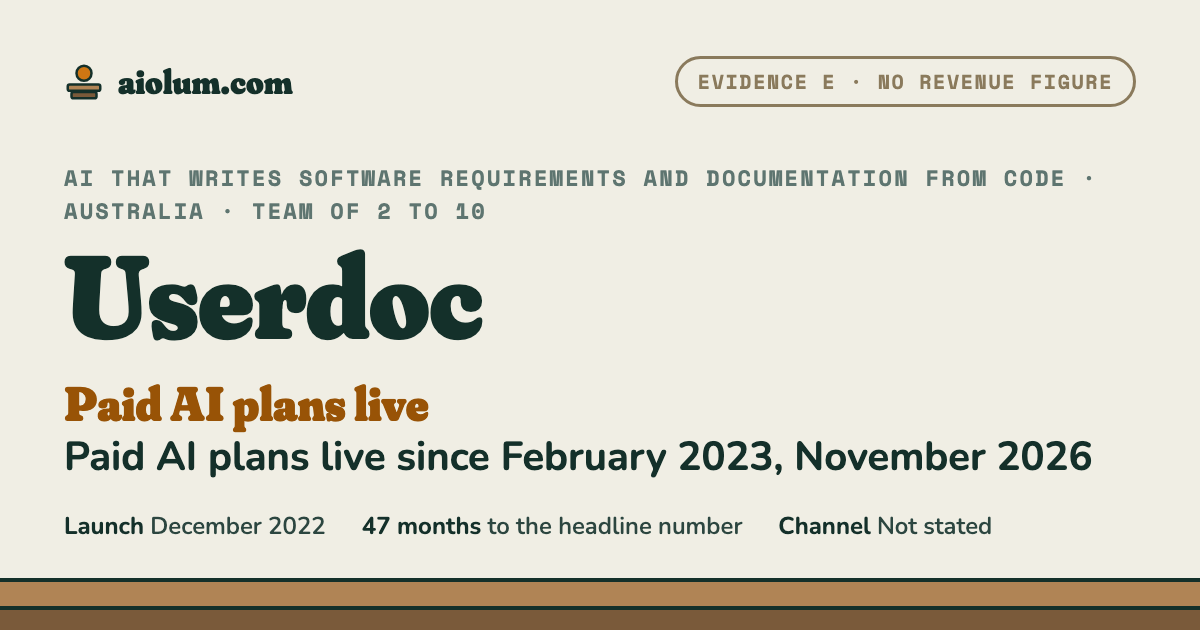
Userdoc (AI that writes software requirements and documentation from code, Australia): Paid AI plans live since February 2023, November 2026. Evidence grade E: no revenue figure was checked. Team: 2 founders (Chris Rickard and his wife Claire) and 1 developer in November 2023; later size not published. Launched December 2022; still running.Added 8 November 2026
- Outcome
- Paid AI plans live since February 2023, November 2026
- Evidence
- E no revenue figure was checked
- Launch
- December 2022
- Status
- Still running
- Team
- 2 founders (Chris Rickard and his wife Claire) and 1 developer in November 2023; later size not published
- Outside funding
- TinySeed accelerator investment, May 2024 (amount not published); Australian Government Industry Growth Program grant, February 2025
- Main channel
- Not stated
What is not verified
No revenue figure was found. The founder wrote on 16 May 2024 that Userdoc had been "a fully bootstrapped (and profitable) company, growing every month" before TinySeed invested, with no number; his two interviews and the company's blog give no revenue, customer count or user count, and no payment-processor profile such as TrustMRR was found. The product is younger than the company that first sold it: the site footer of December 2023 names Wishbyte Pty Ltd, whose ABN Lookup record says "Active from 15 May 2017", and the 2026 footer names Userdoc Pty Ltd, "Active from 02 Apr 2024"; under the user's ruling of 8 November 2026 the product counts from its own launch in December 2022. Archived copies of the domain from December 2021 and April 2022 show only a domain-registrar verification page. The founder's two interviews give 2020 and 2021 for the sale of his earlier agency. A reader could look for an interview with revenue or seat numbers. This story is grade E: the business is real and its product, price and customers are described from public pages, but no revenue figure was checked. Aiolum shows it as an idea worth studying, not as proof that it makes money.
Userdoc is an Australian web app that writes software requirements, the written description of what a program must do, with AI. It drafts user stories, short sentences of the form "As a user, I want this, so that I can do that", together with acceptance criteria, the checks that show a feature works as agreed. Its Code-to-docs service reads an existing codebase and writes functional documentation, a plain description of what the software does for its users. The pricing page lists Lite at US$19 and Pro at US$25 per seat a month, with a 14-day free trial.
Chris Rickard, a software developer who ran his own development agency for eight years, started it after the agency was sold; his wife Claire is named with him as a founder on the early home pages. Archived copies show a waitlist in November 2022, sign-in and three paid plans on 2 December 2022, and AI credits in every plan by 10 February 2023. In November 2023 the team was three people. TinySeed, an accelerator for business-software companies, invested in May 2024, and in February 2025 the company announced an Australian Government grant.
No revenue figure was found: the founder wrote in May 2024 that Userdoc had been "fully bootstrapped (and profitable)" before TinySeed, without a number, so this page is grade E. The product is sold today by Userdoc Pty Ltd, registered in April 2024; in 2023 the site footer named Wishbyte Pty Ltd, a company registered in 2017. The page also shows earlier companies that tried to make code and software plans easier to understand.
How much revenue does Userdoc make?
Each row shows the evidence grade and the source numbers from the list at the end of this page. The grades are explained in How Aiolum verifies.
| Fact | Value | Grade | How we know | Sources |
|---|---|---|---|---|
| Status, November 2026 | Live, with paid plans and a 14-day free trial | C | Home page and pricing page read on 8 November 2026. Footer: "Copyright © 2026 Userdoc Pty Ltd". | [1, 2] |
| Prices, November 2026 | Lite US$19 and Pro US$25 per seat a month; Enterprise by quote | C | Pricing page. Lite allows up to 3 seats; Pro has no seat limit and adds chat to requirements, export and integrations. | [2] |
| Waitlist, 6 November 2022 | "Launching soon", join the waitlist | C | Archived home page. It already showed plans of US$12, US$29 and US$59 a month and named no AI feature. | [4] |
| First live version, by 2 December 2022 | Sign-in, 14-day free trial, plans at US$12, US$29 and US$99 a month | C | Archived home page of 2 December 2022, which names no AI feature. The founder said in November 2023 that Userdoc had been "released for close to 12 months" and in January 2024 that it "went live at the start of 2023". | [5, 8, 9] |
| AI in every paid plan, 10 February 2023 | 100, 300 and 1,000 AI credits a month | C | Archived home page: "Save hours with AI assistance", to generate user stories, acceptance criteria, personas and user flows. Prices unchanged at US$12, US$29 and US$99 a month. | [6] |
| Team, November 2023 | 3 people | C | Founder interview: he is the CEO and writes much of the code; the team is "another great developer" and his wife Claire. No later headcount was found. | [8] |
| Companies that sell the product | Wishbyte Pty Ltd (ABN active from 15 May 2017) in 2023; Userdoc Pty Ltd (ABN active from 2 April 2024) today | A | The archived home page of 6 December 2023 says "Copyright © 2023 Wishbyte Pty Ltd"; ABN Lookup gives Wishbyte "Active from 15 May 2017" and Userdoc Pty Ltd "Active from 02 Apr 2024", both in VIC 3065. The 2026 footer names Userdoc Pty Ltd. Under the user's ruling of 8 November 2026, the product counts from its own launch in December 2022. | [7, 14, 13, 1] |
| Outside funding, May 2024 | TinySeed accelerator investment; amount not published | C | Founder's blog post of 16 May 2024: before TinySeed, Userdoc "had not taken any outside investment and was a fully bootstrapped (and profitable) company, growing every month". No figure is given. | [10] |
| Government grant, February 2025 | $250,000, matched by $250,000 of the company's own money | C | Company's blog post of 26 February 2025: a Commercialisation and Growth grant under the Australian Government's Industry Growth Program, to fast-track features that turn legacy code and business documents into requirements. The post gives no currency. | [11] |
| Named customers | Infosys, Sunoco, Stanley Black & Decker, Portable, MBLM | C | Testimonials on the home page and case studies on the company's own blog. The founder said in January 2024 that customers range from healthcare companies and governments to agencies and large consultancies. | [1, 3, 9] |
| First large Code-to-docs sale, second version (from 2024) | a 1.5-million-line Visual Basic system | C | Founder's blog post of 27 March 2026, on the second version of Code-to-docs. He gives roughly 70% accuracy for the first version (2023), roughly 85% for the second (2024) and above 90% in tests of the third, which "is not a shipped product yet". | [12] |
| Months from launch to November 2026 | 47 | calc | Calculated: December 2022 to November 2026. | [5, 1] |
How to read this table: a grade C value is a statement by the founder or the company, on its own pages, in interviews or in archived copies of its site. A grade A value comes from the Australian Business Register (ABN Lookup). The "calc" value was computed on this page. No source gives revenue, a customer count or a user count.
| Plan | Per month, billed yearly (US$) | Per month, billed monthly (US$) | Limit |
|---|---|---|---|
| Free trial | 0 | 14 days, 1 seat, 1 project, 10 requirements | |
| Lite | 19 per seat | up to 3 seats, unlimited requirements | |
| Pro | 25 per seat | no seat limit, unlimited projects, chat to requirements, export, integrations | |
| Enterprise | custom | single sign-on, workshops, account manager, SLA | |
| Code-to-docs | by lines of code | calculator example US$499 |
Prices are per seat a month. The page says "Save 14% with yearly billing" but shows one price per plan and no yearly price, so the yearly column is empty. Code-to-docs is priced by lines of code with a calculator on the same page, whose example shows US$499; larger projects start with a demo.
When did Userdoc launch, and how did it grow?
From a waitlist in November 2022 to agent-based documentation of old code in 2026. Each entry carries its grade.
- 6 November 2022CThe home page is a waitlist for a requirements tool, "Launching soon", with no AI features named. [4]
- 2 December 2022CLive with sign-in, a 14-day free trial and three paid plans from US$12 a month. [5]
- 10 February 2023CEvery plan includes AI credits to generate user stories, acceptance criteria, personas and user flows. [6]
- November 2023CThree people: the founder, one more developer and his wife Claire. The founder says the AI became good enough with GPT-3.5 and GPT-4. [8]
- 16 May 2024CTinySeed invests. The founder writes that Userdoc had been bootstrapped and profitable until then. The next day the blog reports SOC 2 Type 1 compliance. [10, 3]
- February 2025 to March 2026CAn Australian Government grant for the legacy-code features (February 2025), an MCP server for AI coding tools (May 2025), and a third, agent-based Code-to-docs in use on customer projects but not yet shipped (March 2026). [11, 3, 12]
Why did Userdoc work?
Four causes, in the order they mattered. Each one is a reusable lesson.
A method the founder already used
He spent about twenty years building software and eight running an agency, and the product follows the structure he worked with: user stories with acceptance criteria, personas and user flows. The early home pages say the founders first built it for their own work and then found that clients wanted it too.
The tool first, the AI two months later
The version of December 2022 was a structured editor with paid plans and no AI. By February 2023 every plan came with monthly AI credits at the same prices, so the AI was sold inside an existing subscription instead of as a separate product.
From new software to old software
Customers kept asking for help to understand systems they already had. Code-to-docs reads the code, lets a person confirm the main areas and features, and then writes requirements for each one. The founder writes that a human confirmation step at each stage was what made it work.
How it was built
These details come from the founder's interviews, the company's blog and the page source of its website. The first are grade C; what the page source shows is grade B. [8, 12, 3, 1]
- The founder is the CEO and writes much of the code. In November 2023 the team was him, one more developer and his wife Claire.
- The AI features grew out of OpenAI's GPT-3.5 and GPT-4, which the founder says made the product possible at the level customers needed.
- Code-to-docs has had three designs: in 2023 a knowledge graph and file summaries within small context windows; in 2024 a pipeline of about thirty steps around large-context models such as Gemini 1.5 Pro, with human confirmation of themes and features; in 2026 agents that explore the code, still with human review.
- An MCP server, announced in May 2025, lets AI coding tools such as Cursor, GitHub Copilot, Claude Desktop and Windsurf read the requirements stored in Userdoc.
- The website is built with Next.js, served through Cloudflare and tagged with Google Tag Manager, as its page source shows.
Tools named in the sources
Each one opens its page in the Tools tab, with every story that uses it.
Who tried this before Userdoc, and why did they fail?
Three companies in our database of failed startups tried to make code or software projects easier to understand or to produce. The values below are from that database and are not independently verified.
CodeSee
The promiseInteractive maps that help developers understand large codebases faster.
Why it diedIt could not show engineering leaders a clear return on the money, in a category with many free alternatives.
Omniref
The promiseA shared "Wikipedia for code" in which developers documented and annotated source code.
Why it diedIt needed many unpaid contributors, had little money, and GitHub and Stack Overflow already held the developers.
Builder.ai
The promiseCustom apps scoped and assembled by an AI-assisted production line instead of a hired team.
Why it diedAccording to the database, its apps cost more to build than they sold for, and much of the work presented as AI was done by offshore developers.
The failed startups come from our database of 1,749 dead startups, retold here in our own words. Its entries are AI-assisted summaries of public sources, so these cards carry no evidence grade.
What changed
CodeSee and Omniref tried to make code easier to understand with maps or with documentation written by people, and both had to persuade engineers to change their habits for a tool they saw as optional. Builder.ai promised to turn a plain description into software and, according to the database, relied on many people behind the scenes.
Userdoc sells to the people who must write requirements anyway, not only to engineers, and the slow part of the work, reading code and drafting user stories, is now done by language models while a person confirms the structure. It started small on its own money, and the founder said in May 2024 that it was profitable before the TinySeed investment, though he gave no figure.
Can one person copy Userdoc now?
The method, yes. The domain knowledge takes years.
The product rests on a requirements method that the founder used for years at his agency, and on companies that need written requirements before they build or replace software. One person can copy the approach in another field whose documents follow a fixed structure, but selling to large companies also needs security work, such as the SOC 2 compliance that Userdoc reports.
Where it is still open: Other fixed-structure documents that teams still write by hand: test plans, audit and compliance documentation, data dictionaries, and migration plans for old systems.
- 1Pick a document type that your own past work taught you, with a fixed structure (here: user stories, acceptance criteria, personas and user flows).
- 2Ship the structured editor with paid plans first, then add AI generation inside the same plans.
- 3Keep a person in the loop to confirm each stage of what the AI produces.
- 4Follow customers to the harder job they ask for: here, documentation of old code.
What could go wrong for Userdoc?
The risks are the mirror image of the causes above.
What is not verified
No revenue figure was found. The founder wrote on 16 May 2024 that Userdoc had been "a fully bootstrapped (and profitable) company, growing every month" before TinySeed invested, with no number; his two interviews and the company's blog give no revenue, customer count or user count, and no payment-processor profile such as TrustMRR was found. The product is younger than the company that first sold it: the site footer of December 2023 names Wishbyte Pty Ltd, whose ABN Lookup record says "Active from 15 May 2017", and the 2026 footer names Userdoc Pty Ltd, "Active from 02 Apr 2024"; under the user's ruling of 8 November 2026 the product counts from its own launch in December 2022. Archived copies of the domain from December 2021 and April 2022 show only a domain-registrar verification page. The founder's two interviews give 2020 and 2021 for the sale of his earlier agency. A reader could look for an interview with revenue or seat numbers.
Customer quotes, logos and the SOC 2 badge
Several testimonials on the 2026 home page carry the same names as in February 2023 but different words or titles: the Atlasopen quote moved from "Director of Atlasopen" to "Atlasopen, CEO" and now adds "the AI generated requirements are seriously amazing", and a freelance developer's surname is spelled differently. The Infosys figure also differs: the founder said in January 2024 that Infosys found Userdoc helps it "move 70% faster", while the 2026 home page quotes an Infosys manager on "AI accuracy and relevance at around 70%". The case studies are published by the company itself. The 2026 home page shows a "SOC 2 Type II Compliant" badge and says that Userdoc "is SOC2 Type 2 compliant"; the company's only post on the subject, of 17 May 2024, announces SOC 2 Type 1 compliance checked by an independent auditor that it does not name, and says the company "will be pursuing SOC 2 Type 2 compliance in the near future". No source found names a Type 2 audit. The logo row "Trusted by professional businesses worldwide" also shows a logo labelled "Cayman Island Government", for which no testimonial or case study was found.
Depends on model providers, and similar products
The founder says the AI features became good enough only with OpenAI's GPT-3.5 and GPT-4, and he writes that Gemini 1.5 Pro's one-million-token context window made the 2024 Code-to-docs rebuild possible, so price, quality or policy changes by these providers reach Userdoc directly. Two stories on this site sell similar AI planning documents, ChatPRD (product requirement documents for product managers) and CodeGuide (planning documents for AI coding tools); both report revenue figures and Userdoc does not.
Funding, team and the next version
The founder wrote that the TinySeed money would let the company "hire key resources", and the grant was to fast-track the legacy-code features; no source gives the team size after November 2023 or the amount TinySeed invested. The agent-based Code-to-docs "is not a shipped product yet", in the founder's words of March 2026.
Sources
The grade next to each source is the best grade that the source can support. "Read in full" means that the text of the page was downloaded and the numbers were checked in it.
- C Userdoc home page, read 8 November 2026Read in full, and its page source. Source for the product, the testimonials, the 2026 footer and the website's tools.
- C Userdoc pricing page, read 8 November 2026Read in full. Source for the plans, the per-seat prices and the Code-to-docs calculator.
- C Userdoc blog index, read 8 November 2026Read the list of posts with their dates. Source for the SOC 2 post, the MCP server post and the case studies.
- C Internet Archive copy of userdoc.fyi, 6 November 2022Read in full. Shows the waitlist, "Launching soon", and plans without AI.
- C Internet Archive copy of userdoc.fyi, 2 December 2022Read in full. Shows sign-in, the free trial and three paid plans, with no AI feature named.
- C Internet Archive copy of userdoc.fyi, 10 February 2023Read in full. Shows AI credits in every plan and the founders' names.
- C Internet Archive copy of userdoc.fyi, 6 December 2023Read in full. Source for the footer naming Wishbyte Pty Ltd.
- C Devrims #TechTalk 031: Chris Rickard Talks About AI and UserDoc, 1 November 2023Read in full. Founder interview. Source for the team of three, the agency sale in 2021, the release date and the GPT-3.5 and GPT-4 remark.
- C Build Club, 15 January 2024: Edition 5: Humans of Build Club (Chris Rickard)Read in full. Founder interview. Source for his background, the agency sale in 2020, "went live at the start of 2023", the customer types and the Infosys remark.
- C Userdoc blog, 16 May 2024: Userdoc Joins TinySeed (Chris Rickard)Read in full. Source for the TinySeed investment and the bootstrapped and profitable statement.
- C Userdoc blog, 26 February 2025: Userdoc Awarded Industry Growth Program Grant (Chris Rickard)Read in full. Source for the grant and its purpose.
- C Userdoc blog, 27 March 2026: post by Chris Rickard on the three versions of Code-to-docsRead in full. Source for the three Code-to-docs designs, the models named, the accuracy figures and the first large sale.
- A ABN Lookup: current details for ABN 98 676 258 325, Userdoc Pty LtdRead the current details. Official register entry: "Active from 02 Apr 2024".
- A ABN Lookup: current details for ABN 95 619 067 499, Wishbyte Pty LtdRead the current details. Official register entry: "Active from 15 May 2017".
- C Database of failed startups, local exportLocal export. AI-written summaries, not independently verified. Source for the failed predecessors.
Run this company? Send corrections or a verified figure to aiolum@livyden.com