Vanna AI: Product, team and how it was built
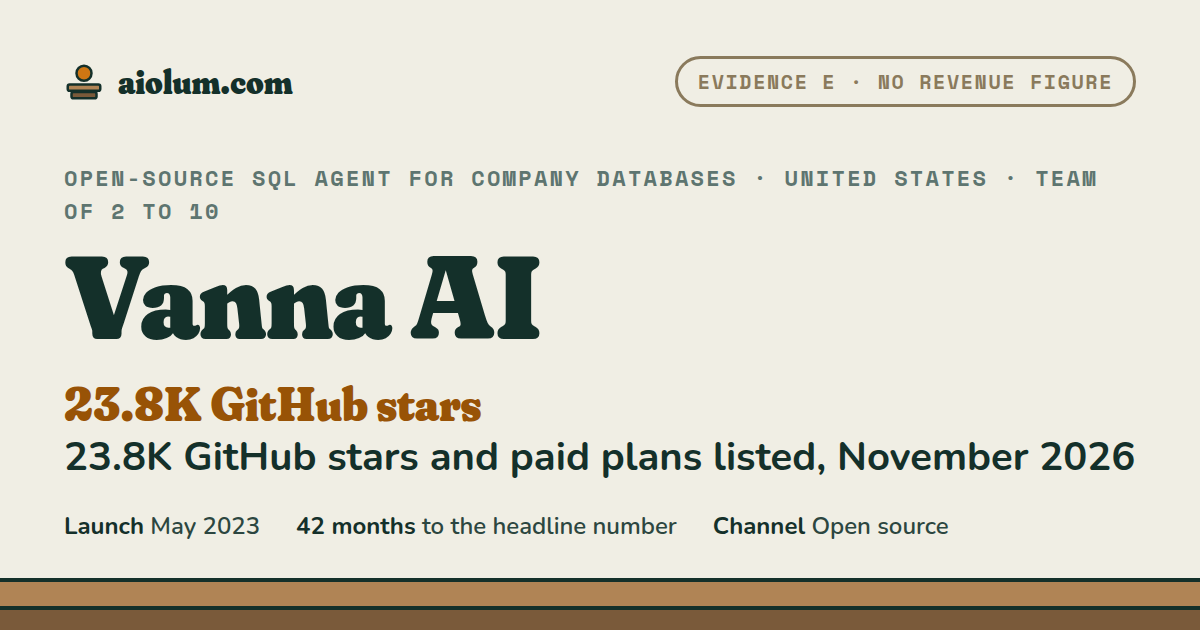
Vanna AI (Open-source SQL agent for company databases, United States): 23.8K GitHub stars and paid plans listed, November 2026. Evidence grade E: no revenue figure was checked. Team: headcount not published. Launched May 2023; still running.Added
- Outcome
- 23.8K GitHub stars and paid plans listed, November 2026
- Evidence
- E no revenue figure was checked
- Launch
- May 2023
- Status
- Still running
- Team
- headcount not published
- Outside funding
- Not published
- Main channel
- Open source
What is not verified
No revenue figure was found. The pricing page lists plans, and the terms mention a paid subscription, but no source states that a customer has paid. A reader could look for a Stripe profile, a founder interview or a funding announcement. The number of people is not published, and no downloaded page names a founder. This story is grade E: the business is real and its product, price and customers are described from public pages, but no revenue figure was checked. Aiolum shows it as an idea worth studying, not as proof that it makes money.
Vanna AI sells an SQL agent: a program that takes a question in plain language and shows the answer from a database. It writes the SQL query, the language that databases answer to, and runs it. The framework is open source under the MIT license and works with several language models and databases. A hosted version adds admin features such as access control and audit logs.
The privacy page names Vanna AI, Inc. and says it is based in the United States, in Fairfield, Connecticut. The GitHub repository was created on 13 May 2023, and a web archive copy of vanna.ai from 18 May 2023 shows the same idea: "Vanna.AI lets you chat with your database". GitHub shows that the owner archived the repository on 29 March 2026, which makes it read-only.
No revenue figure was found, so the grade is E. The page lists self-serve plans at US$50 and US$500 a month, but no source states that a customer has paid. The number of founders and employees is not published either. The package file names Zain Hoda as the author.
Why did Vanna AI work?
Four causes, in the order they mattered. Each one is a reusable lesson.
Free code on GitHub drew more than 20,000 stars
The framework is open source under the MIT license, and the installation is one line, pip install vanna. The company's docs say the project passed 20,000 stars. The GitHub page confirms 23,804. The owner archived the repository on 29 March 2026.
Companies asked for permissions, and the hosted plans include them
The company's docs say its enterprise customers asked how to give each user different permissions. The home page offers access control, audit logs and data retention as optional hosted admin features. The pricing page says the plans include them.
The same code runs free or hosted, so users can upgrade
The pricing page says all tiers use the same core framework. A team can start self-hosted and later move to the managed cloud without rewriting code.
How it was built
These details come from the company's pages and from the Microsoft post. [1, 7, 9]
- A Python package. The Microsoft post calls it an open-source Python RAG (retrieval-augmented generation) framework for SQL generation.
- The home page lists language models from Anthropic, OpenAI, Gemini and Ollama. It also lists databases such as SQLite, PostgreSQL, MySQL, Snowflake and BigQuery.
- The hosted version adds access control, observability, agent memory in a hosted vector database, file storage, audit logs and data retention.
- The rewrite called Vanna 2.0 carries the user identity through every request, as the company's docs say.
Tools named in the sources
Each one opens its page in the Tools tab, with every story that uses it.
Who tried this before Vanna AI, and why did they fail?
Two companies in our database of failed startups promised to turn company data into answers for non-specialists. The values below are from that database and are not independently verified. The match is loose. The cause line of DataNitro does not match its failure analysis, so both are given.
DataNitro
The promiseLet Python programmers run scripts inside Excel to automate data analysis.
Why it diedThe failure analysis says the product was limited by Excel's architecture. It says later tools such as Jupyter notebooks and cloud analytics matured around it.
Lariat Data
The promiseTurn raw media data into insights for engineering, product and design teams.
Why it diedThe failure analysis says strategic misalignment and competition as Tableau and Looker added AI to their products.
The failed startups come from our database of 1,749 dead startups, retold here in our own words. Its entries are AI-assisted summaries of public sources, so these cards carry no evidence grade.
What changed
Both predecessors sold data analysis to people who were not analysts, and both met stronger platforms. DataNitro depended on Excel. Lariat Data met larger analytics vendors that added AI.
Vanna AI differs in two ways. It gives the code away, so the first user pays nothing. It sells the parts a company needs to run it for many users, such as permissions and logs. Whether enough customers pay for that is not shown by any source found.
Can one person copy Vanna AI now?
Partly. The free-then-hosted structure can be copied; the traction cannot be checked.
Open-source code with a hosted paid tier is a repeatable structure. The proof of demand here is 23,800 GitHub stars, not paying customers. A reader can copy the structure but should look for payment evidence first.
Where it is still open: Other narrow jobs where a free framework brings developers and companies later pay for control: document extraction, test automation and search over private data.
- 1Publish the core as open source with a one-line install.
- 2Ask the first company users what blocks them from using it in production.
- 3Sell that part as a hosted plan, such as user permissions, audit logs and storage.
- 4Keep the open-source and hosted versions on the same code, so users can move up without a rewrite.
How much revenue does Vanna AI make?
Each row shows the evidence grade and the source numbers from the list at the end of this page. The grades are explained in How Aiolum verifies.
| Fact | Value | Grade | How we know | Sources |
|---|---|---|---|---|
| Product status | Live; open-source framework and hosted plans | C | Home page, read 12 November 2026: "Open Source • Multi-database • Multi-turn • Access controlled", with optional hosted admin features. | [1] |
| Repository created | 13 May 2023 | B | The creation date in the data of the GitHub repository page vanna-ai/vanna. | [5] |
| Website in 2023 | Archive copy of 18 May 2023 | B | The Internet Archive copy of vanna.ai shows "Vanna.AI lets you chat with your database", Snowflake support and a plan called Premium Beta. The earliest archive copy, of 4 April 2022, is a registrar parking page. | [6, 14] |
| Repository status | Archived by the owner on 29 March 2026 | B | The GitHub page says: "This repository was archived by the owner on Mar 29, 2026. It is now read-only." No downloaded page gives the reason. | [5] |
| Founded, according to a third party | 2023, New York | B | Runa Capital's ROSS Index for Q2 2024 lists Vanna AI as founded in 2023 in New York. The company's privacy page says Fairfield, Connecticut. | [8, 4] |
| GitHub stars | 23,804 stars, 2,550 forks | B | GitHub page read 12 November 2026. ROSS Index counted 6.3K stars in April 2024. | [5, 8] |
| Self-serve paid plans | Explorer US$50 a month, Team US$500 a month | C | The pricing page lists them. It also says "select annual billing during checkout" and that a user can upgrade at any time. | [2] |
| Billing terms | "All sales are final" | C | The terms of 30 October 2025 have a refund policy that mentions "a paid subscription". | [3] |
| Customers named by the company | "enterprise customers", no names | C | The company's docs say it learned three lessons "from our enterprise customers". No customer is named. | [9] |
| Partner post | Microsoft Azure SQL blog, 3 April 2024 | B | The post says Vanna.ai works "in partnership with Azure SQL Database Product Management". | [7] |
| Funding | None listed | C | The ROSS Index lists amounts raised for other companies on the same page but none for Vanna AI. This is an absence, not a statement. | [8] |
| Team | Headcount not published; package author Zain Hoda | B | The package file pyproject.toml names Zain Hoda as author, with a vanna.ai address. No downloaded page names a founder. The GitHub organization shows no public members. | [13, 10] |
How to read this table. Grade C means the company states it on its own page. Grade B means a third party states it or it is visible in public code. No figure here is revenue.
| Plan | Per month, billed yearly (US$) | Per month, billed monthly (US$) | Limit |
|---|---|---|---|
| Explorer | 50 | 20 questions a day; for small teams of 2-3 people | |
| Team | 500 | 300 questions a day; setup support | |
| Enterprise | custom | unlimited questions; on-prem support; SAML SSO |
The page lists monthly prices and says annual subscriptions receive a 20% discount. The page does not show the discounted price. Enterprise pricing is custom. The open-source framework is free.
When did Vanna AI launch, and how did it grow?
From a GitHub repository in May 2023 to an archived repository in March 2026. Each entry carries its grade.
- 13 May 2023BThe GitHub repository vanna-ai/vanna is created. On 18 May the Internet Archive saves vanna.ai with a free plan and a Premium Beta. [5, 6]
- 8 September 2023CThe company's blog announces that Vanna is available as an open-source package. Before that, the server was closed source. [12]
- 3 April 2024BMicrosoft publishes a post on using Vanna with Azure SQL Database, written by a Microsoft product manager. [7]
- 30 October 2025CThe terms are updated. The pages read in November 2026 are titled Vanna 2.0 and list Explorer, Team and Enterprise plans. [3, 2]
- 29 March 2026BThe owner archives the GitHub repository, which becomes read-only. [5]
- November 2026BThe repository shows 23.8K stars and 2.5K forks. The site still lists the paid plans. [5, 2]
What could go wrong for Vanna AI?
The risks are the mirror image of the causes above.
What is not verified
No revenue figure was found. The pricing page lists plans, and the terms mention a paid subscription, but no source states that a customer has paid. A reader could look for a Stripe profile, a founder interview or a funding announcement. The number of people is not published, and no downloaded page names a founder.
Company claims without a source
The home page shows the badges "Open Source Production Ready" and "No Vendor Lock-in". The Premium page says the patterns are "refined across hundreds of production deployments" and the framework is "trusted by teams worldwide". No customer list backs these claims.
One quotation on the home page
The home page prints a quotation under the name Brian Spindolini, Senior Product Manager, Azure SQL Database. The same words are in the Microsoft post of 3 April 2024, whose author is shown as Brian Spendolini. The spellings differ.
The code repository is archived, and an earlier project exists
GitHub shows that the owner archived the repository on 29 March 2026, and no page gives the reason. The site, the price list and the sign-in page were online on 12 November 2026. The 2023 archive copy links to Pycob, an earlier project (github.com/pycob/pycob, created 15 January 2023). Both package files name the same author. No page says if Pycob was the same company.
Sources
The grade next to each source is the best grade that the source can support. "Read in full" means that the text of the page was downloaded and the numbers were checked in it.
- C Vanna AI home page, read 12 November 2026Read in full. Source for the product description, the supported models and databases, the admin features and the badges.
- C Vanna AI pricing page, read 12 November 2026Read in full. Source for the plan prices, the question limits, the annual discount and the checkout wording.
- C Vanna AI terms of service, last updated 30 October 2025Read the refund and subscription sections and searched the rest for age limits and student marketing; none found.
- C Vanna AI privacy policy, last updated 11 April 2024Read the sections that name the company and its location.
- B GitHub: vanna-ai/vanna, read 12 November 2026Read the repository page. Source for the creation date, the stars, the forks, the MIT license and the archive notice.
- B Internet Archive copy of vanna.ai, 18 May 2023Read in full. Source for the 2023 product description, the plans of that time and the link to Pycob.
- B Microsoft Azure SQL Dev Corner, 3 April 2024: Vanna.ai and Azure SQL DatabaseRead the introduction and the section on how Vanna works. Source for the partnership and the Python description.
- B Runa Capital, ROSS Index Q2 2024Read the table row and the list entry for Vanna AI. Source for the founding year, the city and the star count of April 2024.
- C Vanna AI docs: Why We Built Vanna 2.0Read in full. Source for the star claim and the statement about enterprise customers.
- B GitHub organization vanna-ai, people pageRead. It states that the organization has no public members.
- C Database of failed startups, local exportRecord pages read on the website on 12 November 2026. AI-written summaries, not independently verified. Source for the failed predecessors.
- C Vanna AI blog, 8 September 2023: Announcing the open source version of Vanna (Internet Archive copy)Read in full. Source for the date of the open-source release.
- B GitHub: vanna-ai/vanna, file pyproject.toml, read 12 November 2026Read in full. Source for the package author. The same file in pycob/pycob names the same author.
- B Internet Archive copy of vanna.ai, 4 April 2022Read in full. It is a registrar parking page that says the domain was recently registered.
Run this company? Send corrections or a verified figure to aiolum@livyden.com