Voker: Product, team and how it was built
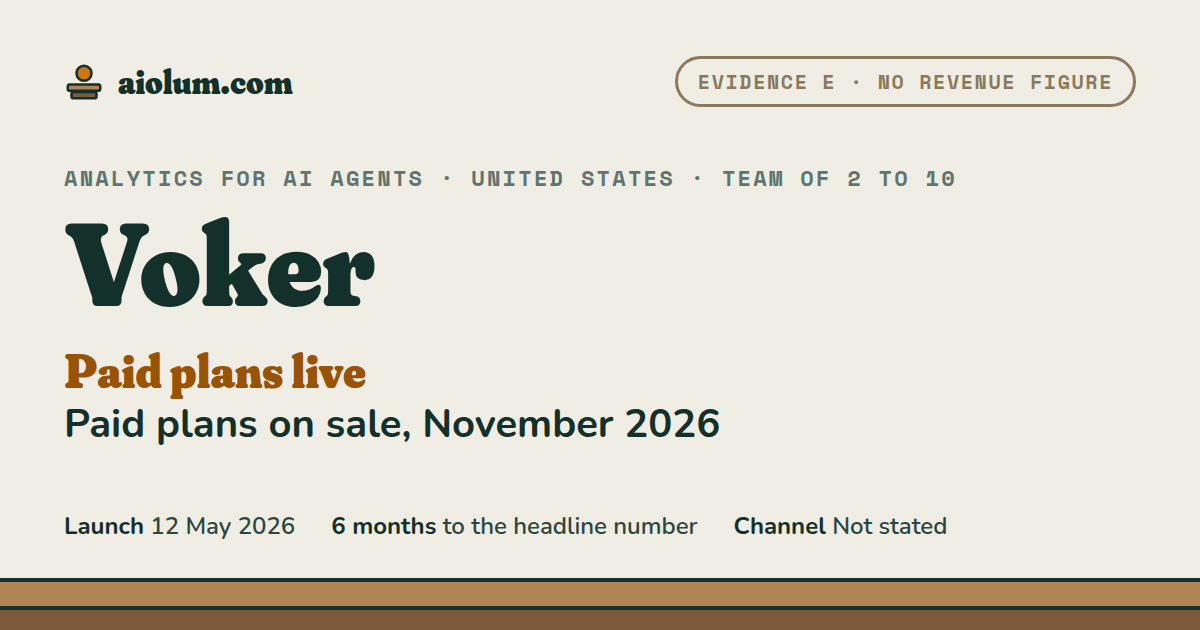
Voker (Analytics for AI agents, United States): Paid plans on sale, November 2026. Evidence grade E: no revenue figure was checked. Team: 2 co-founders at the May 2026 launch post; 6 people per the Y Combinator profile read in November 2026. Launched 12 May 2026; still running.Added
- Outcome
- Paid plans on sale, November 2026
- Evidence
- E no revenue figure was checked
- Launch
- 12 May 2026
- Status
- Still running
- Team
- 2 co-founders at the May 2026 launch post; 6 people per the Y Combinator profile read in November 2026
- Outside funding
- Y Combinator, Summer 2024; a pre-seed round that the company disclosed on 19 May 2026
- Main channel
- Not stated
What is not verified
No revenue figure was found. The sources checked were the company's pricing page and terms, its launch and funding posts, and the Y Combinator profile. The paid plans lead to a sign-up page and the terms name Stripe. The company's Y Combinator profile of September 2024 said it had two paying customers for the earlier builder. No independent source confirms this, and no source states that a customer has paid for the analytics product. A reader could look for a payment-processor profile or an interview that gives revenue. This story is grade E: the business is real and its product, price and customers are described from public pages, but no revenue figure was checked. Aiolum shows it as an idea worth studying, not as proof that it makes money.
Voker is agent analytics for AI product teams. An AI agent is a program that asks a language model what to do next and then acts, such as a booking assistant. The company adds an SDK (a code library) around the calls that the agent makes to OpenAI, Anthropic or Gemini. It then groups each conversation by what the user wanted, where the user had to correct the agent, and whether the request was solved.
Tyler Postle (CEO) and Alex Rudolph (CTO) founded it in Los Angeles, and the Y Combinator profile gives 2024 and the batch Summer 2024. In September 2024 the website sold a no-code AI builder under the same name. The Launch HN post for the analytics product is dated 12 May 2026. The CEO wrote on 19 May 2026 that the company had raised a pre-seed round of US$2.2 million.
No revenue figure is published, so the story is grade E. The checked facts are the price list on the company's page, the billing terms that name Stripe, and the launch post. No independent source shows that a customer has paid. The five customer quotations on the home page are the company's own.
Why did Voker work?
Four causes, in the order they mattered. Each one is a reusable lesson.
The founders helped customers build agents before they sold agent analytics
The September 2024 and September 2025 copies of the site sell a no-code AI builder for product teams. A founder wrote in May 2026 that they had helped teams build agents across over 100 customers from their first product. The 2026 site sells analytics for agents that other teams already built. The sources do not say why the product changed.
A free plan and a two-line SDK make a first test cheap
The free plan has 2,000 events a month and needs no credit card, according to the company's product page. The same page says the SDK is two lines of code and that no infrastructure changes are needed. A team can test it on one agent before it pays.
Three plain terms name what the product measures
The founders wrote that every user comes to an agent with an intent, may correct the agent, and hopes the intent is resolved. Voker counts those three things. The founders wrote that the counting is done by code and not by a language model, so the figures repeat.
How it was built
These details come from the founders' launch post and the company's own pages. They are grade C. [1, 2]
- The SDK wraps calls to OpenAI, Anthropic and Gemini in Python and TypeScript, according to the launch post. The home page shows the install line pip install voker.
- The founders wrote that Voker annotates each conversation with the user's intent and corrections. It uses language models and hierarchical text classification, which sorts text into groups and sub-groups.
- The founders wrote that they do not use language models for the core data engineering, the processing of events and the calculation of statistics.
- The home page says that self-hosting is available and that the customer keeps ownership of the data. The pricing page lists self-hosted deployment on the Enterprise plan.
Tools named in the sources
Each one opens its page in the Tools tab, with every story that uses it.
Who tried this before Voker, and why did they fail?
Three companies in our database of failed startups sold analytics that told a business what its customers did, and closed. The values below are from that database and are not independently verified.
Frogmetrics
The promiseTablets that let retailers collect customer satisfaction metrics in real time.
Why it diedThe record says it fell to high operating costs, slow retail adoption and the rapid change of mobile technology.
Lookery
The promiseDemographic data from Facebook that helped websites show more relevant products.
Why it diedThe record says it depended on Facebook's data, which a Facebook redesign made less useful. Adknowledge acquired it.
Prayas Analytics
The promiseVideo analytics on a store's existing cameras, to show foot traffic and dwell times.
Why it diedThe record says that the varied video quality and hardware of the existing cameras caused problems.
The failed startups come from our database of 1,749 dead startups, retold here in our own words. Its entries are AI-assisted summaries of public sources, so these cards carry no evidence grade.
What changed
Each of the three sold measurement that depended on something it did not control: store hardware, a social network's data, or a store's camera system. The records name cost, a platform change and integration trouble as the causes.
Voker reads only the conversations that a customer's own agent sends through the SDK. It needs no hardware and no outside data source. The records do not answer a different risk: model providers and observability tools may add the same analysis.
Can one person copy Voker now?
A narrow analytics product for one new kind of software can be copied. The proof of payment is missing here.
Two founders with data experience chose one new kind of software, AI agents, and sold a way to measure it. A small team can do the same for another new kind of software. This story shows a price list and a funding post. It does not show that anyone pays.
Where it is still open: Other kinds of AI software with no standard measurement: voice agents, coding agents, and agents that act inside a browser.
- 1Pick a kind of software that is new and has no standard way to measure what users want from it.
- 2Name the few things to measure in plain terms, and publish them with a free plan and an SDK a team can try in minutes.
- 3Post the launch where engineers read, with a demo, and answer every question in the replies.
How much revenue does Voker make?
Each row shows the evidence grade and the source numbers from the list at the end of this page. The grades are explained in How Aiolum verifies.
| Fact | Value | Grade | How we know | Sources |
|---|---|---|---|---|
| Paid plans on the home page, 12 November 2026 | Starter US$80 a month, Agent First US$400 a month | C | The company's home page lists them with a free plan and a custom Enterprise plan. The buttons of the paid plans lead to the sign-up page. | [2] |
| Billing terms | subscriptions, a free trial and Stripe named as the payment provider | C | The terms of service describe monthly or yearly billing cycles and a free trial. They say payments are accepted through Stripe. The terms were last updated on 24 July 2024. | [5] |
| Launch post, 12 May 2026 | Launch HN: Voker (YC S24), 59 points | B | The post says the founders are Alex and Tyler, co-founders. It says the free tier has 2,000 events a month and that paid plans start at US$80 a month with a 30-day free trial. | [1] |
| Company start | 2024 | C | The Y Combinator profile says founded 2024 and batch Summer 2024. It gives Los Angeles, CA as the location. A copy of the profile from 2 September 2024 also says founded 2024. | [3, 11] |
| Operating company | Invoke Labs, Inc. | C | The terms and the privacy policy name it as the operator of voker.ai, and the 2026 footer says the same. A copy of invokelabs.ai from 27 May 2024 says Invoke Labs, with testing, prompt management and metrics for chat agents. | [5, 2, 6] |
| Earlier product under the same name | a no-code AI builder | C | Copies of voker.ai from 19 September 2024, 12 March 2025 and 11 September 2025 say Voker is the No-Code AI builder for product teams. The 2026 pages sell agent analytics instead. | [7, 8, 2] |
| Founders' earlier work | since 2021 | C | The company's Y Combinator launch text says the founders had been building data and AI products and consulting together since 2021. The September 2024 copy of the profile says the two met at an e-commerce company where one of them ran technology and data. | [3, 11] |
| Customers of the first product | over 100 | C | A reply under the launch post says the founders helped PMs and AI engineering teams build agents across over 100 customers from their first product. The post does not name that product or give a year. The September 2024 Y Combinator profile describes one product, the no-code builder. | [1, 11] |
| Team | 2 co-founders in May 2026; 6 people on the Y Combinator profile | C | The launch post is signed by the two co-founders. The profile gives a team size of 6 and no date; it was read on 12 November 2026. The September 2024 copy of the profile gave a team size of 2. | [1, 3, 11] |
| Funding | a pre-seed round, disclosed on 19 May 2026 | C | The company's blog post, signed Tyler Postle, CEO, says US$2.2 million. No investor is named in the post. | [4] |
| Named customers on the home page | 5 quotations from people at 5 companies | C | Each quotation carries a name, a title and a company. None says that the company pays, and no figure is given. | [2] |
How to read this table. Grade B is a value shown by a third-party platform, here Hacker News. Grade C is the company or its founders saying so. No row states revenue.
| Plan | Per month, billed yearly (US$) | Per month, billed monthly (US$) | Limit |
|---|---|---|---|
| Free (Agent Ready) | 0 | 2,000 events a month, 30 days of data kept | |
| Starter (Agent Enabled) | 80 | 20,000 events a month, 90 days of data kept | |
| Agent First | 400 | 2,000,000 events a month, 1 year of data kept | |
| Enterprise (Scale) | custom | talk to sales; self-hosting and single sign-on |
The page lists a price per month and does not say whether it is billed monthly or yearly. The terms say that billing cycles are monthly or yearly by plan. The Launch HN post of May 2026 said paid plans start at US$80 a month with a 30-day free trial. Events are the user messages, assistant messages and tool calls that the agent sends to Voker.
When did Voker launch, and how did it grow?
From two founders who worked together since 2021 to a funded company with a price list, by November 2026. Each entry carries its grade.
- 2021CThe founders say they have been building data and AI products and consulting together since this year. [3]
- 27 May 2024CA copy of invokelabs.ai shows Invoke Labs and "Actionable AI Agents" with API integrations, testing, prompt management and metrics. [6]
- 19 September 2024CA copy of voker.ai shows Voker as a no-code AI builder for product teams. The page has a free start button and a demo button. [7]
- 12 May 2026BLaunch HN for Voker as analytics for AI agents, with a free tier and paid plans from US$80 a month. [1]
- 19 May 2026CThe company's blog says it has raised a pre-seed round of US$2.2 million. [4]
- 12 November 2026CThe home page lists a free plan, Starter, Agent First and Enterprise, with sign-up buttons. [2]
What could go wrong for Voker?
The risks are the mirror image of the causes above.
What is not verified
No revenue figure was found. The sources checked were the company's pricing page and terms, its launch and funding posts, and the Y Combinator profile. The paid plans lead to a sign-up page and the terms name Stripe. The company's Y Combinator profile of September 2024 said it had two paying customers for the earlier builder. No independent source confirms this, and no source states that a customer has paid for the analytics product. A reader could look for a payment-processor profile or an interview that gives revenue.
Start date and the first product
The Y Combinator profile gives 2024 as the founding year. The same profile says the founders worked together since 2021, and a launch reply mentions over 100 customers from a first product. The September 2024 copy of the profile says the two met at an e-commerce company, and it names one product, the no-code builder. No company register could be opened. The company's start is taken as 2024 from the profile and the May 2024 copy of invokelabs.ai.
Home page quotations and logos
The 2026 home page shows five named quotations and a Y Combinator badge. The September 2025 copy shows four of the same people with different sentences, written for the earlier no-code product. The 2024 copy has two rows of logos under the headings "Voker runs on" and "We integrate with". It does not present them as customers.
Funding and team size
The pre-seed round is announced only by the company, and the post names no investor. The team size of 6 comes from the Y Combinator profile, which has no date. The company's blog lists several authors, so the team may be larger than the two co-founders of the launch post.
Sources
The grade next to each source is the best grade that the source can support. "Read in full" means that the text of the page was downloaded and the numbers were checked in it.
- B Launch HN: Voker (YC S24) – Analytics for AI Agents, 12 May 2026Read the post and the replies. Source for the launch date, the free tier, the start of paid plans, the method and the first-product reply.
- C Voker home page and pricing, read 12 November 2026Read in full. Source for the price list, the quotations, the sign-up buttons, the Y Combinator badge and the footer.
- C Y Combinator company page: VokerRead in full on 12 November 2026. Source for the founding year, the batch, the team size, the founders' titles and their work since 2021.
- C Voker blog: Voker discloses $2.2M pre-seed, 19 May 2026Read in full. The company's own funding announcement, signed by the CEO.
- C Voker terms of service and privacy policy, read 12 November 2026Read the sections on billing, subscriptions, free trials and the operator. Source for Invoke Labs, Inc., Stripe and the minimum age of 18.
- C Internet Archive copy of invokelabs.ai, 27 May 2024Read in full. A short page for Invoke Labs. It is the only copy of that domain in the archive index.
- C Internet Archive copy of voker.ai, 19 September 2024Read in full. Shows the no-code AI builder. The archive index lists the first copy that loaded as 19 September 2024.
- C Internet Archive copies of voker.ai, 12 March 2025 and 11 September 2025Read the home pages. Source for the no-code description and the four customer quotations of 2025.
- C Voker product page and blog index, read 12 November 2026Read the product page, its frequently asked questions and the blog index. Source for the free plan terms and the two-line SDK.
- C Database of failed startups, local exportRecord pages read on the website on 12 November 2026. AI-written summaries, not independently verified. Source for the failed predecessors.
- C Internet Archive copy of the Y Combinator company page for Voker, 2 September 2024Read in full. Source for the 2024 founding year, the team size of 2, the two paying customers and the description of the no-code builder.
Run this company? Send corrections or a verified figure to aiolum@livyden.com