Apol: Product, team and how it was built
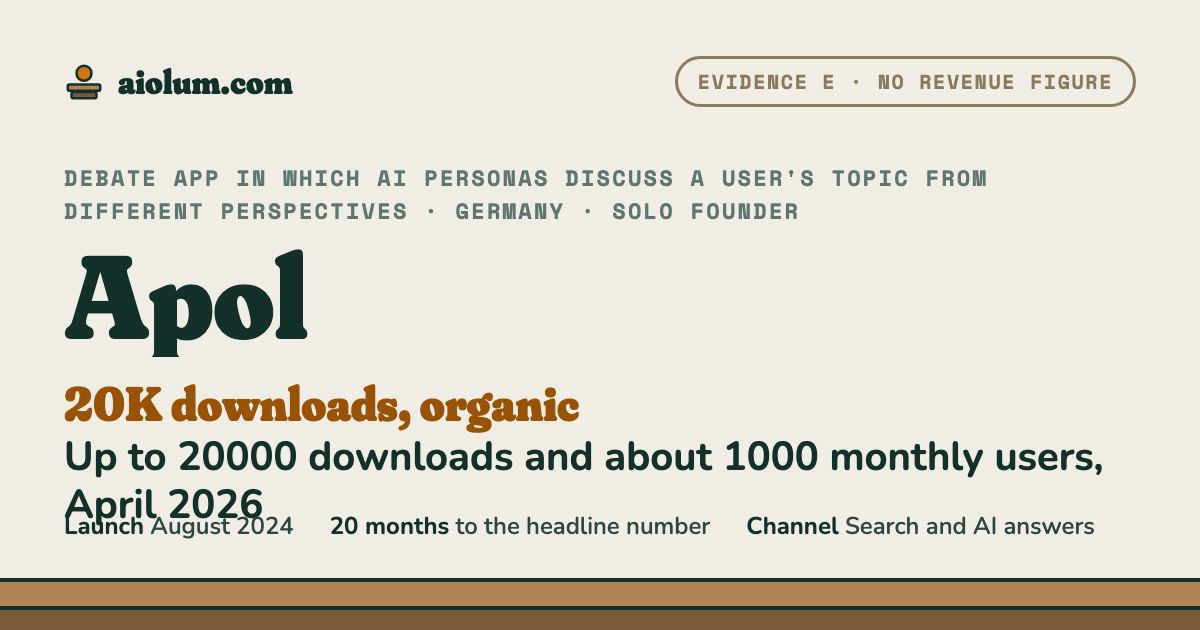
Apol (Debate app in which AI personas discuss a user's topic from different perspectives, Germany): Up to 20000 downloads and about 1000 monthly users, April 2026. Evidence grade E: no revenue figure was checked. Team: 1 founder, Dario Digregorio, as a side project next to an 80% job as a software developer. Launched August 2024; still running.Added 6 November 2026
- Outcome
- Up to 20000 downloads and about 1000 monthly users, April 2026
- Evidence
- E no revenue figure was checked
- Launch
- August 2024
- Status
- Still running
- Team
- 1 founder, Dario Digregorio, as a side project next to an 80% job as a software developer
- Outside funding
- None reported
- Main channel
- Search and AI answers
What is not verified
No revenue figure for Apol was found. What was looked for: a payment-processor profile, a founder interview with numbers, store revenue estimates. In the podcast the founder said "monatliches MMR, habe ich 30 Euro" (translation: monthly recurring revenue, I have 30 euros) while speaking of both apps; the podcast article places that figure with the weather app. The download and user counts are the founder's statements, partly checked by Google Play's "10K+" counter. The launch year differs: the terms date from August 2024, while the founder said 2023. A reader could look for a later interview with Apol's own revenue. This story is grade E: the business is real and its product, price and customers are described from public pages, but no revenue figure was checked. Aiolum shows it as an idea worth studying, not as proof that it makes money.
Apol (short for "apolar", a molecule without poles) is a mobile app in which AI personas, chat bots that a large language model plays with a fixed role, expertise and opinion, debate a topic with the user. A large language model is a program trained on large amounts of text that writes text in answer to a prompt. Apol's terms list Google Gemini as the model service, and the founder said in the podcast that he still uses Google's model.
Dario Digregorio, a Flutter developer from Rosenheim in Germany, builds Apol and a weather app in his free time. He told the Happy Bootstrapping podcast, published on 9 April 2026, that Apol had about 10,000 to 20,000 downloads on both app stores and about 1,000 monthly users, with no paid marketing, most of them in China, Russia, Nigeria and the Philippines. Google Play showed "10K+" downloads in November 2026.
No revenue figure for Apol was found, so the evidence grade is E. What is checked is the live site, the store pages with their subscription prices, the terms of service and the founder's own account in the podcast.
How much revenue does Apol make?
Each row shows the evidence grade and the source numbers from the list at the end of this page. The grades are explained in How Aiolum verifies.
| Fact | Value | Grade | How we know | Sources |
|---|---|---|---|---|
| Status, November 2026 | live on the App Store and Google Play | C | Home page links both stores. Google Play shows "Updated on Mar 7, 2026"; the App Store shows version 2.0.1. | [1, 5, 6] |
| Founder | Dario Digregorio, alone | C | Home page: "Created by Dario Digregorio". The App Store lists him as developer and seller. The podcast describes the apps as his free-time projects next to an 80% job. | [1, 5, 2] |
| Launch | August 2024 | C | The terms say they are "effective as of 2024-08-11". The founder said he started when Google announced a competition for apps built with Gemini. In the podcast he also said "ich habe sie 2023 gelauncht" (translation: I launched it in 2023); the App Store's earliest listed version is 0.5.6 of 1 October 2024. | [7, 3, 5] |
| Downloads, March 2026 | about 10,000 to 20,000 on both stores | C | Founder in the podcast, recorded 16 March 2026: "für APOL habe ich mittlerweile so 10.000 bis 20.000" (translation: for Apol I now have about 10,000 to 20,000). The article says "bis zu 20.000 Downloads" (up to 20,000 downloads). | [3, 2] |
| Monthly users, March 2026 | about 1,000 | C | Founder: "Ich habe jetzt mittlerweile tausend monatliche Nutzer in der App" (translation: I now have a thousand monthly users in the app). | [3, 4] |
| Google Play downloads, November 2026 | 10K+ | C | Store counter, read 6 November 2026. Rating 3.6 from 29 reviews; App Store 5.0 from 1 rating. | [6, 5] |
| Where users come from | mostly China, Russia, Nigeria and the Philippines, also the USA | C | Founder, from App Store, Play Store and Google Analytics statistics. No paid marketing; only occasional posts on his own social accounts. | [3, 2] |
| Prices | Apol Pro from US$1.99 a month or US$17.99 a year | C | US App Store in-app purchase list; a second pair at US$2.99 and US$29.99 is also listed. | [5] |
| AI model | Google Gemini | C | Terms, section 5, list Google Gemini with RevenueCat and Firebase. The founder said he still uses Google's model and plans to allow others. | [7, 3] |
| Languages | more than 15 | C | Home page: "Apol supports 15+ languages". The founder said he translated it into 16 languages with AI. | [1, 3] |
| Outside funding | none reported | C | The podcast presents it as a bootstrapped free-time project with no exit plan. | [2] |
| Time from launch to the April 2026 figures | 20 months | calc | Calculated: August 2024 to April 2026. | [7, 4] |
How to read this table: a grade C value is what the founder said in the podcast, what the podcast's article reports, or what the app stores and the company's pages show. A "calc" value (grade X) was computed on this page. No value comes from a payment processor or a filing.
| Plan | Per month, billed yearly (US$) | Per month, billed monthly (US$) | Limit |
|---|---|---|---|
| Free | 0 | 0 | most features; limited debates and personas |
| Apol Pro, first listed price | 1.50 (17.99 a year) | 1.99 | more debates and personas, custom personas, stronger models |
| Apol Pro, second listed price | 2.50 (29.99 a year) | 2.99 | same plan at a second listed price |
The App Store lists two monthly and two yearly Apol Pro prices; it does not say which applies to whom, so both pairs are shown. The founder said that most features are free and that Pro is needed for more debates, more personas and stronger AI models. In the podcast the host saw euro prices on his own device.
When did Apol launch, and how did it grow?
From a Google competition entry in summer 2024 to version 2.0 in March 2026, read from the terms, the App Store version history and the podcast. Each entry carries its grade.
- Summer 2024CGoogle announces a competition for apps built with Gemini; the founder starts building Apol for it. He did not win that one. [3]
- 11 August 2024CEffective date of Apol's terms and conditions. [7]
- October to November 2024CVersions 0.5.6 to 0.7.8 on the App Store: five more languages, then eight more, accounts that sync debates, and custom personas with Apol Pro. [5]
- March 2025CVersion 1.0.0 on the App Store. [5]
- March 2026CApol 2.0, redesigned and, the founder said, written largely with AI coding tools; both stores show an update on 7 March. The podcast is recorded on 16 March, the day the host saw the relaunch post: up to 20,000 downloads and about 1,000 monthly users. [3, 5, 6]
- 9 April 2026CHappy Bootstrapping episode 167 is published; the article follows on 13 April. [4, 2]
Why did Apol work?
Four causes, in the order they mattered. Each one is a reusable lesson.
An uncrowded App Store niche
The founder said he found a niche that is original and not contested in the app store rankings, unlike weather apps. Most downloads come from store search and the explore pages, he said.
Many languages at little cost
He translated the app into 16 languages with AI. Most users came from countries outside Europe where debating clubs and competitions are common, which he had not expected.
A free app with a cheap subscription
Most features are free; Pro unlocks more debates, more personas and stronger models. The founder said that model costs are paid per use, so a single subscriber covers his costs for Apol.
How it was built
These details come from the founder in the podcast, the terms and the store pages. They are grade C. [3, 7]
- Flutter, one code base for iPhone and Android.
- Google Gemini for the questions, personas and summaries.
- RevenueCat for the in-app subscriptions, Firebase Analytics and Crashlytics for usage and crashes, as the terms list.
- Version 2.0 was written largely with AI. The founder said he uses Cursor on its top subscription, about 200 euros a month in his words, mostly with Claude models; the automatic transcript writes "Cloud-Code". Animations and graphics are mostly made by hand.
- He is moving his apps into one monorepo so that he can ship features more often.
Tools named in the sources
Each one opens its page in the Tools tab, with every story that uses it.
Who tried this before Apol, and why did they fail?
Four companies in a database of failed startups promised better online conversations or discussion among people. The values below are from that database and are not independently verified.
Formspring
The promiseAsk and answer questions, often anonymously.
Why it diedIt did not monetize its users, anonymous questions brought cyberbullying, and Ask.fm and other networks took its users.
Convore
The promiseReal-time group discussions around topics, to replace forums.
Why it diedSlack and others took the market; it had few unique features and no monetization.
Greo
The promiseMeaningful discussions in short video segments.
Why it diedIts niche did not pull users away from large platforms, and TikTok took their attention.
Quibb
The promiseDiscussion of industry news among professionals.
Why it diedIt stayed small and relied on engagement instead of revenue, while LinkedIn offered a larger audience.
The failed startups come from our database of 1,749 dead startups, retold here in our own words. Its entries are AI-assisted summaries of public sources, so these cards carry no evidence grade.
What changed
All four needed many people in the same place to have a discussion at all, and each lost them to a larger network. Apol does not need other users: the AI personas are the other side of the debate, so one user gets a full discussion on the first day.
Apol also has almost no fixed costs. The model is paid per use, the app is one Flutter code base, and the translations were made with AI, so a small number of subscribers can carry it, as the founder said.
Can one person copy Apol now?
Yes, as a side project.
One developer built it in his free time with a cheap model and a subscription through RevenueCat. The open question is revenue: the founder gave no figure for Apol, and the podcast article reports about 30 euros a month in subscriptions for his weather app.
Where it is still open: AI practice partners for other structured conversations: negotiation, interviews, school debating clubs with teacher accounts, and civic discussions in languages that large apps neglect.
- 1Look for an app category with few competitors in store search, not a crowded one.
- 2Translate the app into many languages with AI and watch which countries respond.
- 3Keep most features free and put higher model use behind a low-priced subscription.
- 4Use a model that is paid per use, so that costs grow only with users.
What could go wrong for Apol?
The risks are the mirror image of the causes above.
What is not verified
No revenue figure for Apol was found. What was looked for: a payment-processor profile, a founder interview with numbers, store revenue estimates. In the podcast the founder said "monatliches MMR, habe ich 30 Euro" (translation: monthly recurring revenue, I have 30 euros) while speaking of both apps; the podcast article places that figure with the weather app. The download and user counts are the founder's statements, partly checked by Google Play's "10K+" counter. The launch year differs: the terms date from August 2024, while the founder said 2023. A reader could look for a later interview with Apol's own revenue.
Personas of real people and an age rating of 9+
In the podcast the founder gave as an example adding a persona of a real activist to a climate debate. The App Store rates the app 9+ and Google Play rates it Everyone; the app is not marketed to children, and its terms include a child-safety and content-moderation policy with a report button.
Dependence on one model provider
The terms list Google Gemini as the AI service, and the founder said he still uses Google's model and will allow other models later. A price change or policy change at Google would affect the app directly.
Competition on this site
The closest story on this site is AI Boardroom, where five AI executives debate a founder's decision; Apol sells to consumers through the app stores instead of to founders.
Sources
The grade next to each source is the best grade that the source can support. "Read in full" means that the text of the page was downloaded and the numbers were checked in it.
- C Apol home page, read 6 November 2026Read in full. Source for the product, the languages, the founder's name and the store links.
- C Happy Bootstrapping, 13 April 2026: Wie Dario Digregorio Apps baut, weil er Bock drauf hat (Folge 167)Read in full, in German. Source for the downloads, the monthly users, the countries and the side-project setup.
- C Happy Bootstrapping episode 167, transcript (WebVTT)Read the sections on money, Apol and tools, in German. An automatic transcript; the founder's words are quoted with translations.
- C Happy Bootstrapping podcast feed, episode 167, published 9 April 2026Read the episode entry. Source for the publication date, the episode notes and the chapter list.
- C App Store: Apol: Debate smarter with AIRead in full. Source for the in-app purchase prices, the version history, the age rating and the rating count.
- C Google Play: Apol: Debate smarter with AIRead in full. Source for the 10K+ downloads, the reviews and the update date.
- C Apol Terms & ConditionsRead in full. Source for the effective date, the third-party services and the content policy.
- C Database of failed startups, local exportLocal export. AI-written summaries, not independently verified. Source for the failed predecessors.
Run this company? Send corrections or a verified figure to aiolum@livyden.com