Ballerine: Product, team and how it was built
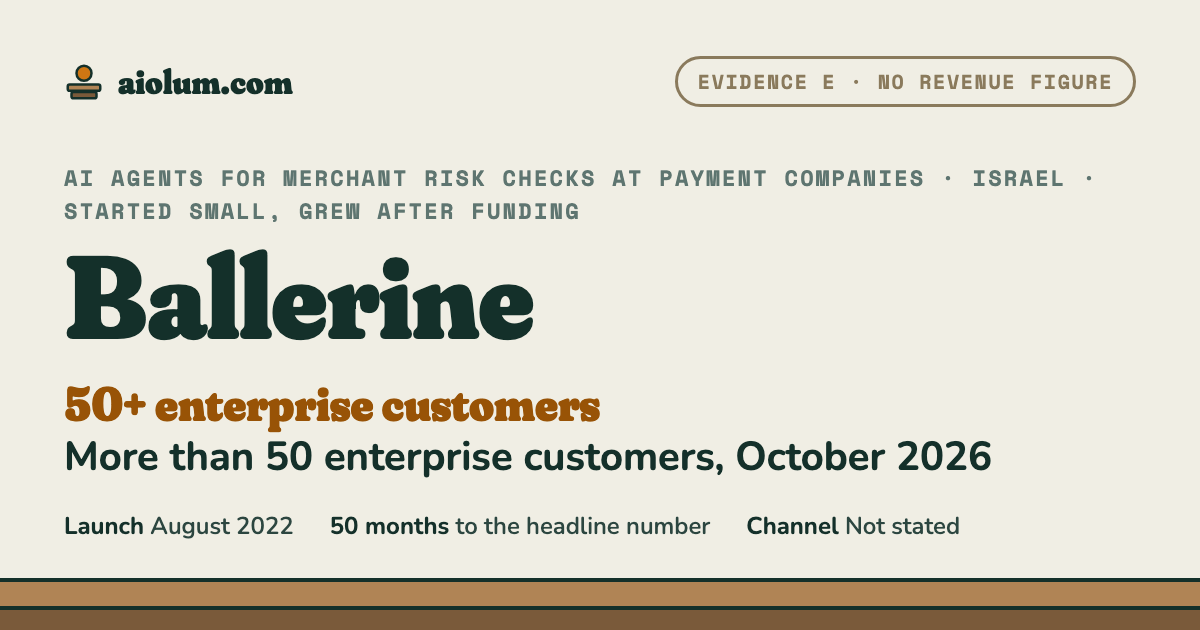
Ballerine (AI agents for merchant risk checks at payment companies, Israel): More than 50 enterprise customers, October 2026. Evidence grade E: no revenue figure was checked. Team: 3 founders in the Y Combinator Summer 2022 batch; 16 employees on the Y Combinator profile read in November 2026. Launched August 2022; still running.Added 5 November 2026 · updated 6 November 2026
- Outcome
- More than 50 enterprise customers, October 2026
- Evidence
- E no revenue figure was checked
- Launch
- August 2022
- Status
- Still running
- Team
- 3 founders in the Y Combinator Summer 2022 batch; 16 employees on the Y Combinator profile read in November 2026
- Outside funding
- Funded: Y Combinator (Summer 2022 batch); the amount and any later rounds were not found in the sources read
- Main channel
- Not stated
What is not verified
No revenue figure was found. Looked for: a payment-processor profile, a founder interview with figures, a funding announcement with figures. The count of "more than fifty enterprises" rests on one UpNext article of 23 October 2026 that does not name its source. The claim of being "One of five solutions globally certified" by Mastercard, with "Up to 75% fine relief", is the company's own and was not checked against Mastercard's list. A reader could look for Mastercard's published list of MMSPs, a funding announcement, or a customer case study with figures. This story is grade E: the business is real and its product, price and customers are described from public pages, but no revenue figure was checked. Aiolum shows it as an idea worth studying, not as proof that it makes money.
Ballerine sells merchant risk software. Merchant risk is the chance that a business accepted by a payment company is fake, sells banned goods or hides other businesses' payments behind its own account. Its AI agents do KYB (know your business: checking who owns and runs a company) and underwriting (deciding whether to accept the merchant and on what terms), then keep monitoring it. The home page says Ballerine is a Mastercard-certified MMSP (Merchant Monitoring Service Provider, a vendor approved to watch merchants for Mastercard's rules).
Y Combinator lists Noam Izhaki, Nitzan Gelbard and Alon Peretz as founders, founded in 2022 in Tel Aviv, Summer 2022 batch. Their launch post of 7 August 2022 described an open-source toolkit for KYC and KYB flows with no AI in it; an LLM document-reading plugin followed on 31 August 2023. By November 2026 the Y Combinator profile showed 16 employees, and on 23 October 2026 UpNext reported that Ballerine won Bronze in the Growth Stage category at Money20/20 USA and serves more than fifty enterprises.
No revenue figure was found, so this page is grade E. The customer count rests on one article.
How much revenue does Ballerine make?
Each row shows the evidence grade and the source numbers from the list at the end of this page. The grades are explained in How Aiolum verifies.
| Fact | Value | Grade | How we know | Sources |
|---|---|---|---|---|
| Enterprise customers, October 2026 | more than fifty | C | UpNext, 23 October 2026, in its report on the Money20/20 USA startup awards. The article does not name its source for the count. | [4] |
| Award, October 2026 | Bronze, Growth Stage Startup category, Money20/20 USA | C | UpNext, 23 October 2026. | [4] |
| Founded | 2022, Tel Aviv-Yafo, Israel | C | Y Combinator company profile: "Founded in 2022 by Nitzan Gelbard, Noam Izhaki, and Alon Peretz". | [1] |
| Founding team | 3 founders | C | Y Combinator profile lists three founders; the August 2022 launch post is signed "Noam, Alon, and Nitzan from Ballerine". | [1, 2] |
| Team, November 2026 | 16 employees | C | Y Combinator profile, read 5 November 2026. The about page lists fourteen people under "Meet the team". | [1, 6] |
| Funding | Y Combinator, Summer 2022 batch | C | Y Combinator pages. The amount and any later rounds were not found in the sources read. | [1, 2] |
| First product, August 2022 | open-source KYC and KYB flows, case dashboard, rule engine | C | Y Combinator launch post of 7 August 2022. It has no AI feature. | [2] |
| First AI feature, August 2023 | an LLM plugin with OCR for bank statements and utility bills | C | Y Combinator launch post of 31 August 2023. | [3] |
| Mastercard certification | Certified MMSP; "One of five solutions globally certified" | C | Company home page, with the claim "Up to 75% fine relief". Not checked against Mastercard's own list. | [5] |
| Open-source repository | 2.5k stars, 315 forks, 2,467 commits | C | GitHub, read 5 November 2026. The readme says the repository "is currently undergoing a major rebuild and is not actively supported at this time". | [7] |
| Time from launch post to the October 2026 customer count | 50 months | calc | Calculated: August 2022 to October 2026. | [2, 4] |
How to read this table: grade C values are the company's own statements, on its site or its Y Combinator pages, or a report that retells them. No value is grade A or B, and no revenue figure was found.
| Plan | Per month, billed yearly (US$) | Per month, billed monthly (US$) | Limit |
|---|---|---|---|
| Free web presence reports | 0 | 0 | 5 reports |
| Enterprise | not published | not published | custom contract after a demo |
The site publishes no plan prices. It offers five free web presence reports to try the product and otherwise asks buyers to schedule a demo. Contracts are sold to enterprises with a deployment team.
When did Ballerine launch, and how did it grow?
From an open-source compliance toolkit to AI agents for card-network rules, in about four years. Each entry carries its grade.
- 2022CNoam Izhaki, Nitzan Gelbard and Alon Peretz found Ballerine in Tel Aviv and join Y Combinator's Summer 2022 batch. [1]
- 7 August 2022CLaunch post on Y Combinator: open-source infrastructure for identity and risk management, with KYC and KYB flows, a case dashboard and a rule engine. The code is to be released over the following weeks. [2]
- 31 August 2023CAn LLM plugin with OCR reads bank statements and utility bills in several formats and languages and maps them to fields that rules can check. [3]
- 2026CThe Y Combinator profile describes an AI-native risk intelligence platform with AI agents for merchant underwriting and monitoring, and shows 16 employees. The home page says Ballerine is a certified Mastercard MMSP. [1, 5]
- 23 October 2026CUpNext reports a Bronze award at Money20/20 USA and more than fifty enterprise customers. [4]
Why did Ballerine work?
Four causes, in the order they mattered. Each one is a reusable lesson.
Start open source in a closed market
The 2022 launch post argued that existing KYC vendors were closed, single-point and not white label, and offered free building blocks instead. The repository collected 2,500 stars on GitHub, and the readme still points paid users to the company.
Agents that do the analyst's research
The home page says the agents pull registry data, filings and web presence from a merchant's legal name and web address, search product listings, social profiles, review sites and marketing claims, and draft outreach emails that the team reviews before sending.
Sell compliance with a card-network rule
The company builds its pages around Mastercard's merchant monitoring standards: a certified MMSP status, monthly scheme compliance reports and the claim of "Up to 75% fine relief". A rule with a deadline gives a payment company a reason to buy now.
How it was built
These details come from the company's site, its Y Combinator pages and its GitHub repository. They are grade C. [2, 3, 5, 7]
- The 2022 open-source core had KYC and KYB user flows, a back-office case management dashboard, integrations with identity verification vendors and a rule engine described by "A simple JSON containing Risk Rules".
- In 2023 an LLM plugin with OCR was added to read documents in different formats and languages.
- Today the agents keep a memory of scheme rules, regulation, fraud patterns and the customer's past decisions, and turn it into checks configured to each customer's policy.
- A deployment team of former risk and payments staff works inside each customer's operation until the customer's own people run the agents.
Who tried this before Ballerine, and why did they fail?
Three companies in our database of failed startups promised payment or compliance infrastructure with risk checks built in, and failed. The values below are from that database and are not independently verified.
Wirecard
The promiseA full-stack payment processor with risk management for merchants.
Why it diedAccounting fraud: about 1.9 billion euros of cash did not exist, hidden behind third-party acquirers and merchants nobody checked.
Railsr
The promiseBanking-as-a-Service APIs with compliance infrastructure for fintechs.
Why it diedReconciliation and compliance monitoring failed; the UK regulator restricted it and it collapsed.
Digital River (SaaS)
The promisePayments, fraud management and tax compliance for software sellers.
Why it diedLong integrations with professional services lost to self-service rivals such as Stripe.
The failed startups come from our database of 1,749 dead startups, retold here in our own words. Its entries are AI-assisted summaries of public sources, so these cards carry no evidence grade.
What changed
Wirecard and Railsr show what happens when merchant and compliance checks fail inside a payment company: regulators act and the business ends. That failure is the demand Ballerine sells to, and card networks now write rules, such as Mastercard's merchant monitoring program, that make the checks an obligation.
What changed is that a language model can read a merchant's web pages, documents and filings the way an analyst would, so one platform can check many merchants without one analyst per case. Digital River's lesson still applies: Ballerine sells with a deployment team inside each customer, which is slower and costlier than self-service software.
Can one person copy Ballerine now?
Not alone, not cheaply.
Selling to banks and acquirers needs certification, security reviews and a deployment team, and Ballerine itself grew to 16 people with Y Combinator funding. The open-source start is the part one person can copy: free building blocks for a regulated workflow that bring companies to the paid version.
Where it is still open: Other scheme and regulatory checks that analysts still do by reading web pages and documents: marketplace seller checks, partner oversight, and agent-to-merchant commerce rules.
- 1Pick one compliance rule with a deadline that a specific buyer must meet.
- 2Publish an open-source core so engineers at those buyers can test it without a sales call.
- 3Add AI where analysts read documents and web pages by hand, and keep a person on the final decision.
- 4Offer free sample reports so buyers see the output before a contract.
What could go wrong for Ballerine?
The risks are the mirror image of the causes above.
What is not verified
No revenue figure was found. Looked for: a payment-processor profile, a founder interview with figures, a funding announcement with figures. The count of "more than fifty enterprises" rests on one UpNext article of 23 October 2026 that does not name its source. The claim of being "One of five solutions globally certified" by Mastercard, with "Up to 75% fine relief", is the company's own and was not checked against Mastercard's list. A reader could look for Mastercard's published list of MMSPs, a funding announcement, or a customer case study with figures.
The team grew, and deployment is part of the product
Three founders started it in 2022; the Y Combinator profile shows 16 employees in November 2026 and the about page lists fourteen people. The home page sells "A dedicated deployment team" that "stays embedded until your people run them on their own". The product is software, but each sale includes this service work.
Trust signals on the site
The about page's "Meet the team" opens with four names and titles that no other source mentions, including a second "Chief Technology Officer" next to co-founder Alon Peretz; they look like template placeholders. The site menu lists "Call Center", "Batch Call", "Branded Call ID" and "Verified Phone Numbers: Prevent being marked as spam", items that no other Ballerine page describes. The home page testimonials name people without their companies. The open-source repository says it "is not actively supported at this time".
Checks on merchants' web and social presence
The agents search "product listings, social profiles, review sites, and marketing claims" of a merchant and report items such as adverse media about a director. These are checks on businesses that card-network and anti-money-laundering rules require of payment companies, not searches of private individuals; the sources do not describe how personal data of owners and directors is handled.
Competition and model providers
The same UpNext article reports Socratix, which builds AI coworkers for fraud and risk teams at banks and fintechs with a US$4.1 million seed round (UpNext's figure), and established KYB vendors sell to the same buyers. The sources read do not name the language-model providers behind the agents or the 2023 LLM plugin; a price or terms change by that provider would reach the product directly.
Sources
The grade next to each source is the best grade that the source can support. "Read in full" means that the text of the page was downloaded and the numbers were checked in it.
- C Y Combinator company profile: Ballerine, Agentic Intelligence Layer for Merchant Risk DecisionsRead in full, 5 November 2026. Source for the founding year, the three founders, the batch, the location and the 16 employees.
- C Y Combinator Launches, 7 August 2022: Ballerine: Open & self-served user risk decisioning platformRead in full. The founders' launch post, signed by Noam, Alon and Nitzan.
- C Y Combinator Launches, 31 August 2023: Ballerine: Open-source & global KYB platform, now with LLM-based OCR!Read in full. Source for the first AI feature.
- C UpNext, 23 October 2026: Money20/20 USA 2026: AI Fraud Fighters and Cross-Border Rails Win the Top Startup PrizesRead in full. Source for the Bronze award and the count of more than fifty enterprises.
- C Ballerine home page, read 5 November 2026Read in full. Source for the product, the MMSP claims, the deployment team, the free reports and the site menu.
- C Ballerine about page, read 5 November 2026Read in full. Source for the mission text and the team list.
- C GitHub: ballerine-io/ballerine, Open-source infrastructure and data orchestration platform for risk decisioningRead the repository page and readme, 5 November 2026. Source for the stars, forks, commits and support status.
- C Database of failed startups, local exportLocal export. AI-written summaries, not independently verified. Source for the failed predecessors.
Run this company? Send corrections or a verified figure to aiolum@livyden.com