Boxes.dev: Product, team and how it was built
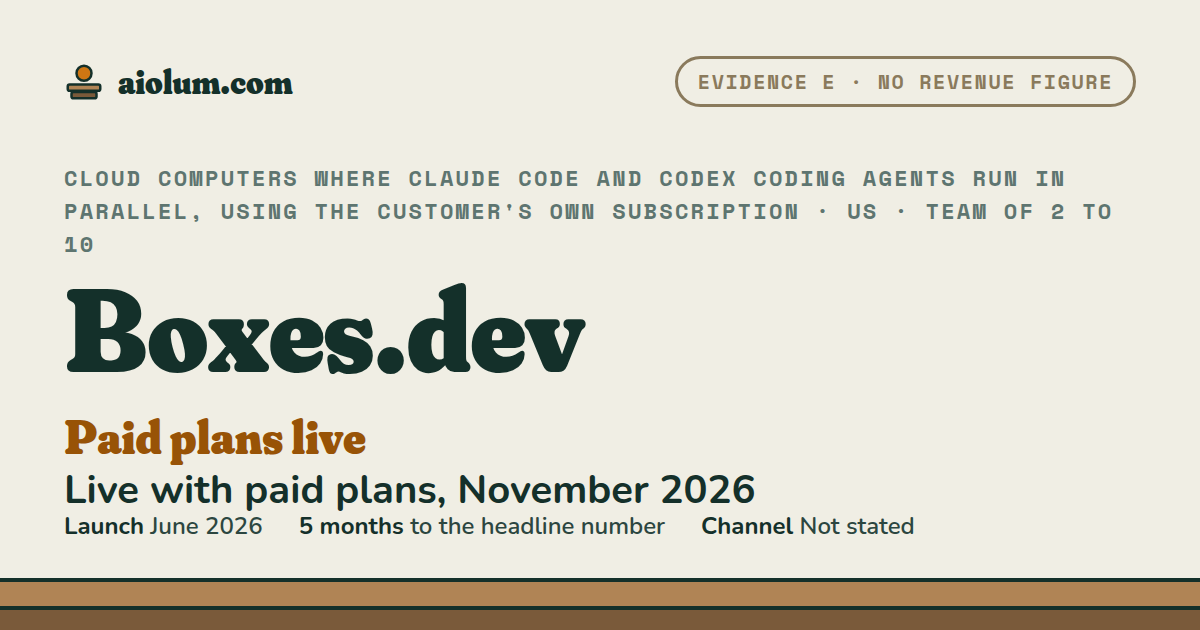
Boxes.dev (Cloud computers where Claude Code and Codex coding agents run in parallel, using the customer's own subscription, US): Live with paid plans, November 2026. Evidence grade E: no revenue figure was checked. Team: 2 co-founders; the Y Combinator company page lists a team size of 2 in November 2026. Launched June 2026; still running.Added
- Outcome
- Live with paid plans, November 2026
- Evidence
- E no revenue figure was checked
- Launch
- June 2026
- Status
- Still running
- Team
- 2 co-founders; the Y Combinator company page lists a team size of 2 in November 2026
- Outside funding
- Y Combinator Fall 2026 batch; amount not published
- Main channel
- Not stated
What is not verified
No revenue figure was found. We looked for a payment-processor profile, press reports, an interview and a funding announcement. The Y Combinator launch post names no customer and states no payment. The claim of a swarm of over 200 agents is the founders' own. A reader could look for a TrustMRR profile, a customer case study or a round announcement. This story is grade E: the business is real and its product, price and customers are described from public pages, but no revenue figure was checked. Aiolum shows it as an idea worth studying, not as proof that it makes money.
Boxes.dev sells cloud computers for coding agents, which are programs such as Claude Code and Codex that write and test software on their own. Each agent gets a devbox: a Linux machine with its own files, processes and ports. The customer pays per user per month for box-hours, one hour awake on a standard 4-CPU machine. The company's pricing section lists US$19 to US$249.
Nick Bushak (co-founder and CEO) and Drew Regitsky (co-founder and CTO) run the company, according to its about page. The Y Combinator company page says it was founded in 2026, is in the Fall 2026 batch and has 2 people. A product update by Regitsky of 27 October 2026 says the company first launched in June. The founders' launch post on the Y Combinator site is dated 9 November 2026.
No revenue figure was found, so this story has evidence grade E. The traction facts are that paid plans are on the company's pricing section and that the founders' launch post says customers use the product. That post names no customer. Its most specific claim is that one customer ran a swarm of over 200 agents on more than 100 machines.
Why did Boxes.dev work?
Four causes, in the order they mattered. Each one is a reusable lesson.
Each agent gets a whole Linux computer, not a worktree
The home page says a Git worktree gives another checkout on the same machine. A devbox has its own files, processes, ports and database state. Its stated reason is that agents can then run and test the app without affecting each other.
The customer keeps the model subscription they already have
The company says it runs Claude Code and Codex unmodified with the customer's own subscription or API key. Its FAQ says it does not resell tokens, so the price covers machine time only.
Agents start from the tools a team already uses
The home page lists Slack, Linear, a schedule and an API call as ways to start an agent. The launch post adds that some customers trigger work through the API and automations, and a pull request is the final output.
How it was built
Only what the company's pages say. No page names the machine hosting provider. [1, 5, 9]
- Setup: the customer pastes a prompt into Claude Code or Codex, which drafts a setup plan. After approval a second agent uploads the environment, and a snapshot of the filesystem and memory is taken. Devboxes start from that snapshot.
- Machines: a standard devbox has 4 virtual CPUs, 8 GiB of memory and 100 GB of disk, billed by the second while awake. Idle devboxes sleep and sleeping devboxes are free.
- Backend: the privacy policy names Convex for authentication, database and APIs, and Cloudflare Workers to proxy connections between clients and remote machines.
- Clients: a desktop app, iOS and Android apps, a command-line tool, and Slack and Linear integrations. The home page and the first product update say so.
Tools named in the sources
Each one opens its page in the Tools tab, with every story that uses it.
Who tried this before Boxes.dev, and why did they fail?
Two companies in our database of failed startups promised cloud development environments or hosting for developers. The values below are from that database and are not independently verified.
Nitrous.io
The promiseInstant cloud-based development environments, a code-anywhere editor that removed local setup.
Why it diedThe record says it died from right idea, wrong timing and fatal competition. It names AWS as one of two forces; the page text is cut off.
DotCloud
The promiseA platform that removed the work of running servers, so developers could deploy applications in many languages.
Why it diedThe record says it focused only on Docker, its container technology, and that the original hosting service was overshadowed.
The failed startups come from our database of 1,749 dead startups, retold here in our own words. Its entries are AI-assisted summaries of public sources, so these cards carry no evidence grade.
What changed
Nitrous.io sold a cloud editor for people. Boxes.dev sells machines for coding agents, which run for hours without a person at the keyboard. The home page says agents keep working when the laptop closes.
What did not change: both depend on larger platforms. Boxes.dev depends on Claude Code and Codex, and its pages state that it is not affiliated with Anthropic or OpenAI.
Can one person copy Boxes.dev now?
The pattern, yes. The timing, narrow.
A paid layer between a new kind of tool and the machine it runs on. The pages show one version: a cloud computer per coding agent, with the customer's own model subscription. The home page compares the product with seven other kinds of tools in a table the company wrote.
Where it is still open: Other agent products that need an isolated machine per task: testing agents, data agents and mobile app builds.
- 1Pick a job that a new tool does badly on one laptop, such as running many coding agents at once.
- 2Move that job to a separate machine per task and bill machine time only.
- 3Let customers bring their own model subscription, so the model is not your cost.
- 4Start work from tools teams already use, such as Slack and an API.
How much revenue does Boxes.dev make?
Each row shows the evidence grade and the source numbers from the list at the end of this page. The grades are explained in How Aiolum verifies.
| Fact | Value | Grade | How we know | Sources |
|---|---|---|---|---|
| Paid plans listed | Starter US$19, Pro US$99, Max US$249 per user per month | C | Company's home page, read 11 November 2026. The help page "Plans and box-hours" lists the same three prices. | [1, 7] |
| Revenue | not published | C | No payment-processor profile, press report or interview with a revenue figure was found. See "What is not verified". | [1, 4] |
| Founded | 2026 | C | Y Combinator company page: "Founded: 2026", "Batch: Fall 2026". The legal entity is Boxes, Inc. in the terms. | [3, 8] |
| First launch | June 2026 | C | Regitsky wrote on 27 October 2026 that the company had come far "since we first launched in June". The earliest Internet Archive copy of boxes.dev is from 4 June 2026. | [5, 10] |
| Founders and team | Nick Bushak (co-founder and CEO), Drew Regitsky (co-founder and CTO); team of 2 | C | The about page names both founders and their roles. The Y Combinator page lists a team size of 2. | [2, 3] |
| Founders' earlier company | Gem, a recruiting software company; a different company | C | The about page says they built Gem together, "growing it to roughly 300 people and a $1.2B valuation". The launch post says "over a $1B valuation". Both are the founders' statements. | [2, 3, 4] |
| Funding | Y Combinator Fall 2026 batch; amount not published | C | The home page shows a "Backed by Y Combinator" badge that links to the Y Combinator company page. No round size was found. | [1, 3] |
| Customer claim in the launch post | one customer ran a swarm of over 200 agents on more than 100 machines | C | The founders' launch post, 9 November 2026. No customer is named and no payment is stated. | [4] |
| Billing terms | monthly subscription with automatic payment | C | Terms of service, last updated 20 October 2026: the customer authorizes the provider to charge the payment method on file monthly. | [8] |
| Model access | customer's own Claude Code or Codex subscription or API key | C | Home page FAQ: "we don't resell tokens". It also says the company is not affiliated with OpenAI or Anthropic. | [1] |
| Services named in the privacy policy | Convex, Cloudflare Workers, OpenAI (session titles), Amplitude, Sentry, Expo Push Service | C | The machine hosting provider is not named. | [9] |
| Months from first launch to the headline | 5 months | calc | Calculated: from the first Internet Archive copy of 4 June 2026 to the launch post of 9 November 2026. | [10, 4] |
How to read this table: a grade C value is a statement by the company or by Y Combinator. A "calc" value was computed on this page. No value is grade A or B, and no row is revenue.
| Plan | Per month, billed yearly (US$) | Per month, billed monthly (US$) | Limit |
|---|---|---|---|
| Trial | 0 | 0 | 20 box-hours included, 2 projects |
| Starter | 19 | 50 box-hours, 5 awake devboxes, 5 projects | |
| Pro | 99 | 300 box-hours, 12 awake devboxes, 10 projects | |
| Max | 249 | 750 box-hours, 25 awake devboxes | |
| Teams | custom | custom | custom seats and hours, SSO, SCIM, audit logs |
Prices are per user per month. The pages give no yearly price. Extra usage costs US$0.40 per box-hour on Starter, Pro and Max, and prepaid credit gets a 5% to 10% discount. The Teams plan has custom volume rates. A copy of the home page that the Internet Archive saved on 9 November 2026 shows the same three prices.
When did Boxes.dev launch, and how did it grow?
From a first launch in June 2026 to a Y Combinator launch post in November 2026. Each entry carries its grade.
- 4 June 2026CThe earliest Internet Archive copy of boxes.dev is saved. Regitsky later writes that the company first launched in June. [10, 5]
- 20 October 2026CThe terms of service are last updated. They name Boxes, Inc. as the provider and describe monthly billing. [8]
- 27 October 2026CRegitsky publishes the first product update, covering onboarding, agent-to-agent messaging, mobile builds, Slack and Linear. [5]
- 4 November 2026CThe Boxes.dev team publishes a guide for users of Conductor Cloud. It says Conductor announced that its team is joining Meta and that Cloud shuts down on 20 November. [6]
- 9 November 2026CThe founders' launch post appears on the Y Combinator site. The Internet Archive saves the home page the same day with the same three prices. [4, 10]
What could go wrong for Boxes.dev?
The risks are the mirror image of the causes above.
What is not verified
No revenue figure was found. We looked for a payment-processor profile, press reports, an interview and a funding announcement. The Y Combinator launch post names no customer and states no payment. The claim of a swarm of over 200 agents is the founders' own. A reader could look for a TrustMRR profile, a customer case study or a round announcement.
Founders' earlier company
Bushak and Regitsky built Gem before Boxes.dev, according to the about page. Gem is a different company with its own start. Boxes.dev counts from 2026. The size and valuation of Gem are the founders' statements on the about page.
Comparison table and competitor guide
The home page compares Boxes.dev with Devin, Cursor and others in a table that the company says reflects features reviewed on 24 August 2026. The company wrote it. A guide of 4 November 2026 offers to move users of Conductor Cloud to Boxes.dev.
Depends on two model providers
The product runs Claude Code and Codex with the customer's own subscription or API key, and says it is independent of both makers. We did not check whether the makers' terms allow this use. The launch post offers 3 free months of Pro.
Sources
The grade next to each source is the best grade that the source can support. "Read in full" means that the text of the page was downloaded and the numbers were checked in it.
- C Boxes.dev home page, read 11 November 2026Read in full: product, pricing section, comparison table, FAQ and the Y Combinator badge. The separate /pricing page loads by script and shows no text; the prices come from this page.
- C Boxes.dev about page, read 11 November 2026Read in full. Source for the founders, their roles and their earlier company.
- C Y Combinator company page: Boxes.devRead in full on 11 November 2026. Source for the founding year, the batch and the team size. Y Combinator's robots.txt allows this page.
- C Y Combinator launch post: Boxes.dev - Move your AI coding to the cloudRead in full. Signed by the two founders and dated 9 November 2026 in the page data. Source for the customer claim.
- C Boxes.dev blog, 27 October 2026: What's new in boxes.dev!Read in full. Written by Drew Regitsky. Source for the June launch and the first product update.
- C Boxes.dev blog, 4 November 2026: Conductor Cloud is shutting down: how to move to boxes.devRead the opening section and the dates it lists. Written by the Boxes.dev team.
- C Boxes.dev help: Plans and box-hoursRead the plan table for the three prices.
- C Boxes.dev terms of service, last updated 20 October 2026Read the order form: provider name, monthly period and automatic payment.
- C Boxes.dev privacy policyRead the section on service providers and processors.
- C Internet Archive copies of boxes.dev, 4 June 2026 and 9 November 2026The index lists the first copy on 4 June 2026, which holds only the page title. The copy of 9 November 2026 shows the same three prices. The Archive holds no copy of the /pricing page.
- C Database of failed startups, local exportRecord pages read on the website on 11 November 2026. AI-written summaries, not independently verified. Source for the failed predecessors.
Run this company? Send corrections or a verified figure to aiolum@livyden.com