CalBuddy
What is not verified
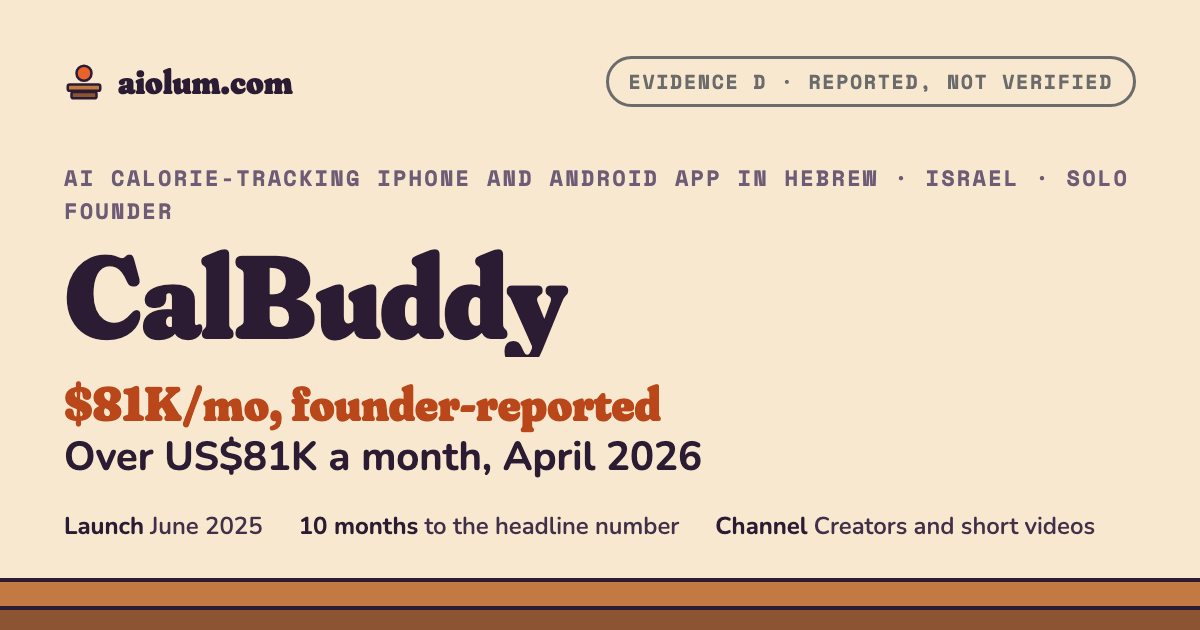
Every revenue figure on this page rests on one source: the Starter Story video interview published on 9 August 2026, in which the founder, Tomer, says that revenue was about US$1,000 in June 2025, about US$20,000 a month after four months, and over US$81,000 in April 2026, reading from a chart he shows on screen. No payment processor, store report or journalist has confirmed any of it, and no second interview with dated figures was found. The only outside numbers are weaker: the Israeli App Store listing's 2,533 ratings, Google Play's "10K+" downloads, and AppGoblin's estimate of under US$10,000 a month for the Android app alone. The founder's full name, Tomer Cnaan, comes from the App Store developer field, not from the interview, which gives only the first name and the X account tomercn. A reader could look for a RevenueCat or TrustMRR verified profile (none existed on 23 October 2026), a second interview with dated figures, or a filing by CALBUDDY TECHNOLOGIES LTD. in the Israeli companies register. The headline number is grade D: one claim or one estimate, with no second source. Aiolum shows it because the story is useful, and marks it so that it is not mistaken for a verified figure.
CalBuddy is a calorie tracker, an app in which a person records every meal so that the total calories eaten each day can be compared with a target. The AI part replaces the typing: the user photographs the plate, the app sends the image to a vision model from Google or OpenAI, and the model returns the foods it sees, their estimated calories and their macronutrients, meaning the grams of protein, carbohydrate and fat. The app is in Hebrew, is sold mainly in Israel, and is paid for through subscriptions in the Apple App Store and Google Play.
Tomer Cnaan, who is listed as the developer of the app on the App Store, told Starter Story in a video interview published on 9 August 2026 that he had worked in marketing for other businesses, heard a podcast with the founder of Cal AI in March 2025, and decided to build the same kind of app for his own country, where none existed in Hebrew. He said that revenue was about US$1,000 in June 2025, the first month, about US$20,000 a month after four months of paid advertising, and over US$81,000 in April 2026. The company behind the app is CALBUDDY TECHNOLOGIES LTD., registered in Israel.
Every revenue figure on this page comes from that one interview, so the page carries the badge "Reported, not verified" and evidence grade D. What outside sources confirm is smaller: the Israeli App Store page showed 2,533 ratings with an average of 4.2 in October 2026, Google Play showed more than 10,000 downloads, and the company's own pages name the tools, the prices and the legal entity. The founder's own words that he "copied a huge app" are the framing of the interview, and this page keeps them: the product is a localization, a version of an existing product adapted to one language and market, not a new idea.
The numbers, graded
Each row shows the evidence grade and the source numbers from the list at the end of this page. The grades are explained in How Aiolum verifies.
| Fact | Value | Grade | How we know | Sources |
|---|---|---|---|---|
| Revenue, April 2026 | over US$81,000 | D | Founder's statement in the Starter Story video interview published 9 August 2026, read from a revenue chart he showed on screen. No second source. | [1] |
| Run rate from the April 2026 figure | about US$972,000 a year | calc | Calculated: US$81,000 times 12. This is the headline figure on this page. | [1] |
| Revenue in the first month, June 2025 | about US$1,000 | D | Founder's statement in the same interview. | [1] |
| Revenue after about four months of paid ads | about US$20,000 a month | D | Founder's statement: paid ads with creatives modeled on viral fitness content took the app to around US$20,000 a month in four months, before the influencer deals. | [1] |
| Ratings on the Israeli App Store, October 2026 | 2,533 ratings, average 4.2 of 5 | C | Apple's listing data on the Israeli store page, read 23 October 2026. The United States store page shows 39 ratings, average 4.4. | [2, 3] |
| Google Play downloads, October 2026 | more than 10,000 | C | Google's listing shows the bracket "10K+" and a last update on 5 October 2026. | [7] |
| Company | CALBUDDY TECHNOLOGIES LTD., registered in Israel | C | Named in the terms of use, the privacy policy and the pricing page, and as the developer on Google Play. | [4, 5, 6, 7] |
| Developer named on the App Store | Tomer Cnaan | C | Both the Israeli and the United States App Store pages list Tomer Cnaan as developer. Starter Story names the founder as Tomer and links the X account tomercn. | [1, 2, 3] |
| Time to build | 2 weeks to a working version, about 2 months to the App Store | D | Founder's statement. He says the wait for the Apple developer program and the App Store review took longer than the coding. | [1] |
| Influencer deal | 50/50 share of revenue from Israel | D | Founder's statement: two well-known fitness influencers get half of the Israeli revenue under an agreement that fixes how many pieces of content and filming days they deliver each month. | [1] |
| Monthly cost of the named tools | US$355 a month | calc | Calculated from the founder's figures: Claude US$200, PostHog US$20, Supabase US$35, Expo US$100. RevenueCat was named without a price. | [1] |
| AI models behind the food scan | Google Gemini API, with the OpenAI API as fallback, through the Vercel AI Gateway | C | Privacy policy dated 20 August 2026. Barcodes are checked against the Open Food Facts database. | [5] |
| Subscription prices | ₪119.90 a year or ₪40.50 a month | C | Pricing page dated 2 July 2026 and the in-app purchase list on the Israeli App Store page. | [6, 2] |
| AppGoblin estimate for the Android app, October 2026 | about 47,000 installs and under US$10,000 a month | D | A third-party estimate for Google Play only, marked as an estimate on the page. It says nothing about the iPhone app, which the founder presents as the main one. | [8] |
| Outside funding | none reported | D | The founder mentions no investors in the interview, and no source read for this page reports a round. | [1] |
| Time from launch to the April 2026 figure | 10 months | calc | Calculated: June 2025 to April 2026. | [1] |
How to read this table: a grade D value is a founder statement from one interview, or a third-party estimate that says so, with no second source. A grade C value comes from the company's own pages or from an app store listing read on the date given. A "calc" value was computed on this page from the rows above it. No value is grade A or B.
| Plan | Per month, billed yearly (US$) | Per month, billed monthly (US$) | Limit |
|---|---|---|---|
| Premium, yearly | 3.20 | ₪119.90 a year (US$38.41); 3-day free trial | |
| Premium, monthly | 12.97 | ₪40.50 a month |
The company's pricing page, dated 2 July 2026, lists a yearly plan at ₪119.90 with a 3-day free trial and a monthly plan at ₪40.50, in Israeli new shekels including VAT. The Israeli App Store listing shows the same two prices as in-app purchases, plus older or promotional yearly subscriptions at ₪59.90, ₪84.00 and ₪99.90. The company's pages say the premium subscription is needed for food-scan results. Web purchases are processed by Paddle according to the pricing page, and by RevenueCat Web Billing according to the terms of use dated 20 August 2026.
The timeline
From a podcast about Cal AI to an app that the founder says makes over US$81,000 a month in Israel, in about thirteen months. Each entry carries its grade.
- March 2025DCnaan, then doing marketing for other businesses, is looking for a product of his own. He hears a podcast with the founder of Cal AI about scaling to over US$1 million a month, and decides to build the same thing for Israel in Hebrew. [1]
- Spring 2025DWith the AI code editor Cursor, and with little coding experience, he has a working version with the main features in two weeks. Getting into the Apple developer program and through App Store review takes most of the two months to launch. [1]
- June 2025DLaunch. About US$1,000 of revenue in the first month, the founder says. AppGoblin first recorded the Google Play listing on 21 June 2025. [1, 8]
- About October 2025DAbout US$20,000 a month after four months of paid ads, the founder says, with creatives modeled on the most viral fitness content in the United States and Israel. [1]
- Late 2025 to early 2026DTwo well-known Israeli fitness influencers sign revenue-share deals: half of the revenue from Israel in return for a fixed number of posts and filming days a month. The founder says this took the app from US$20,000 to US$80,000 a month. [1]
- April 2026DOver US$81,000 of revenue in the month, per the chart the founder showed in the interview. [1]
- 2 July 2026CThe company's pricing page lists ₪119.90 a year and ₪40.50 a month, with web checkout through Paddle. [6]
- 9 August 2026DStarter Story publishes the video interview "I Copied A Huge App. Now I Make $80K/Month". [1]
- 20 August 2026CNew terms of use and privacy policy name CALBUDDY TECHNOLOGIES LTD., the Google Gemini and OpenAI APIs, Supabase, RevenueCat, Expo, PostHog, Sentry, Microsoft Clarity and Singular. [4, 5]
- October 2026CThe Israeli App Store page shows 2,533 ratings at 4.2; Google Play shows 10,000+ downloads and an update on 5 October 2026. The store listings name Tomer Cnaan as developer. [2, 7]
Why it worked
Four causes, in the order they mattered. Each one is a reusable lesson.
Copy a proven product into one language
The founder says the product is not a one-to-one clone but is not very different from other AI calorie trackers: the same photo-to-calories flow, in Hebrew, with small changes for how Israelis eat and name food. He chose a large category, fitness and nutrition, because a small country cannot support a narrow one, and chose it because he knew the Israeli fitness scene personally.
Build with AI, launch in two months
A marketer with high-school coding experience got a working app in two weeks by prompting Cursor, he says. The founder's advice is that the slow part is Apple: the developer program application and the App Store reviews, not the code.
Paid ads where attention is cheap
He says every channel works and the question is which one is most efficient in a given market. In Israel the <dfn>CPM</dfn>, the price of showing an ad a thousand times, is much lower than in the United States, so ads could be profitable without a long testing period. He studied the most viral content of similar American apps and of Israeli fitness accounts, made ad creatives in that style, and reached about US$20,000 a month in four months, by his account.
Influencers as partners, not as ad space
Instead of paying well-known influencers per story or reel, he offered them a share of revenue from Israel, 50/50 by his account, under an agreement that sets how many pieces of content and filming days they owe each month. He waited until the app made about US$20,000 a month so that he could negotiate from strength, and says the two faces took the app to over US$80,000 a month. The cost is that half of the home-market revenue now belongs to the partners.
How it was built
These details come from the founder's interview (grade D) and from the company's own terms of use and privacy policy (grade C). [1, 4, 5, 6]
- Cursor, the AI code editor, for the first version; Claude for coding and for AI agents across the business, at US$200 a month, the founder said in August 2026.
- Expo, the React Native toolchain, for the app and for in-app updates, at US$100 a month per the founder; the privacy policy also names Expo for push notifications.
- Supabase for the database, file storage and backend functions, at US$35 a month per the founder; the privacy policy says the data sits in Frankfurt.
- Google Gemini API for the meal analysis, with the OpenAI API as fallback, routed through the Vercel AI Gateway; Open Food Facts for barcodes.
- RevenueCat for subscription management and web billing; Apple and Google for store billing; Paddle on the web pricing page.
- PostHog for product analytics at US$20 a month per the founder; Sentry for crash reports; Microsoft Clarity for session recordings; Singular for ad attribution to Meta, TikTok and Google.
- No user accounts: the app creates an anonymous identifier on the device and ties the profile, logs and subscription to it.
Tools named in the sources
Each one opens its page in the Tools tab, with every story that uses it.
The dead that came before
Five companies in the Loot Drop database sold consumers a data-driven way to eat or live more healthily. The values below are from that database and are not independently verified.
Arivale
The promiseScientific wellness: genomic tests, blood markers and coaching to improve your health before you get sick.
Why it diedSpent about US$4,700 per customer to earn US$1,200 a year, and the customers lost interest after the first data.
Refolo
The promiseA personal meal planner that moves omnivores to plant-based eating with customized recipes.
Why it diedCharged for meal plans that free sites gave away, and larger wellness apps absorbed the features.
Nutrigene
The promiseCustom liquid vitamins mixed from your DNA, lifestyle and health goals.
Why it diedHigh costs, regulation, and competitors with simpler pills.
SpringWit
The promiseA subscription that turns wearable data into tailored health insights and recommendations.
Why it diedApple and Fitbit owned the data, and the generic tips bored the users.
Airo Health
The promiseA wearable that tracks stress, nutrition intake and exercise in real time.
Why it diedCould not justify its price against Apple and Fitbit, and could not raise more money.
What changed
Each of the five asked consumers to pay for health insight that was expensive to produce: lab tests, coaches, custom supplements, hardware, or hand-written plans. Their marginal cost per customer stayed high, and when a large platform or a free site offered a simpler version, the customers left. CalBuddy's insight is produced by a rented vision model for a fraction of a cent per photo, so the founder says the app could be built in two weeks and could run on a few hundred dollars a month of tools.
Two more things differ. First, the product was not new: Cal AI and others had already shown in the United States that people pay a subscription for photo-based calorie counting, so the founder says he took no product risk, only distribution risk. Second, he chose a market small enough that no funded competitor had bothered to localize for it, where ads were cheap and where he knew the influencers personally. Whether this holds against a Hebrew version from a large competitor is the open question of this page.
Can one person copy it now?
The method, yes. The numbers, unverified.
The method is explicit and the founder presents it as repeatable: take an app that is proven in the United States, rebuild it with AI tools for one language and country that the large apps ignore, buy ads where they are cheap, and then convert the local celebrities into partners with a share of revenue. The revenue figures rest on one interview, so a reader should treat the size of the result as unconfirmed.
Where it is still open: Any subscription app proven in English with no serious version in a mid-sized language: calorie and fitness tracking, sleep, language learning, budgeting, and the other categories where the American leaders have not localized.
- 1Pick a category large enough to work in a small country, and a proven product in it that has no version in your language.
- 2Build the first version with an AI code editor and submit to Apple early; the review and the developer program take longer than the code.
- 3Run paid ads with creatives modeled on the most viral content of the same category, in the local language, and measure cost per subscriber.
- 4Once the app has traction and public reviews, offer the best-known local creators a revenue share with fixed content obligations instead of a fee per post.
What to watch
The risks are the mirror image of the causes above.
What is not verified
Every revenue figure on this page rests on one source: the Starter Story video interview published on 9 August 2026, in which the founder, Tomer, says that revenue was about US$1,000 in June 2025, about US$20,000 a month after four months, and over US$81,000 in April 2026, reading from a chart he shows on screen. No payment processor, store report or journalist has confirmed any of it, and no second interview with dated figures was found. The only outside numbers are weaker: the Israeli App Store listing's 2,533 ratings, Google Play's "10K+" downloads, and AppGoblin's estimate of under US$10,000 a month for the Android app alone. The founder's full name, Tomer Cnaan, comes from the App Store developer field, not from the interview, which gives only the first name and the X account tomercn. A reader could look for a RevenueCat or TrustMRR verified profile (none existed on 23 October 2026), a second interview with dated figures, or a filing by CALBUDDY TECHNOLOGIES LTD. in the Israeli companies register.
Half of the home market belongs to the partners
The founder says the two influencers receive 50 percent of revenue from Israel, which is where the app is sold. The US$81,000 figure he gives is revenue, not what remains after their share, Apple's and Google's commissions and the advertising spend. The page has no profit figure.
A copy can be copied
The founder says that anyone can build the same app with Cursor in two weeks and that his advantage is brand and distribution. Cal AI or another large app could ship a Hebrew version, and a second Israeli builder could sign other influencers. The predecessors on this page died when a bigger platform offered the same thing.
AI estimates of food are estimates
The company's own terms say that portion sizes, hidden ingredients and cooking methods can cause significant errors, and that users must not rely on the app for allergens or medical conditions. App Store reviews quoted on the listing complain about recognition accuracy and about refunds, which Apple controls.
A single small market
The app is in Hebrew with an Arabic and English interface, and the terms say it is primarily intended for users in Israel. Growth beyond the current figure would need either more of a market of about ten million people or a second localization, which means a second brand and a second set of partners.
Sources
The grade next to each source is the best grade that the source can support. "Read in full" means that the text of the page was downloaded and the numbers were checked in it.
- D Starter Story, 9 August 2026: I Copied A Huge App. Now I Make $80K/Month (video interview with transcript)Read the page and the full transcript. Founder's statements on screen. Source for every revenue figure, the build time, the ad and influencer strategy, the tools and their costs. The page names the founder only as Tomer and links the X account tomercn.
- C Apple App Store, Israel: CalBuddy, calorie calculator (id6745977666), read 23 October 2026Read in full. Source for the developer name Tomer Cnaan, the 2,533 ratings at 4.2, the in-app purchase prices in shekels, the languages and the 9+ age rating.
- C Apple App Store, United States: CalBuddy, calorie calculator (id6745977666), read 23 October 2026Read in full. Confirms the developer name Tomer Cnaan; 39 ratings at 4.4; version history from February 2026 showing Apple Health, step tracking and a larger food database.
- C CalBuddy terms of use, last updated 20 August 2026Read in full. Source for the legal entity CALBUDDY TECHNOLOGIES LTD., the no-account design, the AI providers, RevenueCat and the disclaimers about estimates.
- C CalBuddy privacy policy, last updated 20 August 2026Read in full. Source for the full list of service providers: Supabase in Frankfurt, Google Gemini API and OpenAI via the Vercel AI Gateway, Open Food Facts, Singular, Meta, TikTok and Google ads, RevenueCat, Expo, PostHog, Sentry, Microsoft Clarity.
- C CalBuddy pricing page, last updated 2 July 2026Read in full. Source for the yearly and monthly prices in shekels, the 3-day trial and the Paddle checkout.
- C Google Play: CalBuddy, calorie calculator (com.tc.calbuddy), read 23 October 2026Read in full. Source for the developer CalBuddy Technologies LTD, the 10K+ downloads bracket and the 5 October 2026 update.
- D AppGoblin: CalBuddy Android analytics, read 23 October 2026Read in full. A third-party estimate for the Android app only: about 47,000 installs, under US$10,000 a month, first crawled 21 June 2025.
- D nextplatform, 11 August 2026: iOS app case study, CalBuddy's winning strategy for a small local market (Korean)Read in full. A secondary account of the same Starter Story interview, by a named author, with the same figures and the same tool list; it adds no independent verification.
- C Frankfurter exchange-rate API, ILS to USD, 23 October 2026Read the JSON reply: 1 ILS = US$0.32036. Used only to convert the shekel prices in the pricing table.
- C Loot Drop database export, 1,749 failed startupsLocal export. AI-written summaries, not independently verified. Source for the failed predecessors.