Car Catcher: Revenue, team and how it was built
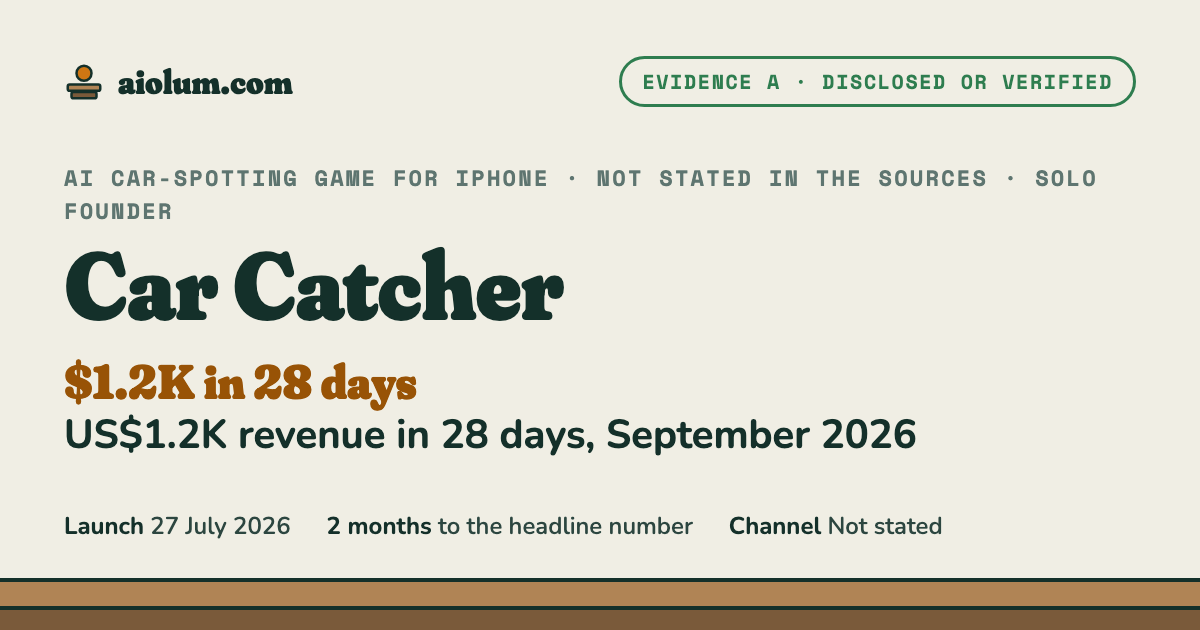
Car Catcher (AI car-spotting game for iPhone, Not stated in the sources): US$1.2K revenue in 28 days, September 2026. Evidence grade A: disclosed by a company or a filing, or verified by a payment processor. Team: 1 named developer and seller, Sacha Smith; the app says it is made by car enthusiasts; headcount not published. Launched 27 July 2026; still running.Added 1 November 2026
- Outcome
- US$1.2K revenue in 28 days, September 2026
- Evidence
- A disclosed by a company or a filing, or verified by a payment processor
- Launch
- 27 July 2026
- Status
- Still running
- Team
- 1 named developer and seller, Sacha Smith; the app says it is made by car enthusiasts; headcount not published
- Outside funding
- Not stated in the sources
- Group
- Photos and portraits
- Main channel
- Not stated
Car Catcher is an iPhone app that turns car spotting into a collecting game. The user takes a photo of a car, and an AI vision model, a program trained on many images that describes what a photo shows, names the make, model and year and estimates how rare the car is. The car then goes into the user's garage, with points for a leaderboard. The App Store lists Sacha Smith as the developer and seller. The app was released on 27 July 2026, and on 1 November 2026 it had 150 ratings in the US store with an average of 4.8.
The money figure comes from whatsthe.app, a marketplace for mobile apps that reads each app's revenue from RevenueCat, a service that records App Store subscription payments for app makers. It showed US$1,227 of revenue in the 28 days to 1 October 2026 and MRR (monthly recurring revenue: the value of all active subscriptions, counted per month) of US$336 from 157 active subscriptions. The revenue is 3.7 times the MRR because most buyers pay US$24.99 for a full year at once, so one month's cash is much higher than one month's share of the subscriptions. Both figures are grade A.
The owner listed the app for sale on whatsthe.app on 24 September 2026 at US$32,000. That is an asking price, not a sale, and no source says the app was sold. A small app two months old is a fragile business: this page shows the numbers as they are, what the low recurring revenue means, and earlier companies that built games and image recognition on phones and failed.
How much revenue does Car Catcher make?
Each row shows the evidence grade and the source numbers from the list at the end of this page. The grades are explained in How Aiolum verifies.
| Fact | Value | Grade | How we know | Sources |
|---|---|---|---|---|
| Revenue in the 28 days to 1 October 2026 | US$1,227 | A | whatsthe.app: "Last 28 days Revenue $1,227" and "All metrics are verified with RevenueCat. Last updated: Oct 1, 2026, 10:08:56 AM UTC". The page data names the same value last_30_days_revenue (1226.72), so the window is 28 or 30 days. The 28 days run from about 3 September to 1 October 2026. | [1] |
| Monthly recurring revenue, 1 October 2026 | US$336, from 157 active subscriptions | A | whatsthe.app: "MRR $336", "Active Subscriptions 157", "ARR $4,031", "ARPPU $2.14". The page data gives MRR as 335.89. | [1] |
| Revenue compared with MRR | 3.65 times | calc | Calculated: US$1,227 / US$336. whatsthe.app shows a "Cash Flow Index" of 3.7x and explains that a ratio of 2 to 4 means a mix of yearly and monthly plans. MRR per subscription, US$2.14, is close to the yearly price divided by 12 (US$2.08), so most subscriptions are yearly. | [1, 2] |
| Revenue run rate from the 28-day figure | about US$14,721 a year | calc | Calculated: US$1,227 x 12 = US$14,724; whatsthe.app shows "AR $14,721" from the unrounded value. This is the outcomeUsd on this page. It assumes every month brings as many new yearly buyers, which no source shows. The recurring figure is lower: US$4,031 a year (ARR). | [1] |
| Asking price, listed 24 September 2026 | US$32,000 | C | The owner's price on whatsthe.app: "This app is for sale. Asking price: $32,000 2.2 x revenue". On 1 November 2026 the page said "27 buyers have viewed this" and "1 inquiry sent". Calculated: 7.9 times ARR, as the site's for-sale list also shows. An asking price is not a sale. | [1, 7] |
| Prices | US$4.99 a month or US$24.99 a year; free tier with 3 identifications a day | B | App Store in-app purchase list, which also shows a Premium Yearly at US$39.99. The free limit is from the developer's reply to a review: "it lifts the 3-a-day identification limit because every identification has real costs behind it". | [2, 1] |
| Release date | 27 July 2026 | B | App Store version history (version 1.0) and whatsthe.app ("Worldwide Release Date: July 27, 2026"). | [2, 1] |
| Time from release to the revenue figure | 66 days, about 2 months | calc | Calculated: 27 July 2026 to 1 October 2026. | [1, 2] |
| Cars identified by 12 September 2026 | over 30,000 | C | Developer's release note for version 1.9.2: "Over 30,000 cars identified and counting." | [2] |
| App Store ratings, 1 November 2026 | 4.8 from 150 ratings in the US store | B | whatsthe.app counted 208 ratings in 14 countries, 114 of them in the US, with the US, the United Kingdom and Germany first. | [2, 1] |
| Age rating | 13+ | B | App Store: "13+ Years", with "Infrequent Contests", user-generated content and social media. The privacy policy says: "Car Catcher is not directed to children under 13." | [2, 4] |
| Subscription and AI services | RevenueCat for subscriptions; outside AI vision services for identification | C | Privacy policy: "We use RevenueCat, a subscription management service" and "Photo data may be sent to AI vision APIs solely for car identification." The provider is not named. | [4] |
| Outside funding | not stated | C | No source mentions investors. The tag Bootstrapped on this page reflects that no funding is reported, not a statement by the developer. | [1, 2] |
How to read this table: a grade A value was read from the app's RevenueCat account by whatsthe.app. A grade B value is a record that Apple shows on the App Store. A grade C value is a statement by the developer, in the app's release notes, replies, website or for-sale listing. A "calc" value was computed on this page from the rows above it.
| Plan | Per month, billed yearly (US$) | Per month, billed monthly (US$) | Limit |
|---|---|---|---|
| Free | 0 | 0 | 3 identifications a day |
| Premium, yearly | 2.08 | US$24.99 a year; unlimited identifications, collections, custom garages | |
| Premium, monthly | 4.99 | same as yearly | |
| Premium Yearly, second price | 3.33 | US$39.99 a year; listed on the App Store |
All purchases go through Apple. The terms of use say new subscribers may get a 3-day free trial that converts to a paid yearly plan. The App Store also lists a second Premium Yearly price of US$39.99 without saying which users see it. One reviewer on 6 October 2026 wrote of a weekly subscription; no weekly price appears in the App Store list.
When did Car Catcher launch, and how did it grow?
From the first terms of use to a for-sale listing in about eleven weeks. Each entry carries its grade.
- 9 July 2026CDate of the first terms of use on carcatcherapp.com: an auto-renewing subscription with a possible 3-day free trial. [5]
- 27 July 2026BVersion 1.0 is released on the App Store for iPhone. [2, 1]
- 31 July 2026CVersion 1.1 makes the app free to play with 3 identifications a day; Premium adds unlimited identifications, collections and custom garages. [2]
- 7 August 2026CVersion 1.4 adds Discover, a feed where users share catches and see what other spotters find. [2]
- 10 September 2026CVersion 1.9.1 adds a weekly leaderboard and rebuilt levels. [2]
- 12 September 2026CThe developer writes that over 30,000 cars have been identified. [2]
- 24 September 2026CThe app is listed for sale on whatsthe.app at US$32,000. [1]
- 1 October 2026ALast data update on whatsthe.app: US$1,227 of revenue in 28 days, MRR of US$336, 157 active subscriptions. [1]
- 6 October 2026CVersion 1.10.3: "Improved AI identification for certain hypercars". [2]
- 21 October 2026CThe website adds a car-spotting and car-meet FAQ page, dated in its sitemap. [6]
- 26 October 2026CVersion 1.10.4: the leaderboard now resets every month. [2]
Why did Car Catcher work?
Four causes, in the order they mattered. Each one is a reusable lesson.
An existing hobby with a missing tool
Car spotters already photograph cars and keep track of what they have seen. The app removes the hard part, naming the car, and adds what collectors like: rarity tiers, sets to complete and a ranking. The app's FAQ page answers the questions spotters search for, such as how to identify a car with no badges or where to find car meets.
Free play with a daily limit
Each identification is a paid call to an AI vision service, as the developer says in a reply to a review. So the free version allows 3 identifications a day, and Premium removes the limit. This keeps the cost of free users bounded and gives regular spotters a reason to pay.
Yearly plans paid in advance
The yearly plan costs US$24.99, five times the monthly price of US$4.99. Most buyers chose it, which is why 28 days of cash (US$1,227) were 3.7 times the recurring revenue (US$336). The cash arrives early, but each yearly buyer must renew a year later.
Frequent visible updates
The App Store shows 19 versions between 27 July and 26 October 2026: Discover, weekly and then monthly leaderboards, new rarity tiers and better identification of hypercars. Leaderboards that reset give new users a chance to rank and old users a reason to return.
How it was built
These details come from the App Store page, the developer's release notes and the app's privacy policy and terms. They are grade B and C. [2, 4, 3]
- A native iPhone app, about 21.9 MB, requiring iOS 13 or later. An Android version has only a waitlist on the website.
- Photos are uploaded to the developer's cloud storage and may be sent to outside AI vision APIs for identification. Each photo gets a long random web address and is not listed publicly.
- Accounts use an email address and password with a one-time code; Sign in with Apple or Google may be offered.
- Subscriptions are sold through Apple and checked with RevenueCat, which also gives the read-only revenue data that whatsthe.app shows.
- The website uses Cloudflare Web Analytics without cookies, and the app does not use the iOS advertising identifier or show third-party ads.
- Game features: XP, levels up to "Godspotter", rarity tiers from Common to Legendary and Unicorn (fewer than 50 cars ever made), collections, daily missions, a Discover feed and shareable garage links.
Tools named in the sources
Each one opens its page in the Tools tab, with every story that uses it.
Who tried this before Car Catcher, and why did they fail?
Four companies in our database of failed startups tried to make a game of the physical world or to recognise objects with a phone camera. The values below are from that database and are not independently verified.
Gowalla
The promiseCollect badges and rewards for checking in at real places with a phone.
Why it diedLost to Foursquare, which had more partners, and was bought by Facebook for its team, not the product.
Blippar
The promisePoint the phone at an object and see videos and 3D content about it.
Why it diedBrands paid only if users came, and users came only for content; each brand campaign needed costly custom work.
Moodstocks
The promiseInstant recognition of objects with a phone camera.
Why it diedCould not stay ahead of Google's image recognition and was bought and absorbed by Google.
QuizUp
The promiseReal-time trivia battles on many topics with a global ranking.
Why it diedEarly growth did not last; it did not add new content or earn enough, and rivals with live hosts took the players.
The failed startups come from our database of 1,749 dead startups, retold here in our own words. Its entries are AI-assisted summaries of public sources, so these cards carry no evidence grade.
What changed
Blippar and Moodstocks needed their own image recognition, which was costly to build and which Google could do better. In 2026 a single developer can send a photo to an outside AI vision service and get the make, model and year back, paying per call. Gowalla and QuizUp needed millions of users and advertisers or partners to earn money; Car Catcher charges the user directly through the App Store from the first week.
What has not changed is the risk that a game loses its players, as QuizUp did, and that a larger company adds the same feature. Several other car identification apps are already in the same App Store section, and the AI vision services that make Car Catcher possible are open to all of them.
Can one person copy Car Catcher now?
Yes, the method is open to anyone. The revenue is small.
A photo-identification game for a hobby with its own vocabulary and collectors is a pattern that one person can build in weeks with an outside AI vision service and a subscription service. Car Catcher shows that such an app can reach US$1,227 of verified revenue in a month two months after release, and also that the recurring part, US$336 a month, is still small.
Where it is still open: Other collecting hobbies with clear identification problems: aircraft, trains, ships, birds, plants, sneakers and watches. Several of these already have apps, so the niche and the game design matter more than the AI.
- 1Pick a hobby where people already photograph and list things, and where naming the thing is the hard part.
- 2Give each identification a rarity score and put the results in sets and a leaderboard that resets.
- 3Limit free identifications per day, because each one costs an API call.
- 4Price the yearly plan at about five months of the monthly plan, and watch renewals a year later.
What could go wrong for Car Catcher?
The risks are the mirror image of the causes above.
Small and very new
The recurring revenue on 1 October 2026 was US$336 a month. The US$1,227 of revenue in 28 days was high because most buyers paid for a year at once. The app was 66 days old, and no source shows a second month, so the trend is unknown. The same data shows 0 active trials and 0 new customers, which does not fit with the revenue; whatsthe.app may not fill these fields for this app.
Old data and a missing second tracker
The whatsthe.app figures were last updated on 1 October 2026 and were not newer when the page was read on 1 November 2026. The page links a TrustMRR profile (trustmrr.com/startup/car-catcher), but the profile answered 404 Not found on 1 November 2026, so no monthly timeline was available.
For sale, not sold
The owner asked US$32,000 on 24 September 2026, 2.2 times the yearly run rate of the 28-day revenue and 7.9 times the recurring revenue. One buyer inquiry was recorded by 1 November 2026. No source reports a sale.
Competition and costs
The App Store shows other car identification apps next to it, such as CarDex and Spotit. One reviewer on 6 October 2026 recommended CarDex instead, and others complained about paying. Each identification costs the developer an AI call, which the daily free limit is meant to control.
Photos of other people's cars and a 13+ audience
The app is rated 13+ and its privacy policy says it is not directed to children under 13; no page reviewed targets children. Its FAQ says that in most places cars visible from a public street may be photographed, and that users should respect an owner who asks them not to post a plate or the car. The Discover feed shows what other spotters catch "and where", which the FAQ presents as a way to find car meets.
Who is behind it
The App Store names Sacha Smith as developer and seller and the app calls its makers "car enthusiasts". No source gives the country, the company or the size of the team.
Sources
The grade next to each source is the best grade that the source can support. "Read in full" means that the text of the page was downloaded and the numbers were checked in it.
- A whatsthe.app: Car Catcher, $1,227 Revenue (for-sale listing with RevenueCat-verified metrics, last updated 1 October 2026)Read in full, downloaded 1 November 2026, including the data embedded in the page. Source for revenue, MRR, ARR, subscriptions, the asking price and the listing date.
- B App Store: Car Catcher: Spot & Collect, by Sacha SmithRead in full, downloaded 1 November 2026: description, ratings, reviews with the developer's reply, version history, age rating and in-app purchase list.
- C Car Catcher home pageRead in full. A short page with the App Store link and an Android waitlist.
- C Car Catcher Privacy Policy, last updated 19 July 2026Read in full. Source for RevenueCat, the AI vision APIs, photo storage and the under-13 statement.
- C Car Catcher Terms of Use, last updated 9 July 2026Read in full. Source for the subscription terms and the 3-day trial.
- C Car Catcher: Car spotting and car meet FAQRead in full, with the site's sitemap for the date. Source for the advice on photographing cars and the Discover feed.
- C whatsthe.app: Apps for SaleRead the Car Catcher entry: price US$32K, 28-day revenue US$1.2K, MRR US$336, 2.2x revenue and 7.9x MRR.
- C Database of failed startups, local exportLocal export. AI-written summaries, not independently verified. Source for the failed predecessors.