Cluely: Revenue, team and how it was built
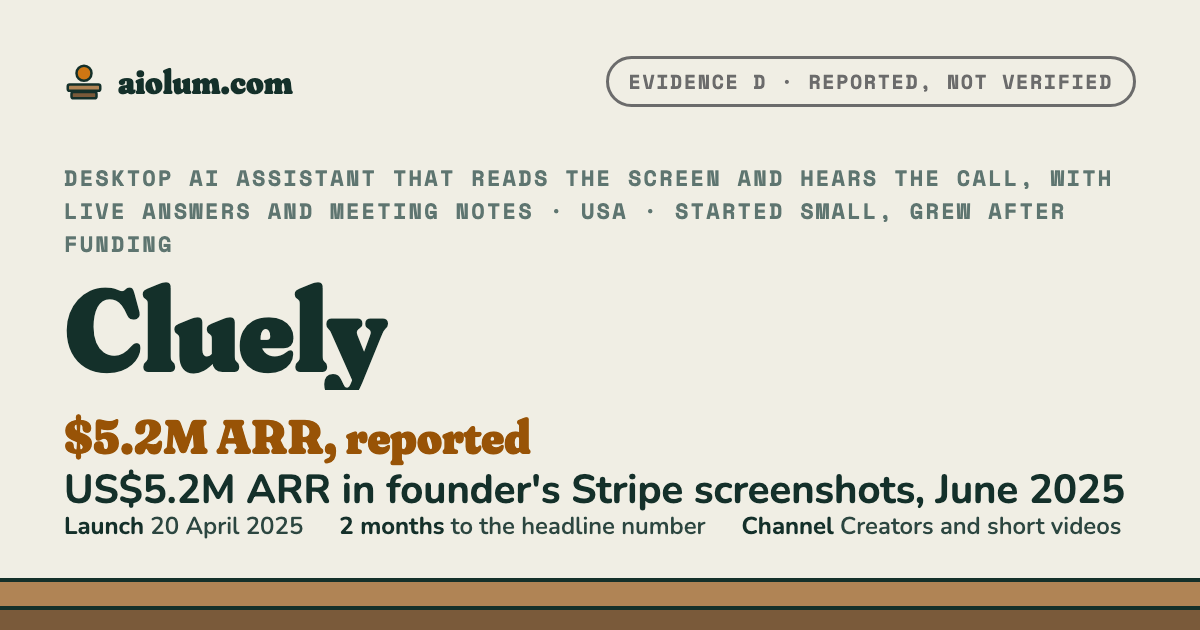
Cluely (Desktop AI assistant that reads the screen and hears the call, with live answers and meeting notes, USA): US$5.2M ARR in founder's Stripe screenshots, June 2025. Evidence grade D: reported, not verified. Team: 2 co-founders, Roy Lee and Neel Shanmugam, who left Columbia in spring 2025 (Wikipedia also lists a third co-founder, CTO Alex Chen); 16 employees in 2025 according to Wikipedia, and 50 content interns according to Andreessen Horowitz in June 2025. Launched 20 April 2025; still running.Added 4 November 2026
- Outcome
- US$5.2M ARR in founder's Stripe screenshots, June 2025
- Evidence
- D reported, not verified
- Launch
- 20 April 2025
- Status
- Still running
- Team
- 2 co-founders, Roy Lee and Neel Shanmugam, who left Columbia in spring 2025 (Wikipedia also lists a third co-founder, CTO Alex Chen); 16 employees in 2025 according to Wikipedia, and 50 content interns according to Andreessen Horowitz in June 2025
- Outside funding
- US$5.3M seed in April 2025 co-led by Abstract Ventures and Susa Ventures, and US$15M led by Andreessen Horowitz in June 2025: US$20.3M in total, as reported by Fortune and Wikipedia
- Group
- Voice and audio
- Main channel
- Creators and short videos
What is not verified
The headline of US$5.2M in annual recurring revenue rests on one source: screenshots of Stripe that Roy Lee posted on X on 5 March 2026, as Wikipedia summarizes TechCrunch's report. This page could not read the post or the TechCrunch article. Villpress wrote that Lee did not give an updated figure in his retraction, so the two reports differ. A reader could look for a payment-processor profile, a filing, or an investor statement with a dated figure. The headline number is grade D: one claim or one estimate, with no second source. Aiolum shows it because the story is useful, and marks it so that it is not mistaken for a verified figure.
Cluely is a real-time AI assistant: a program that works during a conversation, not after it. It captures the user's screen and the call audio, turns the speech into text with live transcription (speech recognition that runs while people talk), sends that context to a large language model (an AI model trained on large amounts of text that writes answers), and shows a suggested answer in an overlay, a small window drawn on top of other windows. The company says the overlay does not appear in screen sharing or recordings and that no bot joins the meeting. It also writes notes after the call.
The product grew out of Interview Coder, which Chungin "Roy" Lee built while a Columbia University student. Gizmodo reported in March 2025 that the tool took screenshots of a coding test and asked an AI model for the solution, and that Lee sold it as a subscription that Gizmodo put at US$60 a month. Columbia placed him on probation and then suspended him; his co-founder Neel Shanmugam was also part of the disciplinary case, and both left the university. They launched Cluely on 20 April 2025 with the slogan "cheat on everything". Fortune reported a US$5.3M seed round that month, and Wikipedia reports a US$15M round led by Andreessen Horowitz in June 2025. By then the team had grown past ten people: Wikipedia gives 16 employees in 2025, and the investor wrote that Cluely had hired 50 interns for its content work.
The revenue numbers need care. Lee told TechCrunch in July 2025 that annual recurring revenue was US$7M; on 5 March 2026 he wrote on X that this figure was false, as Villpress and Ground News reported. Wikipedia says that screenshots of Stripe, the payment processor, that Lee posted with the retraction showed US$5.2M. That corrected figure is the headline here, and it rests on one founder post that this page could only read through Wikipedia's summary of TechCrunch's report. It is grade D: reported, not verified.
How much revenue does Cluely make?
Each row shows the evidence grade and the source numbers from the list at the end of this page. The grades are explained in How Aiolum verifies.
| Fact | Value | Grade | How we know | Sources |
|---|---|---|---|---|
| Annual recurring revenue, June 2025 (headline) | US$5.2 million | D | Wikipedia, citing TechCrunch of 5 March 2026: "According to screenshots posted by Lee on X, it was $5.2 million." The post Wikipedia cites begins "here's our stripes from june 2025". Not read in the original; one founder statement. | [1, 2] |
| Revenue claim retracted by the founder | US$7 million annual recurring revenue, stated July 2025 | C | Lee called it the "only blatantly dishonest thing I've said publicly online" in a post on X on 5 March 2026, as Villpress and Ground News reported. Villpress wrote that he did not give an updated figure in the post; Wikipedia says his screenshots showed US$5.2 million. | [6, 7, 1] |
| Gap between the claim and the corrected figure | US$1.8 million, about 35% above the corrected figure | calc | Calculated: US$7 million minus US$5.2 million, divided by US$5.2 million. | [1, 6] |
| Earlier claim | more than US$3 million annual recurring revenue and profitable | D | Villpress reports that Lee had made this claim before July 2025. No date or original read. | [6] |
| Monthly revenue equal to the headline | about US$433,000 | calc | Calculated: US$5.2 million divided by 12. | [1] |
| Launch | 20 April 2025, 70,000 sign-ups in the first week | D | Wikipedia, citing Business Insider. | [1] |
| Time from launch to the headline figure | 2 months | calc | Calculated: April 2025 to June 2025. | [1, 2] |
| Seed round | US$5.3 million, April 2025 | C | Fortune, 23 April 2025. Wikipedia names Abstract Ventures and Susa Ventures as co-leads. | [3, 1] |
| Series A | US$15 million led by Andreessen Horowitz, June 2025 | C | Wikipedia gives the amount and a total of US$20.3 million. The investor's own announcement of 20 June 2025 confirms the investment but does not state the amount. | [1, 4] |
| Founding team | Roy Lee (CEO) and Neel Shanmugam (COO); Wikipedia also lists Alex Chen (CTO) | C | Fortune names Lee and Shanmugam. Gizmodo describes Lee building the first tool himself; Wikipedia says Lee and Shanmugam built Interview Coder together. | [3, 5, 1, 2] |
| Team after funding | 16 employees in 2025; 50 interns for content; a growth team of 7 | C | Wikipedia, citing the San Francisco Standard of July 2025, for 16 employees. Andreessen Horowitz for the interns and the growth team, whose members each have more than 100,000 followers. | [1, 4] |
| Paid content creators | more than 60 creators and 700 video editors, July 2025 | D | Wikipedia's article on Roy Lee, citing the San Francisco Standard. | [2] |
| Interview Coder price | US$60 a month | C | Gizmodo, 27 March 2025. | [5] |
| iPhone app | 4.7 stars from 574 ratings, age rating 4+ | C | App Store page read on 4 November 2026. Developer Cluely Inc. | [11] |
| Headquarters | San Francisco, moved to New York City in late 2025 | D | Wikipedia, citing the San Francisco Standard: the move followed a zoning violation at a live-work property where employees lived and worked. | [1] |
How to read this table: grade D means one report or one founder statement that this page could not check against a second source. Grade C is a company page or a founder statement read directly. A "calc" value was computed on this page. No value is grade A or B.
| Plan | Per month, billed yearly (US$) | Per month, billed monthly (US$) | Limit |
|---|---|---|---|
| Starter | 0 | 0 | limited AI responses and meeting notes, up to 3 files |
| Pro | 11.99 | 19.99 | unlimited AI responses and notes, latest models |
| Pro + Undetectability | 149.99 | Pro, plus the window is hidden from screen-sharing software |
The page text shows monthly prices. Its title and description say Pro costs US$11.99 a month billed annually; the yearly price of the Undetectability plan is loaded by script and could not be read. The iPhone app is free with in-app purchases.
When did Cluely launch, and how did it grow?
From a coding-interview tool built by one student to a funded company with tens of people, in about four months. Each entry carries its grade.
- Before February 2025CLee, a Columbia computer science student, builds Interview Coder, a tool that screenshots a coding test and asks an AI model for the answer, and posts a video of using it in an Amazon interview. [5, 2]
- 12 February 2025CColumbia holds a disciplinary hearing and places Lee on academic probation. [5]
- March 2025CColumbia suspends Lee for publishing documents from his disciplinary record. Gizmodo reports that he sells Interview Coder at US$60 a month. Lee and Shanmugam leave the university. [5, 2, 3]
- 20 April 2025DCluely launches with the slogan "cheat on everything" and a video of Lee using it on a date. Wikipedia reports 70,000 sign-ups in the first week. [1, 3]
- April 2025CFortune reports a US$5.3M seed round. Late in the month, references to cheating on exams and interviews are removed from the website, according to Wikipedia. [3, 1]
- 20 June 2025CAndreessen Horowitz announces its investment; Wikipedia gives the amount as US$15M. The investor writes that Cluely has enterprise contracts, especially in sales. [4, 1]
- June 2025DAnnual recurring revenue of US$5.2M, according to Stripe screenshots that Lee posted in March 2026. [1, 2]
- July 2025CLee tells TechCrunch that annual recurring revenue doubled in a week to US$7M. The company lists this article on its press page. [6, 10]
- November 2025DThe company presents itself as an ordinary AI meeting assistant and moves its headquarters to New York City, according to Wikipedia. [1]
- 5 March 2026CLee writes on X that the US$7M figure was false. Villpress and Ground News report the retraction. [6, 7]
- November 2026CThe site sells a free plan, Pro and Pro + Undetectability, and an iPhone note-taking app. [9, 11]
Why did Cluely work?
Four causes, in the order they mattered. Each one is a reusable lesson.
A public dispute as a launch
Before Cluely existed, Lee posted his Columbia disciplinary letters and hearing notes online, and press coverage of the case made Interview Coder and its founder widely known. Lee told LinkedIn readers, as Gizmodo quoted, that leaking the letter "probably protected me more than anything else".
Paid short-video creators
Wikipedia, citing the San Francisco Standard, says the company paid more than 60 content creators and 700 video editors by July 2025. Andreessen Horowitz wrote that its growth team of 7 people each had more than 100,000 followers and that 50 interns worked on content.
One idea, widened
Interview Coder did one job: solve a coding problem on screen. Cluely applied the same loop (capture the screen and audio, ask a model, show the answer in a hidden window) to sales calls, meetings and any conversation, which made the product fit companies as well as individuals.
Funding soon after launch
Fortune reported the seed round within days of launch, and Wikipedia reports the Series A two months later. The money paid for the team and the content volume that a two-person company could not have produced.
How it was built
Few technical details are public. These come from the company's pages, the App Store listing and press reports. [8, 9, 11, 2, 5]
- Desktop apps for Mac and Windows that capture the screen and the system audio and show answers in an overlay window opened with Cmd or Ctrl + Enter.
- The company says its window stays invisible in screen sharing, recordings and meeting tools such as Zoom, Google Meet, Microsoft Teams, Slack and Webex, and that no bot joins the call.
- Live transcription in more than 12 languages; the company claims a 300 millisecond response time and 95% transcription accuracy, figures this page could not check.
- An iPhone app that records in-person and phone conversations, transcribes them and syncs with the desktop app.
- Payments: Lee's March 2026 post, as Wikipedia cites it, refers to "our stripes", meaning Stripe dashboards.
- The first version, Interview Coder, took screenshots of a coding test and asked an AI model for a solution, according to Gizmodo.
Tools named in the sources
Each one opens its page in the Tools tab, with every story that uses it.
Who tried this before Cluely, and why did they fail?
Five companies in our database of failed startups promised a new kind of personal assistant, or grew through hype and a young founder's fame, and failed. The values below are from that database and are not independently verified.
Humane
The promiseAn AI badge worn on the clothes that would answer questions and replace the smartphone.
Why it diedThe device cost US$700, worked poorly, and did nothing that a phone could not do.
Refresh
The promiseReal-time background information about the people you were about to meet.
Why it diedIt depended on data from Facebook and LinkedIn, and lost it when those platforms closed access.
Clinkle
The promisePhone-to-phone payments, launched with great publicity by a 21-year-old founder.
Why it diedIt spent heavily before it had a product, then shipped an ordinary debit card three years late.
Meerkat
The promiseLive video streaming from a phone, which spread quickly after a viral launch.
Why it diedIts growth depended on Twitter, which bought a competitor and cut Meerkat off.
Yik Yak
The promiseAn anonymous message board that spread through college campuses.
Why it diedBullying and controversy drove users and schools away, and it never found a way to make money.
The failed startups come from our database of 1,749 dead startups, retold here in our own words. Its entries are AI-assisted summaries of public sources, so these cards carry no evidence grade.
What changed
Humane and Refresh show the two risks of an assistant product: hardware that people do not want, and dependence on another company's data. Cluely avoided both: it is software on a computer the user already owns, and its context comes from the user's own screen and audio, not from a platform that can close access. Clinkle, Meerkat and Yik Yak show the other risk in this story: attention that arrives faster than a durable product.
What differs from those cases is that the AI model does the hard work and is bought from model providers, so a very small team could ship a working product within weeks. The open question is the one Yik Yak and Meerkat faced: whether people keep paying once the attention fades. Villpress reported slowdowns in web traffic, and the company has since presented itself as a meeting note-taker in a market with established competitors.
Can one person copy Cluely now?
The product, partly. The launch, no.
One person built the first version, Interview Coder, from a screen capture, a model call and a hidden window, and the general method is open to any developer. The growth came from a public dispute, a provocative slogan, paid creators and US$20.3M of venture money that Fortune and Wikipedia reported, which a solo founder cannot repeat on purpose.
Where it is still open: Live assistants for narrow professional tasks where the user's own use is clearly allowed: support agents reading a ticket, technicians reading a manual, people practising for interviews.
- 1Pick one narrow job where people need an answer during a live task, and build the smallest tool that captures the context and asks a model.
- 2Charge from the first version, as Lee did with Interview Coder according to Gizmodo.
- 3Publish your numbers only when you can show their source; this company's retraction shows what an unverified figure costs.
- 4Check the recording-consent law in your customers' states and countries before you sell a tool that listens to calls.
What could go wrong for Cluely?
The risks are the mirror image of the causes above.
What is not verified
The headline of US$5.2M in annual recurring revenue rests on one source: screenshots of Stripe that Roy Lee posted on X on 5 March 2026, as Wikipedia summarizes TechCrunch's report. This page could not read the post or the TechCrunch article. Villpress wrote that Lee did not give an updated figure in his retraction, so the two reports differ. A reader could look for a payment-processor profile, a filing, or an investor statement with a dated figure.
A retracted revenue figure
Lee told TechCrunch in July 2025 that annual recurring revenue had doubled in a week to US$7M. On 5 March 2026 he wrote that this was false (Villpress, Ground News). TechCrunch reported, as Wikipedia cites it, that the interview had been arranged through the company's public-relations representative. The company's press page still lists the July 2025 article.
The "cheat" positioning
The launch slogan was "cheat on everything", and the launch video showed Lee using the tool on a date; he later said dates are not a real use case (Fortune). Wikipedia reports that references to cheating on exams and interviews were removed from the site in late April 2025. In November 2026 the manifesto page still reads "We want to cheat on everything", the pricing page names "homework" among uses, and the top plan is sold as undetectable during screen share.
The Columbia disciplinary case
Columbia placed Lee on academic probation, citing "a violation of academic integrity" according to Wikipedia, then suspended him for publishing documents from his disciplinary record, with eligibility to return after 20 May 2026 (Gizmodo, which read the letter; Wikipedia). Fortune reports that Shanmugam was also part of the disciplinary action. Both left the university.
Recording without others knowing
The company says its window is invisible to other participants and that no bot joins the call, and the iPhone app records in-person conversations. Some US states and other countries require every participant's consent to record a conversation; the company's pages read for this story do not discuss this.
Paid creators and a zoning case
Wikipedia, citing the San Francisco Standard, reports more than 60 paid content creators and 700 video editors in July 2025; the sources read here do not say whether those videos disclosed the payment. Wikipedia also reports a zoning violation at a San Francisco live-work property where employees lived, before the move to New York.
Sources
The grade next to each source is the best grade that the source can support. "Read in full" means that the text of the page was downloaded and the numbers were checked in it.
- D Wikipedia: Cluely (revision 1370963689)Read in full on 4 November 2026. Source for the US$5.2M figure from Lee's screenshots (citing TechCrunch, 5 March 2026), the launch date, the funding total, the headcount and the move to New York.
- D Wikipedia: Roy Lee (entrepreneur) (revision 1382949985)Read in full. Source for the Interview Coder history, the suspension, the paid creators and the reference to Lee's post about the June 2025 Stripe screenshots.
- C Fortune, 23 April 2025: Columbia student, who was suspended over his AI job interview cheating tool, raises $5.3 million in seed fundingRead in full. Source for the seed round, the co-founder and COO Neel Shanmugam, the launch video and the manifesto.
- C Andreessen Horowitz, 20 June 2025: Investing in CluelyRead in full. The investor's announcement. Source for the investment, the 50 interns, the growth team and the enterprise contracts. It does not state the amount.
- C Gizmodo, 27 March 2025: He built a tool to get around Big Tech's recruiting process. Columbia kicked him out of schoolRead in full. The journalist interviewed Lee and read the disciplinary letter. Source for how Interview Coder worked, its US$60 monthly price and the suspension terms.
- C Villpress, 6 March 2026: Cluely CEO Roy Lee Admits Lying About $7M Revenue Numbers Last YearRead in full. Source for the retraction, its wording, the earlier US$3M claim and the reported traffic slowdown.
- C Ground News: Cluely CEO Roy Lee admits to publicly lying about revenue numbers last yearRead the summaries of the coverage, which quote TechCrunch's report of 5 March 2026. The TechCrunch article itself was not fetched because techcrunch.com disallows ClaudeBot.
- C Cluely home page and Undetectability page, read 4 November 2026Read in full. Source for what the product does, the supported meeting tools and the company's transcription claims.
- C Cluely pricing page, read 4 November 2026Read in full. Monthly prices from the page text; the annual Pro price from the page's title and description.
- C Cluely manifesto and press pages, read 4 November 2026Read in full. Source for the manifesto wording and the list of press articles the company shows, including the July 2025 TechCrunch article.
- C App Store: Cluely: AI Notetaker, read 4 November 2026Read in full. Source for the iPhone app, its rating, age rating and features.
- C Database of failed startups, local exportLocal export. AI-written summaries, not independently verified. Source for the failed predecessors.