CoCo AI
CoCo AI is an app for online stores built on Shopify. It connects the store to the WhatsApp Business API, the paid interface that lets a company send WhatsApp messages by program instead of by hand. The app sends a reminder when a shopper leaves an abandoned cart, which is a basket of products that was filled but not paid, it sends campaigns to subscribers, and an AI assistant that knows the store's catalog answers questions and recommends products.
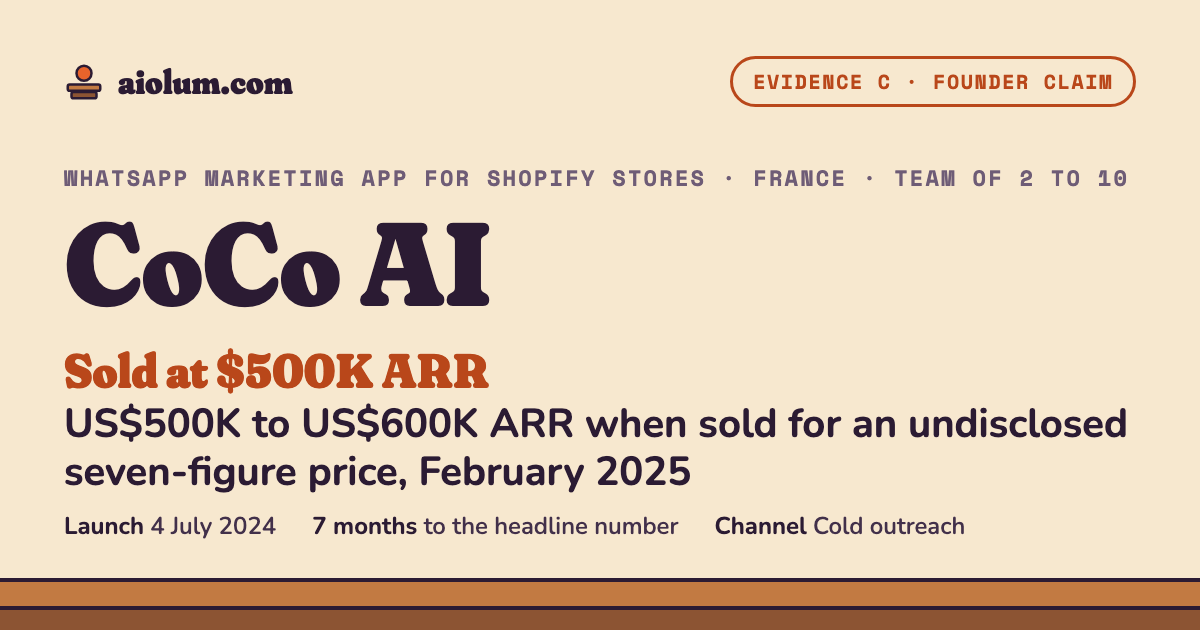
Romàn Czerny and Pierre-Eliott Lallemant, two French founders, built it with a team of three to four people and no investors. The app launched on the Shopify App Store on 4 July 2024. They found customers only by cold outreach, which means writing to people who have never heard of you: about 1,700 emails a day plus LinkedIn messages. Czerny writes that MRR, monthly recurring revenue, the income that repeats every month, was more than US$50,000 before the sale. Lallemant gives €500,000 of ARR, annual recurring revenue, which is the same measure for a year. In early 2025 they sold the company to a buyer that they describe as an American fund, for a price that Czerny calls seven figures.
Every money number on this page is a statement by one of the two founders, made after the sale, grade C. The buyer has never been named and the price has never been published. One fact was checked independently: the Shopify App Store listing named the founders' French company on 23 January 2025 and a developer in the state of New York on 18 April 2025. The page also shows four earlier companies that sold chat and marketing tools to online stores and closed.
The numbers, graded
Each row shows the evidence grade and the source numbers from the list at the end of this page. The grades are explained in How Aiolum verifies.
| Fact | Value | Grade | How we know | Sources |
|---|---|---|---|---|
| MRR before the sale, first founder's blog post of 25 April 2025 | more than US$50,000 | C | Romàn Czerny: "MRR before acquisition: over $50,000 — and still growing when we sold". The same post says the growth from zero took "just a few months" and, in its subtitle, 6 months. | [1] |
| ARR before the sale, second founder's podcast of 19 May 2025 | €500,000 | C | Description of Pierre-Eliott Lallemant's episode, in French: the company reached €500,000 of ARR very quickly before it was resold to an American fund. The recording was not listened to. | [2] |
| ARR before the sale, interview of 18 January 2026 | US$500,000 | C | Description of Czerny's video interview: he grew the app to US$500,000 ARR and sold it for seven figures. The title of his April 2025 blog post and an article of July 2025 give the same figure. This page uses it as the headline number because it is the lower one. | [3, 1, 8] |
| Run rate from the US$50,000 monthly figure | US$600,000 a year | calc | Calculated: 50,000 times 12 equals 600,000. That is 20% above the US$500,000 ARR that the same founder also gives. The two figures are not reconciled anywhere, so the page shows the range. | [1, 3] |
| Sale price | seven figures, exact amount not disclosed | C | One founder's statement in the January 2026 interview, repeated in the video description and in the chapter title "The 7-Figure Exit". Seven figures means at least US$1 million and less than US$10 million. No buyer, broker or marketplace has confirmed it. | [3, 4] |
| Buyer | not identified, described as an American fund | C | The podcast description and a later case study say an American fund. Since April 2025 the App Store listing has shown the developer as "Coco" at a street address in White Plains, New York. Tracxn and a partner directory give Anguilla as the company's location. No name was found. | [2, 9, 5, 13, 16] |
| Month of the sale | February 2025 | C | The month comes from a machine-made summary of the January 2026 interview and was not verified against the recording. It agrees with the App Store listing, which named the French company on 23 January 2025 and the developer in New York on 18 April 2025, and with the blog post of 25 April 2025, which speaks of the sale as done. | [4, 6, 1] |
| Launch on the Shopify App Store | 4 July 2024 | C | The date on the listing. The website my-coco.ai was already online on 1 March 2024 and sold the product through demonstrations. | [5, 11] |
| Time from the App Store launch to the sale | 7 months | calc | Calculated: July 2024 to February 2025. The interview description says the sale came 2 years after the start; the summary says the founders started in 2023 with a first product that failed. | [5, 3, 4] |
| Cost of the sales tools | about US$380 a month | C | Founder's blog post: about US$150 for LinkedIn tools, US$150 for the cold email tools and US$80 for direct messages on X. | [1] |
| Sales tools as a share of monthly revenue | about 0.8% | calc | Calculated: 380 divided by 50,000 equals 0.76%. Salaries and the WhatsApp fees are not in this number. | [1] |
| Cold emails per day | about 1,700 | C | Founder's blog post. On LinkedIn the reply rate was about 23%. | [1] |
| Share of demonstrations that became customers | 50% to 70% | C | Description of the January 2026 interview. The summary of the interview says the rate fell to 15% to 20% in Germany and Spain. | [3, 4] |
| Team | 4 people at first, later 3 | C | From the machine-made summary of the interview: marketing, product and programming. Not verified against the recording. Only Czerny and Lallemant are named in public sources. | [4] |
| Employees of the French company, 2024 | 3 to 5 | A | French state company register: the employee band of Neural Odyssey for 2024. The company was created in Paris on 12 September 2024 with Lallemant as its manager, and it was still active in October 2026. | [7] |
| Outside funding | none | C | Founder's blog post: "We didn't raise." Tracxn lists the company as unfunded. | [1, 13] |
| Reviews on the App Store | 4 in August 2024, 30 in November 2024, 51 in January 2025, 58 in April 2025, 51 in October 2026 | C | Read on the listing and on its archived copies. The rating was 5.0 until January 2025, 4.8 in April 2025, and is 4.9 now. | [6, 5] |
| Stores with the app installed, October 2026 | 221 | C | A third-party estimate by Store Leads. It puts 46.2% of these stores in France. | [12] |
| Revenue per store, if 221 stores paid US$50,000 | about US$226 a month | calc | Calculated: 50,000 divided by 221. The result is between the Pro price of US$159 and the Scale price of US$399, so the founders' figure is plausible. The store count is from October 2026 and the revenue from early 2025, so this is not a proof. | [1, 12, 5] |
| Employees under the new owner, 30 June 2026 | 2 | C | Tracxn's count, a third-party figure. | [13] |
How to read this table: a grade C value is a statement by a founder, a reading of the App Store listing, or an estimate by a third party that says so. A "calc" value was computed on this page from the rows above it. Grade A appears on one row only, the employee band from the French state company register, which is not a money number. No money number of CoCo AI is grade A or B.
| Plan | Per month, billed yearly (US$) | Per month, billed monthly (US$) | Limit |
|---|---|---|---|
| Pro | not offered | 159 | up to 100,000 sessions a month |
| Scale | not offered | 399 | up to 1,000,000 sessions a month, account manager |
| Enterprise | not offered | custom | unlimited sessions, managed service |
All plans are billed monthly, so there is no yearly price. WhatsApp message fees are charged on top, per conversation, at Meta's rate for each country. The company's page gives the limits as sessions; the App Store listing gives the same two prices with limits of 10,000 and 1 million messages a month and a 14-day free trial. Under the founders, in November 2024, the listing showed a free Light plan, Starter at US$59 a month and Pro at US$159 a month, each plus WhatsApp conversation charges.
The timeline
From a first product that nobody bought to a sale, in about two years, of which seven months on the Shopify App Store. Each entry carries its grade.
- 2023CThe founders start with a WhatsApp version of an American product that lets shoppers buy by text message. After about 6 months it has one or two pilot customers and no traction. This entry comes from a summary of the 2026 interview. [4]
- 1 March 2024CThe website my-coco.ai is online: an AI chatbot on WhatsApp for Shopify stores, sold through demonstrations. [11]
- 4 July 2024CThe app launches on the Shopify App Store. In the interview Czerny says it copied Shopify apps that already earned money and was built in about 2 weeks. [5, 3, 4]
- 4 August 2024COne month after the launch the listing shows 4 reviews. The developer named on it is a company in Sarrebourg, France. [6]
- 28 August 2024CWideBundle, the maker of another Shopify app, presents CoCo AI to its own users with a 20% discount. [15]
- 12 September 2024AThe company Neural Odyssey is registered in Paris, with Lallemant as manager. [7]
- 7 November 2024CThe listing shows 30 reviews, all of 5 stars, and plans at US$0, US$59 and US$159 a month plus WhatsApp charges. The developer named on it is now Neural Odyssey, Paris. [6]
- 23 January 2025C51 reviews. The developer on the listing is still Neural Odyssey, Paris. [6]
- February 2025CThe founders sell CoCo AI to a buyer that they call an American fund, at more than US$50,000 of MRR, for a price that Czerny calls seven figures. According to the interview summary, marketplaces offered a low price because the revenue history was shorter than a year, and he found the buyer himself in about 2 months. [1, 2, 3, 4]
- 18 April 2025CThe listing shows a new developer, "Coco", with an address in White Plains, New York, 58 reviews and a rating of 4.8. [6]
- 25 April 2025CCzerny publishes the outreach method, the tools, their cost and the sales presentation on the blog of his next company. [1]
- 19 May 2025CLallemant tells the story on the French podcast EcomPreneurs: €500,000 of ARR, then a sale to an American fund. [2]
- October 2025 to August 2026AWhat the founders did next: GojiberryAI, a tool that finds sales leads. It is a different and larger company and not part of this story. TrustMRR shows US$1,801,629 of revenue in total from its Stripe account, synced on 14 August 2026. [17, 18]
- 18 January 2026CCzerny gives a 48-minute video interview about both companies. Its description says US$500,000 ARR and a seven-figure sale. [3]
- October 2026CCoCo AI is still sold: 4.9 stars from 51 reviews, plans from US$159 a month, a review dated 4 August 2026, and an estimated 221 stores. The terms on its website still name Neural Odyssey as the developer. [5, 10, 12]
Why it worked
Four causes, in the order they mattered. Each one is a reusable lesson.
A copied product in a market that did not have it
The first product moved an American idea, buying by text message, to WhatsApp, and stores did not pay for it. For the second, the founders looked for Shopify apps that already earned US$2 million to US$3 million a year, copied one, and sold it in France, where few competitors sold such an app. In Czerny's account it took about two weeks to build, and the first 5 to 10 customers came within two days from people he already knew. These details come from the interview summary.
Cold outreach as the only sales channel
About 1,700 emails a day, LinkedIn messages and direct messages on X, each with one goal: a demonstration. The founders tried search traffic, influencers and paid ads, and write that none of them worked as well. The tools cost about US$380 a month.
Revenue that grows with the customer's messages
The price was a monthly plan plus a charge for WhatsApp conversations. A store that sends more campaigns pays more, so revenue can grow without new customers. This is called usage-based pricing.
A sale at the first sign of a limit
According to the interview summary, the founders had contacted almost every suitable store in France, and in Germany and Spain far fewer demonstrations became customers. Two team members wanted to sell. They sold seven months after the App Store launch, to a buyer found by direct contact.
How it was built
These details come from the founder's blog post, the app's listing and terms, and the description and a summary of his interview. They are grade C. [1, 5, 10, 3, 4]
- A Shopify app: the store installs it from the App Store. The terms say that Shopify handles the payment; the pricing page of October 2026 says that plans are billed through Stripe.
- WhatsApp access through 360dialog, a provider that gives access to the WhatsApp API. WhatsApp fees are charged per conversation at Meta's rates.
- An AI assistant trained on the store's product catalog. It answers customers and recommends products, and the listing says it works in 96 languages.
- Connections to Klaviyo and to the Shopify checkout, and pop-up windows that collect WhatsApp subscribers.
- Sales by outreach: LinkedIn Sales Navigator and Waalaxy for LinkedIn, Apollo, Clay and Instantly for email, DriPy for messages on X. The blog post says the first region was Brazil; the interview says the main market was France.
- A short sales presentation sent after the first reply or before the demonstration. The founder published it.
Tools named in the sources
Each one opens its page in the Tools tab, with every story that uses it.
The dead that came before
Four companies in the Loot Drop database sold chat, chatbots or marketing automation to online stores and closed. The values below are from that database and are not independently verified.
Vanti
The promiseAI chatbots that guide shoppers to a product and sell it in a conversation.
Why it diedBrands did not see better sales than with a normal store page. Each customer was costly to win and to connect.
RightHello
The promiseLive chat that turns store visitors into buyers.
Why it diedIntercom raised US$240 million and added the same functions. A small chat tool could not keep pace.
Answerly
The promiseChatbots that answer customers' frequent questions, so that people handle only the hard ones.
Why it diedLanguage software of that time could not understand real questions. Each customer needed months of manual setup.
Marketfox
The promiseAutomatic marketing messages for online stores.
Why it diedMailchimp, HubSpot and Klaviyo offered more functions and more connections, with far more money.
What changed
The four companies promised what CoCo AI promises: a program that talks to shoppers and brings them back to buy. Vanti and Answerly failed mainly because the chatbot did not work well enough or needed months of setup for each customer. RightHello and Marketfox failed because larger companies sold the same functions.
Three things differ for CoCo AI. First, a language model can read a product catalog and answer in 96 languages without months of manual setup; the company says that setup takes 30 minutes. Second, the channel is WhatsApp, where the company claims that shoppers open 90% of the cart messages, and the Shopify App Store gives a small team a place where stores look for apps and a billing system. Third, the founders did not try to outlast the larger competitors: they sold after seven months. The risk that ended the four predecessors is still there, and it now belongs to the buyer.
Can one person copy it now?
The method, yes. The result, only with care.
Copying a kind of app that already earns money, then selling it by outreach in a country where few competitors sell it, needs no capital and no audience. The result on this page is less certain than the method: the revenue and the price are the founders' statements, and the founders say that the method stopped working outside their home market.
Where it is still open: App categories where the leaders earn millions of dollars a year and nobody sells actively in your country or language, on Shopify or on another app store.
- 1Look in an app store for a category where several apps earn money, and for a country or language where nobody sells them actively.
- 2Build the smallest working copy and sell it first to people you can reach directly.
- 3Send outreach every day with one goal, a demonstration, and measure how many demonstrations become customers.
- 4Charge by usage, so that revenue grows when the customer grows.
- 5If you want to sell early, write to owners of several apps in the same store. Marketplaces pay little for a revenue history shorter than a year.
What to watch
The risks are the mirror image of the causes above.
No buyer, no price, no outside check
The buyer is called an American fund and has never been named. The price is the two words seven figures in one interview. No payment processor, broker, journalist or buyer has confirmed the revenue. The only independent fact is that the App Store listing changed from a French to a United States developer between 23 January and 18 April 2025.
The founders' numbers do not match exactly
US$50,000 a month is US$600,000 a year, but the same founder also says US$500,000 ARR, and the other founder says €500,000. The time to reach it is given as 6 months, as 9 months and as part of 2 years. All statements were made after the sale.
Revenue by usage is not strictly recurring
The founder calls the figure MRR, but part of it was charges for messages, which rise and fall with each store's campaigns. The sources do not say whether the figure is before or after the WhatsApp fees that go to Meta.
Several details come from a summary of a video
The captions of the January 2026 interview could not be downloaded. The team size, the month of the sale, the reasons for selling and the way the buyer was found come from a machine-made summary of it and are marked as such.
Little sign of growth after the sale
The review count went from 58 in April 2025 to 51 in October 2026. A third party estimates 221 stores, 1.0% more than a quarter earlier, and another counts 2 employees. By the interview summary, the founders sold because growth outside France was hard.
The share of the AI in the revenue is unknown
The product is sold as an AI assistant, but the founder's own description of April 2025 lists cart reminders, campaigns and alerts and does not mention AI. Part of the revenue would exist without the AI.
Two platforms control the product
Meta sets the price and the rules of WhatsApp messages, and Shopify controls the listing and the access to stores. A change by either one can remove the margin or the product.
Sources
The grade next to each source is the best grade that the source can support. "Read in full" means that the text of the page was downloaded and the numbers were checked in it.
- C Gojiberry blog, Romàn Czerny, 25 April 2025: I used this pitch deck to bootstrap my SaaS to $500K in annual recurring revenue in 9 monthsRead in full in the Wayback Machine copy of 5 October 2025; the live address now redirects to the company's home page. Founder's own account. Source for the MRR before the sale, the outreach tools and their cost.
- C EcomPreneurs podcast, episode 37, 19 May 2025: Pierre-Eliott Lallemant, SaaS B2B: CoCo.ai & Gojiberry.ai (in French)Read the episode description, the chapter list and the publication date in the page data. Did not listen to the recording. Source for the €500,000 ARR and the American fund.
- C Florian Darroman on YouTube, 18 January 2026: I Built 2 SaaS Apps to $50K MRR: Here's My 90-Day Playbook (interview with Romàn Czerny)Read the video description, the chapter list and the date in the downloaded page. The captions could not be downloaded, so the recording itself was not read. Source for US$500,000 ARR, the seven-figure sale and the 50% to 70% close rate.
- C YouTubeSummary: machine-made summary of the same interviewRead in full. An automatic summary of source 3, not checked against the recording. Source for the team size, the month and reasons of the sale, and the first failed product.
- C Shopify App Store listing: Coco: AI Cart Recovery & Chat, read 13 October 2026Read in full: developer name and address, launch date, rating, reviews, plans and connections.
- C Wayback Machine copies of the Shopify App Store listing: 4 August 2024, 7 November 2024, 23 January 2025 and 18 April 2025Read the developer block, the rating, the review count and the plans in four copies. The copies of January and April 2025 are the Czech-language versions of the page. Source for the change of developer.
- A French state company register (Recherche d'entreprises): Neural Odyssey, SIREN 933118853Read the register record: creation date, address, manager, status and employee band for 2024. An official register, used here for the team only, not for money.
- C We Are Founders, 24 July 2025: From Zero Sales to 100 Customers in 60 Days: How GojiberryAI Got the Pivot RightRead in full. A secondary article based on Lallemant's account. Repeats US$500,000 ARR before the sale.
- C Superframeworks case study, 31 December 2025: $33K Revenue in 4 Months, the Gojiberry AI case study, and its newsletter of 28 February 2026Read both in full. A secondary account. Says €500,000 ARR, US$50,000 MRR and a sale to an American fund, without a source for the buyer.
- C CoCo AI website: pricing page, home page and terms and conditions, read 13 October 2026Read the three pages in full. Source for the current plans, the billing, the 30-minute setup claim, the use of 360dialog and the developer named in the terms (https://my-coco.ai/terms-conditions/).
- C Wayback Machine copy of my-coco.ai, 1 March 2024Read in full. The earliest archived copy of the website. Shows the product before the App Store launch.
- C Store Leads report on the app, read 13 October 2026Read the public part of the report. A third-party estimate of installs and countries.
- C Tracxn company profile: CoCo AIRead the public part of the profile: founding year, location, funding and employee count. Third-party data.
- C Zero G Talent profile of Romàn CzernyRead in full. A short biography in the founder's own words: a Shopify app that grew to US$500,000 ARR before he sold it in 2025.
- C WideBundle blog, 28 August 2024: Discover CoCo AIRead in full. A partner's presentation of the app with a discount for its users.
- C Avenue Z partner directory: Coco, partner for WhatsApp commerceRead the entry. Gives the location as Anguilla. No owner is named.
- A TrustMRR profile of GojiberryAI, the founders' next companyRead the markdown profile in the local copy. Revenue comes from the company's Stripe account, last synced on 14 August 2026. Used for one timeline entry only; it is a different business.
- C Romàn Czerny on X, 15 December 2025: I grew gojiberry.ai from $0 to $33,000 in 4 monthsRead in full through the fxtwitter interface. Confirms the founder's account name and his next company.
- C Loot Drop database export, 1,749 failed startupsLocal export. AI-written summaries, not independently verified. Source for the failed predecessors.