CodeWisp: Product, team and how it was built
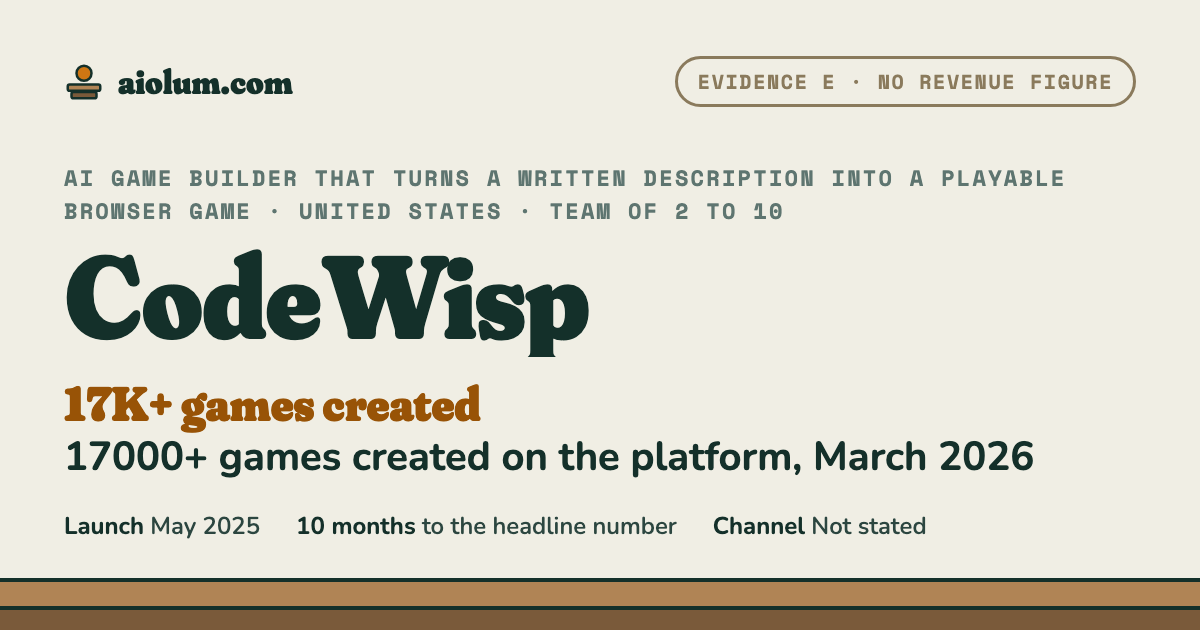
CodeWisp (AI game builder that turns a written description into a playable browser game, United States): 17000+ games created on the platform, March 2026. Evidence grade E: no revenue figure was checked. Team: 1 founder, Elvin Fu; team size 3 on the Y Combinator company page, November 2026. Launched May 2025; still running.Added 6 November 2026
- Outcome
- 17000+ games created on the platform, March 2026
- Evidence
- E no revenue figure was checked
- Launch
- May 2025
- Status
- Still running
- Team
- 1 founder, Elvin Fu; team size 3 on the Y Combinator company page, November 2026
- Outside funding
- Y Combinator, Winter 2026 batch; amount not given in the sources read
- Main channel
- Not stated
What is not verified
No revenue figure was found. We looked for a payment-processor profile, a founder post with a dated money figure and press coverage with numbers, and found none. The headline, 17,000+ games, is the founder's own count in his Y Combinator launch post of 4 March 2026; the 14,000+ count of February 2026 is also the company's own. A reader could look for a revenue figure from the founder or a payment-processor profile. This story is grade E: the business is real and its product, price and customers are described from public pages, but no revenue figure was checked. Aiolum shows it as an idea worth studying, not as proof that it makes money.
CodeWisp is an AI game builder: a tool in which a language model writes the code, art and sound of a game from a plain-English description. The result is a browser game, a game that runs inside a web page with nothing to install. The user can ask for changes in further prompts, click an object to select it, or open the code directly on a paid plan.
Elvin Fu, the only founder named on the Y Combinator pages, started CodeWisp as a beta editor for blocks and TypeScript code; the Internet Archive shows it in May 2025. By February 2026 the home page offered AI generation and counted 14,000+ games. The Y Combinator launch post of 4 March 2026, in the Winter 2026 batch, gave 2,000+ weekly active creators and 17,000+ games created.
No revenue figure was found. The headline is the founder's own count of games created. Paid plans cost US$19 and US$29 a month, as the pricing page states.
How much revenue does CodeWisp make?
Each row shows the evidence grade and the source numbers from the list at the end of this page. The grades are explained in How Aiolum verifies.
| Fact | Value | Grade | How we know | Sources |
|---|---|---|---|---|
| Games created, March 2026 | 17,000+ | C | Founder's Y Combinator launch post, 4 March 2026, under "Traction". Not checked by anyone outside. | [6] |
| Weekly active game creators, March 2026 | 2,000+ | C | Same launch post. It does not say how many of them pay. | [6] |
| Games created, February 2026 | 14,000+ | C | Home page of codewisp.net in the Internet Archive, captured 10 February 2026. | [7] |
| Earliest capture of the CodeWisp editor | May 2025, "CodeWisp v1.0.1 (Beta)" | C | Internet Archive capture of codewisp.net, 17 May 2025: "Create games instantly with our intuitive block editor and seamless JavaScript coding experience." The 26 February 2025 capture of the same domain shows a different name, AstralCode, an educational coding platform for students. | [7, 8] |
| Months from the May 2025 capture to the March 2026 count | 10 | calc | Calculated: May 2025 to March 2026. | [6, 7] |
| Founder | Elvin Fu | C | Y Combinator company page and launch post. The bio says he taught game development to 22+ million people on YouTube and built two game engines. | [5, 6] |
| Team size | 3 | C | Y Combinator company page, read 6 November 2026, which gives 2025 as the year founded and San Francisco as the location. | [5] |
| Outside funding | Y Combinator, Winter 2026 batch | C | Y Combinator company page. No amount is given in the sources read. | [5] |
| Company | CodeWisp, Inc., a Delaware corporation in San Francisco | C | Terms of service. The October 2025 capture of codewisp.net was signed "CodeWisp LLC". | [4, 7] |
| Prices | US$19 and US$29 a month, or US$16 and US$25 billed yearly | C | Pricing page, read 6 November 2026. | [2] |
| AI model providers | OpenAI, Anthropic and Google | C | Terms of service: prompts and project context go to "third-party AI providers (currently OpenAI, Anthropic, and Google)". The model names are not given. | [4] |
| Age rules | players 13 or older; publishers 18 or older or with parental consent | C | Terms of service. The company says it collects date of birth at signup. | [4] |
How to read this table: grade C is what the founder or the company states, on its own site or on its Y Combinator pages. A "calc" value was computed on this page. No value is grade A or B, and no row is a revenue figure.
| Plan | Per month, billed yearly (US$) | Per month, billed monthly (US$) | Limit |
|---|---|---|---|
| Free | 0 | 0 | 800 credits, limited AI model access, no code editing or export |
| Creator | 16 | 19 | 30,000 credits a month, up to 37 game creations and 150 edits |
| Pro | 25 | 29 | 60,000 credits a month, up to 75 game creations and 300 edits |
| Enterprise | custom | custom | unlimited creations and edits, account manager |
Plans are sold in credits. The credits page says the cost of a prompt depends on the model chosen (Fast, Standard or Best Quality) and the size of the change. A user with a ChatGPT plan can connect it, and builds then run on that plan instead of CodeWisp credits. Only paid plans allow game monetization, code editing and export.
When did CodeWisp launch, and how did it grow?
From a block-and-code editor for beginners in May 2025 to an AI game generator in Y Combinator, in about ten months. Each entry carries its grade.
- 26 February 2025CThe domain codewisp.net shows AstralCode, an educational coding platform for students that teaches JavaScript through game development. [8]
- May 2025CCodeWisp v1.0.1 (Beta) is online: a block editor and TypeScript code for making a first game in minutes. [7]
- October 2025CThe home page offers games made from words, blocks or code and says "Join the 4,351 game developers now!" [7]
- February 2026CThe home page is now an AI generator: "Describe your game and watch it appear", with 14,000+ games created. [7]
- 4 March 2026CLaunch post at Y Combinator, Winter 2026 batch: 2,000+ weekly active creators and 17,000+ games created. [6, 5]
- 2 August 2026CUsers can connect a ChatGPT plan, so that builds run on that plan instead of CodeWisp credits. [3]
Why did CodeWisp work?
Four causes, in the order they mattered. Each one is a reusable lesson.
A beginner tool first, AI second
The founder first sold the idea of a first game in minutes with blocks and code. When AI models could write whole browser games, the same promise needed only a text box, and the existing catalog and community pages stayed.
A public catalog of games
Every game is published to the home page with play counts, so the products of users are also the advertising. The home page shows games with several thousand plays each.
Credits tied to model cost
Each prompt costs credits according to the model and the size of the change, so heavy users pay for the model work they cause. Connecting a ChatGPT plan moves part of that cost to the user's own OpenAI subscription.
How it was built
These details come from the company's own pages and its terms of service. They are grade C. [4, 3, 2]
- Language models from OpenAI, Anthropic and Google generate the code, art and sound; the user picks Fast, Standard or Best Quality.
- Infrastructure on Supabase, payments by Stripe, email by Resend and analytics by PostHog, as listed in the terms.
- Games run in the browser and can be 2D, 3D or multiplayer; paid plans allow export and direct code editing.
- A referral program gives 4,000 credits when an invited friend subscribes.
Tools named in the sources
Each one opens its page in the Tools tab, with every story that uses it.
Who tried this before CodeWisp, and why did they fail?
Three companies in our database of failed startups tried to make or sell independent games through a new platform. The values below are from that database and are not independently verified.
Crejo.Fun
The promiseA no-code platform for creators in India to build mobile apps, games and interactive content without programming.
Why it diedA general builder for creators who mainly needed more followers, not another app to manage and promote.
Product Hunt Games
The promiseCommunity discovery of new independent games through upvotes and reviews.
Why it diedSteam offered discovery, sales and community in one place, and a discovery-only site could not compete.
Dropleaf
The promiseOne monthly subscription for a curated library of independent PC games.
Why it diedSteam and Xbox had the developers and the players; developers disliked its revenue share.
The failed startups come from our database of 1,749 dead startups, retold here in our own words. Its entries are AI-assisted summaries of public sources, so these cards carry no evidence grade.
What changed
Crejo.Fun needed users to assemble a game from templates, and few creators had the time. CodeWisp asks only for a sentence, and an AI model does the assembly, so the person who wants a game no longer needs to be a builder.
Product Hunt Games and Dropleaf had to persuade other developers to bring their games. CodeWisp's catalog is filled by its own users, whose games exist only because the tool made them.
Can one person copy CodeWisp now?
Partly: the niche, not the scale.
A founder with game-engine experience and a large teaching audience built this. A solo builder can copy the structure, prompt-to-product with a public catalog of results, in a narrower format.
Where it is still open: Narrow genres (puzzle games for teachers, games for one platform, playable ads) where a general builder gives weak results.
- 1Pick an output type that people want to make but cannot build: a game, a quiz, an interactive story.
- 2Generate it in the browser so the result can be shared as a link.
- 3Publish user results to a public catalog with play counts.
- 4Price in credits that follow the model cost of each prompt.
What could go wrong for CodeWisp?
The risks are the mirror image of the causes above.
What is not verified
No revenue figure was found. We looked for a payment-processor profile, a founder post with a dated money figure and press coverage with numbers, and found none. The headline, 17,000+ games, is the founder's own count in his Y Combinator launch post of 4 March 2026; the 14,000+ count of February 2026 is also the company's own. A reader could look for a revenue figure from the founder or a payment-processor profile.
Young users
The terms admit players from 13 and publishers under 18 with parental or guardian consent, and say the company collects date of birth at signup. The current FAQ addresses "beginners and anyone". The same domain earlier showed AstralCode, a coding platform for students (February 2025), and the October 2025 page had a "For Educators" link. The paid plans include game monetization; the pages read do not explain how payouts to young publishers work.
Games named after other brands
The public catalog on 6 November 2026 lists user games titled "Roblox", "Minecraft" and "Diep.io (Multiplayer Online)". The terms forbid output that infringes intellectual property and give a takedown address, but the catalog relies on users' own titles.
Competition and model providers
SuperBullet, already on this site, also sells an AI game builder, there for Roblox Studio, so the idea is not unique. CodeWisp depends on OpenAI, Anthropic and Google models, as its terms say, and its ChatGPT connection ties part of its use to OpenAI's consumer plans.
Sources
The grade next to each source is the best grade that the source can support. "Read in full" means that the text of the page was downloaded and the numbers were checked in it.
- C CodeWisp home page: Make Your First Real Game in Minutes!Read in full on 6 November 2026. Source for the public game catalog, its play counts and game titles.
- C CodeWisp pricing page: Choose your planRead in full on 6 November 2026, monthly and yearly prices.
- C CodeWisp FAQ, credits page, documentation and blogRead in full on 6 November 2026, with https://codewisp.ai/credits, https://codewisp.ai/documentation and https://codewisp.ai/blog. Source for the audience, the model choices, the ChatGPT connection (blog, 2 August 2026) and the referral credits.
- C CodeWisp Terms of ServiceRead in full on 6 November 2026. Source for the company name, the age rules, the AI providers and the third-party services.
- C Y Combinator company page: CodeWisp, Anyone can create real games with AIRead the page data on 6 November 2026. Source for the founder, the year founded, the team size of 3 and the Winter 2026 batch.
- C Y Combinator launch post, 4 March 2026: CodeWisp - AI Game Creation PlatformRead in full. Founder's own post. Source for the 17,000+ games and 2,000+ weekly active creators.
- C Internet Archive captures of codewisp.net, May 2025 to February 2026Read the captures of 17 May 2025, 15 July 2025, 27 October 2025 and 10 February 2026. Source for the beta editor, the 4,351 developers and the 14,000+ games.
- C Internet Archive capture of codewisp.net, 26 February 2025: AstralCodeRead in full. Shows the earlier educational coding platform on the same domain.
- C Database of failed startups, local exportLocal export. AI-written summaries, not independently verified. Source for the failed predecessors.
Run this company? Send corrections or a verified figure to aiolum@livyden.com