Formbot: Revenue, team and how it was built
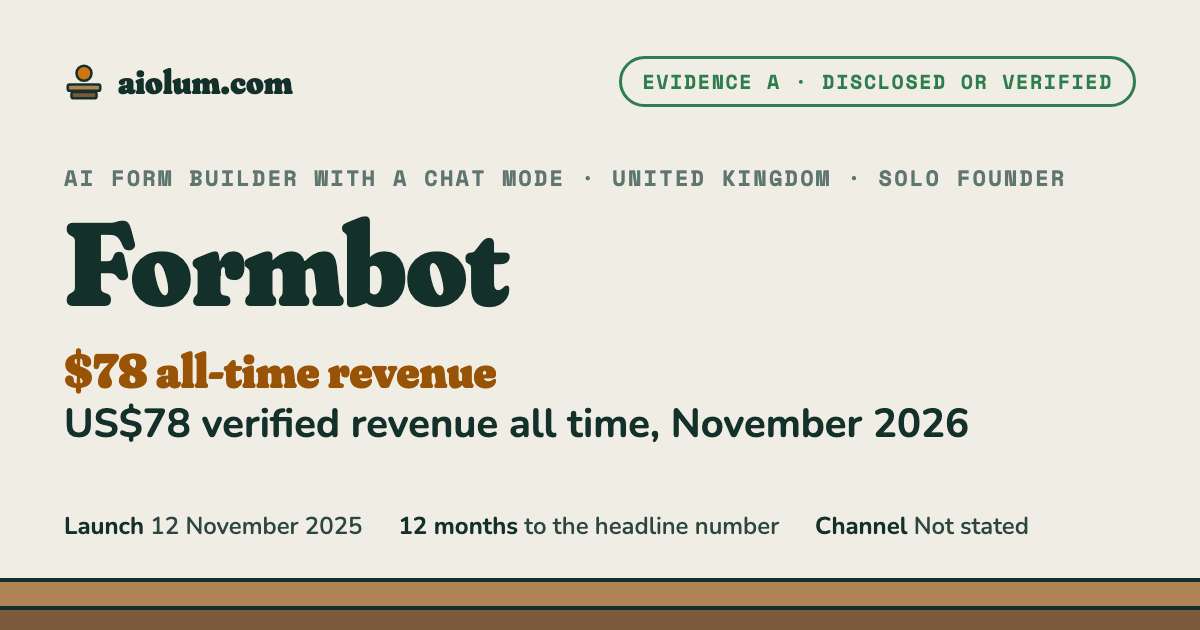
Formbot (AI form builder with a chat mode, United Kingdom): US$78 verified revenue all time, November 2026. Evidence grade A: disclosed by a company or a filing, or verified by a payment processor. Team: 1 founder listed; headcount not published. Launched 12 November 2025; still running, revenue falling.Added 3 November 2026
- Outcome
- US$78 verified revenue all time, November 2026Revenue falling
- Evidence
- A disclosed by a company or a filing, or verified by a payment processor
- Launch
- 12 November 2025
- Status
- Still running
- Team
- 1 founder listed; headcount not published
- Outside funding
- None found in any source
- Main channel
- Not stated
Formbot is an AI form builder: a tool in which a person types what a form should ask, for example "a job application with name, email, CV link and start date", and a large language model (an AI program trained on large amounts of text that writes text on request) produces the fields. Respondents can then use a conversational form, a chat window in which they answer in normal sentences and the model extracts the required values and asks only for what is missing. The privacy policy says the model calls go through OpenRouter, a service that routes requests to many open-source models, with zero data retention.
TrustMRR lists John Joubert as the founder, the United Kingdom as the country and 12 November 2025 as the founding date. The site's terms say Formbot is owned and operated by Tiny Bot Labs Limited, the same company named on the legal pages of his two other products, FeatureBot and Robotomail. TrustMRR reads payments from the Stripe account through an API key (a password that lets one program read another service's data). Its profile, synced on 3 November 2026, shows US$39 in November 2025, US$39 in December 2025, US$78 in total, an MRR (monthly recurring revenue) of US$0 and no active subscription.
The money figure is grade A, read from a payment processor, and it is the smallest figure among the founder's three products: FeatureBot shows one US$99 subscription and Robotomail US$331 a month. What the two US$39 payments bought is not known, because the current price list has no US$39 plan. The page also shows earlier form, survey and chat companies that failed.
How much revenue does Formbot make?
Each row shows the evidence grade and the source numbers from the list at the end of this page. The grades are explained in How Aiolum verifies.
| Fact | Value | Grade | How we know | Sources |
|---|---|---|---|---|
| Total revenue | US$78 | A | TrustMRR, all time and last 12 months, both US$78, from Stripe through an API key, synced 3 November 2026. An earlier copy synced 1 November 2026 gives the same figures. | [1] |
| Revenue per month | US$39 in November 2025 and US$39 in December 2025 | A | TrustMRR monthly revenue timeline. No other month has a payment. | [1] |
| Revenue in the last 6 months and the last 30 days | US$0 | A | TrustMRR revenue table, synced 3 November 2026. Every day from 4 October to 3 November 2026 shows US$0. | [1] |
| MRR and active subscriptions, November 2026 | US$0; 0 active subscriptions | A | TrustMRR metric snapshot. | [1] |
| Months with no payment since the last one | 10 (January to October 2026) | calc | Calculated: December 2025 to October 2026. | [1] |
| Current Pro price | US$19 a month or US$190 a year | C | Pricing page, 3 November 2026. The US$39 payments do not match either price; what they bought is not verified. | [3] |
| Founder | John Joubert | C | Named on the TrustMRR profile. His Product Hunt profile links tryformbot.com and lists Formbot as one of his launches. | [1, 8] |
| Legal owner | Tiny Bot Labs Limited | C | Terms and privacy policy, both last updated 23 October 2026. TrustMRR gives the country as GB. | [4, 5, 1] |
| Founding date | 12 November 2025 | C | Founder-provided TrustMRR field. The Internet Archive first saw the home page on 5 December 2025, and the oldest date in the site's sitemap is 16 December 2025. | [1, 6, 9] |
| Team | headcount not published | C | TrustMRR lists one founder. The site says "we" and names nobody. No source suggests more than one person. | [1, 2] |
| AI provider route | open-source models through OpenRouter, zero data retention | C | Privacy policy. | [5] |
| Templates and blog articles in the sitemap | 201 template pages and 121 blog pages | calc | Calculated: count of /templates/ and /blog/ addresses in tryformbot.com/sitemap.xml on 3 November 2026. The home page says "100+ Templates". | [9, 2] |
| Traffic data on TrustMRR | not connected | A | Google Analytics, DataFast and Search Console are all marked not connected. TrustMRR's own user estimate field says 0. | [1] |
| Time from founding to the November 2026 figure | 12 months | calc | Calculated: November 2025 to November 2026. | [1] |
How to read this table: a grade A value comes from the Stripe data on the TrustMRR profile. A grade C value is the company's own website, an Internet Archive copy of it, or the founder's own profile text. A "calc" value was computed on this page from the rows above it.
| Plan | Per month, billed yearly (US$) | Per month, billed monthly (US$) | Limit |
|---|---|---|---|
| Free (building only) | 0 | 0 | build forms; a 7-day Pro trial starts at the first published form |
| Pro | 15.83 | 19 | unlimited forms and responses, chat mode, CSV export, webhooks, custom branding and domains; US$190 billed yearly |
Building forms is free. A 7-day trial with every Pro feature starts when the user publishes the first form, and the plan then starts automatically unless the user cancels. Pro is US$19 a month or US$190 a year, which the page calls two months free. The pricing page and the terms offer a 30-day money-back guarantee. The terms also mention one-time payment plans, and the site's script in January 2026 had a "lifetime" plan type, but no one-time price is shown now.
When did Formbot launch, and how did it grow?
From the founding date to a live product with templates, a blog and no paying subscription, in twelve months. Each entry carries its grade.
- 12 November 2025CFounding date on the TrustMRR profile. [1]
- November 2025AFirst US$39 payment in Stripe. [1]
- 5 December 2025CFirst archived copy of the home page: form building from plain English, chat mode, the "2.5x" and "40%" completion claims and "100+ Templates". [6]
- December 2025ASecond US$39 payment, the last one so far. Around the same time the founder posts Formbot on Product Hunt. [1, 8]
- January 2026CThe site's script has "pro" and "lifetime" plan types and a trial counter; the pricing page loads its prices by script. [7]
- 23 October 2026CTerms and privacy policy updated. The pricing page shows Pro at US$19 a month and a 7-day trial that starts at the first published form. [3, 4, 5]
- November 2026AUS$78 in total, US$0 MRR, no active subscription. [1]
Why did Formbot work?
Four causes, in the order they mattered. Each one is a reusable lesson.
Describe the form, do not build it
The user writes one sentence and the model returns a list of fields with types and validation. The user can then change each field by hand or ask the AI again. This replaces the drag-and-drop editor of older form builders.
Chat mode for respondents
The form shows its required fields first. The respondent answers in free text, the model extracts as many values as it can, and the form asks only for the missing ones. Respondents who prefer it can use a normal form or a one-question-at-a-time mode.
Free to build, pay to keep collecting
Building is free with no card. A 7-day trial starts when the first form is published, and Pro starts after it unless the user cancels. When a user cancels, the forms stay, but they stop accepting new responses until the user pays again.
Pages that can rank in search
The sitemap lists 201 template pages and 121 blog pages. No source shows how many visitors they bring, and TrustMRR shows no traffic data.
How it was built
These details come from the company's own pages and an archived copy of its script. They are grade C. [2, 3, 5, 7]
- A Next.js web app: the January 2026 copy loads its code from Next.js script files, and the pricing page then loaded its prices by script.
- Form generation runs on open-source models through OpenRouter with zero data retention, according to the privacy policy.
- Sign-in with Google OAuth. Payments through Stripe, which TrustMRR reads.
- Simple Analytics for privacy-friendly site statistics, and Google Ads conversion tracking, which the privacy policy says measures its advertising campaigns.
- Webhooks signed with HMAC (a code computed from the message and a shared secret, so the receiver can check that the message is genuine), CSV export, CAPTCHA and branded subdomains in Pro.
- The footer links the same maker's other products: a feedback tracker (FeatureBot), a churn audit tool and an email service for AI agents (Robotomail).
Tools named in the sources
Each one opens its page in the Tools tab, with every story that uses it.
Who tried this before Formbot, and why did they fail?
Four companies in our database of failed startups sold digital forms, surveys or chat interfaces for websites and failed. The values below are from that database and are not independently verified.
Canvas
The promiseCreate, edit and share digital forms and documents to replace paper.
Why it diedMicrosoft and Adobe added form and document features to their suites, and low-code platforms took the rest.
Vanti
The promiseConversational AI interfaces that let brands talk with shoppers instead of showing pages.
Why it diedIt could not show that chat-driven experiences did better than normal pages, and most customers kept using search and filters.
Answerly
The promiseA website assistant that answers customer questions in natural language.
Why it diedThe language processing of the time could not handle real questions without a lot of manual setup.
Frogmetrics
The promiseTablet surveys in shops instead of paper feedback cards.
Why it diedHardware costs and slow adoption by retailers, while phone-based survey tools caught up.
The failed startups come from our database of 1,749 dead startups, retold here in our own words. Its entries are AI-assisted summaries of public sources, so these cards carry no evidence grade.
What changed
Canvas and Frogmetrics sold a better way to collect answers and lost to larger suites and cheaper tools. Answerly and Vanti bet on chat interfaces, before language models could understand free text and, in Vanti's case, without proof that people preferred chat to a normal page. Formbot faces both problems: form builders are a crowded market, and the chat mode is the reason to choose it.
The technology problem is smaller now. A language model through an API can pull field values out of free text, so one person built the chat mode and the generator, and the free start and the trial cost little to run. The market problem is unchanged. After twelve months the Stripe data shows two payments of US$39 and no subscription, so the product works but the sources show no evidence yet that customers want it enough to pay.
Can one person copy Formbot now?
The product, yes. The result, not yet.
A solo founder can build an AI form generator with a chat mode on top of an open-model API in a short time, as Formbot shows. The verified result is US$78 in twelve months, so this page is an example of what to build, not of how to sell it.
Where it is still open: A form or intake tool for one industry with long forms, where a chat that asks only for the missing fields saves real time, for example insurance claims, clinic intake (with care for health data) or job applications.
- 1Let the user describe the output in one sentence and generate the structure with a model.
- 2Offer the AI mode next to the normal mode, so customers who distrust chat can still use the product.
- 3Route model calls through a provider with zero data retention, and say so in the privacy policy.
- 4Connect the payment processor to a public revenue page from the first day, so progress is visible and checkable.
What could go wrong for Formbot?
The risks are the mirror image of the causes above.
Almost no revenue
The verified total is US$78 from two payments in November and December 2025, according to TrustMRR's Stripe data synced 3 November 2026. There has been no payment in the ten months since, and no active subscription. Who paid, and whether the payers are linked to the founder, is not known.
The US$39 payments do not match the price list
The pricing page sells Pro at US$19 a month or US$190 a year. The terms mention one-time payment plans and the January 2026 script had a "lifetime" plan type, so the US$39 may have been an earlier price or a one-time plan, but no source says so.
Unsourced completion claims
The home page shows "2.5x Higher completion" and "40% Less time to complete" for chat forms, as it did on 5 December 2025. The page gives no study or data behind these numbers, and they are not verified here.
Several products by one founder
The Formbot footer links FeatureBot (feedback tracking), a churn audit tool and Robotomail (email for AI agents). The founder's Product Hunt profile lists Robotomail and Formbot. FeatureBot shows US$99 a month and Robotomail US$331 a month on TrustMRR, so time is split across products with different results.
Sources
The grade next to each source is the best grade that the source can support. "Read in full" means that the text of the page was downloaded and the numbers were checked in it.
- A TrustMRR profile: Formbot (Stripe-verified revenue), synced 3 November 2026Read the markdown profile, downloaded 3 November 2026; a copy downloaded 2 November 2026 (synced 1 November 2026) gives the same figures. Source for the monthly revenue, total, MRR, subscription count, founder, country and founding date. Profile text is founder-written (grade C).
- C Formbot home page, read 3 November 2026Read in full. Source for the features, the chat mode, the completion claims, the template count and the footer links.
- C Formbot pricing page, read 3 November 2026Read in full. Source for the prices, the trial, the guarantee and the cancel rules.
- C Formbot terms of service, last updated 23 October 2026Read the sections on the owner and on payments and refunds.
- C Formbot privacy policy, last updated 23 October 2026Read in full. Source for OpenRouter with zero data retention, Google OAuth, Simple Analytics and Google Ads conversion tracking.
- C Internet Archive copy of tryformbot.com, 5 December 2025Read in full. Source for the earliest archived features and claims.
- C Internet Archive copy of the Formbot pricing page and its scripts, 23 January 2026The page text says only "Loading pricing...". Read the archived Next.js script files as text (not run) and found the "pro" and "lifetime" plan types; no prices.
- C John Joubert's profile on Product HuntRead in full, from the copy downloaded 3 November 2026 for the FeatureBot story. Links tryformbot.com, featurebot.com and robotomail.com, and lists the Formbot launch as "11mo ago".
- C Formbot sitemap, read 3 November 2026Read in full. Counted 326 addresses: 201 templates, 121 blog pages; oldest date 16 December 2025.
- C Database of failed startups, local exportLocal export. AI-written summaries, not independently verified. Source for the failed predecessors.