Graphide: Product, team and how it was built
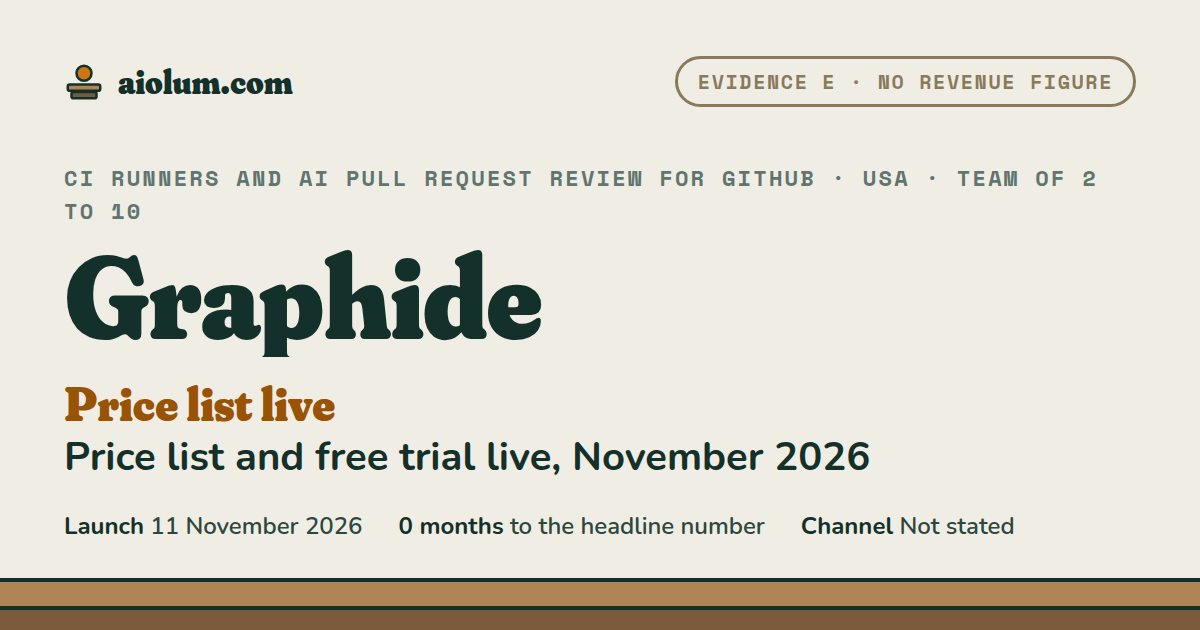
Graphide (CI runners and AI pull request review for GitHub, USA): Price list and free trial live, November 2026. Evidence grade E: no revenue figure was checked. Team: 2 founders, in the Y Combinator Fall 2026 batch. Launched 11 November 2026; still running.Added
- Outcome
- Price list and free trial live, November 2026
- Evidence
- E no revenue figure was checked
- Launch
- 11 November 2026
- Status
- Still running
- Team
- 2 founders, in the Y Combinator Fall 2026 batch
- Outside funding
- Y Combinator Fall 2026 batch; amount not published
- Main channel
- Not stated
What is not verified
No revenue figure was found, and no page names a paying customer. The company's pricing page, its launch post and its terms describe prices, a trial, Stripe and refunds, and that is the company's own statement. No independent source confirms that a customer has paid. No press piece was read. A reader could look for a named customer, a case study or a press report. AI is one part of the product: the review agent and the tuning agents sit inside a CI service. This story is grade E: the business is real and its product, price and customers are described from public pages, but no revenue figure was checked. Aiolum shows it as an idea worth studying, not as proof that it makes money.
Graphide sells a CI runner and an AI review of pull requests. A CI runner is the machine that builds and tests code each time a developer pushes a change. A team moves a job to Graphide by changing one line, runs-on, in its GitHub Actions workflow file. The review agent reads each pull request, a proposed code change, together with the code that the change touches.
Dan McGee and Benjamin McIntyre founded it in 2026, and Y Combinator lists a team of 2 in its Fall 2026 batch. Before the CI product, the company offered a code editor for working with AI agents. Captures of 26 September and 11 October 2026 show that editor. The launch post of the CI runner on the Y Combinator site is dated 11 November 2026.
No revenue figure and no named paying customer was found, so the story is grade E. The headline is a status fact from the company's own pages of 24 November 2026. Those pages show a price list, a free trial and a payment processor. The speed and bug-finding figures are the company's own tests, and the company changed several claims in the last weeks.
Why did Graphide work?
Four causes, in the order they mattered. Each one is a reusable lesson.
The founders say agent-written code makes the CI wait the bottleneck
The launch post of 11 November 2026 says that engineers run fleets of coding agents. It says that every pull request waits on CI, often several times. The founders offer this as the reason for a faster runner. The post gives no customer name and no measured figure for it.
It sells faster machines with agents that tune each job
The company's pages say that jobs start on warm machines with dependencies ready. They say that long test steps are split across runners. They say that agents tune caches, machines and splits. The docs say that no test is left out today, and that test selection is being built and is not on.
The review agent says how it checked each finding
The company's pages say that the review agent reads the code around a change and checks each finding a second time before it is posted. The home page shows a test in which the company's review found 26 of 36 known bugs and Greptile found 21. The company ran that test itself.
How it was built
These details come from the company's own pages and subprocessor list. They are grade C. [4, 9, 13, 8, 12]
- Each CI job runs on its own fresh micro-VM, destroyed when the job ends. The subprocessor list says that Microsoft Azure hosts the servers and the machines that build and test the code.
- The service works through a GitHub App and GitHub Actions. A pull request that changes each job's <code>runs-on</code> line moves the job.
- The privacy policy lists Supabase for sign-in and the database, and Stripe as the seller of record for payments.
- Reviews use AI models from Anthropic. The same list names OpenAI, OpenRouter, Straitly and DeepInfra for other work, such as speeding up CI and computing embeddings.
- The earlier Graphide Editor is, in the license page's words, a derivative work of Visual Studio Code, the open-source editor of Microsoft.
Tools named in the sources
Each one opens its page in the Tools tab, with every story that uses it.
Who tried this before Graphide, and why did they fail?
Four developer-tool companies in our database of failed startups promised to help engineers understand or test code, and shut down. The values below are from that database and are not independently verified.
CodeSee
The promiseAutomatic visual maps of code architecture, dependencies and data flows.
Why it diedThe record says that strong early use came from open-source projects and pilots. Free users did not turn into paying customers, and it shut down in 2024.
Testmunk
The promiseAutomated tests of mobile apps on real devices, to save developers time.
Why it diedThe record says that it could not stand out in a crowded market of automated testing. It adds that the device farm cost a lot to run.
Kite
The promiseAI code completion inside the editor, to make developers more productive.
Why it diedThe record says that it came years before the large code models, and that its choices on how to charge hurt it. GitHub Copilot later led the market.
Fig
The promiseA modern terminal with autocomplete for command-line tools.
Why it diedThe record says that developers paid little for productivity tools, and that free alternatives and shell scripts did similar work.
The failed startups come from our database of 1,749 dead startups, retold here in our own words. Its entries are AI-assisted summaries of public sources, so these cards carry no evidence grade.
What changed
The four companies sold tools that save developer time and met two limits. Free alternatives kept customers from paying, and a large platform vendor later added the same feature. Graphide faces the same two limits. GitHub sells its own runners, and AI review tools are many.
Two things differ. Graphide charges for a cost that teams can see on a bill, CI minutes, and the company says it can lower that bill. The company also targets teams that run many coding agents, a group that did not exist when these four started. Neither point is verified.
Can one person copy Graphide now?
Possible, but the machines and the proof are the hard part.
A small team can sell CI runners, because the work starts with one line in a workflow file. Graphide's own pages show how much proof a buyer is asked to trust: benchmarks, a free trial and a promise of no changed results. A copy needs hardware, tuning and measurements that a buyer can repeat.
Where it is still open: Other waits that coding agents create: test runs, security scans and checks on generated code. The company's own pages do not show that customers pay for any of them.
- 1Pick one slow, paid step of a developer's day, such as waiting for CI.
- 2Make the switch one change in a file, and keep a way back.
- 3Publish how you measured, including the machine sizes, so that a buyer can repeat the test.
- 4Offer a trial that charges nothing until the buyer agrees to a price.
How much revenue does Graphide make?
Each row shows the evidence grade and the source numbers from the list at the end of this page. The grades are explained in How Aiolum verifies.
| Fact | Value | Grade | How we know | Sources |
|---|---|---|---|---|
| Company start | 2026 | C | The Y Combinator company page says "Founded: 2026", "Batch: Fall 2026" and "Team Size: 2". | [1] |
| Founders | Dan McGee (CEO) and Benjamin McIntyre (CTO) | C | Both the Y Combinator page and the company's About page name them as co-founders. The About page says they met in middle school in Cincinnati. | [1, 6] |
| Earlier product: Graphide Editor | an editor for working with AI agents, 2026 | C | A capture of graphide.net dated 26 September 2026 shows "The IDE for building with AI agents" and a "Request access" button. The terms call it "the earlier Graphide Editor" and the license page says it no longer receives updates. | [10, 7, 12] |
| Editor status on 11 October 2026 | closed alpha, downloads need an account | C | A capture of graphide.com dated 11 October 2026. The page shows no price. | [11] |
| Launch of the CI runner | 11 November 2026 | C | The Y Combinator launch post carries this creation date in its page data. | [2] |
| Company form | Graphide, Inc., a Delaware corporation | C | Stated in the terms of service. | [7] |
| Funding | Y Combinator Fall 2026 batch, amount not published | C | Both the home page and the Y Combinator page say so. No amount appears in any page read. | [1, 3] |
| Price list | CI by quote; review US$1 per pull request after 10 free | C | Pricing page, 24 November 2026. The earlier copy listed a US$20 minimum a month and US$0.003 per vCPU-minute. | [4, 5] |
| Payment processor and refunds | Stripe is the merchant of record; 14-day refund | C | The terms say that Stripe sells the subscription on Graphide's behalf, and that after 14 days "we do not refund by default". | [7] |
| Speed test, 5 November 2026 | 10 open-source jobs, 10.7 to 47 times faster | C | Done by hand by the company on 64 or 128 vCPUs. The page says GitHub's standard runner for open-source projects has 4. | [3] |
| Review test, October 2026 | 26 of 36 known bugs found, against 21 for Greptile | C | The company's test on 74 pull requests, 68 of them from one open-source project. A grader matched the findings. | [3, 4] |
| Customers named | none | C | The launch post says that "several customers" gave feedback. No page names a customer. | [2] |
How to read this table. A grade C value is a statement on the company's own pages or on its Y Combinator page. No value is grade A or B, and no press piece was read for this story.
| Plan | Per month, billed yearly (US$) | Per month, billed monthly (US$) | Limit |
|---|---|---|---|
| Graphide CI | quote | one fixed monthly price, set from the customer's usage; x64 Linux jobs on GitHub organizations | |
| Graphide review | 1 per pull request | first 10 reviews free in the trial | |
| Free trial | 0 | 7 days or US$10 of CI usage, whichever comes first; card at checkout | |
| Earlier version: pay as you go | 20 minimum | US$0.003 per vCPU-minute; US$0.006 a minute on a standard Linux runner |
On 24 November 2026 the pricing page said that CI is one fixed monthly price, quoted from the customer's usage. It said that review costs US$1 per pull request after 10 free reviews. The trial is 7 days or US$10 of CI usage, whichever comes first, with a card taken at checkout. An earlier copy of the same page, read the same day, listed a US$20 minimum a month and US$0.003 per vCPU-minute. The launch post of 11 November 2026 also lists US$0.003. The terms of 30 October 2026 describe flat subscriptions.
When did Graphide launch, and how did it grow?
From a code editor in September 2026 to a CI runner with a price list in November 2026. Each entry carries its grade.
- 26 September 2026CA capture of graphide.net shows the Graphide Editor, "The IDE for building with AI agents", with a "Request access" button and the line "Backed by Y Combinator". [10]
- 11 October 2026Cgraphide.com shows the editor as a closed alpha. Downloads need an account. [11]
- 29 October 2026CThe first privacy policy takes effect. It says that earlier versions of the app and editor collected telemetry, which the company stopped on that date. [8]
- 11 November 2026CLaunch post of the CI runner on the Y Combinator site. It lists pay as you go at US$0.003 per vCPU-minute. [2]
- 24 November 2026CThe pricing page asks for a quote for CI and lists US$1 per review after 10 free. A copy read earlier that day listed a US$20 minimum. [4, 5]
What could go wrong for Graphide?
The risks are the mirror image of the causes above.
What is not verified
No revenue figure was found, and no page names a paying customer. The company's pricing page, its launch post and its terms describe prices, a trial, Stripe and refunds, and that is the company's own statement. No independent source confirms that a customer has paid. No press piece was read. A reader could look for a named customer, a case study or a press report. AI is one part of the product: the review agent and the tuning agents sit inside a CI service.
Claims changed within weeks
The home page says that the 5 November 2026 tests ran on 64 or 128 vCPUs, and that a customer's runners go up to 32. The releases page says that jobs asking for more than 8 vCPUs keep running where they do today. An earlier copy of the home page, read on 24 November 2026, said "0 missed failures in 295,411 test runs we left out". The docs say that test selection is not on. The pricing page also changed from a US$20 minimum to a quote.
Data collection before 29 October 2026
The privacy policy says that until 29 October 2026 earlier versions collected session content, screen recordings and usage events. The terms say that earlier terms allowed using session content to train models. The company says that it has never trained a model on it, and that it will delete the data by 30 November 2026. Version 1.3 of the policy, of 19 November 2026, says that the website uses Letter. Letter may identify visiting companies and people, for sales and marketing.
Age and fit of the company
The company is a few months old, and the editor that it began with is no longer updated. The terms still describe flat subscription plans and a permanent free tier. The pricing page of 24 November 2026 describes a quote and a trial. The price list changed between 11 and 24 November 2026.
Sources
The grade next to each source is the best grade that the source can support. "Read in full" means that the text of the page was downloaded and the numbers were checked in it.
- C Y Combinator company page: Graphide, Fall 2026Read in full on 24 November 2026. Source for the start year 2026, the team of 2, the batch and the founders' profiles.
- C Y Combinator, 11 November 2026, Dan McGee and Benjamin McIntyre: Graphide: A CI runner 10x+ faster than GitHub, often under a minuteRead in full on 24 November 2026. The founders' launch post. Source for the launch date, the claim about customers and the pay-as-you-go price.
- C Graphide home pageRead in full on 24 November 2026. Source for the benchmarks, the notes on how they were measured and the line "Built by Dan McGee and Benjamin McIntyre in San Francisco".
- C Graphide pricing pageRead in full on 24 November 2026. Source for the quote model, the trial and the price of a review.
- C Graphide home and pricing pages, earlier copy of 24 November 2026Downloaded earlier on the same day by the screening step and kept in research/screen/graphide/graphide.com/. Source for the US$20 minimum and for the counters that were later removed. No Wayback copy of the pricing page could be read.
- C Graphide About pageRead in full on 24 November 2026. Source for the founders' roles and for the line that the company sells two products.
- C Graphide terms of service, effective 30 October 2026Read in full. Source for the company form, Stripe, the refund rule, the earlier editor and the earlier data rules.
- C Graphide privacy policy, version 1.3, effective 19 November 2026Read in full. Source for the data collected before 29 October 2026, the service list and the website measurement.
- C Graphide docs: How Graphide CI worksRead in full on 24 November 2026. Source for the statement that test selection is not on and for what the agents tune.
- C Wayback Machine capture of graphide.net, 26 September 2026Read in full. Shows the earlier Graphide Editor, its tagline and the "Request access" button.
- C Wayback Machine capture of graphide.com, 11 October 2026Read in full. Shows the editor as a closed alpha, with no price.
- C Graphide license pageRead the sections on the earlier Graphide Editor. The page still marks parts as placeholders.
- C Graphide docs: SubprocessorsRead in full. Source for the hosting, database, payment and model providers.
- C Graphide releases pageRead in full on 24 November 2026. Source for the 8 vCPU limit and for the statement that each review finding is checked twice.
- C Database of failed startups, local exportRecord pages read on the website on 24 November 2026. AI-written summaries, not independently verified. Source for the failed predecessors.
Run this company? Send corrections or a verified figure to aiolum@livyden.com