Logicc: Revenue, team and how it was built
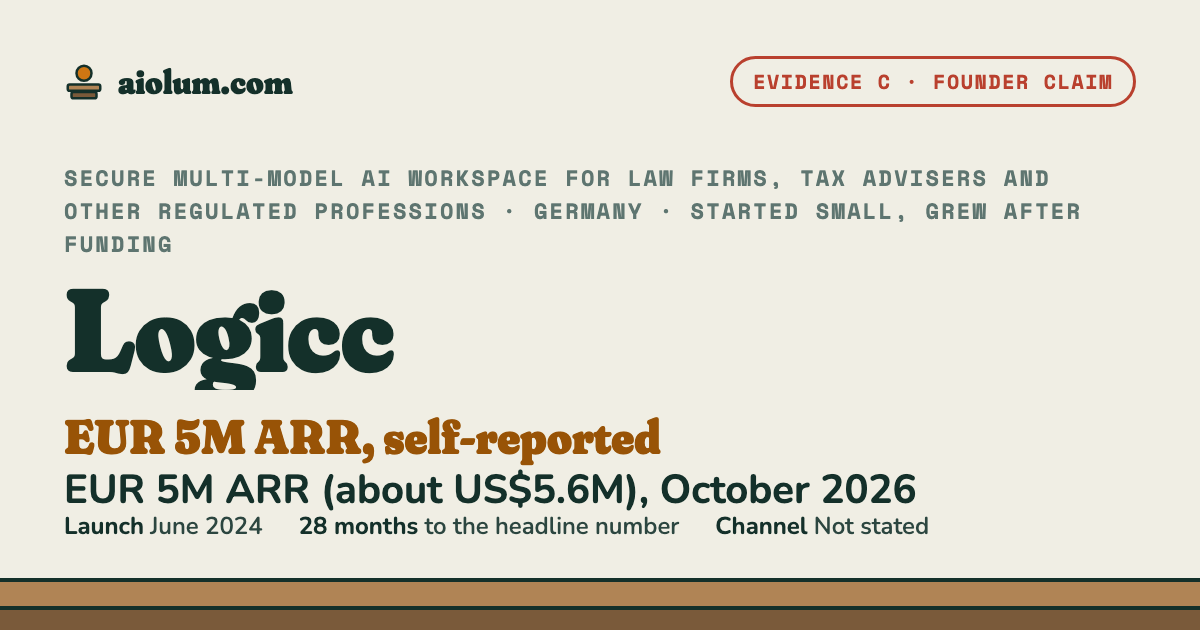
Logicc (Secure multi-model AI workspace for law firms, tax advisers and other regulated professions, Germany): EUR 5M ARR (about US$5.6M), October 2026. Evidence grade C: the founder's own figures, not verified by anyone else. Team: 4 co-founders at the start in June 2024 (podcast, May 2025); 7 people in May 2025; about 20 people in Hamburg after a EUR 2.5M seed round in April 2026 (company page, November 2026). Launched June 2024; still running, revenue growing.Added 5 November 2026
- Outcome
- EUR 5M ARR (about US$5.6M), October 2026Revenue growing
- Evidence
- C the founder's own figures, not verified by anyone else
- Launch
- June 2024
- Status
- Still running
- Team
- 4 co-founders at the start in June 2024 (podcast, May 2025); 7 people in May 2025; about 20 people in Hamburg after a EUR 2.5M seed round in April 2026 (company page, November 2026)
- Outside funding
- Bootstrapped until April 2026, then a EUR 2.5M (about US$2.8M) seed round with 10x Founders, Redstone, MS&AD and business angels, as the company states
- Main channel
- Not stated
Logicc is an AI workspace, one web application in which a team uses several AI models side by side, keeps its chats and documents, and shares assistants. It is a multi-model product: the customer chooses GPT, Claude, Gemini or Mistral for each task, or lets a feature called Smart Select AI choose. The product is built for regulated professions, jobs in which the law limits who may see client data, such as lawyers and tax advisers in Germany. For them Logicc offers storage in Germany, processing in the EU, zero data retention (the model provider does not keep the request after it answers) and an agreement under section 203 StGB, the German criminal-law rule on professional secrecy.
Four co-founders in Hamburg, Emil Woermann, Jacob Leffers, Santiago Martinez-Avial and Benjamin Seifert, run the company. Seifert said in a podcast published on 14 May 2025 that he started it with his three co-founders in June 2024, that the seven-person team was bootstrapped and profitable, and that it had reached 25,000 euros a month in recurring revenue within one year. The company's own page says it reached 1 million euros in ARR (annual recurring revenue, the yearly value of current subscriptions) in April 2026, raised a seed round of 2.5 million euros the same month, and reached 5 million euros ARR in October 2026, about US$5.6 million at the Federal Reserve rate of 30 October 2026, with a team of about 20 people.
Every revenue figure on this page comes from the founders: the company's About page, a founder-written story on MilestoneWins dated 14 October 2026, and a podcast with a co-founder. The figures agree with each other over time, so the grade is C, but no payment processor, filing or journalist has confirmed them. The company started with four people and has since grown past ten after outside funding, which the site allows under its rule for teams that grew.
How much revenue does Logicc make?
Each row shows the evidence grade and the source numbers from the list at the end of this page. The grades are explained in How Aiolum verifies.
| Fact | Value | Grade | How we know | Sources |
|---|---|---|---|---|
| Annual recurring revenue, October 2026 | 5 million euros (about US$5.6 million) | C | Company About page, milestone "Oktober 2026 5 Mio. ARR" with "Der wiederkehrende Jahresumsatz hat sich innerhalb eines halben Jahres verfünffacht" (translation: annual recurring revenue grew five times within half a year). The founder-written MilestoneWins story of 14 October 2026 gives the same 5 million euros ARR. | [1, 2] |
| ARR in US dollars | about US$5,581,500 | calc | Calculated: 5,000,000 x 1.1163 (Federal Reserve H.10 rate, 30 October 2026). | [1, 10] |
| Annual recurring revenue, April 2026 | 1 million euros (about US$1.1 million) | C | Company About page: "April 2026 1 Mio. ARR Erreicht nach gut sechs Monaten am Markt" (translation: 1 million ARR, reached after a little more than six months on the market). | [1] |
| Growth from April to October 2026 | 5 times in 6 months | calc | Calculated: 5,000,000 / 1,000,000 = 5. The company states the same. | [1] |
| Monthly recurring revenue, May 2025 | 25,000 euros (about US$27,900) | C | Podcast notes, 14 May 2025: "Das Unternehmen konnte innerhalb eines Jahres auf 25.000€ monatlichen wiederkehrenden Umsatz wachsen" (translation: the company grew to 25,000 euros of monthly recurring revenue within one year). Calculated: 25,000 x 12 = 300,000 euros a year; 25,000 x 1.1163 = US$27,907. | [3] |
| Target stated in May 2025 | 1 million euros ARR by the end of 2025 | C | Podcast notes. The company page dates the 1 million euros ARR to April 2026, about four months later than this target. | [3, 1] |
| Start | June 2024, by four co-founders | C | Podcast notes: "die er mit seinen drei Mitgründern im Juni 2024 startete" (translation: which he started with his three co-founders in June 2024). The About page instead says "Gegründet 2025 in Hamburg" (founded 2025 in Hamburg) and dates the idea to January 2025. | [3, 1] |
| Team | 7 people in May 2025; about 20 people in November 2026 | C | Podcast notes: "Das siebenköpfige Team" (the seven-person team). About page: "betreut von einem Team aus rund 20 Menschen in Hamburg" (served by a team of about 20 people in Hamburg), and 7 open jobs. | [3, 1] |
| Funding | seed round of 2.5 million euros, April 2026 | C | About page names 10x Founders, Redstone, MS&AD and several business angels. In May 2025 the team was bootstrapped and profitable, according to the podcast notes. | [1, 3] |
| Customers and users | more than 3,000 companies and more than 34,000 active users, November 2026 | C | About page. The MilestoneWins story of 14 October 2026 says more than 1,800 organizations. | [1, 2] |
| List prices | 29.90, 49.90 and 89.90 euros per user per month before VAT | C | Pricing page, 5 November 2026: Business, Secure+ and Max. | [4] |
| Models offered | OpenAI, Anthropic, Google and Mistral models | C | Models page: "OpenAI, Anthropic, Google und Mistral in einer Oberfläche" (in one interface). The home page also offers an API that works with the official OpenAI SDK. | [6, 7] |
| Where the data goes | storage at Hetzner in Germany; OpenAI models through Microsoft Azure in Sweden; Claude and Gemini through Google Cloud in Germany and Belgium | C | Security page. | [5] |
| Legal entity | Logicc GmbH, Hamburg, HRB 188043 | C | Impressum. It names three of the co-founders as managing directors. | [9] |
| Time from start to the October 2026 figure | 28 months | calc | Calculated: June 2024 to October 2026. From the About page's own founding year, 2025, it would be less. | [3, 1] |
How to read this table: a grade C value is a statement by the company or its founders on their own page, in a founder-written story or in a podcast. A grade X value was computed on this page. Only the exchange rate is grade A. No revenue figure is grade A or B.
| Plan | Per month, billed yearly (US$) | Per month, billed monthly (US$) | Limit |
|---|---|---|---|
| Business | 26.70 | 33.38 | all leading models, assistants, unlimited document uploads, web search |
| Secure+ | 44.56 | 55.70 | 70% higher usage limit, section 203 StGB agreement, certificates and audits |
| Max | 80.28 | 100.36 | 200% higher usage limit, Claude Opus and GPT-5.6 Sol, single sign-on |
| Enterprise | custom | custom | contact sales; dedicated servers, training from 100 users |
The page shows a Black Week offer of 30% off yearly plans until 30 November 2026, for up to 5 licenses in the first contract year. The yearly prices shown during the offer are 23.92, 39.92 and 71.92 euros, which are 20% below the monthly prices; the page also says a user saves 107.64 euros a year on Business, which is 30% of twelve monthly payments. Calculated: 29.90 x 1.1163 = US$33.38; 49.90 x 1.1163 = US$55.70; 89.90 x 1.1163 = US$100.36; 23.92 x 1.1163 = US$26.70; 39.92 x 1.1163 = US$44.56; 71.92 x 1.1163 = US$80.28. Every plan starts with a 7-day free trial of the Max plan without a credit card. In May 2025 the podcast notes gave a starting price of 14.90 euros.
When did Logicc launch, and how did it grow?
From four co-founders in Hamburg to about 20 people and 5 million euros ARR in 28 months, as the company tells it. Each entry carries its grade.
- Before 2024CThe four co-founders build OAK25, a startup that they later sell to a competitor, according to the MilestoneWins story. [2]
- June 2024CBenjamin Seifert and his three co-founders start Logicc, according to the podcast notes. The About page dates the idea to January 2025. [3, 1]
- 14 May 2025CHappy Bootstrapping episode 121: 25,000 euros a month in recurring revenue within one year, a seven-person team, bootstrapped and profitable, plans from 14.90 euros, and a target of 1 million euros ARR by the end of 2025. [3]
- April 2026C1 million euros ARR and a seed round of 2.5 million euros with 10x Founders, Redstone, MS&AD and business angels. [1, 2]
- 14 October 2026CA founder-written story on MilestoneWins reports 5 million euros ARR and more than 1,800 organizations. [2]
- October 2026CThe About page dates the 5 million euros ARR milestone to this month. [1]
- 5 November 2026CThe site lists more than 3,000 companies, more than 34,000 active users, about 20 staff, 7 open jobs and a Black Week offer on yearly plans. [1, 4]
Why did Logicc work?
Four causes, in the order they mattered. Each one is a reusable lesson.
Sell the approval, not the model
The models are the same ones anyone can use. What a law firm or tax adviser cannot get from a US chatbot is storage in Germany, processing in the EU, a data processing agreement under Article 28 GDPR and a signed section 203 StGB agreement. Logicc puts these documents on its site and in the app, so the buyer's data-protection check is done before the first message.
Several models in one place
One subscription covers GPT, Claude, Gemini and Mistral models, and Smart Select AI picks one per request. The customer does not have to sign contracts with each model provider, and Logicc can move traffic when one provider changes its price or terms.
Pages for each profession
The site has separate pages, security pages and use cases for law firms, tax advisers with a DATEV connection, medical practices, public offices and financial firms. Each one answers the legal question that its buyer asks first.
Price per seat, plan by secrecy level
Plans are priced per user per month. The section 203 agreement and access to audit reports start at the middle plan, Secure+, so buyers bound by professional secrecy pay more than general business users.
How it was built
These details come from the company's own pages and the podcast notes. They are grade C. [5, 6, 7, 8, 3]
- Chats, documents and account data are stored at Hetzner in Nürnberg and Falkenstein, Germany. The company writes that it chose no US host.
- OpenAI models run through Microsoft Azure in Sweden; Claude and Gemini through Google Cloud in Germany and Belgium; Mistral models through Mistral AI.
- Zero data retention is agreed by contract with all model providers, as far as technically possible, and customer data is not used for training.
- AES-256 encryption at rest, TLS 1.3 in transit, two-factor login and passkeys, single sign-on with Microsoft Entra ID, Google Workspace, Okta and SAML from the Max plan.
- An API that accepts calls in the format of the official OpenAI SDK, so customers can use the same models in their own software.
- Connections to Notion, Atlassian, Google Workspace and Slack, with a DATEV connection for tax advisers in early access.
Tools named in the sources
Each one opens its page in the Tools tab, with every story that uses it.
Who tried this before Logicc, and why did they fail?
Four companies in our database of failed startups tried to sell software to lawyers or to sell privacy as the product, and failed. The values below are from that database and are not independently verified.
ROSS Intelligence
The promiseAI legal research that finds the right case law for lawyers.
Why it diedLawyers stayed with Westlaw and LexisNexis, which had decades of data and high switching costs.
jEugene
The promiseA checker that finds errors and inconsistencies in contracts.
Why it diedBetter-funded AI contract review tools offered more, and law firms adopted new software slowly.
Atrium
The promiseA law firm for startups made faster and cheaper by software.
Why it diedThe automation could not handle real legal complexity, so costs stayed like a law firm's.
Graphite Docs
The promiseA private, encrypted alternative to Google Docs.
Why it diedUsers preferred free and fast tools to private and paid ones.
The failed startups come from our database of 1,749 dead startups, retold here in our own words. Its entries are AI-assisted summaries of public sources, so these cards carry no evidence grade.
What changed
ROSS and jEugene had to build their own legal AI and then convince lawyers that it was good enough, against incumbents with decades of data. Logicc builds no model. It resells the general models from OpenAI, Anthropic, Google and Mistral, which, as MilestoneWins writes, lawyers already knew by name in 2025, so the question it answers for a law firm is not whether the AI works but whether the firm may use it.
Graphite Docs sold privacy to people who did not have to pay for it. Logicc sells privacy to professions for whom it is a legal duty: a lawyer or tax adviser who shares client secrets without a proper agreement risks criminal liability under section 203 StGB. That turns privacy from a preference into a purchase requirement, and the company prices its plans by that requirement.
Can one person copy Logicc now?
Not for one person alone, but the structure, yes.
Logicc was started by four people who had sold a startup before, and it now has about 20 staff and outside funding. The structure is open to a small team: take the general AI models, wrap them in the hosting, contracts and certificates that one regulated profession in one country needs, and sell seats to that profession.
Where it is still open: The same need exists for professions in other countries with secrecy duties (notaries, auditors, patent attorneys, social workers) and in languages that the large US vendors do not serve with local contracts.
- 1Pick a profession whose law limits where client data may go, in one country.
- 2Use EU or local hosting and model access with zero data retention, and publish the data processing agreement and security documents on the site.
- 3Offer several model providers behind one interface, so no single provider can end the product.
- 4Write a page for each profession that answers its legal question first, and price the plan with the legal agreement above the basic one.
What could go wrong for Logicc?
The risks are the mirror image of the causes above.
What is not verified
All revenue figures are the company's own: the About page read on 5 November 2026 (1 million euros ARR in April 2026, 5 million euros ARR in October 2026), the founder-written MilestoneWins story of 14 October 2026, and the notes of the Happy Bootstrapping podcast of 14 May 2025 (25,000 euros a month). No payment processor, company filing or journalist has confirmed them. A reader could look for the annual accounts of Logicc GmbH in the German company register or a press report on the seed round.
Two different founding dates
The podcast notes of May 2025 say Logicc started in June 2024, and the co-founder reported a year of revenue by then. The About page says the company was founded in 2025, the idea was born in January 2025, and 1 million euros ARR came "after a little more than six months on the market". This page uses June 2024, the earliest dated source.
Customer counts differ
The MilestoneWins story of 14 October 2026 says more than 1,800 organizations; the About and pricing pages in November 2026 say more than 3,000 companies. The sources do not say how a company or an active user is counted.
No longer a small team
The company started with four co-founders and had seven people in May 2025. After the seed round of April 2026 it has about 20 people and 7 open jobs, according to its own page. MilestoneWins writes that the CEO set a goal to grow revenue ten times in the twelve months after the round.
Competition
On this site innoGPT, also from Germany, sells a GDPR-compliant AI workspace to companies, and TypingMind sells a multi-model chat interface; the large model providers also sell their own team and enterprise plans in the EU.
Dependence on model providers
The product resells models from OpenAI (through Microsoft Azure), Anthropic and Google (through Google Cloud) and Mistral, according to the security page. The same page says that some model providers are not covered by the section 203 agreement, so after signing it those models are not available. A change in a provider's EU terms or prices would affect the product directly.
Medical and public-sector use
Besides law and tax, the site sells to medical practices (drafting doctors' letters from dictation, summarising patient records) and public offices. These are document tasks, not medical advice, but they involve health and social data under Article 9 GDPR.
Sales wording on the site
The Black Week banner says the offer ends "in a few days" while its own counter shows 25 days. The ROI calculator on the pricing page shows a value 49 times the cost, based on the company's own figure of 1.8 hours saved per person per day.
Sources
The grade next to each source is the best grade that the source can support. "Read in full" means that the text of the page was downloaded and the numbers were checked in it.
- C Logicc, Über Logicc: sichere KI aus Hamburg (About page)Read in full on 5 November 2026. Company statement. Source for the milestones (1 million and 5 million euros ARR, seed round), the team of about 20, the co-founders, investors, customer and user counts.
- C MilestoneWins, 14 October 2026: How Logicc hit €5M ARR: selling AI to the lawyers who couldn't touch itRead in full. The byline names the four co-founders, so it is a founder statement. Source for the 5 million euros ARR, 1,800+ organizations, the earlier startup OAK25 and the revenue goal.
- C Happy Bootstrapping (Andreas Lehr), episode 121, 14 May 2025: Logicc.com: Von 0 auf 25K€ MRR mit KI für den deutschen Mittelstand (#121)Read the episode notes in the podcast's RSS feed (https://happy-bootstrapping.podigee.io/feed/mp3); the audio was not transcribed. Interview with co-founder Benjamin Seifert. Source for the June 2024 start, 25,000 euros MRR, the seven-person team, bootstrapping and profit, and the 14.90 euro starting price.
- C Logicc, Preise (pricing page)Read in full on 5 November 2026, including the price values in the page source. Source for the pricing table and the Black Week offer.
- C Logicc, Sicherheit (security page)Read in full. Source for Hetzner hosting, Azure and Google Cloud model processing, zero data retention, the section 203 agreement and the list of model subprocessors.
- C Logicc, KI-Modelle (models page)Read the sections on providers and model choice.
- C Logicc home pageRead in full on 5 November 2026. Source for the product description, the API and the offer banner.
- C Logicc, Integrationen (integrations page)Read the list of integrations.
- C Logicc, ImpressumRead in full. Source for the legal entity and register number.
- A Federal Reserve Board, H.10 historical rates: US dollars per euroDownloaded the daily table on 5 November 2026 and used the rate of 30 October 2026, 1.1163 dollars per euro, for all conversions. It says nothing about Logicc.
- C Database of failed startups, local exportLocal export. AI-written summaries, not independently verified. Source for the failed predecessors.
Run this company? Send corrections or a verified figure to aiolum@livyden.com