Mono: Revenue, team and how it was built
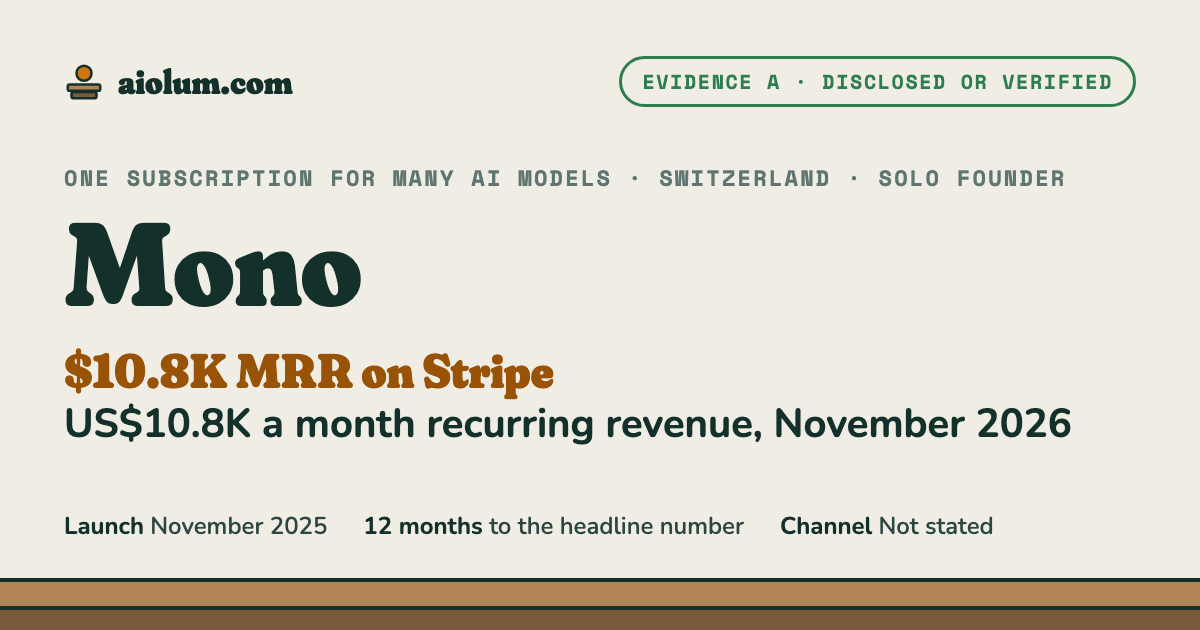
Mono (One subscription for many AI models, Switzerland): US$10.8K a month recurring revenue, November 2026. Evidence grade A: disclosed by a company or a filing, or verified by a payment processor. Team: 1 person (founder-provided on TrustMRR, November 2026); the company pages name only the founder. Launched November 2025; still running, revenue falling.Added 7 November 2026
- Outcome
- US$10.8K a month recurring revenue, November 2026Revenue falling
- Evidence
- A disclosed by a company or a filing, or verified by a payment processor
- Launch
- November 2025
- Status
- Still running
- Team
- 1 person (founder-provided on TrustMRR, November 2026); the company pages name only the founder
- Outside funding
- None (bootstrapped, founder-provided on TrustMRR)
- Main channel
- Not stated
Mono is a model aggregator: a product that buys access to the AI models of several companies and sells them to the user under one subscription and one chat window. Mono calls the models through their API, the paid programming interface that a model company sells to other software, and pays for each request. Its automatic model selection reads each prompt, decides what kind of task it is (a quick answer, research, writing, code, an image) and sends it to the model that the founder chose for that task. The user can change that choice in the settings.
Jonas Kamber, a Swiss software developer and UX designer, built and runs it alone. Solid Technologies AG in Lucerne, where he is the managing director, operates it. His TrustMRR profile gives 1 November 2025 as the founding date; the first payments arrived in December 2025, and version 1.0 was released on 20 January 2026. On 7 November 2026, Stripe data read by TrustMRR showed US$10,815 in monthly recurring revenue (MRR), the monthly value of all active subscriptions, from 393 active subscriptions. That is about US$130,000 a year if nothing changes. Total verified revenue since the start was US$84,993.
The money figures are grade A: TrustMRR reads them from Stripe through an API key. The team size, the founding date and "bootstrapped" are what the founder entered on TrustMRR. Cash received in the last 30 days (US$10,463) was 30.1% below the 30 days before, while MRR rose 5.5%, so the page marks the trend as falling. Below are four earlier companies that promised one place for many services and failed.
How much revenue does Mono make?
Each row shows the evidence grade and the source numbers from the list at the end of this page. The grades are explained in How Aiolum verifies.
| Fact | Value | Grade | How we know | Sources |
|---|---|---|---|---|
| Monthly recurring revenue, 7 November 2026 | US$10,815 | A | TrustMRR snapshot, revenue last synced from Stripe on 7 November 2026. The AI Receipts copied US$10,800 for 6 and 7 November 2026. | [1, 2] |
| Active subscriptions, 7 November 2026 | 393 | A | TrustMRR snapshot. The AI Receipts copied 390 a day earlier. | [1, 2] |
| Run rate from the November 2026 MRR | about US$129,780 a year | calc | Calculated: US$10,815 times 12. This is the headline figure in US dollars a year. | [1] |
| Average MRR per subscription | about US$27.52 | calc | Calculated: US$10,815 divided by 393. Between the US$20 Mono plan and the US$34 Mono Pro plan. | [1, 4] |
| Revenue in the last 30 days, 7 November 2026 | US$10,463, 30.1% below the 30 days before | A | TrustMRR. In the same 30 days MRR grew 5.5%. TrustMRR also stores a snapshot of US$10,503. | [1] |
| Best month of revenue | US$15,566 in September 2026 | A | TrustMRR monthly timeline. October 2026 was US$11,321, 27.3% lower (calc), and about the level of July (US$10,499) and August (US$11,170). | [1] |
| First months of revenue | US$507 in December 2025, US$236 in January 2026, US$3,343 in February 2026 | A | TrustMRR monthly timeline. May 2026 (US$11,066) was 2.3 times April 2026 (US$4,849) (calc). | [1] |
| Total revenue since the start | US$84,993 | A | TrustMRR all-time figure on 7 November 2026; US$84,945 in the last 12 months. The AI Receipts copied US$84,700. | [1, 2] |
| Payment processor | Stripe, connected by API key | A | TrustMRR verification section. TrustMRR lists "Merchant of record: No". | [1] |
| Founding date | 1 November 2025 | C | Founder-provided on TrustMRR. The change log gives version 1.0, "Mono's first stable release", on 20 January 2026. | [1, 7] |
| Team | 1 person | C | Founder-provided on TrustMRR. The about page says "Mono is developed by Swiss founder Jonas Kamber" and names no one else. | [1, 5] |
| Outside funding | none | C | TrustMRR lists "Bootstrapped" (founder-provided). The about page says "Mono is not a bet by big investors." | [1, 5] |
| Company | Solid Technologies AG, Lucerne, Switzerland | C | Imprint, last updated 3 February 2026. Jonas Kamber is named as managing director. The date the company was registered was not checked: the Swiss commercial register site Zefix disallows all automated agents in its robots.txt. | [6] |
| Prices | US$20, US$34 and US$96 a month per user | C | Pricing page, 7 November 2026. Yearly: US$204, US$348 and US$980. TrustMRR lists the same three monthly prices. | [4, 1] |
| Model providers | OpenAI, Anthropic, Google, Perplexity, Grok and more | C | Pricing page FAQ. The home page and change log also name DeepSeek, Z.AI GLM, Mistral, Kimi and the Swiss model Apertus. | [4, 3, 7] |
| Releases | version 4.9.1 on 7 November 2026, after 1.0 on 20 January 2026 | C | Change log. It lists feature releases only; the founder writes that bug fixes ship daily without an entry. | [7] |
| Time from founding date to the headline figure | 12 months | calc | Calculated: November 2025 to November 2026. | [1] |
How to read this table: a grade A value comes from Stripe, the payment processor, as read by TrustMRR through an API key. A grade B value is a third party that copied those figures. A grade C value is what the founder or the company's own pages say. A "calc" value was computed on this page from the rows above it.
| Plan | Per month, billed yearly (US$) | Per month, billed monthly (US$) | Limit |
|---|---|---|---|
| Mono | 17 | 20 | all models and features; limited use of the most expensive models |
| Mono Pro | 29 | 34 | larger file uploads, 2x use of limited models, priority support |
| Mono Max | 81.67 | 96 | 6x use of limited models; up to 660 images or 450 messages with the most limited models |
Yearly prices are US$204, US$348 and US$980 a year; the column shows them divided by 12. The page says the Pro yearly plan saves US$54, but 12 times US$34 minus US$348 is US$60 (calc). About half of the models have usage limits because of their cost, and the page says 95% of users do not reach them. The first 10 messages are free. A workspace with more than 10 paying members gets 10% off Mono Pro and Mono Max.
When did Mono launch, and how did it grow?
From a founding date in November 2025 to more than 390 paying subscriptions in November 2026, with a new release almost every day. Each entry carries its grade.
- 1 November 2025CFounding date that the founder entered on TrustMRR. [1]
- December 2025AFirst verified revenue: US$507 in the month. [1]
- 20 January 2026CVersion 1.0, the first stable release: chat with major AI models, speech input, file uploads, rooms and memory shared across models. [7]
- February to March 2026CMulti-model research as a preview (27 February), an option to exclude OpenAI (2 March) and a German interface and website (20 March). February revenue is US$3,343. [7, 1]
- April to May 2026ASkills (8 April) and the anonymization filter (6 May). Monthly revenue goes from US$4,849 in April to US$11,066 in May. [7, 1]
- 18 August 2026CVersion 3.0 adds plugins that connect Mono to other apps, later also through MCP. [7]
- September 2026ANew plan line-up (2 September), weekly usage limits (14 September) and the best month so far: US$15,566. [7, 1]
- 15 October 2026AVersion 4.0 adds Author Mode. October revenue is US$11,321. [7, 1]
- 7 November 2026AUS$10,815 MRR from 393 active subscriptions, read from Stripe by TrustMRR. [1, 2]
Why did Mono work?
Four causes, in the order they mattered. Each one is a reusable lesson.
One flat price for many models
The pricing page explains the price: Mono may replace ChatGPT, Gemini, Claude and Perplexity for a user, but the user still sends about the same number of messages a month, not five times as many. So one subscription of US$20 can carry the cost of several providers. The average subscription was about US$27.52 a month in November 2026 (calc).
Limits only on the expensive models
About half of the models have usage limits because of their cost, and weekly limits started on 14 September 2026. The page says 95% of users do not reach them. Users who do are sent to Mono Max at US$96 a month, which raises the limits six times.
The model choice is part of the product
Automatic model selection sends each prompt to the model the founder picked for that kind of task, for example Perplexity for research with sources and a DeepSeek model for code. The change log adds new models almost every week, for example Claude Opus 5.5 on 22 September 2026 and Gemini 4 Argon on 14 October 2026. The user buys the choice, not one model.
Revenue in public
The about page says all revenue figures, milestones and setbacks are public, that revenue is published daily on TrustMRR, and that the founder writes daily on LinkedIn about product decisions and failures. No source says how many customers came from these posts, so the channel on this page is unknown.
How it was built
These details come from the company's own pages and the tech-stack section of the TrustMRR profile. They are grade C. [1, 3, 5, 7, 13]
- JavaScript, HTML5 and CSS in the browser and Node.js on the server; Stripe for payments (TrustMRR tech stack).
- Models from OpenAI, Anthropic, Google, Perplexity, Grok, DeepSeek, Z.AI GLM, Mistral, Kimi and the Swiss model Apertus, each added in a release note.
- Privacy: the home page says no data is used for training and that Mono made the opt-out where a provider requires one; an anonymization layer (May 2026) hides chosen terms and personal data from the providers.
- Plugins (August 2026) connect calendars, project tools, CRMs and apps such as Canva, SharePoint, Miro and Power BI; any other source can be connected through MCP, the Model Context Protocol, a standard way for an AI app to read other systems.
- Single sign-on (July 2026), project sharing and team workspaces for companies.
- The about page says the founder worked for years as a software developer and UX designer before Mono and has 20 years of experience in digital product development.
Tools named in the sources
Each one opens its page in the Tools tab, with every story that uses it.
Who tried this before Mono, and why did they fail?
Four companies in our database of failed startups promised one place for many outside services and failed. The values below are from that database and are not independently verified.
Fanhattan
The promiseOne search across every streaming service for films and TV shows.
Why it diedIt did not reach enough users, and Roku and the streaming services built their own search and discovery.
SetJam
The promiseOne place to search and watch TV shows and films from many streaming services.
Why it diedNetflix and Hulu grew their own libraries, and SetJam had no content licenses of its own.
Singly
The promiseOne API for a user's data from many social networks and online services.
Why it diedIt depended on other companies' APIs, which changed and limited it, and Zapier and IFTTT offered more.
Flux
The promiseOne inbox for Slack, email, WhatsApp and other messaging apps.
Why it diedThe platforms kept changing and breaking the integrations, and the money went into repairs.
The failed startups come from our database of 1,749 dead startups, retold here in our own words. Its entries are AI-assisted summaries of public sources, so these cards carry no evidence grade.
What changed
Each of the four put many outside services behind one screen, and each depended on companies that could build the same screen themselves or stop the access. Mono is the same kind of bet: ChatGPT, Claude and Gemini, the apps that Mono's pricing page says it can replace, are sold by the same companies that sell Mono its models.
Two things differ. First, the model companies sell API access to other software on purpose and charge for every request, so Mono pays a published price instead of depending on goodwill, a content license or an unofficial connection. Second, Mono charges the user directly from the first month, while the failed-startup database records say Fanhattan relied on affiliate fees and SetJam had no direct payments from users. The open risk is the margin: Mono pays the providers per request and sells a flat price, so heavy users and expensive new models cost it money, which is why it added weekly limits in September 2026.
Can one person copy Mono now?
Yes, but the margin is thin and the providers set the costs.
One developer built this in about a year with no outside money, and the AI Receipts newsletter rates it as replicable. The building blocks are public: model APIs, Stripe and open standards such as MCP. What has to be copied is the work around them: choosing a model for each task, adding new models quickly, holding the cost of heavy users under the price, and publishing numbers that make strangers trust a new brand.
Where it is still open: Aggregators for one profession or one regulated market (law, health administration, public offices) that need data rules the big chat apps do not offer, and for languages the big apps serve badly.
- 1Pick a market where one brand is not yet strong, for example one language or one country, as Mono did with a German interface and a Swiss company.
- 2Set one price and limit only the expensive models, with a higher plan for heavy users.
- 3Route each task to a model automatically, and let users override the choice.
- 4Watch cost per user every week; add usage limits before the expensive models eat the margin.
What could go wrong for Mono?
The risks are the mirror image of the causes above.
Cash below the subscription value
Revenue in the last 30 days was US$10,463, 30.1% below the 30 days before, and October 2026 (US$11,321) was 27.3% below September (US$15,566) (calc), while MRR grew 5.5% in the same 30 days (TrustMRR). The AI Receipts reads this as yearly plans still counting in MRR while monthly cash cooled. September may have included yearly payments.
The founder's own entries
The team of 1 person, the founding date of 1 November 2025 and "Bootstrapped" are founder-provided on TrustMRR; only the payment metrics are read from Stripe. The register date of Solid Technologies AG, the company that operates Mono, was not checked because the Swiss commercial register disallows automated agents.
Skills for children, hiring and photos
The free skills that Mono publishes include Homework, "a patient AI tutor for children" that works from a photo of a worksheet and says it guides "without giving answers directly"; Shortlist, which ranks job candidates by "an objective match percentage" from their CVs; Taken with my Phone, which turns polished marketing or real estate photos into images that look "genuinely taken with an ordinary phone", with a hotel room as the example; and No Slop, which removes "obviously AI sounding phrasing". No Slop does not claim to pass AI detectors, and the same list offers an AI Detector skill. None of these pages says how the results should be labeled or checked.
Health and plugins that act for the user
The home page says the GLM model is "great for nutrition and calorie planning or a first look at symptoms"; health is one of the task types on the home page, not the product. Since 6 October 2026 the change log lists plugins for Instagram, Meta Ads, Facebook, LinkedIn and Wix, and the plugins page says Mono can "act on your behalf" in connected apps; the pages do not say which actions these plugins take.
Testimonials not checked
The home page shows four short quotes with names, one of them a first name only ("Luca"). We could not check who wrote them.
Competition
On this site Magai sells the same kind of one-subscription access to many models and TypingMind sells a chat window for people's own API keys; The AI Receipts names Kolbo.AI, another aggregator, as the closest peer on its board at about US$41,200 MRR in November 2026.
Dependence on the model providers
Every answer is bought from another company: the about page says the subscription pays "for the AI compute (inference)", and the pricing page says about half of the models are limited "due to the high costs". The change log shows the dependence: an option to exclude OpenAI (March 2026), a Claude model that was added on 11 June 2026, given a privacy warning the same day and removed on 12 June, and weekly usage limits (September 2026). A price change by one provider changes Mono's margin.
Sources
The grade next to each source is the best grade that the source can support. "Read in full" means that the text of the page was downloaded and the numbers were checked in it.
- A TrustMRR: Mono, markdown profile, revenue last synced from Stripe on 7 November 2026Read the markdown profile (trustmrr.com/startup/mono.md) in full. The revenue, MRR, subscription and payment-provider lines are verified from Stripe; the team size, founding date, funding, prices and tech stack are founder-provided.
- B The AI Receipts, 7 November 2026: Mono case study, by Cydel GiraudelRead in full. A newsletter that copies the TrustMRR figures (MRR on 6 and 7 November, subscriptions, all-time revenue) and compares Mono with Kolbo.AI. Not an independent check of Stripe.
- C Mono home page (English), read 7 November 2026Read in full. Source for the model list per task, the features, the prices, the testimonials and the health use case.
- C Mono pricing page, read 7 November 2026Read in full. Source for the monthly and yearly prices, the free messages, the usage limits and the flat-price explanation.
- C Mono: The company behind Mono (about page), read 7 November 2026Read in full. Source for the founder, the public revenue, the daily LinkedIn posts, the lack of investors and the inference costs.
- C Mono imprint, last updated 3 February 2026Read in full. Source for the operating company, its city and the managing director. The street address is left out of this page.
- C Mono change log, read 7 November 2026Read in full. Source for version 1.0 on 20 January 2026, every dated feature and model release, the OpenAI exclusion, the removed model and the usage limits.
- C Mono: Popular Skills, read 7 November 2026Read in full. The list of the twelve published skills, including AI Detector and No Slop.
- C Mono: Homework skill page, read 7 November 2026Read in full. Source for the quotes on the tutor for children.
- C Mono: Shortlist skill page, read 7 November 2026Read in full. Source for the candidate ranking by match percentage.
- C Mono: Taken with my Phone skill page, read 7 November 2026Read in full. Source for the quotes on turning marketing and real estate photos into phone-style images.
- C Mono: No Slop skill page, read 7 November 2026Read in full. Source for the quote on removing AI-sounding phrasing.
- C Mono: Plugins page, read 7 November 2026Read in full. Source for the plugins, MCP support and the words "act on your behalf".
- C Database of failed startups, local exportLocal export. AI-written summaries, not independently verified. Source for the failed predecessors.
Run this company? Send corrections or a verified figure to aiolum@livyden.com