Mixy: Revenue, team and how it was built
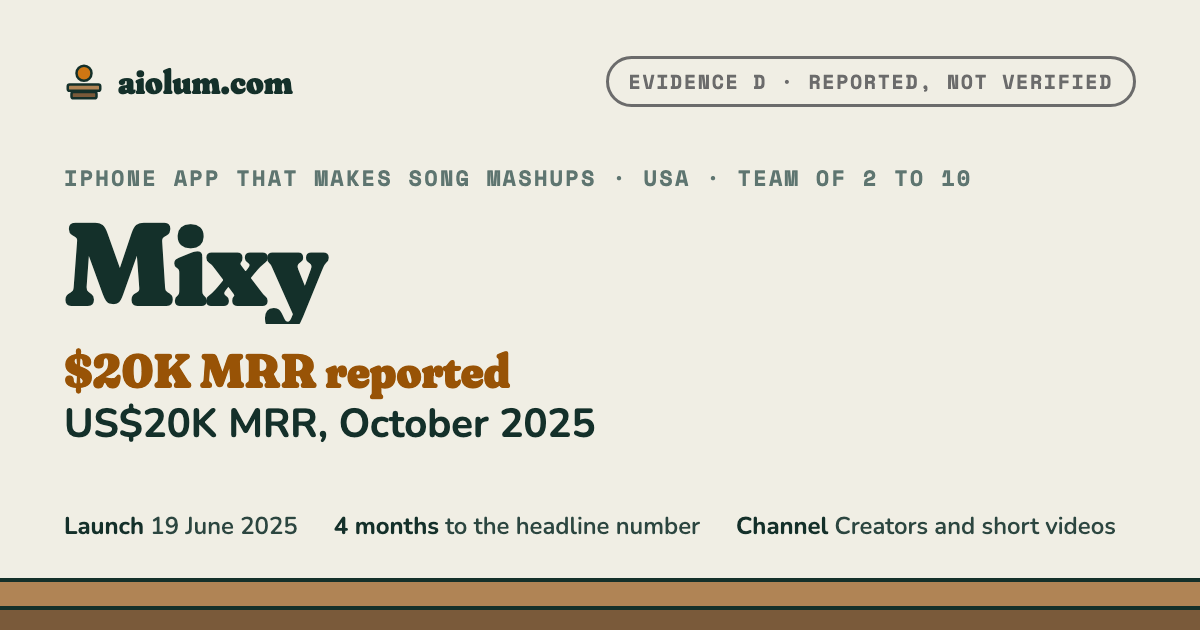
Mixy (iPhone app that makes song mashups, USA): US$20K MRR, October 2025. Evidence grade D: reported, not verified. Team: 2 co-founders (team size 2 on the Y Combinator page, November 2026). Launched 19 June 2025; still running.Added 5 November 2026
- Outcome
- US$20K MRR, October 2025
- Evidence
- D reported, not verified
- Launch
- 19 June 2025
- Status
- Still running
- Team
- 2 co-founders (team size 2 on the Y Combinator page, November 2026)
- Outside funding
- Y Combinator, Fall 2025 batch; amount not stated in the sources
- Group
- Voice and audio
- Main channel
- Creators and short videos
What is not verified
The headline, US$20,000 MRR in October 2025, rests on one statement by the founders in their Y Combinator launch post of 4 November 2025, repeated in the same words on Product Hunt. No payment-processor profile, App Store revenue data or press report was found. The same post claims "$200k in donations" without saying what they were. A reader could look for a later interview with dated figures, or third-party App Store revenue estimates. The headline number is grade D: one claim or one estimate, with no second source. Aiolum shows it because the story is useful, and marks it so that it is not mistaken for a verified figure.
Mixy is an iPhone app that makes a mashup, a new track built from parts of two or more existing songs, usually the vocals of one song over the instrumental beat of another. To do this, the app must split each song into stems, separate audio tracks for vocals, drums, bass and other parts, and then match tempo and key so the parts fit. The founders wrote in their Y Combinator launch post of 4 November 2025 that they had "optimized our own local models", which means the AI runs on the phone and not on a paid cloud service.
Joe Kennedy (CEO) and Jonah Siegle (CTO) met as tech YouTubers in 2008 and started Mixy at the end of 2024. They posted prototypes on TikTok, and they said this brought more than 350,000 pre-orders. The app launched on 19 June 2025. In the November 2025 launch post the founders said Mixy had 1.5 million users in three months, 18 million mashups, "$200k in donations" and "$20k MRR since launching our subscription last month". MRR means monthly recurring revenue, the subscription income of one month. The company is in the Y Combinator Fall 2025 batch, and the Y Combinator page lists a team of 2.
The money figure is one founder statement with one date, repeated word for word on Product Hunt, so it is grade D. The sources do not explain what the US$200,000 in donations was. The app is still updated (version 1.7.2, 27 October 2026), but one App Store review from October 2026 says the app's online sharing services were turned off, and the app's relationship with the owners of the songs it mixes is not described in any source.
How much revenue does Mixy make?
Each row shows the evidence grade and the source numbers from the list at the end of this page. The grades are explained in How Aiolum verifies.
| Fact | Value | Grade | How we know | Sources |
|---|---|---|---|---|
| Monthly recurring revenue, October 2025 | US$20,000 | D | Founders' Y Combinator launch post, created 4 November 2025: "$20k MRR since launching our subscription last month". Repeated word for word on Product Hunt on 11 November 2025. No second source. | [1, 6] |
| Run rate from the October 2025 figure | about US$240,000 a year | calc | Calculated: US$20,000 times 12. This is the headline value used for sorting. | [1] |
| Donations since launch | US$200,000 | D | Same post: "$200k in donations". Neither the post nor any other downloaded source says who donated, for what, or whether this is revenue. It is not counted in the headline. | [1] |
| Users | 1.5 million in three months | D | Founders, on the Y Combinator company page and in the launch post. | [1, 2] |
| Mashups made | 18 million (launch post) and 15 million (company page) | D | Two founder figures that differ; the company page text may be older. | [1, 2] |
| Pre-orders before launch | more than 350,000 | D | Founders: "Prototypes were shared on TikTok, which led to over 350k pre-orders before launch." | [1] |
| App Store rank at launch | #1 in Music, #3 overall | D | Founders' statement. Not checked against chart data. | [1, 2] |
| App Store ratings | 19K ratings, 4.3 out of 5 | C | US App Store page, read 5 November 2026. Age rating 13+. Seller: Mixy, Inc. | [3] |
| Latest version | 1.7.2, 27 October 2026 | C | App Store version history. Version 1.5 (19 January 2026) is described as "A brand new mixing engine". | [3] |
| Team | 2 | C | Y Combinator company page: team size 2, Joe Kennedy (Founder/CEO) and Jonah Siegle (Founder/CTO). | [2] |
| Funding | Y Combinator, Fall 2025 | C | Y Combinator company page. No amount is stated in the sources. | [2] |
| Where the AI runs | the founders' own models, on the phone | D | Launch post: "We've optimized our own local models to produce real time, high quality mashups at no cost." No model name is given. | [1] |
| Legal home | Delaware, United States | C | Terms of service, effective 17 June 2025: governed by the laws of the United States and the State of Delaware. | [4] |
| Time from launch to the October 2025 figure | 4 months | calc | Calculated: June 2025 to October 2025. | [1, 3] |
How to read this table: grade D is a founder statement with one date and no second source. Grade C here is a public listing (the App Store page, the company's terms) read on 5 November 2026. A "calc" value was computed on this page. No value is grade A or B.
| Plan | Per month, billed yearly (US$) | Per month, billed monthly (US$) | Limit |
|---|---|---|---|
| Mixy Pro, lowest listed price | 6.99 | billing period not shown on the App Store page | |
| Mixy Pro, most often listed price | 9.99 | listed four times; billing period not shown | |
| Mixy Pro Offer | 24.99 | billing period not shown | |
| Mixy Pro, higher price | 49.99 | listed twice; billing period not shown | |
| Mixy Pro, highest listed price | 99.99 | billing period not shown |
The app is free to download. The App Store page lists nine Mixy Pro in-app purchases at US$6.99, US$9.99, US$24.99 (marked Offer), US$49.99 and US$99.99, but does not say which is weekly, monthly or yearly. App Store reviews from 20 and 21 June 2025 describe a membership of US$5 a week at launch. The terms say a subscription may start with a free trial and renews automatically.
When did Mixy launch, and how did it grow?
From TikTok prototypes at the end of 2024 to a Y Combinator company with a subscription, in about one year. Each entry carries its grade.
- 2008DJoe Kennedy and Jonah Siegle meet as tech YouTubers; they start building apps together in 2009. Later they work at Apple, Instagram and Skillshare. [1]
- End of 2024DThey start Mixy as a way for fans to make mashups of their favorite songs and post prototypes on TikTok. [1]
- 17 June 2025CThe terms of service take effect. [4]
- 19 June 2025CLaunch on the App Store. The founders say it reached #1 in Music and #3 overall. First reviews on 20 June mention a US$5 weekly membership and login delays. [1, 3]
- September 2025D1.5 million users in three months, by the founders' account. [1, 2]
- October 2025DUS$20,000 MRR in the first month of the subscription, by the founders' account. [1]
- 4 November 2025CLaunch post on Y Combinator (Fall 2025 batch); the same text appears on Product Hunt on 11 November. [1, 6]
- 19 January 2026CVersion 1.5: "A brand new mixing engine". [3]
- October 2026CA user review says the online sharing services are down while mixing still works. Version 1.7.2 ships on 27 October. [3]
Why did Mixy work?
Four causes, in the order they mattered. Each one is a reusable lesson.
Pre-launch demand from short videos
The founders posted prototypes on TikTok before the app existed in the store. They said this produced more than 350,000 pre-orders, so the launch day had a large waiting audience, which is how a new app can reach the top of an App Store category on the first day.
On-device models, near-zero cost per mashup
Splitting songs into stems and blending them is heavy computing. The founders wrote that they optimized their own local models, so the work runs on the user's iPhone. A free app with millions of users would be expensive if every mashup ran on a rented GPU.
A sharing loop
The launch post describes mashups that are played and shared anywhere, and a music social network in which every source track is credited. A user review says users could comment on and remix other users' mashups in 2025. Each shared mashup is an advertisement for the app.
Subscription after reach
By the founders' account the subscription started about four months after launch, when the app already had 1.5 million users, and the founders said it brought US$20,000 MRR in its first month.
How it was built
These details come from the founders' launch post, the App Store page and the terms. Few technical details are public. [1, 3, 4, 5]
- An iPhone app (iOS 18 or later), 48.6 MB, sold by Mixy, Inc.
- The mixing runs on the founders' own optimized models on the phone, by their account; no model provider or model name is given in any source.
- Version 1.5 in January 2026 replaced the mixing engine.
- Payments go through Apple in-app purchases; the terms name Apple as a third-party payment provider.
- Marketing: prototypes on TikTok before launch, and the TikTok account @mixyjoe linked from the home page.
- The same company publishes Mixy Stems, Vidy (music videos) and Riff (making music together) on the App Store.
Tools named in the sources
Each one opens its page in the Tools tab, with every story that uses it.
Who tried this before Mixy, and why did they fail?
Four companies in our database of failed startups built consumer music products on songs that they did not own. The values below are from that database and are not independently verified.
Grooveshark
The promiseFree streaming of any song, uploaded by the users.
Why it diedIt never secured licenses from the major labels and was shut down after copyright lawsuits.
Songza
The promisePlaylists chosen for your mood and time of day.
Why it diedLicensing costs and larger services with better deals; Google bought it in 2014 and closed it later.
Twitter Music
The promiseFind music through what people share on Twitter.
Why it diedIt had no clear reason to exist next to dedicated streaming services and depended on their catalogues.
Mint Songs
The promiseArtists sell their songs to fans as NFTs.
Why it diedInterest ended with the NFT market in 2022.
The failed startups come from our database of 1,749 dead startups, retold here in our own words. Its entries are AI-assisted summaries of public sources, so these cards carry no evidence grade.
What changed
Grooveshark grew on songs that users uploaded and died in court because it had no label licenses. Songza and Twitter Music depended on catalogues that bigger companies licensed on better terms. Mixy also works on songs that it does not own, and no downloaded source says that it holds licenses from labels or publishers.
Two things differ. First, the heavy computing runs on the phone, so the founders say the cost per mashup is near zero, while a streaming service pays for every play. Second, the founders present Mixy as a tool that credits the source artists and plan to pay artists per second of play. Whether rights holders accept that is the open question for the business.
Can one person copy Mixy now?
The launch method, yes. The music rights, not alone.
Two engineers with an audience-building habit showed prototypes on TikTok, collected pre-orders and launched to a waiting crowd, with AI running on the phone so that growth did not raise costs. That method can be copied in any consumer niche where short videos show the result. Doing it with other people's songs adds a legal question that needs lawyers and, in the long run, label agreements.
Where it is still open: On-device AI tools for creators where the output is fun to share: audio effects, music practice, video edits, with content the user owns or that is licensed.
- 1Post short videos of a working prototype before launch and collect pre-orders or a waitlist.
- 2Run the model on the device when the task allows it, so that each free user costs almost nothing.
- 3Make every result shareable, with the app's name on it.
- 4Add the subscription after the user base exists, and test the price.
What could go wrong for Mixy?
The risks are the mirror image of the causes above.
What is not verified
The headline, US$20,000 MRR in October 2025, rests on one statement by the founders in their Y Combinator launch post of 4 November 2025, repeated in the same words on Product Hunt. No payment-processor profile, App Store revenue data or press report was found. The same post claims "$200k in donations" without saying what they were. A reader could look for a later interview with dated figures, or third-party App Store revenue estimates.
Music copyright and label licensing
Mixy mixes commercial songs. No downloaded source says that Mixy has licenses from record labels or music publishers. The terms of service (effective 17 June 2025) put the responsibility on the user: users must not upload content "to which you do not hold the necessary rights", Mixy follows the DMCA takedown process, and the terms forbid content that imitates an artist "through the use of AI-generated voice or audio". A user review from June 2025 speaks of the app's own music library, which suggests the app also supplies songs. A user review from October 2026 says the online sharing services were down and that sharing copyrighted music "would be problematic"; the company has not said why. The founders' plan is to credit every source track and pay artists per second of play.
Dependence on the App Store
Mixy is an iPhone-only app and takes payments through Apple in-app purchases, so Apple's review rules and its share of each payment apply. The App Store age rating is 13+, and the listing says the app contains user-generated content and messaging.
Dependence on model providers
By the founders' account the mixing uses their own models running on the phone, which means no model provider sits between Mixy and its users. No source names the models or the training data, so it is not known what the models were trained on.
Pricing statements disagree
The launch post dates the subscription to October 2025, but App Store reviews from 20 and 21 June 2025 already describe a US$5 weekly membership. The App Store page lists nine Mixy Pro prices without their billing periods.
Sources
The grade next to each source is the best grade that the source can support. "Read in full" means that the text of the page was downloaded and the numbers were checked in it.
- D Y Combinator Launches, 4 November 2025: Mixy - Make Mashups, Remix your music without knowing how to DJRead in full. The founders' own post. Source for the MRR, donations, users, pre-orders, local models and the founders' background.
- C Y Combinator company page: Mixy, Make mashups without knowing how to DJRead in full on 5 November 2026. Source for the team size, the founders' titles, the batch and the company description.
- C App Store: Mixy - Make MashupsRead in full on 5 November 2026: ratings, version history, in-app purchase prices, age rating, seller and the reviews shown on the page.
- C Mixy terms of service, effective 17 June 2025Read the sections on content, licenses, prohibited uses, subscription, copyright notices and governing law.
- C Mixy home pageRead in full; links to the App Store, the TikTok account @mixyjoe, the terms and the privacy policy.
- D Product Hunt: Mixy, Make Mashups (featured 11 November 2025)Read in full. The same founder text as the Y Combinator launch post; not an independent source.
- C Database of failed startups, local exportLocal export. AI-written summaries, not independently verified. Source for the failed predecessors.
Run this company? Send corrections or a verified figure to aiolum@livyden.com