OpenHands: Product, team and how it was built
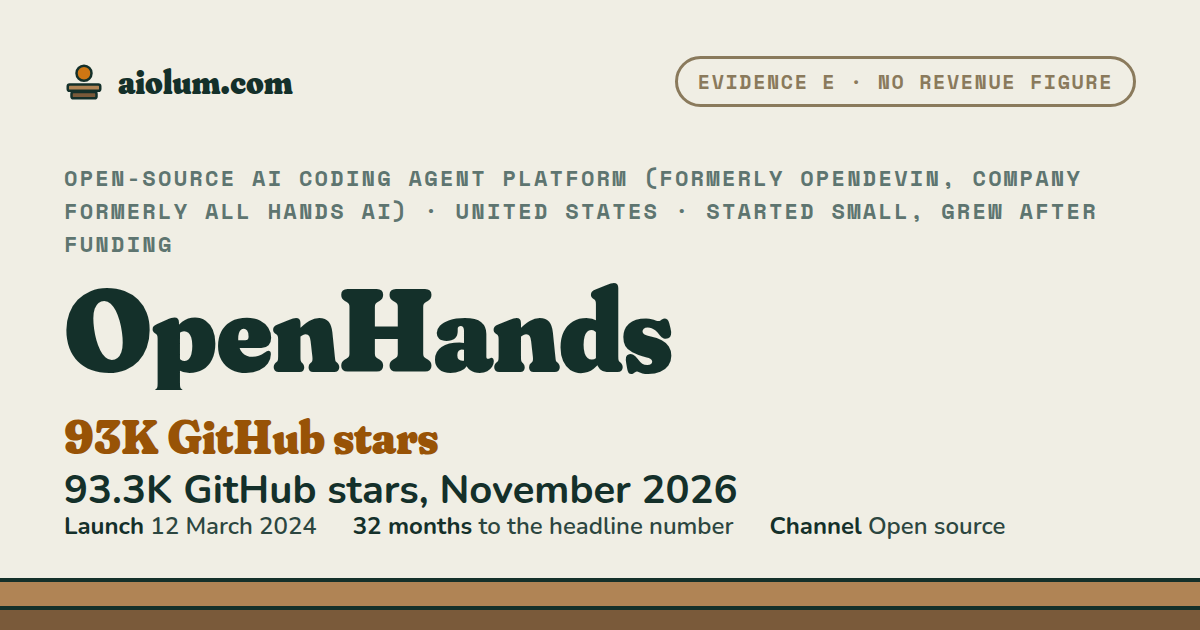
OpenHands (Open-source AI coding agent platform (formerly OpenDevin, company formerly All Hands AI), United States): 93.3K GitHub stars, November 2026. Evidence grade E: no revenue figure was checked. Team: 3 founders in July 2024; 27 people on the About page in November 2026, after a US$5M seed and a US$18.8M Series A (company statements). Launched 12 March 2024; still running, revenue growing.Added
- Outcome
- 93.3K GitHub stars, November 2026Revenue growing
- Evidence
- E no revenue figure was checked
- Launch
- 12 March 2024
- Status
- Still running
- Team
- 3 founders in July 2024; 27 people on the About page in November 2026, after a US$5M seed and a US$18.8M Series A (company statements)
- Outside funding
- US$5M seed, September 2024; US$18.8M Series A, November 2025 (company statements)
- Main channel
- Open source
What is not verified
No revenue figure was found, and no source states that a customer has paid. The pages read were the company's site, its blog and press page, two case studies, an independent news site and GitHub. The Business Wire releases could not be opened, because its robots.txt request timed out. A reader could look for a payment-processor profile, a filing or an interview with the founders. The paying plan rests on the company's own pricing page and trial sign-up. The company's blog and release are the only sources for the US$5 million and US$18.8 million rounds. The company's start date is its announcement, not an incorporation record. This story is grade E: the business is real and its product, price and customers are described from public pages, but no revenue figure was checked. Aiolum shows it as an idea worth studying, not as proof that it makes money.
OpenHands is an AI coding agent platform. An agent is a program that plans a task, runs commands and changes files by itself, unlike an assistant that suggests lines. The core is open source: anyone may read, copy and change the code under the MIT license. The company sells team plans.
The project began on 12 March 2024 as OpenDevin, an open copy of the Devin demo by Cognition. Two researchers from the Qwen model team started it. Robert Brennan, Graham Neubig and Xingyao Wang joined as early contributors and then founded All Hands AI, which announced itself on 15 July 2024. The company states it raised US$5 million in September 2024 and US$18.8 million in November 2025.
No revenue figure was found, so this story is grade E. The headline is the 93.3K stars that GitHub shows on 12 November 2026. The Teams plan, at US$500 a month, and two named customers come from the company's own pages.
Why did OpenHands work?
Four causes, in the order they mattered. Each one is a reusable lesson.
It began as a public project that gathered contributors fast
The repository started as a README. Neubig added a front end soon after the README, the interview says. Brennan wrote that within a few weeks the team had replicated the main functions of Devin. Brennan and Neubig met in the project's Slack. The company announced itself only in July 2024.
Paid staff replaced volunteers when the work became too much
Brennan wrote in June 2025 that he worked 2 to 4 hours a day on the project on top of a full-time job. He quit that job. After the seed round the company hired developers and a community manager, and the community responded, he wrote.
Free code serves individuals and paid plans serve teams
The company states that the free project gets all its code-agent research, about a third of the engineering team. It states that the paid product adds what teams need: user management, cloud deployment and control. Brennan wrote that development time is about half open source and half commercial.
How it was built
These details come from the company's blog posts and pages. They are grade C. [10, 1, 12, 9, 8]
- Every agent runs in an isolated Docker sandbox, the company wrote in November 2025, and works with any model, including the customer's own.
- The product runs on a laptop, in the cloud or in a customer's own network. The home page lists local, cloud sandbox and enterprise VPC.
- In September 2025 the company wrote that its cloud ran mainly on Claude Sonnet and charged 2 times the API cost. It then changed to a US$20 monthly subscription and model choice at no markup.
- The company states that the free project is single-user and has no built-in user management. Teams and Enterprise add identity, access control and budgets.
- Two founders say they met in the project's community Slack. One says a Product Hunt feature came in the first week or so of the working version.
Tools named in the sources
Each one opens its page in the Tools tab, with every story that uses it.
Who tried this before OpenHands, and why did they fail?
Four companies in our database of failed startups built developer tools that free alternatives or large platforms later covered. The values below are from that database and are not independently verified.
Kite
The promiseAI code completion inside the editor, made with machine learning before the large language models.
Why it diedGitHub Copilot launched in June 2021 on a stronger model, and the record says Kite's older models could not match it.
CodeSee
The promiseAutomatic maps of a codebase, to help developers understand unfamiliar code.
Why it diedDevelopers liked the demos, but could not show their managers a return. Teams used free alternatives, says the record.
Sider
The promiseAutomated code review and static analysis for software teams.
Why it diedFree linters and CI tools covered most needs, and large security suites covered the rest, the record says.
Nitrous.io
The promiseA cloud development environment that a developer could open from any computer.
Why it diedAmazon offered Cloud9 cheaply inside AWS, and GitHub's ecosystem grew. The record says Nitrous built a feature, not a platform.
The failed startups come from our database of 1,749 dead startups, retold here in our own words. Its entries are AI-assisted summaries of public sources, so these cards carry no evidence grade.
What changed
Each of the four sold a developer tool that a larger platform or a free tool later matched. Their records name Copilot, free linters, Cloud9 and the lack of a clear return on cost. OpenHands has the same risk: GitHub, Anthropic and OpenAI sell their own coding agents.
The sources show two differences. The core is free and open, so the price war that hurt Kite and Sider does not reach it. The company states that the code stays open. The paid layer is for teams that need control over agents, and it works with any model and any agent. Whether customers pay enough for that layer is not shown by any source read.
Can one person copy OpenHands now?
The structure, yes. The scale, no.
A solo founder cannot copy the team and funding, but can copy the order: open project first, paid team features second. The founders joined a project that already had many stars on GitHub, one founder says, and they raised money after that. Nobody has shown a revenue figure, so the sources do not prove that the order pays.
Where it is still open: Other open-source tools where companies need user management, audit trails and budgets before they can approve the tool.
- 1Publish a working version in the open, with a license that lets others use it.
- 2Answer issues and merge pull requests quickly, so contributors stay.
- 3Keep single-user use free, and charge for what only teams need: users, access control and audit.
- 4Let customers bring their own model key, so the model is never your cost.
How much revenue does OpenHands make?
Each row shows the evidence grade and the source numbers from the list at the end of this page. The grades are explained in How Aiolum verifies.
| Fact | Value | Grade | How we know | Sources |
|---|---|---|---|---|
| Project start as OpenDevin | 12 March 2024 | C | Company blog, 17 March 2025: the project began on that day. Two researchers from the Qwen team created it. | [7] |
| Company founded as All Hands AI | announced 15 July 2024 | C | Company blog: "a new company founded by" the three founders. No incorporation date was found. | [4] |
| Renaming of the project to OpenHands | before 5 September 2024 | C | The company press release of that day writes "OpenHands (formerly OpenDevin)". No rename date was found. The site and the 2025 press now call the company OpenHands, and the privacy policy still names All Hands AI. | [5, 15] |
| Founders | Robert Brennan (CEO), Graham Neubig (Chief Scientist), Xingyao Wang (Chief AI Officer) | C | Company blog and press release name the three as founders. The About page gives the titles. The AI Insider, 8 September 2024, repeats it. | [4, 5, 6, 3] |
| People on the About page, November 2026 | 27 named | C | Counted from the page on 12 November 2026. The three founders are among them. | [3] |
| Seed round, September 2024 | US$5 million, led by Menlo | C | Company press release of 5 September 2024. The AI Insider retells it on 8 September 2024 and says the team plans enterprise features first. | [5, 6] |
| Series A, November 2025 | US$18.8 million, led by Madrona | C | Company blog of 18 November 2025. The press page lists a Business Wire release of the same day, which could not be opened. | [10, 11] |
| Cloud subscription, September 2025 | US$20 a month | C | Company blog of 18 September 2025. Before that, the cloud charged 2 times the model's API cost, the same post states. | [12] |
| Teams plan, 12 November 2026 | US$500 a month for up to 10 users | C | Pricing page, with a 30-day trial and a trial sign-up page. No source states that a customer has paid for it. | [2] |
| GitHub counters, 12 November 2026 | 93.3K stars, 12.5K forks | C | Shown by GitHub on the repository page. The company's home page shows the same 93.3K. In November 2025 the company wrote 65,000 stars. | [16, 1, 10] |
| Customers named by the company | US Mobile (September 2025), C3 AI (December 2025) | C | Two case studies on the company's own blog. They name the customers, but give no payment or contract amount. | [13, 14] |
| Time from the project start to the headline | 32 months | calc | Calculated: March 2024 to November 2026. | [7, 16] |
How to read this table. Every row is grade C: a statement on the company's own pages, or a counter shown by a platform. No row is checked by a payment processor, a filing or a buyer.
| Plan | Per month, billed yearly (US$) | Per month, billed monthly (US$) | Limit |
|---|---|---|---|
| Agent Canvas, open source | 0 | 0 | single user; MIT license; bring your own LLM key |
| Teams | 500 | up to 10 users, 50 more per extra seat; 5,000 sessions a month; 30-day trial | |
| Enterprise | custom price; unlimited users; self-hosted |
The Teams plan is billed per month, and the page shows no yearly price. It starts with a 30-day trial. The page says the plan is capped at 5,000 sessions a month. Enterprise has no published price. The customer pays the model provider separately, because the plans use the customer's own LLM key.
When did OpenHands launch, and how did it grow?
From a README-only project to a funded company with an enterprise product, in 32 months. Each entry carries its grade.
- 12 March 2024CThe OpenDevin project begins as an open copy of the Devin demo. The three later founders join in its first weeks. [7, 8]
- 15 July 2024CAll Hands AI is announced as a new company by Brennan, Wang and Neubig. It starts hiring full-time staff. [4]
- 5 September 2024CThe company states a US$5 million seed round. The project has more than 30,000 GitHub stars, the release says. [5]
- 18 September 2025CThe company wrote that the cloud moves from 2 times the model cost to a US$20 monthly subscription with no markup. [12]
- 18 November 2025CThe company states a US$18.8 million Series A led by Madrona. It wrote about 65,000 stars and over 3 million downloads. [10]
- 12 November 2026CThe pricing page lists a Teams plan at US$500 a month. GitHub shows 93.3K stars. [2, 16]
What could go wrong for OpenHands?
The risks are the mirror image of the causes above.
What is not verified
No revenue figure was found, and no source states that a customer has paid. The pages read were the company's site, its blog and press page, two case studies, an independent news site and GitHub. The Business Wire releases could not be opened, because its robots.txt request timed out. A reader could look for a payment-processor profile, a filing or an interview with the founders. The paying plan rests on the company's own pricing page and trial sign-up. The company's blog and release are the only sources for the US$5 million and US$18.8 million rounds. The company's start date is its announcement, not an incorporation record.
Home page counters, logos and quotes
The home page has a "Trusted by engineers at" logo wall without names in its text or image labels. The image file names point to large firms such as Amazon, Google and Netflix. The company wrote in 2025 that engineers at such companies use the platform, and it did not call them customers. The page shows eight developer quotes with names or X handles, and two carry job titles at Oracle and Walmart. It also shows a partner quote from a director at AMD, and the line "Join millions of developers" with no source. This story does not check them. The counters differ between pages: 595 contributors on the home page and "500 +" on the About page. The company wrote 7,000 forks in 2025, and GitHub shows 12.5K today.
Names and domains changed
The project was OpenDevin, then OpenHands, and the company was All Hands AI. The company's address all-hands.dev opens the OpenHands site, and the privacy policy of 3 September 2025 still names All Hands AI and that domain. No source gives the date when the company changed its name.
The founders still work in research
Neubig is an associate professor at Carnegie Mellon University, the 2024 release states. The paper on the platform lists the three founders among its authors. The company wrote in 2025 that about a third of its engineers work on research.
Sources
The grade next to each source is the best grade that the source can support. "Read in full" means that the text of the page was downloaded and the numbers were checked in it.
- C OpenHands home page, read 12 November 2026Read in full. Source for the counters, the product description, the logo wall, the quotes and the supported runtimes.
- C OpenHands pricing page, read 12 November 2026Read in full. Source for the three plans, the price, the trial and the session cap.
- C OpenHands About page, read 12 November 2026Read in full. Source for the founders' titles and the 27 names.
- C Introducing All Hands AI, company blog, 15 July 2024Read in full. Source for the company announcement and the three founders.
- C Press Release: All Hands Announces $5M to Scale AI Agent for Software Development, 5 September 2024Read in full. A company press release. Source for the seed round, the founders' backgrounds and "formerly OpenDevin".
- C The AI Insider: All Hands AI Announces $5M to Advance Open-source AI Agents for Developers, 8 September 2024Read the article text. An independent site that retells the release. Source for the founders and the enterprise-features plan.
- C One Year of OpenHands (first anniversary post), company blog, 17 March 2025Read in full. Source for the start date of 12 March 2024, the OpenDevin origin and the creation of the company.
- C OpenHands: From README to open source movement, company blog, 17 October 2024Read in full. Interview with the three founders. Source for how they joined the project.
- C Walking the Line with Commercial Open Source, company blog, 11 June 2025Read in full. Written by the CEO. Source for the staffing, the research share and the open-source line.
- C We've Just Raised $18.8M to Build the Open Standard for Autonomous Software Development, company blog, 18 November 2025Read in full. Source for the Series A, the 2025 counters and the sandbox design.
- C OpenHands press page, read 12 November 2026Read in full. Lists the Business Wire release of 18 November 2025, which could not be opened.
- C All New OpenHands Cloud: More Model Choice, Lower Prices, Slicker Design, company blog, 18 September 2025Read in full. Source for the earlier 2 times pricing and the US$20 subscription.
- C Case Study: US Mobile and OpenHands, company blog, 9 September 2025Read in full. A case study written by the company. It names the customer and gives no payment.
- C Eight billion tokens in two weeks: How C3 AI brings agentic coding to every team with OpenHands, company blog, 17 December 2025Read in full. A case study written by the company. It names the customer and gives no payment.
- C OpenHands privacy policy, effective 3 September 2025Read in full. Names All Hands AI and mentions a third-party payment processor without a name.
- C GitHub repository page of OpenHands, read 12 November 2026Read the counters. The older address under All-Hands-AI leads to this page.
- C arXiv 2407.16741: OpenHands: An Open Platform for AI Software Developers as Generalist Agents, 23 July 2024Read the abstract page. Lists the three founders among 24 authors.
- C Database of failed startups, local exportRecord pages read on the website on the day of writing. AI-written summaries, not independently verified. Source for the failed predecessors.
Run this company? Send corrections or a verified figure to aiolum@livyden.com