Prometheo: Revenue, team and how it was built
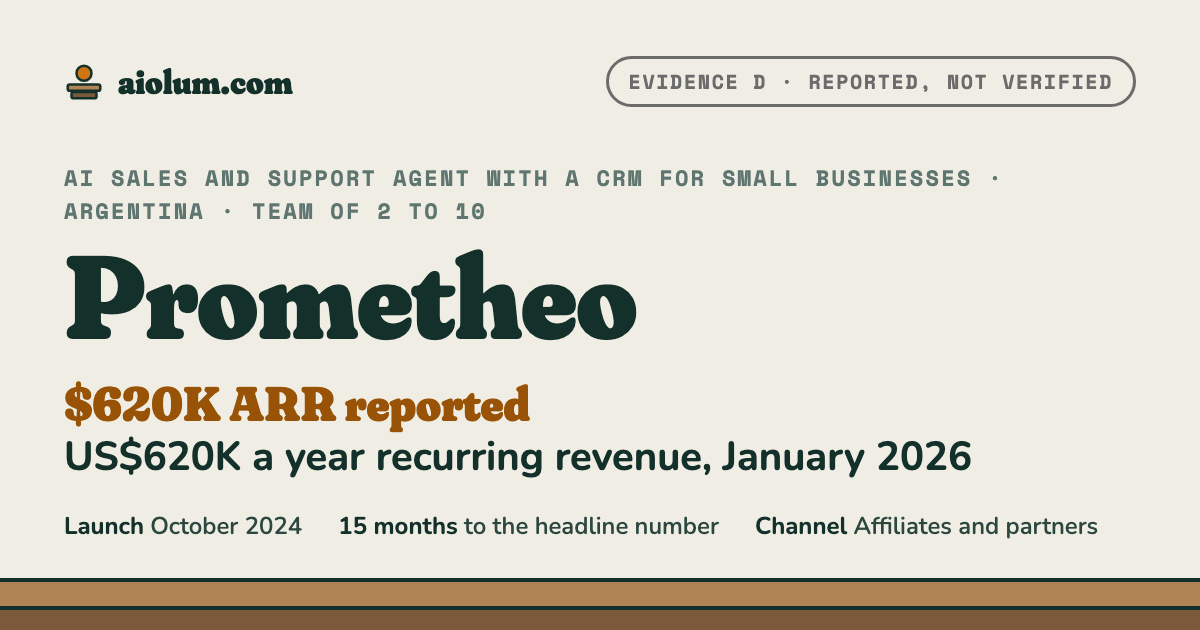
Prometheo (AI sales and support agent with a CRM for small businesses, Argentina): US$620K a year recurring revenue, January 2026. Evidence grade D: reported, not verified. Team: 2 co-founders who met at school; headcount not published. Launched October 2024; still running, revenue growing.Added 5 November 2026
- Outcome
- US$620K a year recurring revenue, January 2026Revenue growing
- Evidence
- D reported, not verified
- Launch
- October 2024
- Status
- Still running
- Team
- 2 co-founders who met at school; headcount not published
- Outside funding
- No outside investment; funded by the founders and by ITESA's income, per the founders
- Main channel
- Affiliates and partners
What is not verified
The headline figure of US$620,000 in annual recurring revenue rests on one source: the company's statement to Ámbito, reprinted by Universidad Torcuato Di Tella on 22 January 2026. No payment-processor profile, filing or document supports it. The partner-channel figure of about US$150,000 a year (iProfesional, 3 October 2025) is also a company statement. The July 2026 article gives only a projection of '3 y 4 millones' with no currency. A reader could look for a TrustMRR or other payment-processor profile, or the company's accounts in the Argentine register. The headline number is grade D: one claim or one estimate, with no second source. Aiolum shows it because the story is useful, and marks it so that it is not mistaken for a verified figure.
Prometheo is a conversational CRM, a customer relationship management system (a list of customers and leads with their history) in which most of the work happens inside chat conversations. The business connects its WhatsApp number and social accounts, describes its products and rules, and an AI agent, a program that uses a large language model to read each message and decide what to answer and what to do next, replies to customers, sorts leads by interest and books meetings. It connects to shop and payment systems such as Tiendanube, Mercado Libre and Mercado Pago. The sources do not say which AI models it uses.
Martín Pilossof and Juan Stein met at secondary school in Olivos, Buenos Aires, and in 2019 founded ITESA Innovation Company, a software studio. During an ITESA real-estate tokenization project tied to crypto, they connected an AI model to Instagram and WhatsApp in one weekend to answer the many questions from prospective clients; the users liked the automatic answers more than the crypto platform, so the founders made the answering tool a product. iProfesional reported in October 2025 that it launched formally in October 2024 and had almost 400 active clients. Ámbito reported in January 2026 that it had more than 500 clients and US$620,000 in annual recurring revenue, without outside investment.
The revenue figure is the company's own statement in one newspaper article, grade D. In July 2026 EmpreHouse reported more than 1,000 companies using it and growth of about eight times in the last year, but gave only a projection for revenue. The page also shows two features that a reader should know about: bulk WhatsApp campaigns to uploaded contact lists, and an unofficial WhatsApp connection by QR code that the company's own blog tells customers to leave.
How much revenue does Prometheo make?
Each row shows the evidence grade and the source numbers from the list at the end of this page. The grades are explained in How Aiolum verifies.
| Fact | Value | Grade | How we know | Sources |
|---|---|---|---|---|
| Annual recurring revenue, January 2026 | US$620,000 | D | Ámbito, reprinted by Universidad Torcuato Di Tella on 22 January 2026: 'algo más de 500 clientes y contabilizar u$s620.000 en ingresos anuales recurrentes (ARR)' (a little more than 500 clients and US$620,000 in annual recurring revenue, translation). A company figure, not checked against any document. | [1] |
| Monthly equivalent of the January 2026 figure | about US$51,667 a month | calc | Calculated: US$620,000 divided by 12. | [1] |
| Revenue through partners, October 2025 | about US$150,000 a year | D | iProfesional, 3 October 2025: 'Solo el canal de partners ya representa cerca de u$s150.000 anuales en ingresos' (the partner channel alone already brings about US$150,000 a year in revenue, translation). The same article says partners bring 40% of sales. | [2] |
| Total implied by the partner figure, October 2025 | about US$375,000 a year | calc | Calculated: US$150,000 divided by 0.40. Rough, because both inputs are rounded company statements. | [2] |
| Revenue projection | 3 to 4 million in billing 'next year', currency not stated | C | EmpreHouse, 7 July 2026: 'proyecta alcanzar entre 3 y 4 millones de facturación el próximo año' (it projects 3 to 4 million in billing next year, translation). A projection, not revenue. In October 2025 the stated goal for 2026 was more than US$1 million in annual recurring billing. | [3, 2] |
| Customers | almost 400 (October 2025), more than 500 (January 2026), more than 1,000 (July 2026) | C | Company counts in iProfesional, Ámbito and EmpreHouse. The home page says '+1000 empresas activas' (more than 1,000 active companies, translation) on 5 November 2026. | [2, 1, 3, 4] |
| Growth in the last year, July 2026 | about eight times | C | EmpreHouse: 'un crecimiento cercano a ocho veces en el último año' (growth of nearly eight times in the last year, translation). The article does not say eight times of what. | [3] |
| Launch | October 2024 | C | iProfesional: 'su lanzamiento formal, en octubre de 2024' (its formal launch, in October 2024, translation). Ámbito says it 'arrancó desde cero en noviembre de 2024' (started from zero in November 2024, translation). | [2, 1] |
| Founders and team | 2 co-founders; headcount not published | C | Martín Pilossof (business background) and Juan Stein (self-taught programmer and designer). EmpreHouse says the company 'proyecta duplicar su equipo' (plans to double its team, translation) but gives no number. | [1, 3] |
| Funding | no outside investment; about US$80,000 to build it | C | Ámbito: financed 'con inversión propia y reinversión de los ingresos de ITESA' (with own money and reinvested ITESA income, translation); initial development about US$80,000, 'según revelaron sus fundadores' (as the founders revealed, translation). | [1] |
| Share of sales through partners | 40% (October 2025 and January 2026), about 50% (July 2026) | C | Mainly marketing agencies. Partners earn a monthly commission that 'arranca en el 20% del abono' (starts at 20% of the subscription, translation), or pre-buy yearly licenses at a discount. | [2, 1, 3] |
| Markets | Argentina base; Mexico and Colombia; Brazil next | C | iProfesional lists 12 countries in October 2025; Ámbito says 10 countries in January 2026. | [2, 1, 3] |
| Time from launch to the January 2026 figure | 15 months | calc | Calculated: October 2024 to January 2026. | [2, 1] |
How to read this table: a grade D value is a company statement reported once in the press, with no document behind it. A grade C value is a statement by the company or its founders on its own pages or in interviews. An "X" value was computed on this page. No value is grade A or B. Spanish quotations are followed by an English translation marked "(translation)".
| Plan | Per month, billed yearly (US$) | Per month, billed monthly (US$) | Limit |
|---|---|---|---|
| Basic | 49 + AI credit | CRM, WhatsApp, Instagram and web chat; unlimited users and chats; no integrations | |
| Pro | 99 + AI credit | adds 1 marketplace integration, notifications, Facebook chat | |
| Enterprise | 149 + AI credit | 2 marketplace integrations, replies to social comments, bulk campaigns, Meta Ads and TikTok integration, onboarding calls |
The plan price does not include AI usage. Customers buy prepaid "saldos de IA" (AI credit); the page puts the average at about US$0.20 per conversation, charges US$10 of credit at sign-up and turns on automatic top-up. Meta's own WhatsApp message charges are extra. Invoices are issued on the 15th of each month. There is a free 7-day trial.
When did Prometheo launch, and how did it grow?
From a support tool inside a software studio to more than 1,000 business customers in about 21 months, by the company's own counts. Each entry carries its grade.
- October 2019CPilossof and Stein register ITESA Innovation Company, a software studio that, by their account, built more than 30 startups for founders in six countries. [1]
- 2024CDuring an ITESA real-estate tokenization project, they connect an AI model to Instagram and WhatsApp in one weekend to answer prospective clients. Users prefer the automatic answers to the crypto platform. [1, 2]
- October 2024CFormal launch of Prometheo as its own product. [2]
- 3 October 2025DiProfesional reports almost 400 active clients in 12 countries, plans from US$49 to US$149 a month, and partners bringing 40% of sales, about US$150,000 a year. [2]
- 22 January 2026DÁmbito reports more than 500 clients, US$620,000 in annual recurring revenue and a formal start in Colombia. [1]
- 7 July 2026CEmpreHouse reports more than 1,000 companies, growth of about eight times in a year, partners near 50% of sales, and Brazil as the next market. [3]
- 5 November 2026CThe site shows three plans, 29 integrations, bulk WhatsApp campaigns, and iPhone and Android apps. [4, 5]
Why did Prometheo work?
Four causes, in the order they mattered. Each one is a reusable lesson.
A tool found inside their own work
The product began as a weekend fix for too many customer questions in one ITESA project. The founders say the users valued the fix more than the project, and they built the company around it instead of around the original idea.
Sold through agencies
Marketing agencies already bring leads to small businesses and lose them when nobody answers. Prometheo gives those agencies a commission or discounted yearly licenses to resell it. The company said partners brought 40% of sales in October 2025 and about 50% in July 2026, which let it enter several countries without its own sales team there.
Price split between seat and usage
A fixed monthly plan pays for the software, and the customer prepays the AI usage separately as credit. The company does not carry the model cost of a busy customer, and the pricing page lists that cost openly, per conversation.
Integrations with regional systems
It connects to Tiendanube, Mercado Libre, Mercado Pago and Tokko Brokers, which are widely used in Latin America, so an agent can check stock, take a deposit or book a property visit inside the chat.
How it was built
Few technical details are public. These come from the company's site and press interviews, grade C. [1, 2, 4, 6]
- Stein, the technical co-founder, taught himself programming; ITESA, the founders' software studio, built the product and paid for it.
- The first version connected an AI model to Instagram and WhatsApp in one weekend. The sources do not name the model or provider.
- WhatsApp runs through Meta's official API in 'Coexistence' mode, which lets the same number stay in use on the phone; an older QR-code connection also exists (see Watch).
- The pricing page lists 29 integrations, 8 channels and 7 extensions, including Tiendanube, Mercado Libre, Mercado Pago, Google Calendar and Meta Ads.
- The site's page source shows it is built with the Next.js web framework. There are iPhone and Android apps.
Tools named in the sources
Each one opens its page in the Tools tab, with every story that uses it.
Who tried this before Prometheo, and why did they fail?
Three companies in our database of failed startups sold automated customer conversations or all-in-one software to businesses and failed. The values below are from that database and are not independently verified.
Vanti
The promiseAI conversational commerce: chatbots that guide shoppers to buy.
Why it diedShoppers did not want to buy through chat on brand sites; high sales cost and integration work hurt the unit economics.
Answerly
The promiseAutomated answers on company websites to cut support tickets.
Why it diedLanguage technology of the time matched questions to canned answers badly, and Zendesk and Intercom held the market.
Kyte (B2B SaaS)
The promiseAll-in-one operations software, with CRM, for small businesses in India.
Why it diedSmall businesses paid little and churned, while selling to them needed people; the money ran out.
The failed startups come from our database of 1,749 dead startups, retold here in our own words. Its entries are AI-assisted summaries of public sources, so these cards carry no evidence grade.
What changed
Vanti and Answerly sold automated conversations before language models could hold a real conversation; their bots matched keywords to fixed answers, and customers noticed. Prometheo's agent writes each answer from the context of the chat, and the founders say customers already use AI in daily life, so adoption is faster.
Kyte shows the risk that remains: small businesses pay little and need help to start. Prometheo answers this in two ways that the sources describe. Setup is self-service, which the founder said takes five minutes, and agencies that already serve these businesses do much of the selling and onboarding for a commission.
Can one person copy Prometheo now?
The method, yes. The head start, partly.
Two founders with a software studio turned a tool from their own client work into a product, then sold it through agencies instead of hiring salespeople. A solo founder can copy the pattern for one country or one industry, such as clinics or property agents, but needs approval from Meta for official WhatsApp access and must compete with many similar tools.
Where it is still open: Industry-specific agents in other regions where small businesses sell through chat apps: Brazil, Southeast Asia, India and Africa, each with its own marketplaces and payment systems.
- 1Look in your own client projects for the side tool that users like more than the main product.
- 2Use the official WhatsApp Business API from the start, not a QR-code connection.
- 3Charge a fixed plan and pass the AI usage through as prepaid credit, so a heavy user never costs you money.
- 4Recruit marketing agencies as resellers with a clear, stated commission.
- 5Integrate the shop, payment and booking systems that your region actually uses.
What could go wrong for Prometheo?
The risks are the mirror image of the causes above.
What is not verified
The headline figure of US$620,000 in annual recurring revenue rests on one source: the company's statement to Ámbito, reprinted by Universidad Torcuato Di Tella on 22 January 2026. No payment-processor profile, filing or document supports it. The partner-channel figure of about US$150,000 a year (iProfesional, 3 October 2025) is also a company statement. The July 2026 article gives only a projection of '3 y 4 millones' with no currency. A reader could look for a TrustMRR or other payment-processor profile, or the company's accounts in the Argentine register.
Bulk WhatsApp campaigns to uploaded lists
The Enterprise plan includes "Campañas de envíos masivos" (bulk sending campaigns, translation). The feature page says "Segmentás por Smart Tag dentro de Prometheo o subís una base externa en Excel" (you segment by Smart Tag inside Prometheo or upload an outside list in Excel, translation), and that messages go out "con plantillas aprobadas por Meta" (with templates approved by Meta, translation). The pages read for this story do not say how Prometheo collects the consent of the people on uploaded lists.
An unofficial WhatsApp connection
The company's own blog, undated, says many customers connect WhatsApp by QR code and that "El método QR no es oficial y, por lo tanto, está expuesto a riesgos de bloqueos o restricciones por parte de Meta" (the QR method is not official and is therefore exposed to blocks or restrictions by Meta, translation). It says "Prometheo recomienda a sus clientes migrar" (Prometheo recommends that its customers migrate, translation) to the official Coexistence API. The pages read on 5 November 2026 do not say whether the QR option is still offered to new customers.
Dependence on Meta and on model providers
Most conversations run on WhatsApp, Instagram and Facebook, all owned by Meta, which sets the access rules and prices; the company's blog says Meta charges per message sent from 1 October 2026. The AI answers come from language models whose provider the sources do not name, so a price change by that provider moves the cost of every conversation.
Many competitors, and a team size that is not public
AI agents for WhatsApp sales are sold by many companies in Latin America and worldwide, and one testimonial on the home page compares Prometheo with building the same thing in n8n, an automation tool. No source gives the number of employees; the company said in July 2026 that it plans to double its team, and its parent studio ITESA ran a network of more than 100 freelancers, so the people working on the product may be more than the two founders.
Sources
The grade next to each source is the best grade that the source can support. "Read in full" means that the text of the page was downloaded and the numbers were checked in it.
- D Una startup argentina fundada hace apenas un año creó una solución de IA para pymes que se expandió por América latina (Jorge Velázquez, Ámbito, reprinted by Universidad Torcuato Di Tella, 22 January 2026)Read in full. The university's press page reprints the Ámbito article and links to it. Source for the US$620,000 ARR, the client count, the founding story, ITESA and the funding.
- D Son argentinos y crearon una herramienta con inteligencia artificial para vender más (iProfesional, 3 October 2025)Read in full. Interview with Martín Pilossof. Source for the launch date, the prices, the partner program and the partner revenue.
- C Se conocieron en el colegio y hoy impulsan con IA a más de 1.000 empresas en América Latina (EmpreHouse, 7 July 2026)Read in full. Source for the 1,000 companies, the eight-times growth, the projection, the partner share and the markets.
- C Prometheo home and pricing pageRead in full on 5 November 2026. Source for the plans, the AI credit, the features, the integrations count, the testimonials and the app links.
- C Campañas masivas · Prometheo (feature page)Read in full on 5 November 2026. Source for the bulk WhatsApp campaigns and uploaded lists.
- C WhatsApp Coexistence o QR? · Blog PrometheoRead in full on 5 November 2026; the post shows no date. Source for the QR connection and the official API.
- C Database of failed startups, local exportLocal export. AI-written summaries, not independently verified. Source for the failed predecessors.
Run this company? Send corrections or a verified figure to aiolum@livyden.com