Runlayer: Product, team and how it was built
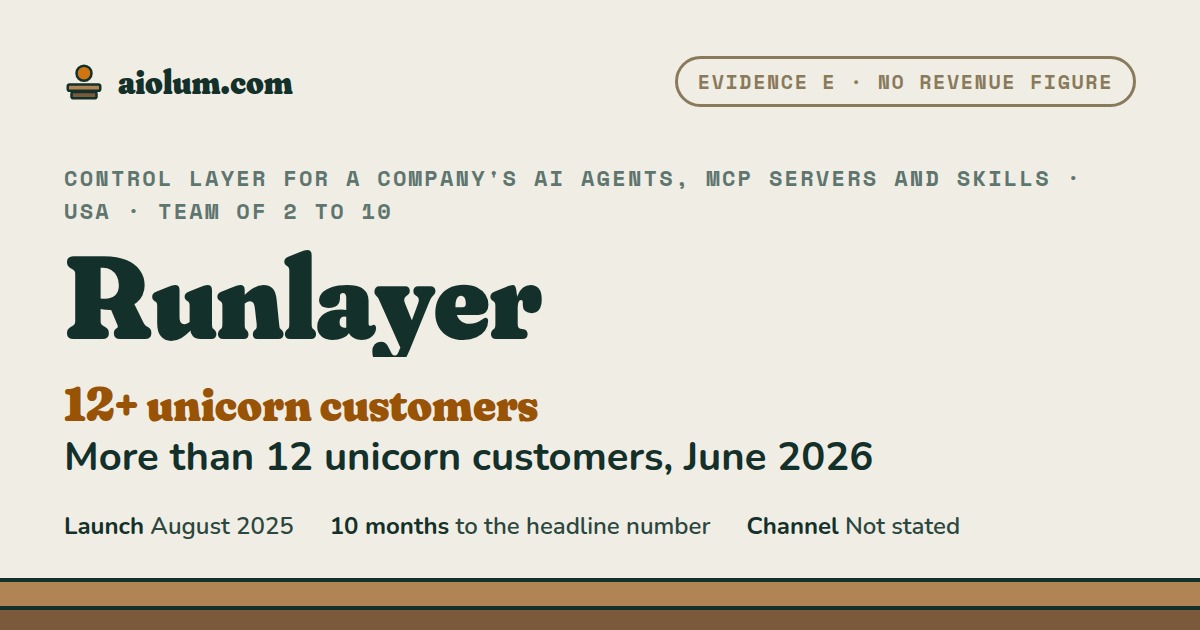
Runlayer (Control layer for a company's AI agents, MCP servers and skills, USA): More than 12 unicorn customers, June 2026. Evidence grade E: no revenue figure was checked. Team: 3 founders in 2025; headcount not published; 16 open full-time roles on the About page in November 2026. Launched August 2025; still running.Added
- Outcome
- More than 12 unicorn customers, June 2026
- Evidence
- E no revenue figure was checked
- Launch
- August 2025
- Status
- Still running
- Team
- 3 founders in 2025; headcount not published; 16 open full-time roles on the About page in November 2026
- Outside funding
- US$42M in total: an US$11M seed (17 November 2025) and a US$30M Series A (24 June 2026), as the company and Fortune state
- Main channel
- Not stated
What is not verified
No revenue figure was found. Fortune wrote that the CEO would not disclose revenue. The customers are named by Fortune, which retold the company's statements, and by the company itself. No independent source confirms that these customers pay. The company publishes no price, and its pages show only a Book a demo button. A reader could look for a customer's own statement that it pays. Headcount was not found either. This story is grade E: the business is real and its product, price and customers are described from public pages, but no revenue figure was checked. Aiolum shows it as an idea worth studying, not as proof that it makes money.
Runlayer sells a control layer for the AI that a company's employees use. An AI agent is a program that uses a language model to take actions. MCP (Model Context Protocol) is an open standard that lets an agent connect to outside tools and data. Runlayer puts one gateway between the agents and those tools, with permissions, scanners and an audit trail.
Andrew Berman founded Runlayer about ten and a half months before 24 June 2026, as Fortune reported. He earlier co-founded Nanit and Vowel, which Zapier bought in 2023. The company's About page names two more founders and says all three worked at Zapier or on its MCP products. The company says it raised an US$11 million seed in November 2025 and a US$30 million Series A in June 2026.
No revenue figure was found, so this story has no money headline and is grade E. Fortune wrote that the CEO would not disclose revenue. Fortune named five customers and the company's own post named seven. No independent source confirms that these customers pay.
Why did Runlayer work?
Four causes, in the order they mattered. Each one is a reusable lesson.
The founders had built Zapier's MCP and agent products
The About page says the founding team built Zapier MCP and Agents, and that Tal Peretz built Zapier MCP in two days. It says the team raised over US$200 million in total, across earlier companies. These are the company's claims, and no outside source for them was read.
It offers one control point for every agent, server and skill
The home page says a company can see every agent, MCP server and skill in use. It says policies are defined once and enforced everywhere, with scanners that start in alert-only mode and then block. The company's own post says it supports the 5 to 20 AI clients that an average enterprise uses.
Its named customers are large companies with thousands of staff
Gusto says 3,000 or more knowledge workers connect through Runlayer, and Lemonade says 1,700 or more employees do. The company chose to publish these counts. Fortune also reported a bank with more than 100,000 employees, which it did not name.
How it was built
These details come from the company's pages, its posts and one news report. They are grade C. [2, 2, 5, 8, 2]
- One gateway sits between the agents and the company's data, with permissions, authentication and allowed tools set up front, as the home page says.
- Built-in scanners look for intent drift, personal data and data exfiltration. They start in alert-only mode to set a baseline, then move to blocking.
- The seed post says it can be deployed in the customer's own cloud (VPC) or in the company's cloud.
- The Lemonade case study says Runlayer was deployed through the customer's device management system, and that everyone was onboarded within a day.
- The company's site is built with Next.js, as the page source shows.
Tools named in the sources
Each one opens its page in the Tools tab, with every story that uses it.
Who tried this before Runlayer, and why did they fail?
Three developer-tool companies in our database of failed startups promised to give software teams a clearer view or more control. The values below are from that database, read on 22 November 2026, and are not independently verified.
Kite
The promiseAn AI code completion engine in the editor, so developers write code faster with less typing.
Why it diedThe page says GitHub Copilot, launched in June 2021, beat Kite's older models. Free users did not convert to the paid plan.
Dashblock
The promiseTurn any web page into an API with no code, so businesses could use web data.
Why it diedThe page points to strategic missteps. It says the tool depended on web page structures that kept changing, a continuous drain.
CodeSee
The promiseAutomatic maps of code that show how software is built, to help developers onboard and debug.
Why it diedThe page says it failed to prove return on investment to engineering leaders. It also says free users did not become paid customers.
The failed startups come from our database of 1,749 dead startups, retold here in our own words. Its entries are AI-assisted summaries of public sources, so these cards carry no evidence grade.
What changed
All three sold a tool to technical teams and met buyers who found free options or did not feel enough pain to pay. Kite also met a platform owner that built the same feature.
The idea of one control point over how staff use outside software is not new. What the company says is new is that agents and MCP servers spread among employees faster than security teams can review them. Gusto's case study describes teams that downloaded MCP servers on their own before the security team had a view of them.
Fortune reported that Wiz, Palo Alto Networks and Okta are all building agent governance. The investor quoted by Fortune calls Runlayer a neutral business that no platform can own. Whether buyers pay for that is not shown, because no revenue figure exists.
Can one person copy Runlayer now?
Not as a small project; the pattern, partly.
A solo copy is unlikely, because Fortune reported US$42 million raised and the company lists 16 open roles. The pattern is still readable. A new kind of software enters companies faster than their security teams can review it. A platform that lists it all gives those teams a reason to buy.
Where it is still open: Other software that spreads before review, such as browser agents and code assistants. A buyer there needs a list and a policy.
- 1Pick a new kind of software that employees adopt without a review, and that a security or IT team must account for.
- 2Start with an inventory that the buyer can see quickly, then add policies and an audit trail on the same data.
- 3Publish a case study for each named customer, with its own counts, as the company does.
How much revenue does Runlayer make?
Each row shows the evidence grade and the source numbers from the list at the end of this page. The grades are explained in How Aiolum verifies.
| Fact | Value | Grade | How we know | Sources |
|---|---|---|---|---|
| Company start | about August 2025 | C | Fortune, 24 June 2026: "He founded Runlayer 10-and-a-half months ago." The Internet Archive index lists the domain runlayer.com from 13 July 2025, as a redirect. No earlier name or product was found. | [1, 12] |
| Time from the start to the Fortune article | about 10 months | calc | Calculated: 10.5 months before 24 June 2026 is about 9 August 2025. | [1] |
| Legal entity | Anysource, Inc., doing business as Runlayer | C | The privacy notice and the master services agreement use this name. The start date of Anysource, Inc. was not found, and no source says whether it is an earlier name of the business. | [10, 11] |
| Founders | 3, with Andrew Berman as CEO | C | The About page names three founders, Andy Berman, Tal Peretz and Vitor Balocco, and says they came from Zapier. Fortune names Berman as CEO. | [3, 1] |
| Seed round | US$11 million, 17 November 2025 | C | The company's own post states the round, led by Keith Rabois at Khosla Ventures with Felicis. Fortune gives the same amount and investors. | [5, 1] |
| Series A | US$30 million led by Felicis with Khosla Ventures; US$42 million raised in total | C | Fortune and the company's post of 24 June 2026 state the same round and total. | [1, 4] |
| Customers named by Fortune | Instacart, Gusto, Opendoor, dbt Labs, AngelList | C | Fortune wrote that Runlayer had signed "more than 12 unicorn customers", including these five. The company's post names AppLovin, Gusto, Decagon, Opendoor, dbt Labs, AngelList and Lemonade. | [1, 4] |
| Customer case studies | Gusto 3,000+ knowledge workers; Lemonade 1,700+ employees; Jane App 800+; Homebase 400+ | C | The company's own case studies give these counts. Each has a named person from the customer, as a quotation. None says what the customer pays. | [6, 7, 8, 9] |
| A bank customer and Gusto's use | a Fortune 500 bank monitoring more than 100,000 employees; half of Gusto's staff using it daily | C | Fortune reported both. The bank is not named. | [1] |
| How the company charges | order forms, with usage-based fees invoiced in arrears | C | Master services agreement, last updated 5 November 2026. No price amount appears in it. | [11] |
| Team size | not found; 16 open full-time roles on the About page | calc | Calculated: a count of the roles on the About page on 22 November 2026. The page gives no headcount. | [3] |
| Revenue amount and customer payments | not found | E | Fortune wrote that Berman "won't disclose revenue figures". No filing, payment-processor profile or interview gives an amount. | [1] |
How to read this table. Grade C is a statement by the company, sometimes repeated by a news report that did not check contracts. Grade X was computed on this page. Grade E marks something that was looked for and not found.
| Plan | Per month, billed yearly (US$) | Per month, billed monthly (US$) | Limit |
|---|---|---|---|
| Platform subscription under an order form | price not published | set per customer in an order form | |
| Usage-based fees | price not published | invoiced in arrears, as the agreement says |
The company publishes no price. The /pricing address of runlayer.com answers 404, and the home page has only a Book a demo button. The master services agreement says the customer pays the fees in each order form. It says usage-based fees are invoiced after use and that other fees are due within 30 days of the invoice. The trial terms say trial fees are due in advance.
When did Runlayer launch, and how did it grow?
From a founding in about August 2025 to a US$30 million Series A in June 2026, in about ten months. Each entry carries its grade.
- 13 July 2025CThe Internet Archive index lists runlayer.com for the first time, as a redirect. [12]
- About August 2025CBerman founds Runlayer, as Fortune dates it from his words. [1]
- 17 November 2025CThe company announces an US$11 million seed round. It says Gusto and Opendoor already use the product in production. [5]
- 24 June 2026CThe US$30 million Series A is announced. Fortune reports more than 12 unicorn customers and does not give revenue. [1, 4]
- November 2026CThe company's customer page shows four case studies. Its master services agreement was updated on 5 November 2026. [6, 11]
What could go wrong for Runlayer?
The risks are the mirror image of the causes above.
What is not verified
No revenue figure was found. Fortune wrote that the CEO would not disclose revenue. The customers are named by Fortune, which retold the company's statements, and by the company itself. No independent source confirms that these customers pay. The company publishes no price, and its pages show only a Book a demo button. A reader could look for a customer's own statement that it pays. Headcount was not found either.
Logo row, testimonials and counters
The home page has a row of ten customer logos: Gusto, PagerDuty, Opendoor, Lemonade, Jane, Homebase, Decagon, Baseten, AppLovin and AngelList. No source read ties PagerDuty or Baseten to the company. The page shows five named testimonials. Two come from Cursor's head of security and Anthropic's co-creator of MCP, whom the About page also lists as backers. The customer counts on the case studies, and the bank's 100,000 employees, are the company's or Fortune's statements. A badge row says SOC 2 Certified, HIPAA Compliant and GDPR Compliant, and no report was read.
Team size and later growth
The company says nothing about its headcount. It was founded by three people, and the About page lists 16 open full-time roles. A funded company with a bank customer is probably larger than 10 people by now, but no source says so. The company's name in its legal pages is Anysource, Inc., and its start date was not found.
Sources
The grade next to each source is the best grade that the source can support. "Read in full" means that the text of the page was downloaded and the numbers were checked in it.
- C Fortune, 24 June 2026, Lily Mae Lazarus: Exclusive: Vinod Khosla wanted 'every available dollar' of Runlayer's funding round. It just raised $30 million to govern the agent workforceRead in full, 22 November 2026. Journalist's report of an interview with the CEO. Source for the start, the rounds, the named customers and the undisclosed revenue.
- C Runlayer home pageRead in full, 22 November 2026. Source for the product, the logo row, the testimonials and the badges. It has only a Book a demo button and no price.
- C Runlayer About pageRead in full, 22 November 2026. Source for the founders, their earlier work, the backers and the open roles.
- C Runlayer post, 24 June 2026, Andy Berman: We Raised $30M to Help Companies Go All In on AIRead in full, 22 November 2026. The company's own post. Source for the Series A, the total and the seven named customers.
- C Runlayer post, 17 November 2025, Andy Berman: Runlayer Raises $11M to Scale Enterprise MCP InfrastructureRead in full, 22 November 2026. The company's own post. Source for the seed round and the deployment options.
- C Runlayer case study: How Gusto Ignited an AI-Driven Workflow Revolution Across 3,000+ Knowledge Workers With RunlayerRead in full, 22 November 2026. The company's case study with a customer's quotations. It says nothing about payment.
- C Runlayer case study: How Lemonade Transformed Its MCPs Into a Governed AI Operating Model for 1700+ Employees With RunlayerRead in full, 22 November 2026. The company's case study. Source for the Lemonade counts and the deployment through device management.
- C Runlayer case study: Jane App Moves 800+ Knowledge Workers From AI Experiments to Production Workflows With RunlayerRead in full, 22 November 2026. The company's case study. Source for the Jane App count.
- C Runlayer case study: Homebase Scaled Governed AI Workflows to 400+ Employees in Under 5 Months With RunlayerRead in full, 22 November 2026. The company's case study. Source for the Homebase count.
- C Runlayer Privacy Notice, last updated 27 October 2026Read in full, 22 November 2026. Names Anysource, Inc., doing business as Runlayer.
- C Runlayer Master Services Agreement, last updated 5 November 2026Read in full, 22 November 2026. Source for the order forms, the usage-based fees and the payment terms.
- B Internet Archive index of runlayer.comRead in full, 22 November 2026. Lists captures of runlayer.com on 13 July 2025 and 24 October 2025.
- C Runlayer Online Trial Services TermsRead in full, 22 November 2026. Source for trial fees due in advance.
- C Database of failed startups, local exportRecord pages read on the website on 22 November 2026. AI-written summaries, not independently verified. Source for the failed predecessors.
Run this company? Send corrections or a verified figure to aiolum@livyden.com