ScribeKit: Revenue, team and how it was built
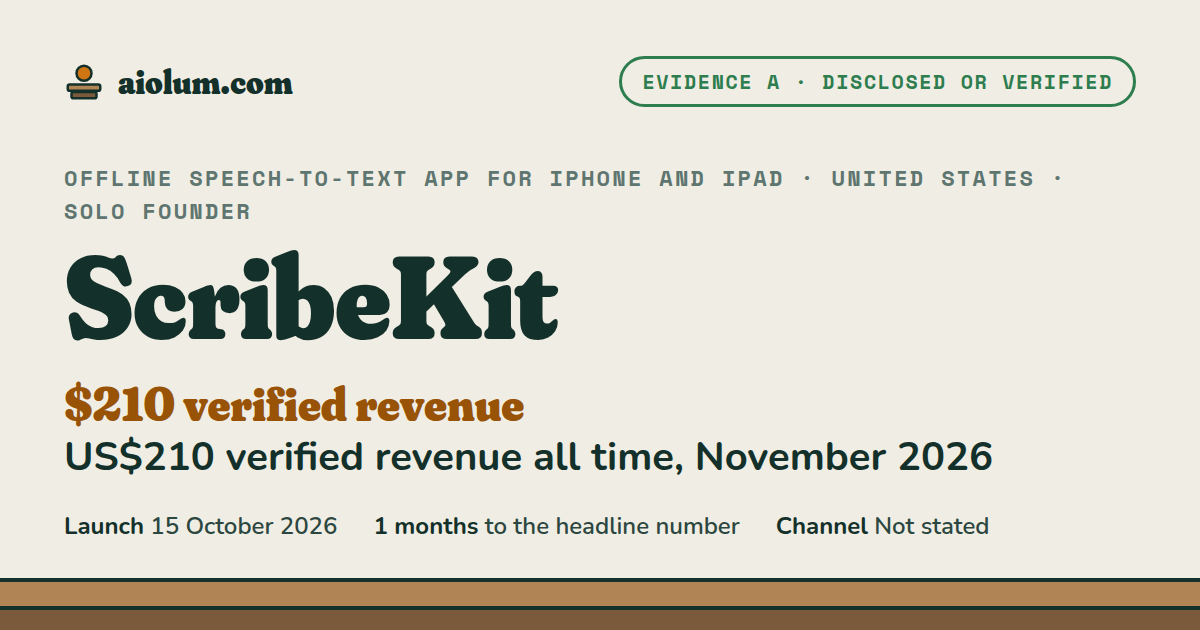
ScribeKit (Offline speech-to-text app for iPhone and iPad, United States): US$210 verified revenue all time, November 2026. Evidence grade A: disclosed by a company or a filing, or verified by a payment processor. Team: 1 person (the company's About page and the TrustMRR profile). Launched 15 October 2026; still running, revenue growing.Added
- Outcome
- US$210 verified revenue all time, November 2026Revenue growing
- Evidence
- A disclosed by a company or a filing, or verified by a payment processor
- Launch
- 15 October 2026
- Status
- Still running
- Team
- 1 person (the company's About page and the TrustMRR profile)
- Outside funding
- None
- Group
- Voice and audio
- Main channel
- Not stated
ScribeKit is an app that does speech-to-text on the phone itself. Speech-to-text means software that listens to audio and writes the words. The app ships with NVIDIA's open Parakeet speech model inside it, covering 25 languages, so it works in Airplane Mode. With the Pro plan, a user can download one of five Whisper models, which cover more than 100 languages.
The studio behind it is called trulyoffline. Its About page says it is one independent iOS developer with no team and no funding. The studio also lists two other apps, Nashi and Caravan. The App Store lists ScribeKit's first version, 1.0.0, on 15 October 2026. TrustMRR shows its first revenue in October 2026.
The headline figure comes from TrustMRR, which reads the revenue from the app's RevenueCat account through an API key. RevenueCat is a service that manages in-app purchases. TrustMRR showed US$210 of revenue in total and US$206 in the last 30 days when it synced on 20 November 2026. The figure is small and the history is five weeks long, so it shows that some people pay, not that the business is large.
Why did ScribeKit work?
Four causes, in the order they mattered. Each one is a reusable lesson.
The site is written for people whose recordings are private
The home page says the app is "For words that aren't yours to share" and lists journalists, students and therapists. The company has a page for each group. Each page states what the app does not do: it does not label speakers, record phone calls or show a live transcript. No source says that this audience caused the sales, so this is the company's positioning and not a proven cause.
The speech model sits inside the app, so nothing is uploaded
The model is part of the download, which is why the app is about half a gigabyte. The company's pages say there is no account, no analytics and no crash reporting. Only an anonymous purchase record goes to RevenueCat. The studio has no transcription server to pay for.
It charges a low price and offers a one-time purchase
Pro costs US$1.99 a month, US$9.99 a year or US$19.99 once. The company's first post says every app in the family will always have a price that can be paid once. TrustMRR shows 17 active subscriptions and a monthly recurring revenue of US$28.47.
How it was built
These details come from the company's blog and privacy policy, the App Store page and the TrustMRR profile. The TrustMRR tech stack is entered by the founder, so it is grade C. [1, 6, 10, 15]
- Swift and SwiftUI for the app. The TrustMRR profile lists them as the frontend. The app needs iOS 18 or later.
- NVIDIA's Parakeet TDT v3, an open speech model, in a Core ML form from FluidAudio. The four compiled models are bundled in the app download.
- WhisperKit, an open-source library from Argmax, runs the optional Whisper models for Pro users. The app fetches them from Hugging Face.
- Purchases go through Apple. RevenueCat confirms purchases and restores them on other devices.
- No analytics code and no server for the audio. The company says transcription works in Airplane Mode.
Tools named in the sources
Each one opens its page in the Tools tab, with every story that uses it.
Who tried this before ScribeKit, and why did they fail?
Four companies in our database of failed startups built audio, voice or note products. None was a speech-to-text app, so the match is loose. The values below are from that database and are not independently verified.
VideoNotes
The promiseNotes that sync to video timestamps for students and professionals.
Why it diedThe record says the platform was pigeonholed into education with no clear path to profitability.
Talkito
The promiseReal-time voice conversations over the internet in a social network.
Why it diedThe record says users were used to text, and that server costs for voice data were high with no clear way to earn money.
Memo
The promiseRich media memos for engineering, product and design teams.
Why it diedThe record says it could not compete with larger tools that added similar features.
Audobox
The promiseA tool for teams to share audio feedback on design and engineering work.
Why it diedThe record says it could not find a strong niche in a field dominated by larger companies.
The failed startups come from our database of 1,749 dead startups, retold here in our own words. Its entries are AI-assisted summaries of public sources, so these cards carry no evidence grade.
What changed
None of the four sold transcription, so this page cannot say that the same product failed before. What the records share is a narrow audience and larger competitors. Talkito's record also names the cost of servers for voice data.
ScribeKit differs in two ways that its own pages state. The speech model runs on the phone, so the studio has no server cost for audio. The price is also low, from US$9.99 a year. The App Store page lists several other offline transcription apps next to it, so the niche is not empty.
Can one person copy ScribeKit now?
The structure, yes. The revenue, not yet proven.
An on-device app with no server cost can charge a small price and still cover its costs. Only US$210 of revenue is verified, so this page shows that people pay, not how far it can grow. A second person would need to check the demand before copying it.
Where it is still open: Other jobs that people prefer to keep on their own device: meeting notes, voice memos in many languages, and recordings in regulated work.
- 1Pick a job where users do not want to upload their files, such as interviews, lectures or session notes.
- 2Ship an open speech model inside the app, so that no server is needed.
- 3Offer a free tier with a monthly limit and a Pro plan with a monthly, yearly and one-time price.
- 4Connect the store purchases to a revenue service, and let a verifier such as TrustMRR read the figures.
How much revenue does ScribeKit make?
Each row shows the evidence grade and the source numbers from the list at the end of this page. The grades are explained in How Aiolum verifies.
| Fact | Value | Grade | How we know | Sources |
|---|---|---|---|---|
| Verified revenue, all time, to 20 November 2026 | US$210 | A | TrustMRR reads it from RevenueCat through an API key. Last synced on 20 November 2026 at 18:13 UTC. | [1] |
| Verified revenue, last 30 days | US$206 | A | TrustMRR, same sync. Its daily table shows revenue on 14 of the 30 days and none from 17 to 20 November. | [1] |
| Verified revenue by month | August and September 2026: US$0. October 2026: US$65.13. November 2026 to the 20th: US$145 | A | TrustMRR monthly table. November is a partial month. | [1] |
| Monthly recurring revenue and subscriptions | US$28.47 a month from 17 active subscriptions | A | A snapshot that TrustMRR stores on the profile, from the same payment records. It does not give the snapshot date. | [1] |
| Annual run rate from the monthly recurring revenue | about US$342 a year | calc | Calculated: US$28.47 times 12 is US$341.64. It does not include the one-time lifetime purchases. | [1] |
| Largest single day of revenue | US$44.64 on 22 October 2026, 21% of the total | calc | Calculated: US$44.64 divided by US$210. The daily value is TrustMRR's. | [1] |
| Prices | Pro at US$1.99 a month, US$9.99 a year or US$19.99 once | C | The company's product page and terms, and the App Store in-app purchase list. | [2, 5, 10] |
| Free plan | 10 new transcriptions a month, up to 30 minutes each | C | The company's product page and terms. The company says it has no account and no ads. | [2, 5] |
| Team | 1 person | C | The About page says "One independent iOS developer" and "No team, no funding". The TrustMRR profile says team size 1 person and bootstrapped. | [3, 1] |
| Start of the studio | 14 April 2026, no earlier name or product found | C | The first blog post, "Hello, trulyoffline", carries this date in its structured data. The footers, terms and privacy pages show only 2026. The Internet Archive had no capture of trulyoffline.app on 20 November 2026. | [8, 6, 16] |
| Launch of ScribeKit | 15 October 2026 on the App Store; the company's blog post is dated 17 September 2026 | C | The App Store version history lists 1.0.0 on 15 October and 1.0.1 on 27 October. TrustMRR gives the founded date as 15 October 2026. The company's post "ScribeKit is live on the App Store" carries 17 September 2026 in its structured data. The sources do not explain the difference. | [10, 1, 7] |
| App Store listing, 20 November 2026 | 1 rating (5.0), age 4+, Productivity, 507.2 MB, 13 languages | C | Apple's public page. The size is large because the speech model ships inside the app. | [10] |
| Speech models | NVIDIA Parakeet TDT v3 built in; five Whisper models with Pro | C | The company's blog says Parakeet runs on Apple's Neural Engine through a Core ML conversion. It says Pro runs Whisper through the open-source WhisperKit. | [15] |
| Other apps of the studio | Nashi (a private AI chat) and Caravan (a walking game) | C | The company's pages. Its About page says Nashi costs US$0.99 once, and its blog says Nashi went live on 22 April 2026. | [11, 9, 3] |
How to read this table. Grade A values are the revenue figures that TrustMRR reads from RevenueCat through an API key. Grade C values are statements on the company's own pages, its blog or the App Store page. A "calc" value was computed on this page from the rows above it.
| Plan | Per month, billed yearly (US$) | Per month, billed monthly (US$) | Limit |
|---|---|---|---|
| Free | 0 | 0 | 10 new transcriptions a month, up to 30 minutes each, 25 languages |
| Pro, subscription | 0.83 | 1.99 | No monthly limit, recordings up to 3 hours, Whisper models, folders, widgets, ZIP export |
| Pro, lifetime | 19.99 one-time | The same Pro features, bought once |
Pro is sold in three ways. A monthly subscription costs US$1.99. A yearly subscription costs US$9.99 and has a 7-day free trial. A one-time lifetime purchase costs US$19.99. The yearly plan is shown here as US$0.83 a month. The company says prices vary by country and that purchases go through Apple. The Free plan has no account and no ads.
When did ScribeKit launch, and how did it grow?
From a studio's first blog post to a first verified US$210 in about seven months. Each entry carries its grade.
- 14 April 2026CThe first blog post of trulyoffline names the first app, Nashi, and says ScribeKit is next. [8]
- 22 April 2026CThe company's blog says Nashi, a private AI chat for iPhone and iPad, is live on the App Store. [9]
- 17 September 2026CThe date in the structured data of the company's blog post that says ScribeKit is on the App Store. [7]
- 15 October 2026CThe App Store lists version 1.0.0. TrustMRR gives this as the founded date. [10, 1]
- 22 October 2026AThe largest day of revenue so far, US$44.64, as TrustMRR shows it. [1]
- 27 October 2026CVersion 1.0.1 adds 12 app languages, so the app can be used in 13 languages. [10]
- 20 November 2026ATrustMRR shows US$210 in total, US$206 in the last 30 days and 17 active subscriptions. [1]
What could go wrong for ScribeKit?
The risks are the mirror image of the causes above.
The founder identity differs between sources
The sources name the person behind the app in different ways. TrustMRR lists the founder as "Jack", with the handle truly_offline. The App Store lists the seller and copyright holder as KHUSAN RAKHMATULLAEV. The company's website names no person. This page does not say that these are the same person, and no source does.
The revenue is very small and only five weeks old
TrustMRR shows US$210 in total and US$0 for August and September 2026. The daily table shows no revenue from 17 to 20 November 2026. TrustMRR's "growth" of +5080.2% for the last 30 days compares two very small numbers. The trend label "growing" rests on November 2026 so far (US$145) being above October (US$65.13).
The launch date differs between sources
The App Store and TrustMRR give 15 October 2026. The structured data of the company's blog post says 17 September 2026. The posts also show "Updated 6 Oct 2026". The sources do not explain the gap, so this page uses the App Store date.
Counters on the home page and an illustrative receipt
The home page shows counters such as "0 trackers in our apps", "0 accounts to create" and 3 apps live on the App Store. They are the company's own statements, not counts of users. Its sample transcription receipt is labelled "illustrative". The pages show no logo wall and no testimonials.
Recording consent and marketing to regulated work
The terms say "You are responsible for ensuring you have consent to record any conversations you transcribe." The home page lists therapists, and the company has a page for therapists and one for journalists. The privacy policy says to consult a compliance officer before regulated work. No page claims a health result or legal compliance.
The AI is an open model that others also use
The speech models are NVIDIA's Parakeet and OpenAI's Whisper, in forms that other companies publish. The studio does not train its own model. The App Store page lists other offline transcription apps under "You Might Also Like". The studio's other apps are Nashi and Caravan.
Parts of the TrustMRR profile are written by the founder
TrustMRR says that only the data in its verification section is checked, and the rest of the profile is user-generated. The description, team size, funding, marketing channels and tech stack are founder statements. The sources do not say how most customers arrived, so the channel is shown as unknown.
Sources
The grade next to each source is the best grade that the source can support. "Read in full" means that the text of the page was downloaded and the numbers were checked in it.
- A TrustMRR profile: ScribeKit (markdown profile), read 20 November 2026Read in full the markdown profile. The revenue, monthly revenue, MRR and subscription figures are verified through RevenueCat. The description, team, funding, channels and tech stack are user-generated.
- C trulyoffline: ScribeKit, offline transcription app for iPhone and iPadRead in full. The company's product page, source for the features, prices, free limits and the FAQ.
- C trulyoffline: AboutRead in full. Source for the one-developer, no-team, no-funding statement and the principles.
- C trulyoffline: Contact and supportRead in full. It says the studio is one person and that email is the only support channel. The address on it is not copied here.
- C ScribeKit Terms of Use, last updated 6 October 2026Read in full. Source for the plans, the prices, the consent clause and the model licences. The contact address in it is not copied here.
- C ScribeKit Privacy Policy, last updated 6 October 2026Read in full. Source for RevenueCat, the Hugging Face downloads, the data that is not collected and the regulated-work sentence.
- C trulyoffline blog: ScribeKit is live on the App StoreRead the post. The structured data gives 17 September 2026. The page also says Updated 6 Oct 2026.
- C trulyoffline blog: Hello, trulyofflineRead in full. The structured data gives 14 April 2026. Source for the studio's start, the pricing idea and the order of the apps.
- C trulyoffline blog: Nashi is live on the App StoreRead in full. Dated 22 April 2026. Source for the first app and its one-time price.
- C App Store: ScribeKit - Offline Transcribe, read 20 November 2026Read in full. Source for the seller and copyright lines, the version dates, the rating, the size, the languages and the in-app purchase prices.
- C trulyoffline: home pageRead in full. Source for the counters, the illustrative receipt, the audience line and the list of three apps.
- C trulyoffline: ScribeKit for studentsRead the page. It says to ask permission before recording a lecture and never to record covertly.
- C trulyoffline: ScribeKit for therapistsRead the page. It says that HHS does not certify software and tells users to get client consent.
- C trulyoffline: ScribeKit for journalistsRead the page. Source for the list of what the app does not do.
- C trulyoffline blog: Parakeet vs Whisper on iPhone, and How ScribeKit transcribes on your phoneRead both posts. Source for the Core ML conversion, FluidAudio, WhisperKit and the Neural Engine.
- C Internet Archive availability check for trulyoffline.app, 20 November 2026Read the reply. It lists no archived snapshot, so no earlier version of the domain could be read.
- C Database of failed startups, local exportRecord pages read on the website on 20 November 2026. AI-written summaries, not independently verified. Source for the failed predecessors.
Run this company? Send corrections or a verified figure to aiolum@livyden.com