supermemory: Product, team and how it was built
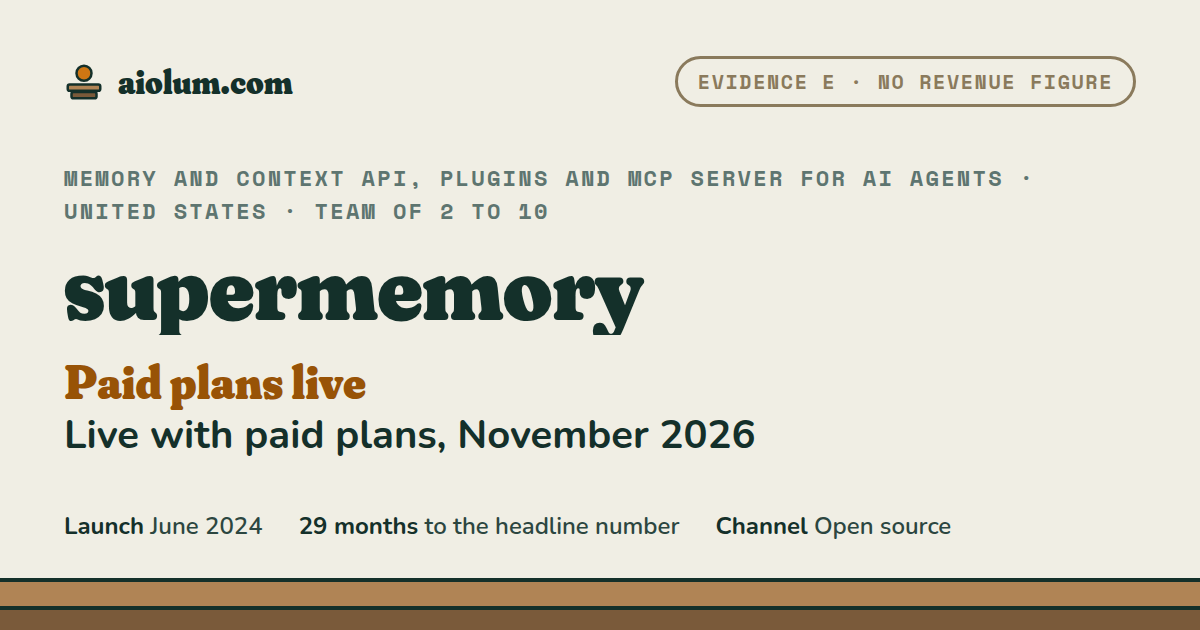
supermemory (Memory and context API, plugins and MCP server for AI agents, United States): Live with paid plans, November 2026. Evidence grade E: no revenue figure was checked. Team: 4 student developers in October 2024; headcount not published in November 2026, the company says "a small team". Launched June 2024; still running.Added
- Outcome
- Live with paid plans, November 2026
- Evidence
- E no revenue figure was checked
- Launch
- June 2024
- Status
- Still running
- Team
- 4 student developers in October 2024; headcount not published in November 2026, the company says "a small team"
- Outside funding
- US$3M round, October 2025, stated by the company
- Main channel
- Open source
What is not verified
No revenue figure was found, and no source states that a customer has paid. The pages read were the company's home, pricing, about, terms, privacy and blog pages, its GitHub page and archived copies of 2024. No payment-processor profile, filing or press piece with a revenue figure was found. The founder named his Stripe dashboard in July 2025 and gave no number. The US$3 million round is the company's own statement. A reader could look for a payment-processor profile, a press interview or a filing. This story is grade E: the business is real and its product, price and customers are described from public pages, but no revenue figure was checked. Aiolum shows it as an idea worth studying, not as proof that it makes money.
supermemory sells memory for AI agents. Memory here means stored facts about a user or a task that go back into a model's input on the next call. The company offers it as an API, a set of web calls, and as an MCP server, a connector for assistants. The company says it began in the summer of 2024 as an open-source consumer app, a "second brain" for saved items.
Dhravya Shah is named on the company's About page as its founder. The page says the company is a small team in San Francisco and gives no headcount. An archived home page of October 2024 says "a small team of 4 student developers". In a blog post of 6 October 2025 the founder wrote that the company had raised US$3 million.
No revenue figure was found, so this story has grade E. The pricing page lists a Free plan and paid Pro, Max and Scale plans with a link to a billing page. No source states that a customer has paid, and the company's own counters of customers and usage are not checked.
Why did supermemory work?
Four causes, in the order they mattered. Each one is a reusable lesson.
An open-source app drew companies that asked for its engine
The founder wrote that the consumer app reached more than 50,000 users and 10,000 GitHub stars. He wrote that companies then asked to use the infrastructure behind it. The company opened that engine to developers.
The company stopped products that competed with its customers
The founder wrote in September 2026 that building a company brain risked a conflict of interest with customers. He wrote that the company would work on the memory API only. The refund was part of that change.
It prices usage from one monthly credit balance
The pricing page gives every plan the same usage rates and a monthly credit balance. The company's post of 18 May 2026 says the headline prices did not change and that most customers would pay less for the same work.
How it was built
These details come from the company's own pages and blog posts. They are grade C. [3, 5, 7, 12, 15, 16]
- The first product was an open-source second-brain app. The repository is under the MIT license and the founder's October 2025 post calls it a side-project that turned into a business.
- The company says it built its own vector database, content parser and extractor. A vector database stores text as lists of numbers so that a program can find similar passages.
- The home page names a model called learner-1. It says the model updates, merges, infers and forgets memories before they go into the agent's context.
- The privacy page names OpenAI and Google Gemini as AI providers that may process user content. It names Timescale and Cloudflare as infrastructure partners.
- A 2025 post says the database was moved to PlanetScale from TigerData, formerly Timescale, with no interruption. A June 2025 post advises hosting MCP servers on Cloudflare and says the founder worked on that technology there.
Tools named in the sources
Each one opens its page in the Tools tab, with every story that uses it.
Who tried this before supermemory, and why did they fail?
Two companies in our database of failed startups offered a memory or a helper that stayed out of the user's way. The values below are from that database and are not independently verified.
Springpad
The promiseA place to collect and organize web content such as articles, videos and recipes, as a rival to Evernote.
Why it diedThe record says it struggled to find a sustainable business model and a monetization strategy that worked.
Kite DevTool
The promiseAn AI code completion engine inside the editor, for individual developers and small teams.
Why it diedThe record says it came seven years before GitHub Copilot and made strategic mistakes in monetization.
The failed startups come from our database of 1,749 dead startups, retold here in our own words. Its entries are AI-assisted summaries of public sources, so these cards carry no evidence grade.
What changed
Springpad let people collect web content for themselves, as the supermemory consumer app did. The founder's July 2025 post says that app relied on manual input. It also says users stopped using it. supermemory dropped the consumer product and sold the storage layer to developers.
Kite sold to developers directly and met a market that Copilot took over. supermemory sells to developers too. The company's pages compare it with Mem0, another memory service. No source here shows what share of the market it holds.
Can one person copy supermemory now?
Partly. The path is visible, but no source shows that customers pay enough.
The method is clear: publish an open-source tool, see who asks to use its engine, and turn the engine into a metered service. This page cannot show what that earns. A reader who copies it needs a plan for competition: the company's own pages compare it with Mem0.
Where it is still open: Other building blocks that agents need and that model makers do not sell: permissions, audit logs, scheduling and file storage for agents.
- 1Publish a small open-source tool and watch which companies ask about its internals.
- 2Sell the part they ask about as a service with a free plan.
- 3Meter usage from one credit balance and keep the rates the same on every plan.
- 4Publish a payment-processor figure so that readers can check the business.
How much revenue does supermemory make?
Each row shows the evidence grade and the source numbers from the list at the end of this page. The grades are explained in How Aiolum verifies.
| Fact | Value | Grade | How we know | Sources |
|---|---|---|---|---|
| Plans and prices | Free, Pro, Max and Scale; Enterprise by contract | C | The company's pricing page, read on 12 November 2026, lists Pro at US$19 a month, Max at US$100 and Scale at US$399. It also lists a Free plan with US$5 of credits. | [2] |
| A way to pay | billing page, auto top-up and fee terms | C | The pricing page links to a billing page in the company's console and says paid plans offer automatic top-ups. The terms state "All fees paid for the Services are non-refundable". No source states that a customer has paid. | [2, 4] |
| Start of the company | June 2024 | C | The About page says the company began "in the summer of 2024". The earliest archived copy of supermemory.ai, dated 16 May 2024, is a domain parking page. The copy of 2 June 2024 shows the consumer app with a waitlist and the words "Launching July 1st, 2024". No earlier name was found. | [1, 19, 10] |
| Founder | Dhravya Shah | C | The About page says the company is "founded by Dhravya Shah" and that he was working on AI infrastructure at Cloudflare at the time. | [1] |
| Team | small, headcount not published | C | The About page says "a small team across engineering, research and growth". An archived home page of 5 October 2024 says "a small team of 4 student developers". | [1, 11] |
| Funding | US$3 million, October 2025 | C | The founder's blog post of 6 October 2025 names Susa Ventures, Browder Capital and SF1.vc. The About page repeats the round. No outside source was read. | [7, 1] |
| Revenue, as the founder wrote it | no figure | C | The founder wrote in July 2025 about "the revenue graph on my Stripe dashboard" and gave no number. | [9] |
| Open-source base | 31.6k GitHub stars, MIT license | C | The repository page, read on 12 November 2026, shows these values. The founder's post of 6 October 2025 gives 10,000 stars and more than 50,000 users of the consumer app. | [12, 7] |
| Customers named by the company | Chatarmin, Adapta, Cluely, Composio, Scira AI | C | The company's case studies name Chatarmin and Adapta. The funding post names Cluely and Composio as enterprise customers and Scira AI as an open-source project. | [13, 14, 7] |
| Usage counters | 100k+ organizations, over a trillion tokens a month | C | The About and home pages state these counters. The pricing page states "100B+ tokens a month". The September 2026 post says "hundreds of thousands of companies". No source checks them. | [1, 3, 2, 8] |
| Products closed in September 2026 | company brain and Nova | C | The founder wrote on 10 September 2026 that the company stopped both on 9 September and that "everyone who was charged was refunded". | [8] |
| Time from the first archived product page to the headline | 29 months | calc | Calculated: June 2024 to November 2026. | [10, 2] |
How to read this table. Grade C is a statement by the company or its founder, or a page that anyone can read. A grade E story has no dated money figure, so no row here is a revenue number.
| Plan | Per month, billed yearly (US$) | Per month, billed monthly (US$) | Limit |
|---|---|---|---|
| Free | 0 | US$5 of credits a month | |
| Pro | 19 | US$20 of credits a month; 3 team seats | |
| Max | 100 | US$130 of credits a month; Gmail connector | |
| Scale | 399 | US$600 of credits a month; unlimited seats; self-hosted option | |
| Enterprise | custom contract, committed spend |
The page shows one price per month for each paid plan and no yearly option. It lists the credits that each plan includes: US$5 for Free, US$20 for Pro, US$130 for Max and US$600 for Scale. Usage draws from those credits at the same rates on every plan. The rate card lists, for example, US$5 per 1 million tokens for plain-text memory. Enterprise is priced by contract.
When did supermemory launch, and how did it grow?
From an open-source note-taking app in June 2024 to a memory API with paid plans in November 2026. Each entry carries its grade.
- 2 June 2024CAn archived copy of supermemory.ai shows an open-source second brain: save items, chat with collections and search them. The page shows a waitlist and the words "Launching July 1st, 2024". Its text shows no price. [10]
- 5 October 2024CAn archived copy says "a small team of 4 student developers". It says "It's free. Sign up now" and names Telegram and X integrations. [11]
- 25 July 2025CThe founder writes that the consumer app had weak retention and that the company moved to business customers. He mentions his Stripe dashboard and selling business licenses. [9]
- 6 October 2025CThe founder announces the US$3 million round. He writes that many companies were ready to pay right away. [7]
- 9 September 2026CThe company stops its company brain and its Nova app and refunds everyone who was charged. The MCP server and plugins continue. [8]
- 12 November 2026CThe pricing page lists Free, Pro, Max, Scale and Enterprise plans with credit-based usage prices. [2]
What could go wrong for supermemory?
The risks are the mirror image of the causes above.
What is not verified
No revenue figure was found, and no source states that a customer has paid. The pages read were the company's home, pricing, about, terms, privacy and blog pages, its GitHub page and archived copies of 2024. No payment-processor profile, filing or press piece with a revenue figure was found. The founder named his Stripe dashboard in July 2025 and gave no number. The US$3 million round is the company's own statement. A reader could look for a payment-processor profile, a press interview or a filing.
Counters, badges and quotations
The About and home pages state 100k+ organizations, tens of millions of end users and over a trillion tokens a month. Badges for SOC 2 Type II, HIPAA and GDPR are shown with no report attached. The pricing page states "100B+ tokens a month". The pricing page prints three quotations attributed to founders of Razorpay, Chatarmin and Adapta. The Chatarmin words match the company's case study, which embeds a post on X. The Razorpay quotation has no link, and no other page of the site names that company. The Adapta case study quotes the founder in different words. The words on the pricing page match that case study's own summary line. The home page states a first place on three public memory benchmarks. No independent check of these items was read.
Products closed and an earlier consumer app
The company stopped its company brain and its Nova app on 9 September 2026 and refunded everyone who was charged. The consumer app of 2024 was open source and free, and its home page spoke to students, professionals and others. The current terms require users to be at least 18. The company's terms also say all fees are non-refundable.
Sources
The grade next to each source is the best grade that the source can support. "Read in full" means that the text of the page was downloaded and the numbers were checked in it.
- C supermemory About pageRead in full, 12 November 2026. Source for the start, the founder, the team wording, the funding line and the counters.
- C supermemory pricing pageRead in full, 12 November 2026. Source for the plans, prices, credits, billing link and the three quotations.
- C supermemory home pageRead in full, 12 November 2026. Source for the product description, the counters, the learner-1 model and the compliance badges.
- C supermemory terms of serviceRead in full, 12 November 2026. Source for the fee, refund and age terms.
- C supermemory privacy policyRead in full, 12 November 2026. Source for the AI providers and infrastructure partners named.
- C supermemory blog indexRead in full, 12 November 2026. Source for the list and dates of posts.
- C Supermemory raises $3 million with the best memory engine for LLMs, by Dhravya Shah, 6 October 2025Read in full, 12 November 2026. Company blog post by the founder. Source for the round, the origin, the stars and users, and the customers named.
- C An update to supermemory: discontinuing company brain and Nova, by Dhravya Shah, 10 September 2026Read in full, 12 November 2026. Source for the closure, the refunds and the reasons the founder gives.
- C Unified Memory That Works Where You Work, by Dhravya Shah, 25 July 2025Read the first sections, 12 November 2026. Source for the move to business customers, the retention remark and the Stripe mention.
- C Internet Archive copy of supermemory.ai, 2 June 2024Read in full, 12 November 2026. The archive named it as the closest copy to 1 June 2024. Source for the first product.
- C Internet Archive copy of supermemory.ai, 5 October 2024Read in full, 12 November 2026. The archive named it as the closest copy to 1 October 2024. Source for the team of 4.
- C GitHub repository supermemoryai/supermemoryRead the top of the page, 12 November 2026. Source for the stars, the license and the repository topics.
- C How Chatarmin Ditched RAG and Went Memory-Only with Supermemory, 10 June 2026Read in full, 12 November 2026. Company case study. Source for the customer named and the response times it gives.
- C Scaling Conversations: How Adapta Grew Usage Without Losing Context, 12 June 2026Read in full, 12 November 2026. Company case study. Source for the customer named and the words of its quote.
- C Supermemory just got faster on PlanetScaleRead the sections on the database move, 12 November 2026. Source for the database change.
- C The UX and technicalities of awesome MCPsRead the first sections, 12 November 2026. Source for the MCP launch and the hosting on Cloudflare.
- C Dear reader, we just made supermemory insanely cheap... the Context Cloud, 18 May 2026Read in full, 12 November 2026. Company blog post. Source for the credit pricing and the sentence on headline prices.
- C Database of failed startups, local exportRecord pages read on the website on 12 November 2026. AI-written summaries, not independently verified. Source for the failed predecessors.
- C Internet Archive copy of www.supermemory.ai, 16 May 2024Read in full, 12 November 2026. The archive's capture list names it as the first copy with content. It is a domain parking page.
Run this company? Send corrections or a verified figure to aiolum@livyden.com