Tavily: Revenue, sale and how it was built
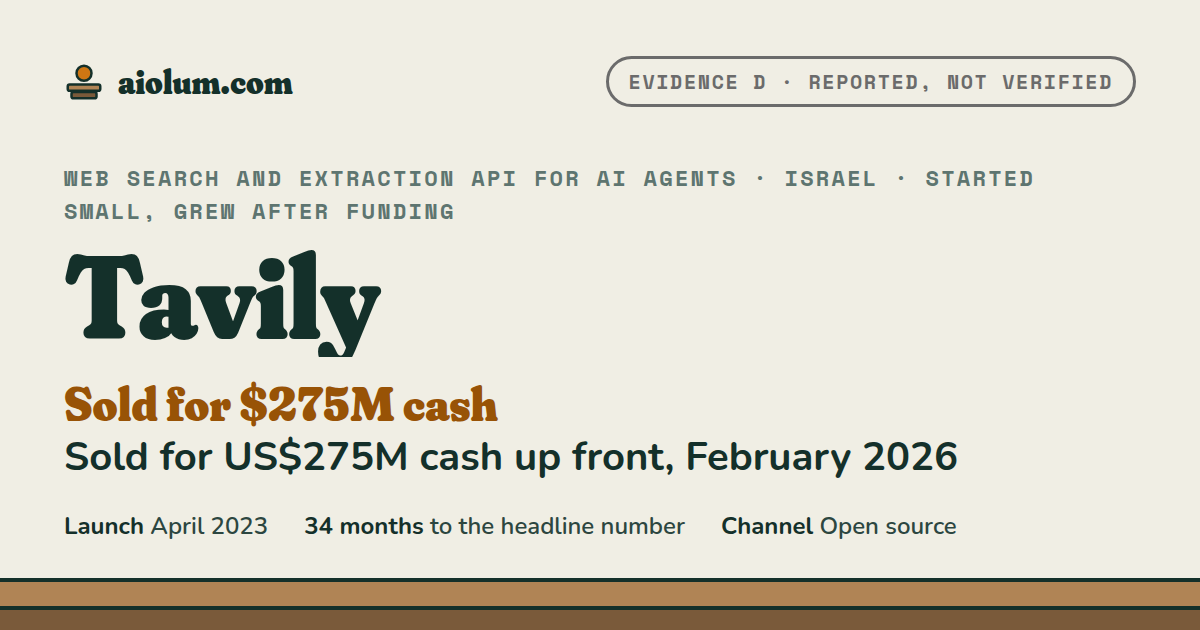
Tavily (Web search and extraction API for AI agents, Israel): Sold for US$275M cash up front, February 2026. Evidence grade D: reported, not verified. Team: 3 founders named by Calcalist; about 30 people in February 2026. Launched April 2023; sold 34 months after launch.Added
- Outcome
- Sold for US$275M cash up front, February 2026
- Evidence
- D reported, not verified
- Launch
- April 2023
- Status
- Sold, 34 months after launch
- Team
- 3 founders named by Calcalist; about 30 people in February 2026
- Outside funding
- US$25M in total, led by Insight Partners and Alpha Wave Global (Calcalist and the company's own post)
- Main channel
- Open source
What is not verified
The sale price rests on press reports. Calcalist reported US$275 million in cash up front on 10 February 2026, and did not name its source. Globes said Bloomberg reported US$275 million. The Bloomberg report was not read. Nebius said the value was not disclosed. A reader could look for a Nebius filing that states the price. The headline number is grade D: one claim or one estimate, with no second source. Aiolum shows it because the story is useful, and marks it so that it is not mistaken for a verified figure.
Tavily is a search layer for AI agents, programs in which a language model decides what to do next and calls tools. An agent that needs fresh facts calls Tavily to search, extract or crawl the web. Calcalist said in February 2026 that Tavily was founded in late 2024 by Rotem Weiss, Assaf Elovic and Yuval Rozio. It said Weiss described a start with an open-source agent. An archived copy of the Tavily home page from 15 April 2023 already shows a "Tavily AI" research tool with a waitlist. So the name and the site are older than the press date.
The money story is a sale. Nebius, an AI cloud company listed on Nasdaq, announced on 10 February 2026 that it agreed to acquire Tavily. Nebius said the transaction value was not disclosed. Calcalist reported that Nebius would pay US$275 million in cash up front, and US$400 million at most if milestones were met. Globes said Bloomberg reported US$275 million. The headline on this page is the US$275 million cash part only. The milestone part is a separate row.
The headline figure is grade D: it rests on press reports whose sources are not named, and the buyer did not confirm it. The team was about 30 people when Calcalist wrote, so this is a founder-led start that grew, not a one-person business. A founder cannot copy the sale, but the open-source, product-led start is a pattern that others can study.
Why did Tavily work?
Four causes, in the order they mattered. Each one is a reusable lesson.
It started as open source and spread by developer use
Weiss told Calcalist that the company started with an open-source agent that became the product. In August 2025 he wrote that all growth was product-led and cited 100,000 GitHub mentions and more than a million monthly installs. These are his figures and were not checked.
One API covered search, extraction and crawling for agents
Tavily sells search, extraction and crawl behind one API, priced in credits with a free tier. Nebius said that adding Tavily removes the need for developers to patch together separate vendors. Weiss wrote that the goal was one API that is structured, controllable and grounded in reality.
Funding and enterprise customers came before the sale
The company raised US$25 million in total, according to Calcalist and its own post. Nebius named IBM, Cohere and Groq as customers. Calcalist named three founders and said the company employs around 30 people.
The buyer needed a search layer for its AI cloud
Nebius said it wants a unified platform where companies build, tune and run agents. Roman Chernin, a Nebius co-founder, said the acquisition brings the search layer directly into the stack.
How it was built
These details come from the company's own pages and the press. Little of the technical build is published. [1, 9, 6, 7]
- The product began as an open-source agent, Weiss told Calcalist. The archived April 2023 page shows an earlier research tool delivered by email.
- The current product has endpoints for search, extract, research, crawl and map, according to the company's pages.
- The home page says requests pass through security, privacy and content checks that block personal data leaks and prompt injection.
- Weiss told Calcalist that Tavily works with several model providers, including Groq.
- Pricing uses API credits, with a free plan of 1,000 credits a month and pay-as-you-go at US$0.008 per credit.
Who tried this before Tavily, and why did they fail?
Three companies in our database of failed startups tried to improve search or research with software and failed. The values below are from that database, read on 11 November 2026, and are not independently verified.
Neeva
The promiseAn ad-free, privacy-first search engine that users paid for.
Why it diedThe page says Neeva died from user acquisition costs that were too high and a business model that did not match consumer behavior.
ROSS Intelligence
The promiseAn AI legal research platform that finds case law for lawyers.
Why it diedThe page says it struggled to gain traction in a market dominated by incumbents with decades of data and integrated solutions.
InstaGrok
The promiseA visual search tool for students and teachers.
Why it diedThe page says it could not secure a sustainable user base or earn money from the platform.
The failed startups come from our database of 1,749 dead startups, retold here in our own words. Its entries are AI-assisted summaries of public sources, so these cards carry no evidence grade.
What changed
Each of the three sold search or research to people. Neeva charged consumers, ROSS charged law firms and InstaGrok served students. The customers could use free or bundled alternatives, so the cost of finding users stayed high.
Tavily sold to developers who build agents, and its first customer is a program. Weiss said that growth was product-led and came from builders using the product. A language model agent also creates a need that did not exist earlier: it cannot browse the web by itself.
Can one person copy Tavily now?
The sale, no. The start, partly.
A solo founder cannot repeat a US$275 million sale that was reported with a funded team of about 30. The start is open to study: a free open-source tool that developers adopt, followed by a paid API with a credit price.
Where it is still open: Other agent needs: web access for private data, browsing with safe limits, and extraction from documents.
- 1Publish a small open-source tool that fixes one problem for developers who build agents.
- 2Offer a free tier of credits with no credit card, then charge per use.
- 3Add an enterprise plan only after developers use the free tier.
- 4Record usage figures with dates, because the company's own counters changed between posts.
How much did Tavily make, and what was it sold for?
Each row shows the evidence grade and the source numbers from the list at the end of this page. The grades are explained in How Aiolum verifies.
| Fact | Value | Grade | How we know | Sources |
|---|---|---|---|---|
| Sale price, cash up front | US$275 million | D | Calcalist reported it on 10 February 2026 and did not name its source. Globes said Bloomberg reported US$275 million. Nebius said the transaction value was not disclosed. | [1, 3, 2] |
| Total price if milestones are met | US$400 million at most | D | Calcalist reported that the sum could rise to US$400 million if certain milestones are met. This contingent figure is not the headline. | [1] |
| Buyer and announcement | Nebius, 10 February 2026 | A | Nebius announced an agreement to acquire Tavily and said it expected to close in the next few weeks. A completion notice was not downloaded. The home page read on 11 November 2026 shows the logo "Tavily by Nebius". | [2, 6] |
| Start of the product | Waitlist page archived on 15 April 2023 | C | The archived page shows "Tavily AI" with a "Join the Waitlist" button. Calcalist said the company was founded in late 2024. The structured data of the company's home page gives the founding year 2024. | [9, 1, 6] |
| Founders | Rotem Weiss (CEO), Assaf Elovic and Yuval Rozio | D | Calcalist named Rozio in his role as Managing Director at Alpha Wave Global, which incubated the company 12 months before the article. It did not state how many people worked there at the start. The structured data of the company's home page names only Weiss as founder. | [1, 6] |
| Team in February 2026 | about 30 people | D | Calcalist said the company employs around 30 people in New York, Tel Aviv and Abu Dhabi. It said the plan was to double that by the end of the year. Nebius said the team joins Nebius. | [1, 2] |
| Funding | US$25 million in total | D | Calcalist said Tavily raised a US$20 million Series A in August 2025 and US$25 million in total. The company's own post of 6 August 2025 says it raised a US$25 million Series A. Both name Insight Partners and Alpha Wave Global as leaders. | [1, 5] |
| Users, as the company counted | 700,000 users in August 2025; more than 1 million in February 2026 | C | The company's Series A post said over 700,000 users. Nebius said a developer community of more than one million users. The home page now says 3M+ developers. | [5, 2, 6] |
| Downloads, as counted by different parties | 1 million monthly (Calcalist); 3 million monthly SDK downloads (Nebius) | D | Calcalist said Tavily says it passed one million monthly downloads. Nebius said over 3 million monthly SDK downloads. The two figures were published on the same day and differ. | [1, 2] |
| Growth channel | Product-led, no outbound | C | Weiss wrote in August 2025 that all growth was product-led, with no outbound and no campaigns. In February 2026 he wrote that usage grew without marketing spend. | [5, 4] |
| Customers named by Nebius | IBM, Cohere, Groq | A | Nebius said Tavily serves Fortune 500 enterprises including IBM, and leading AI companies such as Cohere and Groq. | [2] |
| Time from first archived page to sale announcement | 34 months | calc | Calculated: April 2023 to February 2026. From the late 2024 founding date in Calcalist it is about 14 months. | [9, 2] |
How to read this table. Grade A is a statement by the buyer, Nebius. Grade C is a statement by the company on its own pages. Grade D is a press report whose source is not named. A "calc" value was computed on this page.
| Plan | Per month, billed yearly (US$) | Per month, billed monthly (US$) | Limit |
|---|---|---|---|
| Researcher, free | 0 | 0 | 1,000 API credits a month, no credit card |
| Pay As You Go | 0.008 per credit | pay only for use | |
| Project | 30 | 4,000 API credits a month, higher rate limits | |
| Enterprise | custom | custom | custom API calls, rate limits and support |
One API credit is the unit of billing, and more advanced or higher-volume requests use more credits, as the page says. The Project plan has a slider that adjusts the plan; the page shows US$30 a month for 4,000 credits. Startups can ask for 100,000 free credits, and students use the service at no cost.
When did Tavily launch, and how did it grow?
From an archived waitlist page in April 2023 to the sale announcement in February 2026, in 34 months. Each entry carries its grade.
- 15 April 2023CThe earliest archived Tavily home page shows a research tool called "Tavily AI" with a waitlist. [9]
- Late 2024DCalcalist said Tavily was founded in late 2024 and that Weiss said it started with an open-source agent. [1]
- 6 August 2025CWeiss announced a Series A led by Insight Partners and Alpha Wave Global. He wrote of more than 700,000 users and growth with no outbound sales. [5]
- 23 January 2026CAn archived pricing page lists a free plan, Pay As You Go at US$0.008 per credit, and a Project plan at US$30 a month. [8]
- 10 February 2026ANebius announces an agreement to acquire Tavily and says the value is not disclosed. [2]
- 10 February 2026DCalcalist reports that Nebius will pay US$275 million in cash up front. Calcalist does not name its source. [1]
- 10 February 2026CWeiss writes that Tavily is joining Nebius, that the API stays the same and that Tavily keeps operating as before. [4]
What could go wrong for Tavily?
The risks are the mirror image of the causes above.
What is not verified
The sale price rests on press reports. Calcalist reported US$275 million in cash up front on 10 February 2026, and did not name its source. Globes said Bloomberg reported US$275 million. The Bloomberg report was not read. Nebius said the value was not disclosed. A reader could look for a Nebius filing that states the price.
The start year differs between sources
Calcalist said Tavily was founded in late 2024, and the company's home page data gives the founding year 2024. An archived page from 15 April 2023 shows a waitlist for a product called Tavily AI. Its footer reads "© 2023 Tavily Inc." Both dates are 2022 or later, and this page uses the earlier date.
Founding team size is not stated
Calcalist names three founders, one of them in his role at the incubator Alpha Wave Global. The company's home page data names only Rotem Weiss as founder. No downloaded source states how many people worked at the company at the start.
Counters, logos and badges on the home page are not sourced
The home page shows counters such as 3M+ developers and 300M+ monthly requests. It also shows a row of company logos and a quote from a head of product at JetBrains. It shows SOC 2, ISO 27001 and GDPR badges, and the badges link to no report. The page gives no source for the counters. Earlier posts gave 700,000 and one million users.
Funding is described in two ways
Calcalist said a US$20 million Series A and US$25 million in total. The company's own post of 6 August 2025 says a US$25 million Series A.
The closing date of the sale was not found
No closing notice was downloaded. Nebius said on 10 February 2026 that it expected to close in the next few weeks. On 11 November 2026 the home page shows the logo "Tavily by Nebius" and its data names Nebius Group as parent organization.
The product reads pages that other people published
Tavily's extract and crawl endpoints return the text of other sites' pages to paying customers. The pages read for this story do not say how the service treats a site's robots.txt or terms. No source read for this story reports a legal action about it.
Sources
The grade next to each source is the best grade that the source can support. "Read in full" means that the text of the page was downloaded and the numbers were checked in it.
- D Calcalist (Ctech), 10 February 2026: Nebius to acquire one-year-old Israeli AI startup Tavily in deal worth up to $400 millionRead in full on 11 November 2026, after its robots.txt. Source for the price, the founders, the team size and the funding.
- A Nebius, 10 February 2026: Nebius announces agreement to acquire Tavily to add agentic search to its AI cloud platformRead in full. The buyer's release. It states that the transaction value was not disclosed and names customers and usage figures.
- D Globes, February 2026: Nebius buys Israeli agentic search co TavilyRead in full. It says Bloomberg reports a price of US$275 million and that no financial details were disclosed.
- C Tavily blog, 10 February 2026: Tavily is Joining NebiusRead in full. Founder's post on the sale and on how growth happened.
- C Tavily blog, 6 August 2025: Big News from Tavily: Announcing 25M Series ARead in full. Founder's post on the funding round, users and product-led growth.
- C Tavily home page, read 11 November 2026Read in full as text. Source for the counters, the logo row, the customer quote and the endpoints.
- C Tavily pricing page, read 11 November 2026Read in full as text. Source for the plans and prices.
- C Internet Archive copy of the Tavily pricing page, 23 January 2026Read the plan section. It shows the same prices as the live page, before the sale.
- C Internet Archive copy of the Tavily home page, 15 April 2023Read in full. Shows the early research tool with a waitlist.
- C Tavily about page, read 11 November 2026Read in full as text. It lists offices in New York, Tel Aviv and Austin and states no headcount.
- C Database of failed startups, local exportRecord pages read on the website on 11 November 2026. AI-written summaries, not independently verified. Source for the failed predecessors.
Run this company? Send corrections or a verified figure to aiolum@livyden.com