ToneAdapt
What is not verified
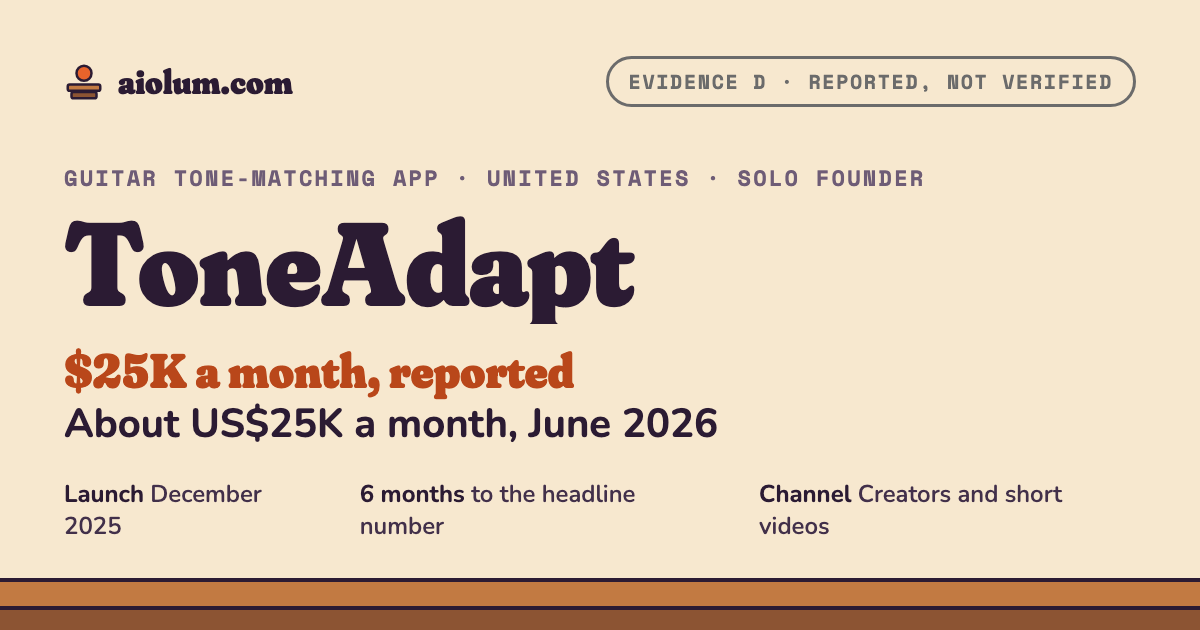
The headline figure, over US$25,000 in the four weeks before the interview (about US$11,500 on the web and about US$14,000 in the iPhone app), rests on one source: the founder's statement in a Starter Story interview published on 14 June 2026. The interviewer said that the founder showed his revenue dashboards on screen, but this page could not check them. AI Dev Cases wrote on 23 July 2026 that TrustMRR showed US$17,261 in the last 30 days and quoted a founder peak of "$35K last month"; the TrustMRR profile returned "Not found" on 24 October 2026. A reader could look for a live TrustMRR or RevenueCat verified profile, a second dated interview, or the founder's own revenue posts on X. The headline number is grade D: one claim or one estimate, with no second source. Aiolum shows it because the story is useful, and marks it so that it is not mistaken for a verified figure.
ToneAdapt is a tone-matching app for guitarists. A guitar's tone is the character of its sound, and it depends on the guitar, its pickups (the magnetic sensors under the strings), the amplifier and its knobs, and the effect pedals in the signal chain, the order in which the guitar signal passes through each device. Copying a famous player's knob positions rarely works, because every brand of amplifier responds differently. ToneAdapt uses an AI model with web search to find the gear and settings behind a recording, then gives settings for the user's own gear.
Kyan Santiago-Calling, a computer-science student at San Diego State University who had taken up the guitar in 2024, built the first version in about a week over the Thanksgiving break of 2025, without writing code by hand. AI Dev Cases reports that the web app went live on 8 December 2025 and that the iPhone app followed in April 2026. In a Starter Story interview published on 14 June 2026, the founder said that the web and the app together had made over US$25,000 in the previous four weeks: about US$11,500 through Stripe on the web and about US$14,000 in the iPhone app.
That figure rests on one founder statement on one date, so this page grades it D, reported but not verified. The interviewer said the founder showed his revenue dashboards on screen, but no payment processor, buyer or journalist has published the numbers, and the TrustMRR profile that a later article cited could not be opened. The page also shows four failed companies that tried to make guitar playing easier or cheaper with hardware, rentals or celebrity teachers.
The numbers, graded
Each row shows the evidence grade and the source numbers from the list at the end of this page. The grades are explained in How Aiolum verifies.
| Fact | Value | Grade | How we know | Sources |
|---|---|---|---|---|
| Revenue in the four weeks before the interview, web and iPhone app together | over US$25,000 | D | Founder, Starter Story interview published 14 June 2026: about US$11,500 on the Stripe dashboard for the web app and about US$14,000 in the iPhone app. The interviewer, Pat Walls, said the founder pulled up his revenue dashboard and showed it. This page could not check the dashboards. | [1, 2] |
| Run rate from the June 2026 figure | about US$300,000 a year | calc | Calculated: US$25,000 times 12. Using the founder's two parts, US$25,500 per four weeks, times 13 four-week periods gives US$331,500. | [1] |
| Web revenue in the three months before the interview | US$45,000, with 1,400 new subscribers | D | Founder, Starter Story interview, 14 June 2026. That is US$15,000 a month on average (calculated). | [1] |
| Active subscribers in the iPhone app | over 397 | D | Founder, Starter Story interview, 14 June 2026, about one month after the app launch. | [1] |
| Users | over 100,000 by June 2026 | D | Founder in the interview. His own site says 100,000 people in the first 100 days on the App Store and 300,000+ players in October 2026; the company home page says 150,000+ guitarists. The counts are not explained. | [1, 4, 5] |
| Revenue in January 2026 | US$750 | D | Reported by AI Dev Cases on 23 July 2026 as a founder figure, with no primary source given for it. | [3] |
| Revenue by February 2026 | about US$9,600 | D | Reported by AI Dev Cases on 23 July 2026, with no primary source given for it. | [3] |
| Last-30-day revenue on TrustMRR, as quoted | US$17,261 | D | AI Dev Cases wrote on 23 July 2026 that the TrustMRR tracker showed this figure. On 24 October 2026 the TrustMRR markdown profile returned "Not found", so this page could not read it. | [3, 8] |
| Highest month, as quoted | "$35K last month" | D | A founder figure quoted by AI Dev Cases on 23 July 2026 without a date or link. AI Dev Cases notes that published figures range from US$17,000 to US$35,000. | [3] |
| Time to build the first version | about a week | D | Founder: built over the Thanksgiving break of 2025 with AI coding tools, "Not a single line of code has been written myself". | [1] |
| Web launch | 8 December 2025 | D | Reported by AI Dev Cases. The founder said only that he built it over the Thanksgiving break. | [3, 1] |
| iPhone app launch | April 2026 | C | Founder's site. The earliest App Store reviews shown are dated 10 April. On 30 April 2026 the founder posted "18 days into my first iOS app" (quoted by AI Dev Cases). | [4, 7, 3] |
| Time from the web launch to the June 2026 figure | 6 months | calc | Calculated: December 2025 to June 2026. | [1, 3] |
| App Store seller and copyright holder | Kyan Santiago-Calling; copyright ToneAdapt, LLC | C | US App Store listing, read 24 October 2026. His own site says his company Six String Studio, LLC (Delaware, 2026) owns ToneAdapt. | [7, 4] |
| App Store rating | 4.8 from 3,200 ratings | C | US App Store, 24 October 2026. AI Dev Cases recorded 4.75 from 610 ratings in July 2026. The founder's site says 4.8 from 6,000+ ratings, probably across countries. | [7, 3, 4] |
| Gear database | 9,000+ items | C | App Store description, October 2026. The founder showed over 1,500 guitars and 2,000 amps in June 2026; AI Dev Cases reports a jump from 200 to over 4,000 items in March 2026. | [7, 1, 3] |
| Paid advertising | none by April 2026, according to the founder | D | Founder's X post of 30 April 2026, quoted by AI Dev Cases: "Still don't understand or run TikTok or Meta ads". In June 2026 he advised putting money behind winning videos on Meta and TikTok ads, and his site lists paid social among his skills, so this may have changed. | [3, 1, 4] |
| Outside funding | none reported | D | AI Dev Cases writes "Fully bootstrapped". No source mentions an investor. | [3] |
| Team | 1 person | C | The founder speaks of building and marketing the app himself ("I used Cursor to build the entire project"); the App Store names him as seller and developer. No source names an employee. He also co-founded a separate app studio in Seattle in early 2026, which makes other apps. | [1, 7, 4] |
How to read this table: a grade D value is reported but not verified, usually one founder statement on one date, or a third party's reading that this page could not open. A grade C value comes from the company's own pages or the App Store listing. A "calc" value was computed on this page from the rows above it. No value is grade A or B.
| Plan | Per month, billed yearly (US$) | Per month, billed monthly (US$) | Limit |
|---|---|---|---|
| Web, Beginner | 3.33 | 6.99 | 20 tone adaptations a month, 15 saved tones a month; billed 39.99 a year; monthly price derived |
| Web, Expert | 4.17 | 10.99 | unlimited adaptations and saved tones; billed 49.99 a year; monthly price derived |
| iPhone, ToneAdapt Unlimited | 2.50 to 6.25 | 14.99 | unlimited; yearly 29.99, 59.99 or 74.99; weekly 5.99 or 9.99 |
| iPhone, ToneAdapt | 2.92 to 4.17 | yearly 34.99 or 49.99; weekly 8.99 |
The web plans page shows yearly prices and a 7-day free trial; its monthly prices load only when a switch is pressed, so the monthly column for the web is derived from the page's own "save" figures (US$43.89 and US$81.89 a year). The App Store lists ten in-app purchases with several prices for the same period, which suggests that the app tests different paywalls. In the June 2026 interview the founder described the prices as about US$10 a week and about US$60 a year. The plans page says "All sales final. No refunds."
The timeline
From a student's resume project to an iPhone app with a reported US$25,000 a month, in about six months. Each entry carries its grade.
- 2023CStarts computer science at San Diego State University. His site says he later left to build. [4]
- 2024CWorks as a machine-learning data associate at Amazon, and takes up the guitar, which he soon plays almost every day. [4, 3, 1]
- Autumn 2025DMakes short user-generated videos for brands for extra money, and learns which videos get attention. While looking for a resume project, he notices that ChatGPT gives inaccurate guitar settings. [1]
- Thanksgiving 2025DBuilds the first web version in about a week, all with AI coding tools. [1]
- 8 December 2025DThe web app goes live, according to AI Dev Cases. The first video about it spreads overnight, the founder said. [3, 1]
- January to February 2026DAI Dev Cases reports US$750 of revenue in January and about US$9,600 by February. [3]
- March 2026DThe gear database grows from 200 to more than 4,000 items, according to AI Dev Cases. [3]
- April 2026CThe iPhone app goes live, built natively in Swift. On 30 April the founder posts that he does not run TikTok or Meta ads. [4, 3, 1]
- 14 June 2026DStarter Story publishes the interview: over US$25,000 in four weeks and over 100,000 users, the founder said. The video had 180,396 views by 24 October 2026. [1, 2]
- 23 July 2026DAI Dev Cases publishes a case study and quotes a TrustMRR reading of US$17,261 in 30 days. [3]
- September 2026CTwo more guitar apps, ToneID and GuitarMaxx, go out, and the founder sets up Six String Studio to own all three. Version 1.2.0 of ToneAdapt adds over 5,000 guitars and 3,000 amps. [4, 7]
- October 2026CVersion 1.2.4, with a new results screen that draws the user's own amp and pedals. The App Store shows 4.8 stars from 3,200 ratings in the US. [7]
Why it worked
Four causes, in the order they mattered. Each one is a reusable lesson.
The founder was the customer
He played guitar almost every day and could not get the sound of the records on his own gear. He asked ChatGPT for settings and found the answers inaccurate, and other guitarists in Reddit and Instagram comments had the same complaint. So he knew the problem and the words his customers used for it before he wrote any code.
The demo is the advertisement
A 15-second clip that shows a famous song's tone dialed in on ordinary gear is both a product demo and entertainment. The founder posted three times a day on TikTok, Instagram, YouTube and Facebook, with his own face, and when one video format brought subscribers he remade it many times. The first video about the app spread overnight, he said.
Web first, phone app second
The first version was a web app with Stripe payments, built in about a week. Only after it had paying users did he build a native iPhone app with an in-app paywall. The founder said in June 2026 that the iPhone app made about US$14,000 in its first month, more than the web in the same four weeks.
Data around the model
Any developer can call an AI model. ToneAdapt adds a database of gear models with the real controls of each amplifier and pedal, which grew to more than 9,000 items by October 2026 according to the App Store page. The model's research is then translated onto those controls, so the answer names knobs that the user's amp actually has.
How it was built
These details come from the founder's Starter Story interview and the App Store listing. The interview text is an automatic transcript, so two product names in it are misspelled; the likely names are given. [1, 7]
- The founder said every line of code was written by AI tools: Cursor for the first version, and a coding tool that the transcript spells "Cloud Code", probably Anthropic's Claude Code.
- Web app: Supabase for the database, Vercel for hosting, analytics and the backend API routes, Mailgun for email and Stripe for payments.
- AI: the OpenAI API, plus a web search API that the transcript spells "Tavli", probably Tavily, to research the gear behind each recording.
- iPhone app: written natively in Swift, with RevenueCat to track subscriptions and Superwall to show and test paywalls.
- Marketing: short videos three times a day on TikTok, Instagram, YouTube and Facebook, and posts on X about building the app.
Tools named in the sources
Each one opens its page in the Tools tab, with every story that uses it.
The dead that came before
Four companies in the Loot Drop database tried to make guitar playing easier or cheaper for ordinary musicians, mostly with hardware or people instead of software. The values below are from that database and are not independently verified.
Magic Instruments
The promiseA digital guitar with buttons and lights on the neck, so a beginner could play songs without learning chords.
Why it diedThe hardware was expensive to make, players found the move to a real guitar hard, and cheaper music-learning apps did the same job without a special instrument.
Guitar Hero Live
The promiseA guitar game with a new controller and live-action crowds, so playing felt like a real concert.
Why it diedPlastic guitar controllers cost too much next to free phone games, the rhythm-game genre declined, and Activision stopped supporting it.
Sharingear
The promiseA marketplace where independent musicians rent instruments, amps and pedals from each other on tour.
Why it diedMusicians did not trust strangers with their gear, insurance could not cover the risk, and rental prices left too little margin.
FrontRow
The promiseOnline classes in singing, music, acting and comedy taught by Indian celebrities, at a low price.
Why it diedEach celebrity course cost a lot to make, while students would pay little, so the company spent its money before the numbers worked.
What changed
The four predecessors needed something expensive between the musician and the result: a special guitar, a game controller, a rental network with insurance, or a celebrity's time. Each of those costs grew with every new customer. ToneAdapt sells only an answer on a screen. Each answer comes from calls to an AI model and a web search service, and the founder said that he built the first version alone in about a week.
Two things made that possible in 2025. AI models with web search can read rig rundowns, interviews and forum posts and produce a likely list of the gear on a recording, which a person would need hours to collect. And AI coding tools let a student with no shipped software build a web app and then a native iPhone app. What did not change is the need for customers to find the product; the founder's answer was his own short videos, not paid advertising, at least until April 2026.
Can one person copy it now?
Yes, if you are already inside the hobby.
The method does not depend on a moment in time: pick a small, frequent pain in a hobby you practice yourself, ship a paid web version in days, and show the product working in short videos every day. The hard part is the content. The founder had made videos for brands before, and he showed his face from the first day.
Where it is still open: Other hobbies where equipment differs from person to person and the result can be shown in seconds: bass and synthesizer patches, camera and lens settings, fishing tackle, home espresso machines, bicycle setup.
- 1List the small problems you meet in a hobby you practice every week, and check in comment sections that strangers have the same problem.
- 2Ship a paid web version in days with an AI coding tool, a hosted database and Stripe.
- 3Post the product solving a real case on short-video platforms three times a day for at least four weeks.
- 4When one video format brings subscribers, remake it many times, then build the phone app with a tested paywall.
What to watch
The risks are the mirror image of the causes above.
What is not verified
The headline figure, over US$25,000 in the four weeks before the interview (about US$11,500 on the web and about US$14,000 in the iPhone app), rests on one source: the founder's statement in a Starter Story interview published on 14 June 2026. The interviewer said that the founder showed his revenue dashboards on screen, but this page could not check them. AI Dev Cases wrote on 23 July 2026 that TrustMRR showed US$17,261 in the last 30 days and quoted a founder peak of "$35K last month"; the TrustMRR profile returned "Not found" on 24 October 2026. A reader could look for a live TrustMRR or RevenueCat verified profile, a second dated interview, or the founder's own revenue posts on X.
The figures disagree
Published monthly figures range from US$17,000 to US$35,000, and user counts from 100,000 to 300,000, depending on the source and the date. Weekly subscriptions and yearly plans paid at once make a four-week revenue window move a lot from month to month.
Accuracy complaints
Several App Store reviews praise the app, but one from May 2026 says it gave the same settings for very different songs and calls it AI output that invents wrong answers. A tool that tells a beginner where to set the knobs depends on users trusting its answers, and an AI model can state wrong settings with confidence.
Growth depends on a stream of videos
The founder's method is to post three times a day and remake the formats that work. When the videos stop or a platform changes what it shows, new users can stop too. The founder now also runs two newer guitar apps and a consulting offer, which share his time.
Strict billing terms
The plans page says "All sales final. No refunds.", the iPhone app sells weekly plans up to US$9.99, and one reviewer who signed up through Apple wrote that he could not reach support. Pricing like this raises revenue in the short term and can raise complaints and refund requests later.
Sources
The grade next to each source is the best grade that the source can support. "Read in full" means that the text of the page was downloaded and the numbers were checked in it.
- D Starter Story episode page, 14 June 2026: The First App I Ever Built Makes $25K/Month, with transcriptRead in full, including the automatic transcript. Founder interview by Pat Walls. Source for the four-week and three-month revenue, subscribers, users, the build time, the stack and the marketing method.
- D YouTube watch page of the Starter Story video, 14 June 2026Read the public watch page text: title, description, publication date and view count. The video itself was not downloaded.
- D AI Dev Cases, 23 July 2026: A 21-Year-Old Student Turned His Own Guitar-Tone Frustration Into an AppRead in full. A secondary case study that compiles the founder's X posts and other sources. Source for the launch dates, the January and February figures, the TrustMRR reading and the quoted X post of 30 April 2026.
- C Kyan Santiago-Calling's personal siteRead in full. Founder's own site. Source for his background, Six String Studio, the April 2026 App Store launch, the later apps and the user count.
- C ToneAdapt home pageRead in full. Source for the product description and the company's own user count.
- C ToneAdapt plans pageRead in full on 24 October 2026. Source for the web prices, plan limits, the free trial and the no-refund line.
- C ToneAdapt on the US App StoreRead in full on 24 October 2026. Source for the seller, the in-app purchase prices, the ratings, the reviews and the version history.
- D TrustMRR markdown profile for ToneAdaptCould not open: the markdown profile returned "Not found" on 24 October 2026. Its last-30-day figure is cited from AI Dev Cases' quotation.
- C Loot Drop database export, 1,749 failed startupsLocal export. AI-written summaries, not independently verified. Source for the failed predecessors.