Yuma AI: Product, team and how it was built
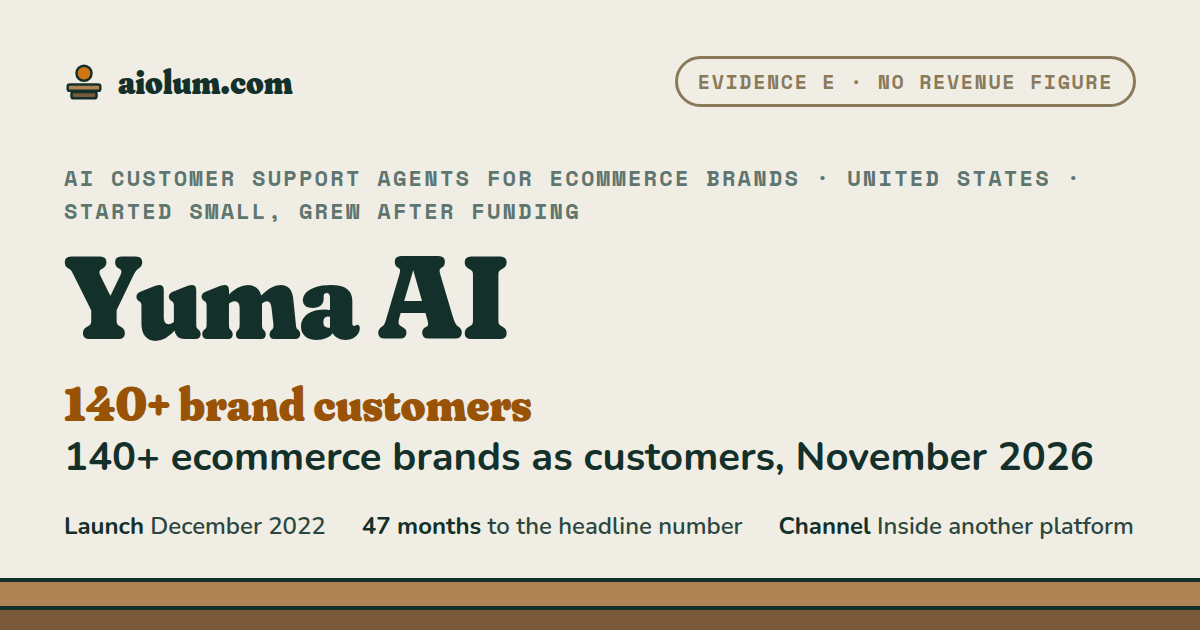
Yuma AI (AI customer support agents for ecommerce brands, United States): 140+ ecommerce brands as customers, November 2026. Evidence grade E: no revenue figure was checked. Team: 1 named founder when the first product launched in December 2022; 12 people in May 2024; around 30 in November 2026. Launched December 2022; still running, revenue growing.Added
- Outcome
- 140+ ecommerce brands as customers, November 2026Revenue growing
- Evidence
- E no revenue figure was checked
- Launch
- December 2022
- Status
- Still running
- Team
- 1 named founder when the first product launched in December 2022; 12 people in May 2024; around 30 in November 2026
- Outside funding
- US$5M announced in October 2024 in a company press release; backed by Y Combinator, Gradient Ventures and others
- Main channel
- Inside another platform
What is not verified
No revenue figure was found. A company press release of 30 October 2024 announced US$5 million of funding. The release says that the valuation passed US$30 million in summer 2024. The customer count of 140+ brands and the statement that customers pay are the company's own. No independent source confirms that these customers pay. The company says that more than 100 merchants paid in September 2024. A reader could look for a payment-processor profile, a founder interview with figures or an independent review. G2 refused the request for its reviews page. This story is grade E: the business is real and its product, price and customers are described from public pages, but no revenue figure was checked. Aiolum shows it as an idea worth studying, not as proof that it makes money.
Yuma AI sells an AI agent for the customer support of ecommerce brands. A ticket is one customer request in a helpdesk, the program where a support team reads and answers requests. Yuma works inside helpdesks such as Gorgias and Zendesk, and its agents take actions such as refunds. Yuma bills a full resolution, a ticket that the agent closed with no human involved.
The company's about page says that its founder, Guillaume Luccisano, launched an early AI support app on the Gorgias app store in November 2022. A launch post on its Y Combinator page gives December 2022. The April 2023 about page lists only him as the team, and the company says it has around 30 people in November 2026. A press release, published by The AI Insider on 30 October 2024, announced US$5 million of funding.
No revenue figure was found, so this story has grade E. The headline is the company's own statement of 140 or more brands. The company says its customers pay, and it publishes prices from US$14,400 a year. No independent source confirms the customer count or that the customers pay.
Why did Yuma AI work?
Four causes, in the order they mattered. Each one is a reusable lesson.
It started in a helpdesk's app store and merchants came to it
The company's about page says the first app went on the Gorgias app store, and that dozens of merchants reached out overnight. The launch post says that the founder's inbox filled with installation requests from Shopify merchants. Both the Gorgias and the Shopify app stores list the product today.
It charges for resolved tickets and not for seats or conversations
The pricing page says that Yuma bills only the tickets it handled start to finish with no human. It says that conversations, escalations and seats cost nothing extra. The page also says there is no implementation fee and that the first 30 days are free.
It works inside the helpdesk the shop already runs
The about page says that Yuma installs inside Gorgias, Zendesk, Kustomer and others with no migration. It says that the agents take real actions such as refunds, reshipments and subscription changes. The company says that brands automate support without switching helpdesks.
How it was built
These details come from the company's own pages. They are grade C. [2, 8, 17, 1]
- The first product used GPT-3 to draft replies for a support agent to approve. The company's April 2023 about page says so.
- The company's FAQ says that Yuma uses OpenAI, Anthropic and Google models and switches providers when one has an outage.
- The agents follow written playbooks that the brand edits in a Handbook. The company says that every change is versioned and that nothing goes live until someone on the brand's team publishes it.
- The company says that Hard Limits cap refund amounts, coupon values and loyalty points. It says that every reply and action is logged.
- Each brand gets an account manager and a shared Slack channel, according to the company's about page.
- The company says it is SOC 2 Type II compliant. This story does not record the audit report.
Tools named in the sources
Each one opens its page in the Tools tab, with every story that uses it.
Who tried this before Yuma AI, and why did they fail?
Two companies in our database of failed startups built customer support or live chat software for websites. The values below are from that database, which calls them AI-assisted summaries, and are not independently verified.
Answerly
The promiseFewer support tickets, by matching customer questions to written answers on a company's website.
Why it diedThe record says the product's promise did not match how customer service teams work. It says that reducing ticket volume is a weak goal when customers want their problem solved.
RightHello
The promiseLive chat for online shops that turns website visitors into customers, founded in Poland in 2014.
Why it diedThe record says it was too feature-rich to compete on price. It says that Intercom, Drift and Zendesk were adding chat to larger products.
The failed startups come from our database of 1,749 dead startups, retold here in our own words. Its entries are AI-assisted summaries of public sources, so these cards carry no evidence grade.
What changed
Answerly matched questions to written answers to cut ticket volume. The the failed-startup database record says that deflecting tickets is a weak goal. Yuma's claim is a different one: the agent resolves the ticket by taking the action, such as a refund. The company bills only for that result.
RightHello sold live chat to shops in a market of larger suites. Yuma sells to one kind of customer, the ecommerce brand, and works inside the helpdesk that the brand already pays for. Whether the claim holds is not shown by any independent source found for this page.
Can one person copy Yuma AI now?
The start can be copied. The company that followed cannot.
A prototype for one narrow job, released on a helpdesk's app store, drew demo requests overnight, the company says. The company's own pages say that it grew to around 30 people, and a press release announced US$5 million of funding. One person today would copy the start and the billing model, not the later company.
Where it is still open: Other jobs inside one platform's store: returns, subscription changes and order edits for ecommerce platforms other than Shopify and Gorgias.
- 1Pick one job inside a platform that has an app store, such as support tickets inside a helpdesk.
- 2Release a small prototype there and count the requests that arrive.
- 3Charge for the result, such as a resolved ticket, and not for seats.
- 4Work inside the tool the customer already uses, so that no migration is needed.
How much revenue does Yuma AI make?
Each row shows the evidence grade and the source numbers from the list at the end of this page. The grades are explained in How Aiolum verifies.
| Fact | Value | Grade | How we know | Sources |
|---|---|---|---|---|
| Launch of the first product | December 2022 | C | A launch post on the company's Y Combinator page, 2 March 2023: "I released a prototype in December 2022". The company's about page says November 2022. The earliest Internet Archive copy of yuma.ai is from 22 December 2022. | [5, 1, 9] |
| First product | an AI Ticket Assistant that drafts replies with GPT-3 | C | The company's about page, archived 13 April 2023: "Automated response drafting for customer support tickets using GPT-3". | [8] |
| Team | 1 named person in April 2023, 12 in May 2024, around 30 in November 2026 | C | The April 2023 about page lists one person under "Meet our team". The Y Combinator page, archived 15 May 2024, says "Team Size: 12". The November 2026 about page says "around 30 people". | [8, 10, 1] |
| Funding | US$5 million, announced 30 October 2024 | C | A company press release published by The AI Insider. It says that the seed round closed in spring 2023 and that more investment in summer 2024 gave a valuation of over US$30 million. | [7] |
| Customers | 140+ brands in November 2026; 100+ paying merchants in September 2024 | C | The company's home page says "runs support for 140+ brands". A launch post of 18 September 2024 says "over 100+ paying merchants". | [3, 6] |
| Tickets handled | 1,827,264 interactions counted in November 2026 | C | A counter on the company's about page, described as "Interactions successfully automated across Yuma-powered support experiences". The page does not say how it counts. | [1] |
| Billing model | only for fully resolved tickets, with no charge for conversations or seats | C | The company's pricing page: "Yuma bills per fully resolved ticket". Every plan carries a 12-month commitment. | [2] |
| Published annual prices | US$14,400, US$40,000 and US$90,000 a year | C | The company's pricing page lists them as "illustrative annual prices" for 12,000, about 48,000 and about 120,000 resolutions a year. | [2] |
| Earlier monthly prices | two sets in September 2024: US$299, US$549 and US$799 a month; US$350, US$650 and US$900 a month | C | A copy of the pricing page archived 20 September 2024 holds both sets. The first set has quotas of billable tickets, and the second has quotas of automated resolutions. | [11] |
| Example customer result | 89% of tickets fully automated at EvryJewels | C | The company's own case study of a jewelry brand. It also says that the cost per ticket fell from US$5.50 to US$2. | [14] |
| Accelerator | Y Combinator, Winter 2023 batch | C | The Y Combinator company page lists Winter 2023 and the status "Active". | [4] |
| Legal entity | Yuma AI Inc. | C | Named in the company's privacy policy, last updated August 2026. The pricing page archived 20 September 2024 also names Yuma AI PTE. LTD. and a Singapore office. | [18, 11] |
How to read this table. Grade C means the company said it on its own pages, in a launch post or in a press release. No value is grade A or B, and no revenue figure was found.
| Plan | Per month, billed yearly (US$) | Per month, billed monthly (US$) | Limit |
|---|---|---|---|
| Starter | 1,200 | 12,000 full resolutions a year, about US$1.20 each | |
| Growth | 3,333 | about 48,000 full resolutions a year, about US$0.83 each | |
| Scale | 7,500 | about 120,000 full resolutions a year, about US$0.75 each | |
| Shopify App Store listing | 850 | "From $850/month" with a free trial |
The page calls these figures illustrative annual prices paid upfront, with a 12-month commitment, and says monthly plans also exist. The monthly column here is the annual price divided by 12. The page says that a monthly plan bills US$1.50 for each ticket over the quota. The Shopify App Store listing says "From $850/month". The page says that the exact bundle is built around the brand's forecast. A copy of the pricing page from 20 September 2024 holds two sets of monthly prices. The copy gives one set as US$299, US$549 and US$799, and the other as US$350, US$650 and US$900.
When did Yuma AI launch, and how did it grow?
From a prototype on a helpdesk's app store to a company of around 30 people, in 47 months. Each entry carries its grade.
- November or December 2022CA first AI support app goes on the Gorgias app store. The company's about page says merchants asked to test it overnight. A copy of yuma.ai from 22 December 2022 shows an AI Ticket Assistant. [1, 5, 9]
- 2 March 2023CA launch post on the company's Y Combinator page presents Yuma as part of the Winter 2023 batch. It says that the founder's inbox filled with installation requests from Shopify merchants. [5, 4]
- Spring 2023CA press release says that the seed round closed. It names Gradient Ventures, Altman Capital Fund and AI Grant among the investors. [7]
- 15 May 2024CThe Y Combinator page lists a team size of 12 and a founding year of 2023. The company's own pages give 2022 for the first launch. [10]
- September and October 2024CA launch post says that more than 100 merchants pay. The company announces US$5 million of funding on 30 October 2024. [6, 7]
- November 2026CThe company says that 140+ brands use it, with around 30 people in Boston, Barcelona and remote. It sells support, sales, social, chat and voice agents. [1, 3]
What could go wrong for Yuma AI?
The risks are the mirror image of the causes above.
What is not verified
No revenue figure was found. A company press release of 30 October 2024 announced US$5 million of funding. The release says that the valuation passed US$30 million in summer 2024. The customer count of 140+ brands and the statement that customers pay are the company's own. No independent source confirms that these customers pay. The company says that more than 100 merchants paid in September 2024. A reader could look for a payment-processor profile, a founder interview with figures or an independent review. G2 refused the request for its reviews page.
Counters, testimonials and dates on the company pages
The home page signs several quotations with a first name and an initial, with a role or with "Verified User". The home page shows four brand logos under "Trusted by leading ecommerce brands", and the about page names ten clients. The about page counter of 1,827,264 automated interactions does not say how it counts. A case study says that a brand joined in early 2024 and that its ticket volume was counted in October 2023. The company's pages give November 2022, December 2022 and 2023 as the start. The earliest copy of yuma.ai is from 22 December 2022. The "Rated 4.8/5 on G2" line and the G2 badges named on the about page were not checked, because G2 refused the request.
Agents that reply on the brand's behalf
Social AI replies to comments and messages on a brand's pages and hides spam. The company's FAQ says that negative or misleading comments can also be hidden, when the brand chooses that. Voice AI answers support calls. No downloaded page says whether callers or commenters are told that they are talking to an AI. The company says that an escalation sends the conversation to a human with full context.
No source gives the team size at the start
The April 2023 about page lists one person, and the launch post is written in the first person. The same about page says the product is "built by Silicon Valley veterans". Neither says how many people worked on the company in 2022 or early 2023. The company's pages say that a founding team came together in the first quarter of 2023, without a number.
Sources
The grade next to each source is the best grade that the source can support. "Read in full" means that the text of the page was downloaded and the numbers were checked in it.
- C Yuma AI, About us, read 11 November 2026Read in full. The company's own page. Source for the start in November 2022, the timeline, the team size and the counter.
- C Yuma AI, Pricing, read 11 November 2026Read in full. Source for the billing model, the annual prices and the monthly over-quota price.
- C Yuma AI, home page, read 11 November 2026Read in full. Source for the 140+ brands, the testimonials and the product list.
- C Y Combinator, Yuma AI company page, read 11 November 2026Read in full. Source for the Winter 2023 batch and the founder's note on a December 2022 prototype.
- C Y Combinator launch post, Yuma - ChatGPT for customer support, 2 March 2023Read in full. A first-person post on the company's page. Source for the December 2022 prototype and the demand from Shopify merchants.
- C Y Combinator launch post, Yuma: AI agents for e-commerce customer service, 18 September 2024Read in full. Source for the statement of more than 100 paying merchants in September 2024.
- C The AI Insider, Yuma.ai Raises $5M to Transform E-commerce Customer Support, 30 October 2024Read in full. It prints the company's press release. Source for the US$5 million, the seed round and the investors.
- C Yuma AI, About us, Internet Archive copy of 13 April 2023Read in full. Source for the first product, the GPT-3 statement and the one person listed as the team.
- C Yuma AI, home page, Internet Archive copy of 22 December 2022Read in full. The earliest copy of the domain. It shows the AI Ticket Assistant.
- C Y Combinator, Yuma AI company page, Internet Archive copy of 15 May 2024Read the company details. Source for "Team Size: 12" and "Founded: 2023".
- C Yuma AI, Pricing, Internet Archive copy of 20 September 2024Read in full. Source for the monthly prices of September 2024.
- C Shopify App Store, Yuma AI, read 11 November 2026Read in full. Source for the listing price "From $850/month" and the rating of 5.0 from 9 reviews.
- C Gorgias App Store, Yuma AI, read 11 November 2026Read in full. A listing written by the company. It says Yuma was founded in 2022.
- C Yuma AI case study, EvryJewels, read 11 November 2026Read in full. The company's own case study of a customer. Source for the 89% automation and the cost per ticket.
- C database of failed startups, record of Answerly, read 11 November 2026Record page read on the website on the day of writing. An AI-assisted summary, not independently verified.
- C database of failed startups, record of RightHello, read 11 November 2026Record page read on the website on the day of writing. An AI-assisted summary, not independently verified.
- C Yuma AI, FAQ, read 11 November 2026Read in full. Source for the model providers and the failover statement.
- C Yuma AI, Privacy Policy, read 11 November 2026Read in full. Source for the name Yuma AI Inc.
Run this company? Send corrections or a verified figure to aiolum@livyden.com