assistant-ui: Product, team and how it was built
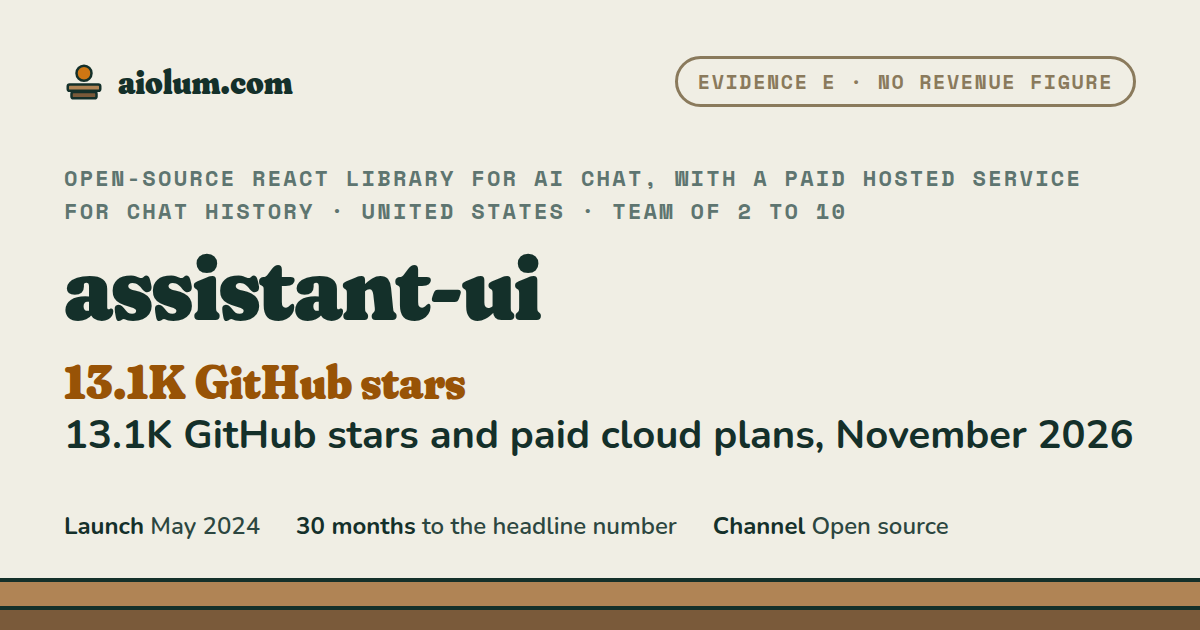
assistant-ui (Open-source React library for AI chat, with a paid hosted service for chat history, United States): 13.1K GitHub stars and paid cloud plans, November 2026. Evidence grade E: no revenue figure was checked. Team: 3 people (Y Combinator listing); 1 founder named. Launched May 2024; still running.Added
- Outcome
- 13.1K GitHub stars and paid cloud plans, November 2026
- Evidence
- E no revenue figure was checked
- Launch
- May 2024
- Status
- Still running
- Team
- 3 people (Y Combinator listing); 1 founder named
- Outside funding
- Y Combinator Winter 2025 batch; amount not published
- Main channel
- Open source
What is not verified
No revenue figure, paying-customer count or funding amount was found. The pricing page, the terms and a working sign-up path show that a paid plan is on sale. No source says that a customer has paid. A reader could look for a payment-processor profile, a founder interview or a press article. This story is grade E: the business is real and its product, price and customers are described from public pages, but no revenue figure was checked. Aiolum shows it as an idea worth studying, not as proof that it makes money.
assistant-ui is a component library: ready-made parts of a user interface that a programmer puts into an application. This one is for React, a JavaScript library for building web pages, and it draws the chat window of an AI assistant. The library is free under the MIT licence. The company, AgentbaseAI Inc., also sells assistant-cloud, a hosted service that saves chat threads and history.
The company's Y Combinator page names Simon Farshid as founder and chief executive, in the Winter 2025 batch, with a team of 3. The first version of the package was published on the npm registry on 7 May 2024. The Internet Archive recorded the website the same day. The founder wrote on 29 July 2024 that he released the project the month before.
No revenue figure was found, and this story is grade E. The pricing page lists a US$50 monthly plan with a sign-up link, and the terms describe recurring charges. No source says that a customer has paid, and no customer count is published.
Why did assistant-ui work?
Four causes, in the order they mattered. Each one is a reusable lesson.
A free MIT library lets developers try it at no cost
The pricing page says the library is free forever under the MIT licence and can be used in commercial products. The company's own home page counts 13.1K GitHub stars and 3.2M weekly downloads. The GitHub page confirms the stars. The npm download record gives 3,155,541 downloads for 4 to 10 November 2026.
The paid service covers the part that developers would build themselves
The pricing page describes assistant-cloud as an optional backend for threads, history and sign-in. Its Free plan includes thread persistence. The Pro plan adds 500 monthly active users and early access to new features. The company states that the library works without the cloud.
One runtime connects the chat window to many backends
The home page lists AI SDK, LangGraph, LangChain and Mastra as backends, and a custom one. The Y Combinator page names LangChain, Stack AI, Browser Use and Athena Intelligence as users. These names are the company's own statement.
How it was built
These details come from the company's own pages and from public records. They are grade C. [5, 9, 4]
- The library is written in TypeScript and published as several npm packages. The npm registry holds 465 versions of the main package.
- The command npx assistant-ui@latest create copies the interface source code into the developer's project, as the home page says.
- The interface is made of composable parts, for example ThreadPrimitive and ComposerPrimitive. The developer controls the look of each part.
- The privacy notice names PostHog, Vercel Analytics and a self-hosted Umami for measuring, and Stripe for payment data.
Tools named in the sources
Each one opens its page in the Tools tab, with every story that uses it.
Who tried this before assistant-ui, and why did they fail?
Three companies in our database of failed startups sold a tool to developers with a free way in. The records say they struggled to earn money. All three ended in 2024. The values below are from that database and are not independently verified.
Kite DevTool
The promiseMachine-learning code completion inside the editor, with a free tier and a paid Pro version.
Why it diedThe record names competition from GitHub Copilot as the primary cause of death. It also says that free users never converted at scale.
CodeSee
The promiseAutomatic maps of a codebase for developers, with open-source traction.
Why it diedThe record says it struggled to convert free users to paid customers and calls the tool a vitamin when buyers wanted a painkiller.
Fig DevTool
The promiseAutocomplete and visual commands for the terminal, with a large community of early users.
Why it diedThe record says its failure was a unit economics and monetization problem, with a loved product and low willingness to pay.
The failed startups come from our database of 1,749 dead startups, retold here in our own words. Its entries are AI-assisted summaries of public sources, so these cards carry no evidence grade.
What changed
All three predecessors made a tool that developers liked and that was free to try. The the failed-startup database records say each one found it hard to turn those users into paying customers.
assistant-ui follows the same first step, a free library with stars and downloads. Its paid part is a service that stores data, which the free library does not do. Whether companies pay for that service is not shown by any source found.
Can one person copy assistant-ui now?
The structure can be copied. The result is not proven.
A free open-source library with a small paid hosted service is a structure that one developer can start. Nothing found shows that customers pay for it. The founder started with one narrow job, the chat window.
Where it is still open: Other parts that every AI product rebuilds: file upload screens, approval dialogs for tool calls, voice input, and usage meters.
- 1Pick one narrow job in AI products that every team rebuilds, such as the chat screen.
- 2Publish it under a free licence and let developers copy the source into their own projects.
- 3Sell the part that needs a server, such as thread storage, with a free plan and a flat first paid plan.
How much revenue does assistant-ui make?
Each row shows the evidence grade and the source numbers from the list at the end of this page. The grades are explained in How Aiolum verifies.
| Fact | Value | Grade | How we know | Sources |
|---|---|---|---|---|
| First package published on npm | 7 May 2024 | C | The npm record for @assistant-ui/react shows version 0.0.1 on that date. Version 0.1.0 followed on 16 June 2024. | [9] |
| First record of the website in the Internet Archive | 7 May 2024 | C | The first capture of assistant-ui.com in the archive's index is dated 7 May 2024. No earlier name or domain was found. | [14] |
| Company entity | AgentbaseAI Inc., registered in Delaware | C | The terms of service, last updated 31 August 2026, give this name. The npm record lists the same name as author. No incorporation date was found. | [3, 9] |
| Y Combinator listing | Winter 2025 batch, founded 2024, team size 3 | C | Company page at Y Combinator, read 12 November 2026. The funding amount is not given. | [7] |
| Founder | Simon Farshid, founder and chief executive | C | The Y Combinator page and the author line of the July 2024 blog post name him. The Y Combinator page lists him as the only active founder. | [7, 10] |
| Earlier company of the founder | READO, a book recommendation engine | C | The Y Combinator page says he co-founded it and grew it to 140,000 monthly users. It is a different business from assistant-ui. | [7] |
| GitHub stars, forks and commits | 13.1K stars, 1.3K forks, 7,352 commits | C | GitHub repository page for assistant-ui/assistant-ui, read 12 November 2026. The licence is MIT. | [8] |
| Weekly downloads of the main package | 3.2M | C | The home page and the traction page show this live counter without a date. The npm download record gives 3,155,541 for 4 to 10 November 2026. | [5, 6, 16] |
| Way to buy the Pro plan | Start Pro link that leads to a sign-up page | C | The pricing page links to cloud.assistant-ui.com with plan=pro, which sends a new visitor to a sign-in page with email, Google and a sign-up link. | [1, 2] |
| Billing terms | Subscriptions renew until cancelled, non-refundable | C | Terms of service: "Your subscription will continue and automatically renew unless canceled." Payment data is handled by Stripe, the privacy notice says. | [3, 4] |
| Open roles | 3, in San Francisco | C | The careers page calls the company "A small team making the frontend layer for AI agents." | [13] |
| Time from first package to the November 2026 figures | 30 months | calc | Calculated: May 2024 to November 2026. | [9, 8] |
How to read this table. Every value is grade C: the company's own pages, the GitHub page or the npm registry record. No payment processor, press article or buyer confirms any of it.
| Plan | Per month, billed yearly (US$) | Per month, billed monthly (US$) | Limit |
|---|---|---|---|
| Free | 0 | 200 MAU | |
| Pro | 50 | 500 MAU, then US$0.10 per extra MAU | |
| Enterprise | custom | custom MAU price, own backend, 99.9% uptime SLA |
Plans are priced by monthly active users (MAU), which means people who send at least one message in the month. Pro adds US$0.10 for each extra MAU. The page lists no yearly price. The library itself is free under the MIT licence.
When did assistant-ui launch, and how did it grow?
From a first package on npm to a library for the web, phones and terminals, in 30 months. Each entry carries its grade.
- 7 May 2024CVersion 0.0.1 of @assistant-ui/react is published on npm. The Internet Archive records the website the same day. [9, 14]
- 29 July 2024CThe founder's first blog post says he released the project the month before, after two years of building prototypes with generative AI. [10]
- 31 January 2025CThe monthly changelog says assistant-cloud was rolled out to early users, with a public announcement planned in a few days. [11]
- Winter 2025CThe company is in the Y Combinator Winter 2025 batch with a team of 3. [7]
- 9 March 2026CLaunch week: the company adds React Native and terminal versions that use the same runtime as the web library. [12]
- 12 November 2026CThe pricing page lists a free plan, a US$50 plan and a custom plan. The repository shows 13.1K stars. [1, 8]
What could go wrong for assistant-ui?
The risks are the mirror image of the causes above.
What is not verified
No revenue figure, paying-customer count or funding amount was found. The pricing page, the terms and a working sign-up path show that a paid plan is on sale. No source says that a customer has paid. A reader could look for a payment-processor profile, a founder interview or a press article.
Start date and earlier work
The first package and the first website copy are dated 7 May 2024, and no earlier name was found. The Y Combinator page lists the year as 2024. The founder's earlier company READO is a different business, and no incorporation date for AgentbaseAI Inc. was found. The founder's Y Combinator launch post is dated 13 February 2025. It says he built the first version the year before, for an app of his own.
Counters, a badge and a logo row on the home page
Outside records confirm the two counters and the badge, but nothing explains the logo row. The home page shows "13.1k GitHub stars", "3.2M weekly downloads" and "Backed by" Y Combinator. The GitHub page confirms the stars, and the Y Combinator page confirms the listing. The npm download record gives 3,155,541 downloads for 4 to 10 November 2026. The page also shows eight logos without a label: Anthropic, Google Cloud, AWS, LangChain, Builder.io, Paperclip, Unsloth and Neon. The page does not say what ties these companies to assistant-ui.
Testimonials are posts that were not checked
The home page shows quotations headed by the X names @LangChainAI, @neondatabase and @hwchase17. The July 2024 blog post shows three more: @raw_works, @eliasdevs and @manuuonly. The X posts could not be read, so the speakers and wording are not verified.
Sources
The grade next to each source is the best grade that the source can support. "Read in full" means that the text of the page was downloaded and the numbers were checked in it.
- C assistant-ui pricing page, read 12 November 2026Read in full. Source for the plans, the MAU limits, the Start Pro link and the statement that the library is free under the MIT licence.
- C assistant-ui accounts sign-in page, reached from the Start Pro link, read 12 November 2026Read in full. The link redirects to a sign-in page with email, Google and a sign-up link.
- C assistant-ui Terms of Service, last updated 31 August 2026Read in full. Source for the company name, the Delaware registration, the subscription and refund terms.
- C assistant-ui Privacy Policy, last updated 31 August 2026Read in full. Source for Stripe, PostHog, Vercel Analytics and Umami.
- C assistant-ui home page, read 12 November 2026Read in full. Source for the counters, the badge, the logo row, the backends and the quotations.
- C assistant-ui traction page, read 12 November 2026Read in full. Live counters without dates: stars, weekly downloads, contributors, forks and commits.
- C Y Combinator company page: assistant-uiRead in full on 12 November 2026. Source for the batch, the founding year, the team size and the founder.
- C GitHub repository assistant-ui/assistant-uiRead the front page on 12 November 2026. Source for stars, forks, commits and the licence.
- C npm registry record for @assistant-ui/reactRead the version times on 12 November 2026. Source for the first publish date, the author name and the number of versions.
- C assistant-ui blog, 29 July 2024: Hello, assistant-uiRead in full. The founder's launch post and the source for why he built it.
- C assistant-ui blog, 31 January 2025: January 2025 ChangelogRead the section on Assistant Cloud. Source for the early-user rollout.
- C assistant-ui blog, 9 March 2026: Launch WeekRead the introduction and the first days. Source for React Native and terminal support.
- C assistant-ui careers page, read 12 November 2026Read in full. Source for the small-team statement and the three open roles.
- C Internet Archive index of assistant-ui.comRead the index lines. The earliest capture is 7 May 2024.
- C Database of failed startups, local exportRecord pages read on 12 November 2026. AI-assisted summaries, not independently verified. Source for the failed predecessors.
- C npm download record for @assistant-ui/react, 4 to 10 November 2026Read in full on 12 November 2026. The registry's record gives 3,155,541 downloads for that week.
Run this company? Send corrections or a verified figure to aiolum@livyden.com