Cognee: Product, team and how it was built
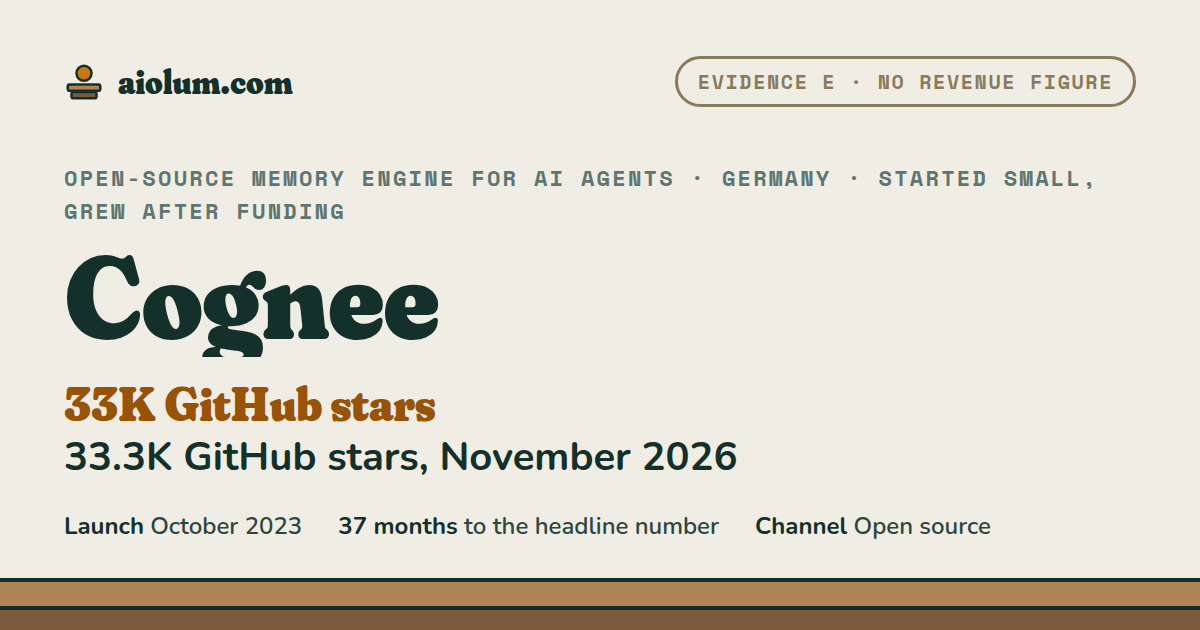
Cognee (Open-source memory engine for AI agents, Germany): 33.3K GitHub stars, November 2026. Evidence grade E: no revenue figure was checked. Team: 2 co-founders and 5 team members listed in February 2025; 17 people listed in November 2026. Launched October 2023; still running.Added
- Outcome
- 33.3K GitHub stars, November 2026
- Evidence
- E no revenue figure was checked
- Launch
- October 2023
- Status
- Still running
- Team
- 2 co-founders and 5 team members listed in February 2025; 17 people listed in November 2026
- Outside funding
- EUR 1.5M pre-seed (company page, February 2025); US$7.5M seed (company blog, 19 February 2026)
- Main channel
- Open source
What is not verified
No revenue figure was found, so the story is grade E. The pricing page, home page, about page, blog, newsroom and repository were read; none gives revenue. A reader could look for a payment-processor profile or a press interview. The company names customers on its own pages, and no independent source confirms that they pay. The company's posts say it started in 2024. GitHub and a register summary show a start in 2023. This story is grade E: the business is real and its product, price and customers are described from public pages, but no revenue figure was checked. Aiolum shows it as an idea worth studying, not as proof that it makes money.
Cognee, from Topoteretes UG (haftungsbeschränkt) in Berlin, is an open-source memory engine for AI agents, also sold as a hosted cloud. A memory engine keeps the facts that an agent learned in one session, so that the agent can find them in the next. Cognee turns documents and tool data into a knowledge graph, a set of facts joined by links. It also stores embeddings, lists of numbers that let a program find similar text.
The first public trace is a GitHub organization created on 15 February 2023, and the first release of the code is dated 8 October 2023. The company's own post says it started Cognee in Berlin in 2024. A copy of the company's about page from 19 February 2025 names two co-founders, Vasilije Markovic and Boris Arzentar, and five team members. The about page of November 2026 lists 17 people, and the company wrote on 19 February 2026 that it raised a US$7.5M seed round.
No revenue figure was found, so the story is grade E. The headline is the 33.3K GitHub stars read on 12 November 2026. A paid plan can be bought without a sales call, and the privacy notice names Stripe as the payment processor. No source states that a customer has paid.
Why did Cognee work?
Four causes, in the order they mattered. Each one is a reusable lesson.
The free code reached 33,259 stars and leads to the hosted plan
The repository is licensed under Apache-2.0 and shows 33,259 stars. The company wrote that it went from an open-source experiment to production infrastructure in 2025. The home page sends visitors to a free cloud account. No source says how many customers came from the repository.
The price list moved from a flat monthly fee to a price per token
A copy from 10 November 2025 lists a Cloud plan at US$25 a month. The page of 12 November 2026 lists US$1.00 per 1M tokens and US$5 for each extra workspace. A company newsletter memo of 24 September 2026 speaks of cloud tokens down to a dollar per million.
The top plan is an engagement run by the company's own engineers
The pricing page describes Enterprise as a fixed-scope engagement in the customer's own cloud, with company engineers. The about page lists a Head of FDE, and the home page quotes the FDE team. This part is closer to services than to software.
How it was built
These details come from the company's own pages and from GitHub. They are grade C. [6, 11, 1, 10, 2]
- The first release in October 2023 was a framework for testing RAG pipelines. Version 0.1.0 of March 2024 loaded files through dlt and built graphs from user-defined data models.
- Cognee 1.0 of June 2026 changed the interface to four verbs: remember, recall, improve and forget. The company wrote that early versions asked developers to run a graph database that almost nobody wanted to run.
- The cloud runs on gpt-oss-120b, an open-weight model from OpenAI, according to the pricing page.
- Plans are paid by card through Stripe, as the privacy notice states.
- Integrations named on the home page include Claude Code, Codex, Cursor, LangGraph and any MCP client.
Tools named in the sources
Each one opens its page in the Tools tab, with every story that uses it.
Who tried this before Cognee, and why did they fail?
Four companies in our database of failed startups sold software for keeping and finding knowledge, or a database that developers liked and did not pay for. The values below are from that database, were read on 12 November 2026 and are not independently verified.
Springpad
The promiseA place to collect, organize and find web content such as articles, videos and recipes.
Why it diedThe record says it never found a sustainable business model or a way to earn from its users.
Neeva
The promisePaid, ad-free search that also searches the user's own email, calendar and cloud files.
Why it diedThe record says user acquisition cost too much, and a paid search model did not match how consumers behave.
RethinkDB
The promiseA database that pushes changes in query results to the application as they happen.
Why it diedThe record says developers liked it but would not pay, and replacing a whole data layer was too large a risk.
Primary Data
The promiseA virtualization layer that makes data location-agnostic across on-premise and cloud storage.
Why it diedThe record says the product was too complex, and enterprises resisted changing how they store and reach data.
The failed startups come from our database of 1,749 dead startups, retold here in our own words. Its entries are AI-assisted summaries of public sources, so these cards carry no evidence grade.
What changed
The four records share one trouble: users liked the tool, and few paid for it. Springpad and Neeva were consumer products that asked people to pay, and RethinkDB and Primary Data asked companies to replace a data layer. Cognee meets part of the same trouble. A memory layer sits inside an agent, so a team must add it to existing code.
Two things differ from the records. The code is free, so a developer can add it with one install command before anyone pays. The hosted plan charges by tokens processed, so a small user pays little and a large user pays more. Whether enough teams pay is not shown by any source found.
Can one person copy Cognee now?
The open-source-then-hosted structure can be copied; the result is not shown.
A small team can publish the code of an infrastructure tool and sell a hosted version priced by usage. The sources show stars, a price list and funding, and they show no revenue. Treat this as a pattern, not as proof that it earns.
Where it is still open: Other layers that agents lack: shared state, permissions, tool logs and tests, each as open code with a hosted version.
- 1Pick one gap that developers of a new kind of software hit, such as agents that forget between sessions.
- 2Publish the code under a permissive licence, with one install command.
- 3Offer a free hosted plan, then a plan that charges for the tokens processed.
- 4Add integrations for the coding agents that developers already use.
How much revenue does Cognee make?
Each row shows the evidence grade and the source numbers from the list at the end of this page. The grades are explained in How Aiolum verifies.
| Fact | Value | Grade | How we know | Sources |
|---|---|---|---|---|
| Company | Topoteretes UG (haftungsbeschränkt), Berlin | C | The page footer names the company and a Managing Director, Vasilije Markovic. The privacy notice names Cognee Inc. of San Francisco as controller and calls Topoteretes UG its wholly-owned subsidiary. | [1, 10] |
| Start of the project | GitHub organization created 15 February 2023 | C | GitHub's record of the topoteretes organization. North Data's summary of register notices dates the registration of Topoteretes UG to 28 April 2023. The company's own posts say it started Cognee in Berlin in 2024. | [16, 21, 4] |
| Earlier project of the same organization | PromethAI repositories, 15 May 2023 | C | Two repositories of the organization, PromethAI-Mobile and PromethAI-Backend, were created on that day. The old address topoteretes/PromethAI-Memory answers with the cognee repository. | [16, 17] |
| First release of the code | 0.0.1 on 8 October 2023; 159 releases by November 2026 | C | The first release note reads Cognitive Architecture - Initial test framework for RAGs. The newest release read was v1.6.7 of 6 November 2026. | [6] |
| GitHub repository | 33,259 stars, 3,503 forks, Apache-2.0 licence | C | GitHub's record, read on 12 November 2026. The home page shows 33.3k stars. | [5, 2] |
| Team | 2 co-founders and 5 team members in February 2025; 17 people in November 2026 | C | A copy of the about page of 19 February 2025 lists both groups. The about page of November 2026 has 18 entries; one entry, titled Chief Barketing Officer, is not counted. That page no longer lists the second co-founder. | [7, 3] |
| Funding | EUR 1.5M pre-seed; US$7.5M seed | C | The about-page copy of February 2025 says the company raised a 1.5 m EUR pre seed round. The company blog of 19 February 2026 names Pebblebed as lead of the seed round. | [7, 4] |
| Prices today | Free; Standard at US$1.00 per 1M tokens plus US$5 per extra workspace; Enterprise on request | C | The company's pricing page, read on 12 November 2026. | [1] |
| Earlier prices, 10 November 2025 | Cloud at US$25 a month (beta); on-premise for small companies at US$3,500 a month | C | A copy of the pricing page in the Internet Archive. The page lists a Cloud plan with 1 GB ingestion and 10,000 API calls. | [9] |
| How a plan is bought | Self-serve sign-up; payment through Stripe | C | The sign-up page offers Google, GitHub or email. The privacy notice says payment is processed by Stripe and lists metered billing. | [15, 10] |
| Customers the company names | Bayer, University of Wyoming, Knowunity | C | The company's own case-study page. It states 10,000 papers for Bayer, a first system in 30 days for Wyoming and a 40,000-student proof of concept for Knowunity. | [14] |
| Accelerator | Berkeley Xcelerator, 2026 Spring Cohort | C | The company post of 13 July 2026 calls it non-dilutive and lists cloud and GPU credits of up to US$10,000 each from three providers. | [12] |
How to read this table. Grade C means the company states the value, or a public GitHub record shows it. No value is grade A or B, and no calc value is used.
| Plan | Per month, billed yearly (US$) | Per month, billed monthly (US$) | Limit |
|---|---|---|---|
| Free | 0 | 1 workspace, 1M tokens included, no card required | |
| Standard | usage-based | US$1.00 per 1M tokens; US$5 a month for each extra workspace | |
| Enterprise | custom | custom | bring-your-own-cloud engagement with company engineers; terms of 6, 12 or 24 months |
The Standard plan has no monthly base fee. The page lists US$1.00 per 1M tokens processed and US$5 a month for each extra workspace. The Enterprise plan is a fixed-scope engagement in the customer's own cloud, with no price on the page. A copy of the page from 10 November 2025 listed a Cloud plan at US$25 a month as beta pricing.
When did Cognee launch, and how did it grow?
From a GitHub organization in February 2023 to a hosted memory platform with a price per token in November 2026.
- 15 February to 15 May 2023CGitHub shows the topoteretes organization created on 15 February 2023 and two PromethAI repositories on 15 May 2023. [16]
- 8 October 2023CFirst release of the code, version 0.0.1, with a note about an initial test framework for RAGs. [6]
- 24 March 2024CA copy of cognee.ai offers to help tailor a customer's AI memory and asks visitors to book time with the team. It quotes a customer, keepi.ai. [8]
- 19 February 2025CA copy of the about page names two co-founders and five team members and says the company raised a 1.5 m EUR pre seed round. [7]
- 19 February 2026CThe company's blog announces a US$7.5M seed round led by Pebblebed and says Cognee runs live in more than 70 companies. [4]
- 26 June 2026CThe company releases cognee 1.0, with a remember, recall, improve and forget interface. The post offers a managed cloud, self-hosting and a Rust core. [11]
What could go wrong for Cognee?
The risks are the mirror image of the causes above.
What is not verified
No revenue figure was found, so the story is grade E. The pricing page, home page, about page, blog, newsroom and repository were read; none gives revenue. A reader could look for a payment-processor profile or a press interview. The company names customers on its own pages, and no independent source confirms that they pay. The company's posts say it started in 2024. GitHub and a register summary show a start in 2023.
Home-page trust signals are not sourced
The home page shows a row of company logos under “Trusted by engineers from”, with names such as Apple, Google and Microsoft. It shows a counter of 5M+ SDK runs a month and heyData seals for the EU AI Act and GDPR. It quotes six X handles and five named people. One of the five is titled CEO today; a copy of 24 March 2024 titles the same person Architect, with different wording. The X posts were not opened, and the page does not say whether any was paid.
The company pays creators to post, and one blog post is an April Fools' text
The Creator Program pays cash or cloud credits for posts about Cognee, by reach. The page requires every paid post to carry the platform's paid-partnership label, and says an undisclosed post is not eligible. The page caps cash payouts for a LinkedIn post at US$3,000. A company blog post of 1 April 2026 says leaked Claude Code source code held comments that refer to Cognee. The post ends with the words “Happy April 1st.”, so it reads as an April Fools' text, not as a report.
One customer project used data about school students
The company's case study of 11 September 2025 says Knowunity gave it metadata on 40,000 students from Bremen. The data held grade levels, school types and IP address patterns, used to infer which students are classmates or live near each other. The post says the IP addresses were anonymized and that the analysis complied fully with GDPR. The post calls the app's users teenagers and does not describe their consent.
Sources
The grade next to each source is the best grade that the source can support. "Read in full" means that the text of the page was downloaded and the numbers were checked in it.
- C Cognee pricing pageRead in full on 12 November 2026. Source for the three plans, the prices, the legal footer and the model that the cloud runs on.
- C Cognee home pageRead in full on 12 November 2026. Source for the product description, the logo row, the counters, the quotations and the integrations.
- C Cognee about pageRead in full on 12 November 2026. Source for the 18 team entries and the offices.
- C Cognee blog, 19 February 2026: Cognee Raises $7.5M Seed to Build Memory for AI AgentsRead in full on 12 November 2026. The company's own post, bylined by its CEO and founder. Source for the seed round, the investors and the start in 2024.
- C GitHub API: repository topoteretes/cogneeRead on 12 November 2026. Source for the creation date of the repository, the stars, the forks and the licence.
- C GitHub API: releases of topoteretes/cognee, pages 1 and 2Read both pages on 12 November 2026. Source for the first release of 8 October 2023, the release count and the 0.1.0 note.
- C Internet Archive copy of cognee.ai/about-us, 19 February 2025Read in full. Source for the two co-founders, the five team members and the pre-seed round.
- C Internet Archive copy of cognee.ai, 24 March 2024Read in full. Source for the consulting offer of 2024 and the earlier testimonials.
- C Internet Archive copy of cognee.ai/pricing, 10 November 2025Read in full. Source for the earlier Cloud and on-premise prices.
- C Cognee privacy noticeRead in full on 12 November 2026. Source for Stripe, metered billing and the US operating company.
- C Cognee blog, 26 June 2026: cognee 1.0, the open-source memory platform for AI agentsRead in full on 12 November 2026. Signed by the founder and CEO. Source for the redesign, the lessons and the deployment options.
- C Cognee blog, 13 July 2026: cognee joins UC Berkeley Xcelerator's 2026 Agentic AI CohortRead in full on 12 November 2026. Source for the accelerator, the credits and the founder's earlier employers.
- C Cognee Creator Program pageRead in full on 12 November 2026. Source for the pay rates and the disclosure rules.
- C Cognee case studies pageRead in full on 12 November 2026. Source for the three customer stories.
- C Cognee Cloud sign-up pageRead in full on 12 November 2026. It offers account creation with Google, GitHub or email.
- C GitHub API: organization topoteretes and its repositoriesRead the organization record and the repository list on 12 November 2026. Source for the creation dates of the organization and of the PromethAI repositories.
- C GitHub API: address topoteretes/PromethAI-MemoryRequested on 12 November 2026. The answer is the record of the cognee repository.
- C Cognee newsroom pageRead in full on 12 November 2026. Lists the newsletter memos with their dates, for example memo 005 of 24 September 2026.
- C Cognee blog, 1 April 2026: Claude Code's Leak Reveals Anthropic's Obsession with CogneeRead in full on 12 November 2026. A company post that ends with the words “Happy April 1st.”. Source for the claim described in the watch item.
- C Database of failed startups, local exportRecord pages read on the website on 12 November 2026. AI-written summaries, not independently verified.
- C North Data: Topoteretes UG, Berlin, Amtsgericht Charlottenburg HRB 252065 BRead the list of register publications on 12 November 2026. It dates the registration to 28 April 2023. It is an automated summary of register notices, not the register itself.
- C Cognee blog, 11 September 2025: Smart Networks, Smarter Students: How cognee Connected 40,000 German LearnersRead in full on 12 November 2026. The company's own case study of Knowunity. Source for the student data described in the watch item.
Run this company? Send corrections or a verified figure to aiolum@livyden.com