Conductor: Revenue, sale and how it was built
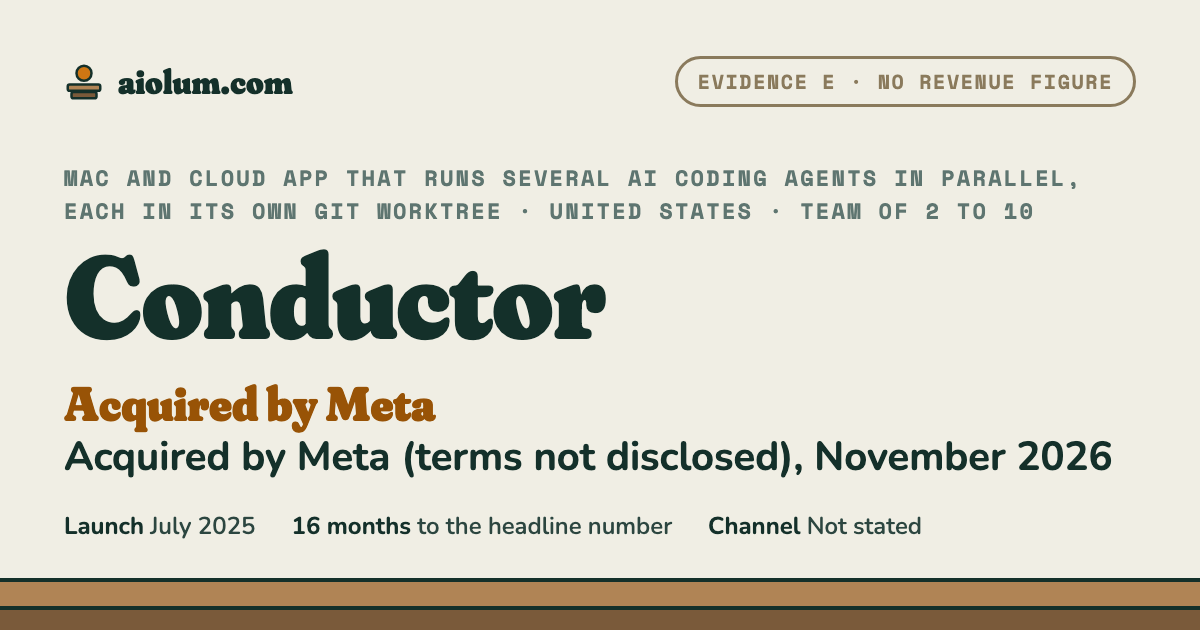
Conductor (Mac and cloud app that runs several AI coding agents in parallel, each in its own Git worktree, United States): Acquired by Meta (terms not disclosed), November 2026. Evidence grade E: no revenue figure was checked. Team: 2 founders in 2024 (Charlie Holtz, Jackson de Campos); Y Combinator's company page lists a team of 8 (read 7 November 2026). Launched July 2025; sold 16 months after launch.Added 7 November 2026
- Outcome
- Acquired by Meta (terms not disclosed), November 2026
- Evidence
- E no revenue figure was checked
- Launch
- July 2025
- Status
- Sold, 16 months after launch
- Team
- 2 founders in 2024 (Charlie Holtz, Jackson de Campos); Y Combinator's company page lists a team of 8 (read 7 November 2026)
- Outside funding
- Y Combinator (Summer 2024) and seed investors; a US$22M Series A from Spark and Matrix in March 2026, as reported by Dealroom and AI Weekly
- Main channel
- Not stated
What is not verified
No revenue figure, number of paying users, Pro price or sale price was found. The sale rests on the founder's announcement on the company site and on reports by Dealroom and AI Weekly; no statement written by Meta was read, and the Axios report that AI Weekly cites returned 403. The US$22 million Series A of March 2026 is reported by Dealroom and AI Weekly only. The home page shows 'Trusted by 100k+ builders' next to logos of Linear, Vercel, Notion, Ramp, Y Combinator, Square, PostHog and Spotify, with no source or customer story for most of them, a first-name testimonial and a 'SOC 2 Type II' badge with no link to a report. The general FAQ still answers 'How does Conductor make money?' with 'Right now we don't', while the Cloud FAQ and release notes describe paid Pro, Team and Enterprise plans. Looked for: a payment-processor profile, a founder interview with figures, Meta's own announcement. A reader could look for a Meta filing or press statement on the deal. This story is grade E: the business is real and its product, price and customers are described from public pages, but no revenue figure was checked. Aiolum shows it as an idea worth studying, not as proof that it makes money.
Conductor is an app that runs several coding agents at once. A coding agent is a program built on a large language model that reads a code repository, edits files and runs commands to finish a programming task. Conductor gives each agent its own Git worktree, a second working folder attached to the same Git repository with its own branch, so agents can work in parallel without editing the same files. The developer then reviews each branch and turns it into a pull request, a proposed change that others can check before it is merged.
Charlie Holtz and Jackson de Campos founded it in 2024 and went through Y Combinator's Summer 2024 batch, according to Y Combinator's company page. The founder's announcement says Conductor launched in July 2025. On 30 July 2026 it added Conductor Cloud, which runs each agent in a cloud sandbox (an isolated virtual machine) and needed a paid Pro plan. Dealroom and AI Weekly reported a US$22 million Series A from Spark and Matrix in March 2026, and on 4 November 2026 the company announced that Conductor is joining Meta.
No revenue figure and no sale price were found, so this story has evidence grade E. The company's own pages show that it sold Pro subscriptions before the sale, but they do not publish the price or the number of paying users.
How much did Conductor make, and what was it sold for?
Each row shows the evidence grade and the source numbers from the list at the end of this page. The grades are explained in How Aiolum verifies.
| Fact | Value | Grade | How we know | Sources |
|---|---|---|---|---|
| Sale | Acquired by Meta, announced 4 November 2026 | C | The founder's announcement on the company site: 'I have big news: Conductor is joining Meta.' Dealroom and AI Weekly report the same date. No statement written by Meta was read; the Axios report that AI Weekly cites could not be opened (403). | [1, 2, 3, 8] |
| Sale price | not disclosed | C | Dealroom and AI Weekly: 'Financial terms were not disclosed.' | [2, 3] |
| Founded | 2024, Y Combinator Summer 2024 batch | C | Y Combinator company page (year founded 2024, batch S24), confirmed by AI Weekly. Y Combinator's old address /companies/melty now redirects to Conductor, and the terms of service name the company Melty Labs, Inc. | [4, 3, 11] |
| Founders | Charlie Holtz (CEO) and Jackson de Campos (CTO) | C | Y Combinator lists both as founders; Holtz's profile says he met de Campos at Brown University. Dealroom names them as chief executive and chief technology officer. | [4, 2] |
| Launch | July 2025 | C | The founder's announcement: 'We launched Conductor a lifetime ago, in the distant past of July 2025.' | [1] |
| Team | 8 people | C | Team size field on Y Combinator's company page, read 7 November 2026; the page does not date it. The company FAQ says 'We're a small team'. | [4, 9] |
| Funding | seed round, then a US$22 million Series A in March 2026 (Spark and Matrix) | C | The Series A is reported by Dealroom and by AI Weekly; no announcement by the company or the investors was read. The FAQ mentions 'seed funding from a few great investors'. | [2, 3, 9] |
| Paid plans | Pro, Team (invite-only) and Enterprise | C | Cloud FAQ. The Cloud launch notes of 30 July 2026 say 'sign up for Pro' and that billing 'opens the Stripe billing portal'. The sale announcement says active subscribers will get a refund. No price amount is published. | [6, 7, 1, 12] |
| Users claimed on the home page | "Trusted by 100k+ builders" | C | The company's own statement, next to a row of company logos, with no source or date. Not checked. | [5] |
| Wind-down after the sale | no new sign-ups from 4 November 2026; Cloud read-only on 13 November and shut down on 20 November; local app updates until early 2027 | C | The announcement timeline and the 0.93.0 release notes. | [1, 8] |
| Time from launch to the sale | 16 months | calc | Calculated: July 2025 to November 2026. | [1, 2] |
How to read this table: a grade C value is the company's own statement on its pages, or a fact reported by the press. A "calc" value was computed on this page. No revenue figure or sale price was found, so the headline is the sale itself.
| Plan | Per month, billed yearly (US$) | Per month, billed monthly (US$) | Limit |
|---|---|---|---|
| Free (local app) | 0 | 0 | runs on your Mac with your own agent subscriptions or keys |
| Pro | not published | cloud workspaces, Conductor API, shared workspaces with other Pro users | |
| Team | not published (invite-only) | Pro features for a company, live collaboration, central billing, admin portal | |
| Enterprise | not published | Team features plus automated user provisioning, a support SLA and security controls |
The local Mac app was free, and the developer paid the model providers through his or her own Claude, OpenAI or Cursor subscription or API key. Cloud workspaces needed a Pro, Team or Enterprise plan; the Cloud FAQ says cloud compute had no extra fee and that usage-based pricing was planned. Billing ran through a Stripe billing portal. Since 4 November 2026 new users cannot sign up, free users cannot upgrade, Pro users keep Pro features for free, and active Cloud subscribers are to get a refund.
When did Conductor launch, and how did it grow?
From a Y Combinator company in 2024 to a sale to Meta in November 2026. Each entry carries its grade.
- 2024CCharlie Holtz and Jackson de Campos found the company and join Y Combinator's Summer 2024 batch. [4, 3]
- July 2025CConductor launches as a Mac app that runs several coding agents in parallel, each in its own Git worktree. [1, 10]
- March 2026CDealroom and AI Weekly report a US$22 million Series A from Spark and Matrix. [2, 3]
- 30 July 2026CConductor Cloud and the Conductor API launch. Cloud workspaces need a Pro plan, billed through Stripe. [7, 6]
- 4 November 2026CThe founder announces that Conductor is joining Meta. Terms are not disclosed. New sign-ups stop, and AI Weekly, citing Axios, reports that both founders join Meta Superintelligence Labs. [1, 2, 3]
- 13 and 20 November 2026 (planned)CConductor Cloud goes read-only, then shuts down. The local app is to get new models and critical fixes until early 2027. [1, 8]
Why did Conductor work?
Four causes, in the order they mattered. Each one is a reusable lesson.
One worktree per agent
When a developer creates a workspace, Conductor creates a Git worktree and checks out a branch in it. Each agent edits its own files, and each branch becomes the unit that the developer reviews, pushes and turns into a pull request. That is what makes parallel agents on one repository possible.
The agents and the models belong to someone else
Conductor bundles its own installation of Claude Code and Codex and uses Cursor and OpenCode through their integrations, with the tokens or API keys already on the developer's Mac. The developer pays the model providers directly, so the free local app carried no model cost for Conductor.
Charge for what runs on Conductor's side
The paid Pro plan sold cloud workspaces that keep running when the laptop is closed, the Conductor API and shared workspaces. Team and Enterprise plans added live collaboration, central billing and administration, the parts that a company buys rather than a single developer.
How it was built
These details come from the company's own documentation and release notes. They are grade C. [10, 9, 6, 7, 5]
- A Mac desktop app. Each workspace is a Git worktree named after a city, which gives the files a stable folder that agents and other programs can find.
- It ships its own copies of Claude Code and Codex so that the versions stay compatible, and it signs in with the developer's existing Claude Pro or Max login, an API key, a Cursor API key or OpenCode.
- Conductor Cloud, launched on 30 July 2026, creates a Vercel Sandbox for each cloud workspace: 8 virtual CPUs, 16 GB of memory and 32 GB of temporary NVMe storage on Amazon Linux 2023. The FAQ says it was built in close collaboration with Vercel. Cloud workspaces support GitHub repositories only.
- The Conductor API lets users create workspaces, send prompts to the agent and read its replies from their own programs.
- Subscriptions are managed in the Stripe billing portal.
- Agents run with the user's own permissions on the Mac, without a sandbox, as the FAQ states.
Tools named in the sources
Each one opens its page in the Tools tab, with every story that uses it.
Who tried this before Conductor, and why did they fail?
Three developer-tool companies in our database of failed startups sold a better way to write code and lost to tools that larger companies gave away or bundled. The values below are from that database and are not independently verified.
Kite DevTool
The promiseAI code completion inside the developer's editor, years before GitHub Copilot.
Why it diedCould not make developers pay for a freemium tool, then GitHub Copilot arrived with GitHub's distribution and stronger OpenAI models.
Nitrous.io
The promiseInstant cloud development environments, so code runs the same everywhere and new team members start at once.
Why it diedAmazon bought the competitor Cloud9 and gave it away, while Nitrous tried to sell what the large platforms bundled.
Light Table/Eve
The promiseA code editor with live feedback on what the code does, then a new way for non-programmers to build apps.
Why it diedDevelopers stayed with the mainstream editors, and the company could not turn a new editor into a business.
The failed startups come from our database of 1,749 dead startups, retold here in our own words. Its entries are AI-assisted summaries of public sources, so these cards carry no evidence grade.
What changed
Each of the three sold a better developer workspace and lost when a large company bundled a similar tool or gave it away. Conductor faced a similar risk: it depended on agents made by the model companies, which decide how those agents work.
Two things differed. Conductor did not build its own model or agent; it ran the agents that the providers already sell and let the developer pay for them, so the free app carried no model cost. And it was bought by a large AI company early, 16 months after launch according to the founder's dates, instead of competing with the providers for years.
Can one person copy Conductor now?
The product, yes. The outcome, not by plan.
The core idea, one Git worktree per agent around agent programs that developers already pay for, uses standard Git features and the agents' own command-line programs, so one developer can build a first version. The sale to Meta came after a Y Combinator batch, a reported Series A and a team of about eight; Dealroom reported that people familiar with the deal expect Conductor's product work to support Meta's next AI coding products.
Where it is still open: Tools around coding agents that the model providers do not build themselves: review of agent work, testing, team dashboards and agents on other Git hosts than GitHub.
- 1Build on the agents developers already pay for, and let them bring their own subscriptions and keys, so models are never your cost.
- 2Solve one concrete conflict, such as two agents editing the same files, with a standard mechanism like Git worktrees.
- 3Keep the local app free and charge for what you must run yourself: cloud machines, an API and collaboration.
- 4Ship and publish release notes often; the company's changelog reached version 0.93 in 16 months.
What could go wrong for Conductor?
The risks are the mirror image of the causes above.
What is not verified
No revenue figure, number of paying users, Pro price or sale price was found. The sale rests on the founder's announcement on the company site and on reports by Dealroom and AI Weekly; no statement written by Meta was read, and the Axios report that AI Weekly cites returned 403. The US$22 million Series A of March 2026 is reported by Dealroom and AI Weekly only. The home page shows 'Trusted by 100k+ builders' next to logos of Linear, Vercel, Notion, Ramp, Y Combinator, Square, PostHog and Spotify, with no source or customer story for most of them, a first-name testimonial and a 'SOC 2 Type II' badge with no link to a report. The general FAQ still answers 'How does Conductor make money?' with 'Right now we don't', while the Cloud FAQ and release notes describe paid Pro, Team and Enterprise plans. Looked for: a payment-processor profile, a founder interview with figures, Meta's own announcement. A reader could look for a Meta filing or press statement on the deal.
Team size, funding and the wind-down
Two founders started it in 2024. Y Combinator's page lists a team of 8, with no date. AI Weekly, citing Axios, reports that both founders join Meta Superintelligence Labs. The product is closing: no new sign-ups since 4 November 2026, Conductor Cloud shuts down on 20 November 2026, and the local app gets updates until early 2027, according to the founder's announcement.
Competition
Other developer-tool stories on this site also sit on top of coding agents, for example Omnara, which started as a web and mobile remote control for Claude Code, and Repo Prompt, a Mac app that selects the files of a repository for a model; Conductor differs in running several agents at once in separate worktrees. Dealroom notes that on the same day OpenAI said it plans to acquire another developer-tools startup.
Dependence on model providers
Conductor ran Anthropic's Claude Code, OpenAI's Codex, Cursor and OpenCode with the user's own subscriptions and keys, according to its home page and FAQ, and its cloud ran on Vercel Sandbox. A change in those providers' terms, prices or features could have removed the reason to use it. AI Weekly asks whether Meta will keep support for the other providers' agents.
Sources
The grade next to each source is the best grade that the source can support. "Read in full" means that the text of the page was downloaded and the numbers were checked in it.
- C Conductor: Conductor is joining Meta (founder's announcement, signed Charlie), 4 November 2026Read in full. Source for the sale, the July 2025 launch, the wind-down timeline, the Pro plan and the refunds.
- C Dealroom News, 4 November 2026: Meta buys AI coding startup Conductor to speed up its developer toolsRead in full (downloaded by the pipeline's harvester on 7 November 2026). A short news item that credits tradersunion.com. Source for the undisclosed terms, the founding year, the founders' roles and the Series A.
- C AI Weekly, 4 November 2026: Meta Buys Conductor to Run Teams of AI Coding Agents in ParallelRead in full. Cites Axios, which could not be opened (403). Source for the Y Combinator batch, the Series A, the founders joining Meta Superintelligence Labs and the shutdown dates.
- C Y Combinator company page: Conductor, Run a team of coding agents on your MacRead the company data on the page (year founded, batch, team size, location, founders). The address /companies/melty redirects here.
- C Conductor home page, read 7 November 2026Read in full. Source for the product description, the supported agents, the user claim, the logo row and the badge.
- C Conductor Docs: Cloud FAQRead the sections on plans, pricing and cloud specifications.
- C Conductor changelog 0.78.0, 30 July 2026: Introducing Conductor CloudRead in full. Source for the Cloud and API launch, the Pro sign-up and the Stripe billing portal.
- C Conductor changelog 0.93.0, 4 November 2026: Conductor is joining MetaRead in full. Confirms the date and the wind-down plan.
- C Conductor Docs: FAQRead in full. Source for authentication, the bundled agents, the unsandboxed agents and the 'small team' answer.
- C Conductor Docs: Git worktreesRead in full. Source for how workspaces use Git worktrees.
- C Conductor terms of serviceRead the opening and the section on fees. Source for the company name Melty Labs, Inc.
- C Conductor Teams pageRead in full. Team plans are invite-only.
- C Database of failed startups, local exportLocal export. AI-written summaries, not independently verified. Source for the failed predecessors.
Run this company? Send corrections or a verified figure to aiolum@livyden.com