Datalab: Product, team and how it was built
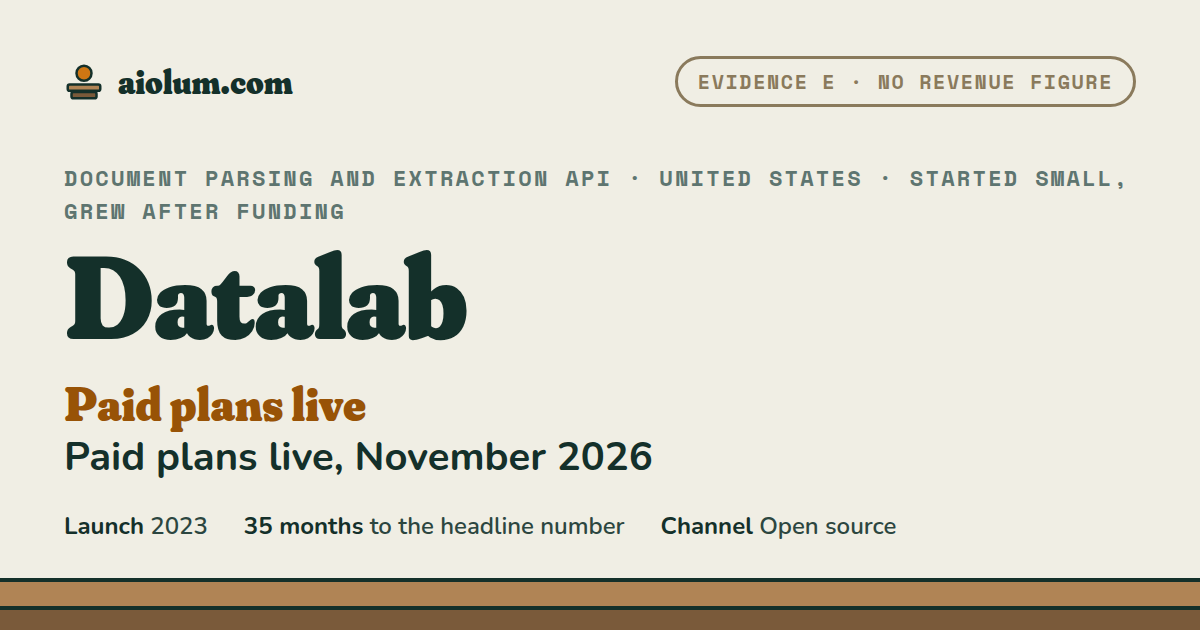
Datalab (Document parsing and extraction API, United States): Paid plans live, November 2026. Evidence grade E: no revenue figure was checked. Team: First models written by 1 developer in 2023, by his own account; 2 people named on the About page in December 2024; 14 named in November 2026. Launched 2023; still running.Added
- Outcome
- Paid plans live, November 2026
- Evidence
- E no revenue figure was checked
- Launch
- 2023
- Status
- Still running
- Team
- First models written by 1 developer in 2023, by his own account; 2 people named on the About page in December 2024; 14 named in November 2026
- Outside funding
- Backers named on the About page, amount not published
- Main channel
- Open source
What is not verified
No revenue figure was found. Looked at: the pricing page, the About page, the case studies, the Runa Capital table and the end user agreement. Datalab's own statement is the only source for paying customers. A reader could look for a payment-processor profile, a funding announcement or an interview with the CEO. The 2023 start rests on one table that gives no basis. Datalab's blog of 30 October 2025 says Surya and Marker were released "last year", which points to 2024. The founding team is not named as founders on any page read. A June 2025 case study calls "Vik" the CEO. In April 2024 he wrote that he was "thinking about building a business around my open source tools". His site also lists an earlier education project, Endless Academy. No company register could be read, so the start date of the company Endless Labs is not verified. This story is grade E: the business is real and its product, price and customers are described from public pages, but no revenue figure was checked. Aiolum shows it as an idea worth studying, not as proof that it makes money.
Datalab sells an API, a way for one program to call another over the internet, that reads documents. Its models do OCR, which means turning the image of a page into text, and they also find tables, headings and reading order. The models are named Marker, Surya, Chandra and Indra. Datalab's pricing page lists a free plan, a Team plan at US$400 a month and a custom Enterprise plan.
The company started small and grew. A Runa Capital table of open-source companies lists Datalab as founded in 2023 in Oakland. An archived copy of Datalab's About page, dated 13 December 2024, names two people, both developers. The About page of 12 November 2026 names 14 people and says the team works from an office in Manhattan.
No revenue figure was found, so the story is grade E. The headline fact, paid plans on sale, comes from the pricing page and from the end user agreement, which describes recurring charges. No source says that a named customer paid.
Why did Datalab work?
Four causes, in the order they mattered. Each one is a reusable lesson.
Free open-source models brought customers to the hosted API
Datalab's case study on Gamma says Gamma found Datalab through a Twitter post by Datalab's CEO, who shared early versions of his library. Another Datalab case study says Purchaser.ai found Datalab on GitHub. In both cases the customer met the open code first and the hosted service second. Datalab's pricing page also offers a free allowance, so a new customer can test the service before paying.
Owning the models lets Datalab offer cloud, private cloud and offline use
Datalab's home page says "We own the models — so you choose the network". It lists a managed cloud, a deployment inside the customer's private cloud, and an air-gapped version with no internet. Datalab gives its ownership of the models as the reason it can offer all three.
Datalab added a cheaper mode in October 2026 and cut one price in November
Datalab's blog post of 22 October 2026 says lite mode costs US$0.50 per 1,000 pages. The post of 11 November 2026 says fast mode costs US$1 per 1,000 pages with data sharing, down from US$3. Whether lower prices raised usage is not stated in any source.
How it was built
These details come from Datalab's own pages, its blog and the founder's personal site. They are grade C. [11, 15, 1, 16, 19, 2]
- Datalab describes its own models as custom architectures for documents. They use UTF-16 tokenization for 90 or more languages and give a box for every character, word, line and block.
- Vik Paruchuri wrote that he trained his first models on 4 A6000 graphics cards, and that Marker chains several models with rules between them.
- The hosted API runs the models as processors that a customer combines: convert, extract, segment and evaluate. Each processor has its own price per 1,000 pages.
- The models are published as open source on GitHub and Hugging Face. Marker is the most starred, with 40.9 thousand stars on 12 November 2026.
- Datalab lists SOC 2 Type II for its managed cloud. No audit report was read for this page.
Tools named in the sources
Each one opens its page in the Tools tab, with every story that uses it.
Who tried this before Datalab, and why did they fail?
Two companies in our database of failed startups also sold developers a service for handling files or data. The values below are from that database and are not independently verified. The match is loose: neither record is about reading documents. The FileStack record also says in one place that the company may still be operating.
FileStack
The promiseAn API for developers to upload and manage files from any web or mobile application.
Why it diedLarge cloud providers began to offer more complete file-management services, and FileStack lost its edge.
DataNitro
The promiseLet Python programmers run Python scripts inside Excel to automate data analysis.
Why it diedThe product was limited by Excel's own design, and it stopped operating.
The failed startups come from our database of 1,749 dead startups, retold here in our own words. Its entries are AI-assisted summaries of public sources, so these cards carry no evidence grade.
What changed
Both predecessors sold a convenience layer on top of a platform that the platform's owner could improve. FileStack depended on cloud providers that added the same service. DataNitro depended on Excel, which it could not change.
Datalab differs in one way that the sources show. It trains and owns its own models, and it publishes some of them as open code. Whether that protects it from large providers is not shown by any source read for this page.
Can one person copy Datalab now?
Partly. The open-source start can be copied, but the result has not been verified.
A small team can publish a useful open model and sell a hosted version of it. Datalab's case studies say that is how Gamma and Purchaser.ai found it. No source shows how much this earned.
Where it is still open: Other narrow open models whose hosted version is hard to run: speech, video, scientific figures and handwriting.
- 1Publish a model or tool that solves one narrow problem and works without an account.
- 2Offer a hosted version with a free allowance and a published price per unit.
- 3Write a case study for each early customer, with a named person's quotation.
- 4Offer a private-cloud version for customers whose data cannot leave their network.
How much revenue does Datalab make?
Each row shows the evidence grade and the source numbers from the list at the end of this page. The grades are explained in How Aiolum verifies.
| Fact | Value | Grade | How we know | Sources |
|---|---|---|---|---|
| Paid plans on sale | Free at US$0 a month, Team at US$400 a month, Enterprise on request | C | Datalab's pricing page shows a Subscribe button on the Team plan. Its end user agreement says Datalab and its payment processors charge the customer's payment method on a recurring basis. | [1, 5] |
| Per-page price of fast mode, 11 November 2026 | US$1 per 1,000 pages with data sharing | C | Datalab's blog post of 11 November 2026 says this is down from US$3. The post gives no price without data sharing. | [18] |
| Start | 2023, Oakland | D | A Runa Capital table of open-source companies, quarter 2 of 2024. The table gives no basis for the year and leaves the amount raised empty. GitHub's public record dates the Marker code repository to 30 October 2023. | [13, 21] |
| Company that sells it | Endless Labs, Inc., trading as Datalab | C | Datalab's terms of use and end user agreement. The archived About page of December 2024 carries that name in its footer. No company register was read, so the date this company was formed is not verified. | [3, 5, 6] |
| Team, 13 December 2024 | 2 people named, both with the title Developer | C | Archived copy of Datalab's About page. The page does not say how many people worked there. The CEO's own post of April 2024 describes writing the first models himself. | [3, 15] |
| Team, 12 November 2026 | 14 people named | C | Datalab's About page lists 14 names under "Meet the team". The page says nothing about the size of the team at the start. | [2] |
| Funding | backers named, no amount | C | Datalab's About page says it is backed by founding members of OpenAI, FAIR and Hugging Face. No source gives an amount or a date. | [2] |
| Named customers | Gamma, Purchaser.ai, RevisionDojo, Radical AI | C | Each has a case study on Datalab's own blog, with a quotation from a named person. The case studies are Datalab's statements. | [7, 8, 9, 10] |
| Pages processed by June 2025 | more than 250 million | C | Datalab's blog post of 12 June 2025. No outside party confirms the count. | [11] |
| Gamma volume, June 2025 | more than 1 million PDFs a week | C | Datalab's case study of 17 June 2025, which also says Gamma became one of Datalab's first customers. | [7] |
| Open-source code on GitHub, 12 November 2026 | Marker 40.9 thousand stars, Surya 21.6 thousand stars | B | Public GitHub pages read on that day. Marker code is under the Apache 2.0 license. | [16, 17] |
| Months from start to the headline fact | at least 35 months | calc | Calculated: December 2023, the latest month that fits the year 2023, to November 2026. The true figure is higher. | [13, 1] |
How to read this table. A grade C value is the company's own statement on its own pages. A grade D value is a third-party table that gives no basis. A grade B value is visible in public code. A "calc" value was computed on this page.
| Plan | Per month, billed yearly (US$) | Per month, billed monthly (US$) | Limit |
|---|---|---|---|
| Free | 0 | 0 | US$20 usage a month (work email), US$10 (personal email); 25 requests a minute |
| Team | 400 | US$400 usage included; 400 requests a minute; email and Slack support | |
| Enterprise | custom | single sign-on, own cloud or air-gapped, service agreement |
All plans use the same per-page rates. Datalab's pricing page says the Free plan includes US$20 of usage a month on a work email and US$10 on a personal one. Datalab's page lists the Team plan with US$400 of included usage. Datalab's page lists rates from US$0.375 to US$15 per 1,000 pages with data shared for model training. Datalab's page says these rates include a 25% discount for sharing. Datalab's pricing page says the Team plan is invoiced every US$1,000 or monthly.
When did Datalab launch, and how did it grow?
From a 2023 start as open-source models to a hosted service with 14 named people, in about 35 months. Each entry carries its grade.
- 2023DStart of the company in Oakland, according to a Runa Capital table. Vik Paruchuri's post of 11 April 2024 says that the year before, he started building again and made Marker. [13, 15]
- 29 May 2024CThe earliest archived copy of datalab.to shows a menu with Pricing, On-Prem and API, and a button for API sign-up. [4]
- 13 December 2024CThe archived About page names two developers. Its footer reads "Endless Labs, Inc." [3]
- 17 June 2025CA case study says Gamma became one of Datalab's first customers and sends more than 1 million PDFs a week. [7]
- 30 October 2025CDatalab posts about Chandra, a new open model for reading documents that it released the week before. [19]
- 12 November 2026CFree, Team and Enterprise plans are on sale. The About page names 14 people. [1, 2]
What could go wrong for Datalab?
The risks are the mirror image of the causes above.
What is not verified
No revenue figure was found. Looked at: the pricing page, the About page, the case studies, the Runa Capital table and the end user agreement. Datalab's own statement is the only source for paying customers. A reader could look for a payment-processor profile, a funding announcement or an interview with the CEO. The 2023 start rests on one table that gives no basis. Datalab's blog of 30 October 2025 says Surya and Marker were released "last year", which points to 2024. The founding team is not named as founders on any page read. A June 2025 case study calls "Vik" the CEO. In April 2024 he wrote that he was "thinking about building a business around my open source tools". His site also lists an earlier education project, Endless Academy. No company register could be read, so the start date of the company Endless Labs is not verified.
Claims on the pages that no source confirms
The home page shows a "Trusted by" wall of logos with no text, and an "In production at" wall on the About page. The home page claims "1B+ pages in a day" and "used by thousands of teams". The About page says "hundreds of teams", including Anthropic, ElevenLabs and Legora. A testimonial from "S., Member of Technical Staff, Frontier Lab" has no company name. The home page says the service is "In production at the largest AI labs and Fortune 500 enterprises". The pages also claim SOC 2 Type II and 99.99% uptime, with no report shown.
Customer data can train Datalab's models
Documents sent to the public playground can be used by Datalab for any lawful purpose, including training, with no opt-out, says the end user agreement. For account customers, Datalab says it does not train on their data by default. Pricing takes 25% off the per-page rates when a customer shares data for training.
The open model weights have a revenue limit
Marker's code is free under Apache 2.0. Its model weights are free for research, personal use and startups under US$5M funding or revenue, says the GitHub page. A larger company that wants the weights pays Datalab. This is a commercial rule, not an open-source license in the usual sense.
Sources
The grade next to each source is the best grade that the source can support. "Read in full" means that the text of the page was downloaded and the numbers were checked in it.
- C Datalab pricing page, read 12 November 2026Read in full. Source for the plans, the usage amounts, the per-page rates and the data-sharing discount.
- C Datalab About page, read 12 November 2026Read in full. Source for the 14 names, the backers and the office in Manhattan.
- C Datalab About page, archived copy of 13 December 2024Read in full. Source for the two named developers and the footer "Endless Labs, Inc."
- C Datalab home page, archived copy of 29 May 2024Read in full. Source for the earliest menu with Pricing, On-Prem and API sign-up. Its pricing page could not be opened.
- C Datalab end user license agreement, read 12 November 2026Read the sections on fees, data use and the playground. Source for recurring charges and training rights.
- C Datalab terms of use, read 12 November 2026Read the first sections. Source for the company name Endless Labs, Inc. dba Datalab.
- C Datalab blog, 17 June 2025: Gamma: Unlocking a 40% Conversion Boost with reliable and accurate PDF conversionRead in full. A case study written by Datalab. Source for the first customer, the CEO's Twitter post and the weekly volume.
- C Datalab blog, 16 July 2025: Purchaser.ai: Six-figure cost savings and 50% higher retention with DatalabRead in full. A case study written by Datalab. Source for the customer who found Datalab on GitHub.
- C Datalab blog, 1 July 2025: RevisionDojo (YC F24): Achieving 10x cost reduction and seamless scalability with DatalabRead in full. A case study written by Datalab. Source for the quotation and role of the founding engineer.
- C Datalab blog, 26 March 2026: How Radical AI Accelerates Materials Science Discovery with DatalabRead in full. A case study written by Datalab. Source for the quotation of a named product lead.
- C Datalab blog, 12 June 2025: Building better document intelligence for an AI-first worldRead in full. Source for the 250 million pages and the model design.
- C Datalab home page, read 12 November 2026Read in full. Source for the research-lab description, the deployment modes and the unsourced counters and logo wall.
- D Runa Capital, ROSS Index of top trending open-source startups, quarter 2 of 2024Read the table row for Datalab in the copy saved on 12 November 2026. Source for the year 2023 and the city Oakland.
- C Vikas Paruchuri's personal site, projects page, read 12 November 2026Read in full. Lists Marker, Surya and Datalab among the projects he built.
- C Vikas Paruchuri, 11 April 2024: How I got into deep learningRead in full. Source for the first models, the graphics cards and the earlier education company.
- B GitHub, datalab-to/marker, read 12 November 2026Read the page. Source for the star count, the Apache 2.0 license and the weights license.
- B GitHub, datalab-to/surya, read 12 November 2026Read the page. Source for the star count.
- C Datalab blog index, read 12 November 2026Read the index. Source for the posts of 22 October and 11 November 2026 and their prices.
- C Datalab blog, 30 October 2025: Introducing our newest model: ChandraRead in full. Source for the Chandra release and the sentence about last year's Surya and Marker release.
- C Database of failed startups, local exportRecord pages read on the website on 12 November 2026. AI-written summaries, not independently verified. Source for the failed predecessors.
- B GitHub API, repository record of datalab-to/marker, read 12 November 2026Read the field created_at. Source for the date the Marker repository was created.
Run this company? Send corrections or a verified figure to aiolum@livyden.com