Freed: Revenue, team and how it was built
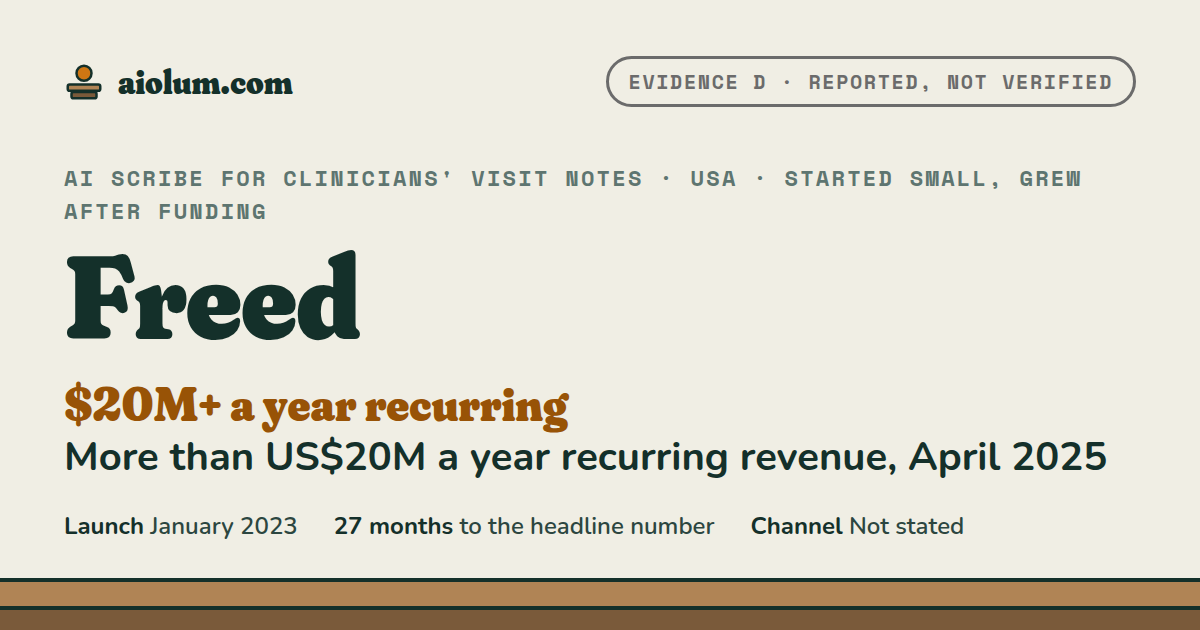
Freed (AI scribe for clinicians' visit notes, USA): More than US$20M a year recurring revenue, April 2025. Evidence grade D: reported, not verified. Team: 2 co-founders in January 2023; Dealroom listed 146 employees in November 2026, after a US$30M round in March 2025. Launched January 2023; still running, revenue growing.Added
- Outcome
- More than US$20M a year recurring revenue, April 2025Revenue growing
- Evidence
- D reported, not verified
- Launch
- January 2023
- Status
- Still running
- Team
- 2 co-founders in January 2023; Dealroom listed 146 employees in November 2026, after a US$30M round in March 2025
- Outside funding
- US$30M Series A led by Sequoia Capital in March 2025; about US$34M in total (company statement)
- Main channel
- Not stated
What is not verified
The headline figure rests on one statement by the CEO. VentureBeat reported on 24 July 2025 that he had posted it on X in April 2025. The post itself was not read, and no filing or payment processor confirms the figure. Sacra's US$19 million for March 2025 is Sacra's own estimate. The company's statement of US$1.5 million in annual revenue has no date. The company says it had more than 17,000 paying customers in March 2025, and Pulse 2.0 retold that. A reader could look for a payment-processor profile or a second dated founder statement. The headline number is grade D: one claim or one estimate, with no second source. Aiolum shows it because the story is useful, and marks it so that it is not mistaken for a verified figure.
Freed is an AI scribe: software that turns a recorded patient visit into a written clinical note. A clinician is a doctor, nurse practitioner, therapist or other licensed care provider. The clinician reviews the note and pushes it into the practice's EHR, the electronic health record system. The company's pages also list a clinical question tool, a coding assistant and an AI receptionist in beta.
Erez Druk and Andrey Bannikov started the company in January 2023, according to the company's own blog post of 24 July 2026. They are named as CEO and CTO in a March 2025 funding announcement. An archived copy of the website from 3 February 2023 shows a waitlist form. Another archived copy, from 17 May 2023, says Freed is free during the beta and will not charge before 1 June 2023.
The headline figure is one statement by the CEO, so this story is grade D. VentureBeat reported in July 2025 that the CEO had stated more than US$20 million in annual recurring revenue on X in April 2025. Annual recurring revenue is the yearly value of the subscriptions in force. Sacra, a research firm, estimated US$19 million for March 2025. The company said in its March 2025 announcement that it had more than 17,000 paying customers and had raised US$30 million.
Why did Freed work?
Four causes, in the order they mattered. Each one is a reusable lesson.
The CEO built it for a clinician he lived with
The home page quotes the CEO: "For years, I watched my wife chart late into the night." The company blog adds that he worked with his co-founder at Facebook before the start. The sources do not say how many other clinicians the founders interviewed.
It sells directly to individual clinicians in small practices
The March 2025 announcement says Freed's direct-to-clinician model "bypasses the often slow procurement cycles of traditional hospital systems". The home page says Freed is not made for massive healthcare systems. The pricing page lists plans for one clinician from US$39 a month.
A free beta in 2023 came before the paid plans
The archived page of 17 May 2023 says the product was free during the beta. It also says the company expected to charge about US$100 to US$200 a month afterward. The pricing page in November 2026 lists lower prices, from US$39 a month.
How it was built
These details come from the company's own pages and one press interview. The company's pages do not name the AI models behind the notes. [10, 4, 13]
- The product records the visit and writes a note. The security page says recordings are saved only until the note is complete, then deleted.
- Notes reach the clinic's record system through a browser extension. The March 2025 announcement calls it "EHR Integration via Browser Extension".
- The security page says the software runs on Microsoft Azure and uses Drata for monitoring and vulnerability scanning.
- The security page says the AI "is only trained on de-identified notes". This is the company's statement and was not verified.
- VentureBeat reported in July 2025 that the first transcription step uses "a fine-tuned version of OpenAI's open source Whisper model".
Tools named in the sources
Each one opens its page in the Tools tab, with every story that uses it.
Who tried this before Freed, and why did they fail?
Three companies in our database of failed startups tried to reduce the paperwork of health care. The values below are from that database and are not independently verified.
Olive AI
The promiseSoftware bots that would automate prior authorizations, claims checks and billing for hospitals.
Why it diedThe record says Olive died from "overpromising, underdelivering, and catastrophic unit economics", after selling a vision of autonomous AI.
CareLedger
The promiseA platform to track patient billing and insurance claims for health care providers.
Why it diedThe record says it could not reach the scale and the link to major record systems fast enough. Larger competitors had more resources.
PatientBank
The promiseA website where patients could request, store and share their medical records.
Why it diedThe record says its end was largely due to "strategic missteps in market penetration and user acquisition". It also names slow sales cycles in health care and high costs to win customers.
The failed startups come from our database of 1,749 dead startups, retold here in our own words. Its entries are AI-assisted summaries of public sources, so these cards carry no evidence grade.
What changed
Olive AI sold to hospitals and health systems. The CareLedger record names slow adoption by providers and missing links to major record systems, and the PatientBank record names slow sales cycles. Freed's pages say it sells to individual clinicians and small practices instead.
A note-writing tool is also a narrower job than automating billing across a hospital. The company's sources do not say whether speech models or other technology changed. The company says its notes go to the clinician for review before they enter the record.
Can one person copy Freed now?
The structure, partly. The funding and the clinical setting are not copyable by one person.
Freed shows a narrow job, a free beta, a monthly price per clinician and a direct sale to one person at a time. The company says it raised US$34 million in total. A health product also needs privacy and security work, which the company says it did. A solo founder would need a clinician as a partner and a budget for compliance.
Where it is still open: Other professions that write a record after each client meeting: lawyers, social workers, veterinarians, home inspectors and financial advisers.
- 1Pick one document that one professional writes every day and dislikes writing.
- 2Let the professional try it free and judge the result before any price.
- 3Price per professional, with a low entry plan and a higher plan for the full workflow.
- 4Plan for health privacy rules from the first day, because the buyer will ask.
How much revenue does Freed make?
Each row shows the evidence grade and the source numbers from the list at the end of this page. The grades are explained in How Aiolum verifies.
| Fact | Value | Grade | How we know | Sources |
|---|---|---|---|---|
| Annual recurring revenue, April 2025 | more than US$20 million | D | VentureBeat, 24 July 2025: "In April 2025, Druk publicly shared on X that Freed has surpassed $20 million in annual recurring revenue." The post itself was not read. | [13] |
| Outside estimates of annual recurring revenue | US$19 million in March 2025; US$33 million in August 2026 | D | Sacra's own estimates, not company figures. Sacra also estimates US$8 million for March 2024 and US$27 million for the end of 2025. | [14, 15] |
| Paying clinicians, July 2025 | 20,000 | D | VentureBeat wrote that the CEO told it Freed had reached "20,000 paying clinician users". | [13] |
| Paying customers, March 2025 | more than 17,000 | D | Company announcement, dated 17 March 2025 on the company's site and 12 March 2025 on Pulse 2.0. Pulse 2.0 retells it. The company blog says 17,000 clinicians used Freed within two years. | [4, 5, 3] |
| Annual revenue, undated | US$1.5 million within four months of launch | D | Company blog post of 24 July 2026: "Within four months of launch, 1,500 clinicians were using Freed for their notes, and Freed crossed $1.5M in annual revenue." It gives no calendar date and does not say whether the figure is recurring. | [3] |
| Growth, March 2025 | 4x year over year in annual recurring revenue | D | Company announcement. No dollar figure is given for the base. | [4, 5] |
| Founded | January 2023 by Erez Druk and Andrey Bannikov | C | Company blog: "in January 2023, Erez and Andrey co-founded Freed." The announcement of March 2025 names them as CEO and CTO. | [3, 4] |
| Earliest web page | 3 February 2023, a waitlist form | C | Internet Archive copy of the home page. It says "Join the waitlist." | [6] |
| Beta and first charge date | free in beta on 17 May 2023; charging "Not before 6/1/2023" | C | Archived home page of 17 May 2023. It also says that the price after the beta would be about US$100 to US$200 a month. | [7] |
| Funding | US$30 million Series A led by Sequoia Capital; about US$34 million in total | C | Company announcement of March 2025, retold by Pulse 2.0. The blog of July 2026 repeats the figures. | [4, 5, 3] |
| Price today | from US$39 a month, billed yearly | C | Starter plan on the pricing page, with a 7-day free trial. | [2] |
| Clinicians and clinics, July 2026 | 26,000+ clinicians in 1,700+ clinics | C | Company blog. The home page counter says 26,000+ clinicians and 1,300+ clinics, with no date. | [3, 1] |
| Patient visits transcribed in 2025 | 32,589,627 | C | Counter on the home page. The company blog rounds it to 32.5 million. | [1, 3] |
| Products | AI scribe, Clinical Evidence, Coding Assistant, Front Desk (beta) | C | Listed on the home page and on the Front Desk page. | [1, 11] |
| Headcount | 146 employees listed by Dealroom, November 2026 | D | A directory figure, read on 12 November 2026. The company's careers page names two offices and gives no number. VentureBeat wrote in July 2025 that "More than 20 in-house clinicians" audit notes. | [16, 9, 13] |
How to read this table. Grade C is a statement on the company's own pages. Grade D is a single company or founder claim, a press retelling of one, or an outside estimate. No value is grade A or B.
| Plan | Per month, billed yearly (US$) | Per month, billed monthly (US$) | Limit |
|---|---|---|---|
| Starter, 1 clinician | 39 | 59 | up to 40 notes a month |
| Core, 1 clinician | 79 | unlimited notes; the page shows 59 for monthly billing, the FAQ says 79 | |
| Premier, 1 clinician | 104 | 119 | adds EHR push, ICD-10 coding, patient letters |
| Groups | custom | single sign-on, admin dashboard, account manager | |
| Front Desk Starter (beta) | 149 | per block of 250 calls; AI receptionist |
Plans are per clinician. The Starter plan has a limit of 40 notes a month. Every plan has a 7-day free trial with no credit card. The Core row is uncertain. The page code shows US$59 for monthly billing and US$79 for annual billing. The company's FAQ says US$79 a month. Groups are sold by custom quote. Freed Front Desk, the AI receptionist, is a separate product in beta at US$149 a month per block of 250 calls.
When did Freed launch, and how did it grow?
From a waitlist page in February 2023 to a company that says it has more than 26,000 clinicians in July 2026. Each entry carries its grade.
- January 2023CErez Druk and Andrey Bannikov co-found Freed, according to the company blog. [3]
- 3 February 2023CThe earliest archived copy of getfreed.ai shows a waitlist form and no price. [6]
- 17 May 2023CThe home page says Freed is free during the beta and will not charge before 1 June 2023. [7]
- March 2025DThe company announces a US$30 million Series A led by Sequoia Capital and more than 17,000 paying customers. [4, 5]
- April 2025DThe CEO states on X that Freed passed US$20 million in annual recurring revenue, according to VentureBeat's article of July 2025. [13]
- 24 July 2025DVentureBeat writes that the CEO told it Freed had 20,000 paying clinician users. [13]
- 2025CThe home page counter says 32,589,627 patient visits were transcribed in 2025. [1]
- 24 July 2026CThe company blog says 26,000+ clinicians in 1,700+ clinics use Freed, and lists a front-desk product. [3]
What could go wrong for Freed?
The risks are the mirror image of the causes above.
What is not verified
The headline figure rests on one statement by the CEO. VentureBeat reported on 24 July 2025 that he had posted it on X in April 2025. The post itself was not read, and no filing or payment processor confirms the figure. Sacra's US$19 million for March 2025 is Sacra's own estimate. The company's statement of US$1.5 million in annual revenue has no date. The company says it had more than 17,000 paying customers in March 2025, and Pulse 2.0 retold that. A reader could look for a payment-processor profile or a second dated founder statement.
Counters, logo walls and testimonials on the home page
The home page shows counters, press logos, an award badge and three named testimonials, and no independent source confirms them. The counters say 26,000+ clinicians, 1,300+ clinics, 32,589,627 visits and 5.9 million hours returned each year. The blog says 1,700+ clinics. The page also states "98% recall on medical terms" and names no study. The section "As seen in" shows the logos of CNBC, Forbes and the Wall Street Journal, and those articles were not read. The section "Awarded" shows a CB Insights badge. The three named testimonials were not checked on other sites. The Front Desk page shows results from one named clinic. A 2023 archived review came from a clinician whom the 2026 home page ties to the CEO as his wife.
A clinical tool inside a documentation product
The main product writes visit notes for licensed clinicians. The terms say the Clinical Evidence feature "assists in diagnosis, treatment planning, and other clinical decisions" and is only a support tool. The terms also say the platform is "NOT INTENDED TO DIAGNOSE, TREAT, CURE, OR PREVENT ANY DISEASE". The terms limit the platform to people aged 18 or older.
AI receptionist in beta, and a team that grew
The Front Desk product answers clinic phone calls and is in beta. The pages read do not say whether callers are told it is an AI. The company started with 2 co-founders and is no longer a small team. Dealroom listed 146 employees in November 2026. The company itself publishes no number.
Sources
The grade next to each source is the best grade that the source can support. "Read in full" means that the text of the page was downloaded and the numbers were checked in it.
- C Freed home page, read 11 November 2026Read in full. Source for the products, counters, testimonials, the CEO's quotation and the compliance statements.
- C Freed pricing page, read 11 November 2026Read in full. The page code was also read, because the Core price is inconsistent.
- D Freed blog, 24 July 2026: Building for the People We LoveRead in full. The company's own account of the founding date, the revenue statement and the funding.
- D Freed press page, 17 March 2025 Business Wire release: Freed Secures $30M Series A Led by Sequoia CapitalRead in full. A company announcement posted on the company's site. Source for 17,000 paying customers, 4x growth and the founders' roles.
- D Pulse 2.0, 12 March 2025: Freed: $30 Million (Series A) Closed For AI-Based Clinician AssistantRead in full. A news site that retells the company's announcement. It adds no figures of its own.
- C Internet Archive copy of getfreed.ai, 3 February 2023Read in full. The earliest capture in the Internet Archive index.
- C Internet Archive copy of getfreed.ai, 17 May 2023Read in full. Source for the free beta and the planned charge date.
- C Freed Platform Terms of Use - Scribe & AI Chat, last updated 13 August 2026Read the sections on age, Clinical Evidence and medical disclaimers.
- C Freed careers page, read 11 November 2026Read in full. It names two offices and gives no headcount. The list of open roles loads by script and could not be read.
- C Freed security page, read 11 November 2026Read in full. Source for recordings, hosting, monitoring tools and AI training statements.
- C Freed Front Desk page, read 11 November 2026Read the sections on the beta, the price and the product description.
- C Database of failed startups, local exportRecord pages read on the website. AI-written summaries, not independently verified. Source for the failed predecessors.
- D VentureBeat, 24 July 2025, Carl Franzen: Freed says 20,000 clinicians are using its medical AI transcription 'scribe,' but competition is rising fastRead in full. An interview article that retells the CEO's statements. Source for the headline figure, the paying clinicians and the transcription model.
- D Sacra research note: Freed at $19M ARR, read 12 November 2026Read the summary. Sacra's own estimates of annual recurring revenue for March 2024 and March 2025.
- D Sacra company page: Freed revenue, funding and growth rate, read 12 November 2026Read the public part. Sacra's own estimates for the end of 2025 and August 2026.
- D Dealroom company page: Freed, read 12 November 2026Read the public part. A directory that lists 146 employees and the founding year 2023.
Run this company? Send corrections or a verified figure to aiolum@livyden.com