Lazyweb: Revenue, team and how it was built
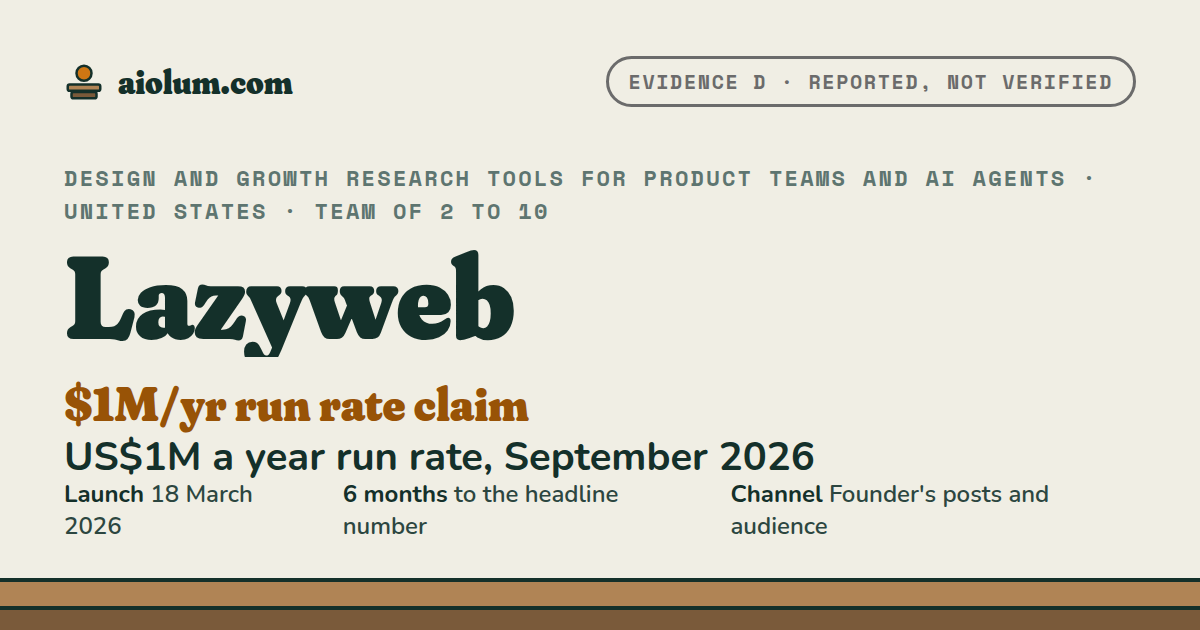
Lazyweb (Design and growth research tools for product teams and AI agents, United States): US$1M a year run rate, September 2026. Evidence grade D: reported, not verified. Team: 2 people (a16z Speedrun profile, read 11 November 2026); one founder alone when work began in January 2026. Launched 18 March 2026; still running.Added
- Outcome
- US$1M a year run rate, September 2026
- Evidence
- D reported, not verified
- Launch
- 18 March 2026
- Status
- Still running
- Team
- 2 people (a16z Speedrun profile, read 11 November 2026); one founder alone when work began in January 2026
- Outside funding
- a16z Speedrun cohort SR007 (Lazyweb's own amount not published)
- Main channel
- Founder's posts and audience
What is not verified
The US$1M annual recurring revenue figure is a founder statement. Ali Abouelatta wrote "We've hit $1M ARR" on 28 September 2026, and the Speedrun page says "0->$1M live ARR in only 2mo" without a date. That page was read on 11 November 2026, and a third-party article had retold it by 9 October 2026. No payment-processor profile, press piece or buyer confirms it. The sources do not define "live ARR", name a paying customer, or say how much comes from the US$39 and US$99 plans. A reader could look for a Stripe or TrustMRR profile. The headline number is grade D: one claim or one estimate, with no second source. Aiolum shows it because the story is useful, and marks it so that it is not mistaken for a verified figure.
Lazyweb sells design and growth research to product teams and to AI agents. It stores screenshots of other companies' public apps and the A/B tests (controlled experiments that compare two versions of a screen) that those companies ran. A team or its agent searches the library through an MCP server, a standard connection that lets an AI coding tool call outside tools. The company lists a free plan, Pro at US$39 a month and Team at US$99 a month.
Ali Abouelatta, who worked at Duolingo from 2022, started Lazyweb in January 2026 and wrote in March 2026 that it was live. He wrote on 4 August 2026 that he had met his co-founder Francesco Polizzi, and the a16z Speedrun page lists two people. Ali wrote on 7 August 2026 that Lazyweb had joined the Speedrun accelerator. On 28 September 2026 he wrote that the company had hit US$1M ARR, annual recurring revenue. ARR usually means the current monthly subscription revenue multiplied by twelve, and Ali does not define it.
The US$1M figure rests on founder statements only. Ali wrote it in his newsletter on 28 September 2026, and the Speedrun company page says "0->$1M live ARR in only 2mo" with no date. No payment processor, buyer or journalist has confirmed it. No source says how much of it comes from the US$39 and US$99 plans the company lists.
Why did Lazyweb work?
Four causes, in the order they mattered. Each one is a reusable lesson.
The founder turned his own Duolingo app audits into software
Ali wrote that at Duolingo he compared purchase flows across about 220 apps and revisited them every six months. In January 2024 he wrote a script that used GPT-4 vision to compare the screenshots. In 2025 it grew into a code base of about 100,000 lines. He wrote that Lazyweb is the culmination of what he did manually at Duolingo. The start therefore came from a method he had used for years.
The first two products failed and the MCP reached the agent chat
Ali wrote in August 2026 that he built a Mac app, which failed, and a web app, which also failed. He then built an MCP server, which went viral in his words. He wrote that people said they asked ChatGPT or Codex for growth ideas, so he put Lazyweb inside that conversation. For agent users he removed the email requirement, and he wrote that this raised activation by more than 50 percent.
The founder lists his own posts as a source of the signups
In his 27 August 2026 post Ali lists building in public on X and Substack among the tactics he tried. He wrote that his MCP launch post on X reached more than 365,000 views. He wrote that 50,000 people signed up with no marketing spend. Whether paying customers came from the same channels is not stated.
How it was built
These details come from the founder's own newsletter posts and the company's pages. They are grade C. [6, 7, 8, 10, 13, 4]
- The first version was a Mac app, then a web app with a canvas. The founder wrote that he rewrote the app for the web in early 2026.
- The library holds screens and flows from mobile and web apps. The founder wrote that early vision models annotated screenshots badly. He annotated by hand and built a combined OCR, embedding and vision-description pipeline.
- The product is reached through a hosted MCP server and skills for Claude Code, Codex and Cursor. The design site says it works with any coding agent.
- Reports and answers use AI models. The terms say hosted tools answer from published content using AI models and that customer data is sent to the model providers that power them.
- The founder wrote that guest accounts for agents and a one-line install command raised activation.
Tools named in the sources
Each one opens its page in the Tools tab, with every story that uses it.
Who tried this before Lazyweb, and why did they fail?
Three companies in our database of failed startups sold software to professional teams. They sold product workflow software, conversion tracking for online shops, and analysis of public social media data. The values below are from that database and are not independently verified.
Unflow
The promiseA shared space where designers, engineers and product managers manage digital product workflows.
Why it diedIt struggled to differentiate in a crowded market, and larger collaboration suites added similar features.
Ve Interactive
The promiseBehavior tracking and pop-ups that recover abandoned shopping carts for online retailers.
Why it diedAggressive growth spending and weak unit economics, with large sales teams needed for enterprise deals.
Isentium
The promiseSentiment analysis of social media and news for finance and insurance teams.
Why it diedIt relied on noisy social data with compliance risks, and more advanced competitors appeared.
The failed startups come from our database of 1,749 dead startups, retold here in our own words. Its entries are AI-assisted summaries of public sources, so these cards carry no evidence grade.
What changed
The three records give different causes. Unflow sold into a collaboration market that bigger suites covered. Ve Interactive needed large sales teams, and its record calls its unit economics broken. Isentium depended on noisy social media data, and its record says more advanced competitors appeared.
Lazyweb differs in two ways that the sources show. It reaches users inside the AI coding tool they already use, through MCP. The company's copyright page says the library shows public app screens. No source shows whether paying customers stay.
Can one person copy Lazyweb now?
The method yes; the revenue figure is unproven.
The part to copy is the route, not the number. Take a work method that one person already does by hand, automate it, and offer it inside the tools that agents already call. The US$1M figure is a founder statement, so do not plan on it.
Where it is still open: Any research task that product, growth or design teams repeat and coding agents cannot do alone, such as pricing pages or onboarding flows.
- 1Pick a research task that you already do by hand for your job, and write down each step.
- 2Automate one step with a vision or language model and check the output by hand first.
- 3Offer the result as an MCP server, so a coding agent can call it without a new tab.
- 4Let agents sign up without an email step, and measure activation.
How much revenue does Lazyweb make?
Each row shows the evidence grade and the source numbers from the list at the end of this page. The grades are explained in How Aiolum verifies.
| Fact | Value | Grade | How we know | Sources |
|---|---|---|---|---|
| Annual recurring revenue, September 2026 | US$1M | D | Ali Abouelatta's newsletter, 28 September 2026: "We've hit $1M ARR." The Speedrun company page says "0->$1M live ARR in only 2mo"; the page is undated and was read on 11 November 2026. A third-party article of 9 October 2026 already retold the Speedrun claim. | [1, 2, 11] |
| Monthly revenue implied by the claim | about US$83,333 a month | calc | Calculated: US$1,000,000 divided by 12. At the US$39 Pro price that would be about 2,137 subscriptions if all revenue came from Pro. The sources do not say how revenue splits between plans. | [1, 3] |
| Start of full-time work | about 4 January 2026 | C | Ali's post of 7 January 2026 says he took time off Duolingo "starting 3 days ago" to build Lazyweb.com. His 18 March 2026 post says it was 77 days later. | [6, 7] |
| Public launch | 18 March 2026 | C | Ali's newsletter post "Lazyweb is live (finally)". The first version was a Mac app; he rewrote it as a web app. | [7] |
| Free MCP launch | 2 May 2026 | C | Ali's X post, as reproduced in his 27 August 2026 newsletter: 257k+ screens, 6 design research skills, "100% Free...no subscriptions". | [10] |
| Signups and active users, August 2026 | close to 50,000 signups; more than 15,000 active users | C | Ali's newsletter, 4 August 2026. His 27 August 2026 post says 50,000 signups with US$0 marketing. | [8, 10] |
| Joined a16z Speedrun SR007 | announced 7 August 2026 | C | Ali's newsletter. Demo day was 6 October 2026, according to his 10 November 2026 post. Speedrun's standard deal is up to US$1M; the amount for Lazyweb is not published. | [9, 16, 15] |
| Team | 2 people | C | The a16z Speedrun profile lists 2 employees, with Francesco Polizzi as chief executive and Ali Abouelatta as co-founder. Ali called it a one-person company in January 2026. | [2, 6] |
| Company start | 2026 | C | The Speedrun profile says founded 2026. Ali's posts date the full-time start to January 2026. | [2, 6] |
| Legal entity | Lazyweb Group Inc. | C | Named in the terms of service and privacy policy. The terms are governed by Delaware law. A date of incorporation was not found. | [4, 18] |
| Earlier use of the domain and product | a manifesto page by Ali, July 2025 | C | A Wayback copy of lazyweb.com from 22 July 2025 has the page title "Lazyweb" and the social-card title "Builders Manifesto | Ali Abouelatta". A January 2024 script and a 2025 code base were the product's earlier forms, in Ali's account. Wayback copies of August 2024 and February 2025 say only "Coming soon." and name no owner. A 2016 copy shows the domain for sale. | [14, 6] |
| Paid plans | Pro US$39 and Team US$99 a month | C | Company pricing page, read 11 November 2026. The date these plans started was not found. A third-party article of 9 October 2026 already lists both prices. | [3, 11] |
| Time from launch to the claim | 6 months | calc | Calculated: 18 March 2026 to 28 September 2026. | [1, 7] |
How to read this table. Grade D means one party, here the founders, states the figure and no one outside has checked it. A "calc" value is computed on this page from the rows above it. Prices are the company's own list.
| Plan | Per month, billed yearly (US$) | Per month, billed monthly (US$) | Limit |
|---|---|---|---|
| Free | 0 | 0 | human browsing and MCP setup; partial reports; limited monthly tool allowance |
| Pro | 39 | 1 seat; full toolkit without competitor tracking | |
| Team | 99 | 5 seats; adds competitor tracking and a shared workspace |
Pro and Team are monthly subscriptions with a 3-day free trial that needs a card. The page shows no yearly price. The free plan is limited: the plans page lists a limited monthly tool allowance and one growth report a day. A separate Agent-led growth product is free up to one million agent events a month, according to the terms. The design site also offers an Enterprise option through "Contact us", with no published price.
When did Lazyweb launch, and how did it grow?
From a full-time start in January 2026 to a stated US$1M annual run rate in September 2026. Each entry carries its grade.
- January 2024CAli writes a script that uses GPT-4 vision to compare screenshots of purchase flows. He writes that it cut his audit time by 60 to 80 percent. [6]
- July 2025CThe lazyweb.com page is a manifesto about competitive analysis, written by Ali. [14]
- About 4 January 2026CAli takes time off Duolingo to build and launch Lazyweb.com. [6]
- 20 January 2026CThe home page asks visitors to join a waitlist for design inspiration and product intelligence. [14]
- 18 March 2026CAli announces that Lazyweb is live as a web app with a canvas and an AI design agent. [7]
- 2 May 2026CAli launches a free MCP server with design research skills for Claude and Codex. His post reached about 366,000 views. [10]
- 4 August 2026CAli writes that close to 50,000 people have signed up and that he has met his co-founder. [8]
- 7 August 2026CLazyweb joins a16z Speedrun SR007. [9]
- 28 September 2026DAli writes that Lazyweb has hit US$1M ARR and reached over 100,000 page visits a month through answer-engine optimization. [1]
- 6 October 2026CSpeedrun demo day. [16]
- 9 October 2026DA third-party article retells the Speedrun profile's US$1M claim and lists the US$39 and US$99 plans. [11]
- 11 November 2026CThe pricing page lists Free, Pro at US$39 and Team at US$99. The home page leads with a second product, agent-led growth. [3, 12]
What could go wrong for Lazyweb?
The risks are the mirror image of the causes above.
What is not verified
The US$1M annual recurring revenue figure is a founder statement. Ali Abouelatta wrote "We've hit $1M ARR" on 28 September 2026, and the Speedrun page says "0->$1M live ARR in only 2mo" without a date. That page was read on 11 November 2026, and a third-party article had retold it by 9 October 2026. No payment-processor profile, press piece or buyer confirms it. The sources do not define "live ARR", name a paying customer, or say how much comes from the US$39 and US$99 plans. A reader could look for a Stripe or TrustMRR profile.
Free first, paid plans dated unknown
Ali's X post of 2 May 2026 said "no subscriptions", and the terms of 1 November 2026 say "If we introduce paid plans". The pricing and plans pages list Pro and Team. The date the paid plans started was not found. A third-party article of 9 October 2026 already lists both prices. The privacy policy of 1 November 2026 lists Stripe for payments.
The library shows other companies' app screens
Lazyweb stores screenshots of other companies' public apps and shows them to its users. Its copyright page, last updated 26 August 2026, says they are shown "for research, commentary, and education". The page does not say that the owners gave permission. It says owners keep their rights and can request removal by email. The terms forbid bulk scraping or redistributing the library. No source says whether any owner has objected.
Trust signals on the home page
The home page has a strip titled "Built by product growth leaders from Discord, Duolingo, Dropbox and Photomath" and a "Backed by a16z speedrun" badge. The Speedrun profile names Discord, Duolingo and Photomath for the founders. Dropbox appears in no founder statement that was read. Counters differ between pages. The home page says 28K+ A/B tests. The plans page says 20,000+ mobile A/B tests and 281k+ screens. A March 2026 post says over 300,000 screens. The signup and active-user counts are founder statements. Customer examples on the home page are labelled "Illustrative example". No customer logo or testimonial was found on the pages read.
The product mix changed
The home page on 11 November 2026 leads with agent-led growth, which shows website owners which AI agents visit and what they ask. The design research library and its paid plans sit on design.lazyweb.com. The sources do not say which product earned the US$1M. The design site also offers an Enterprise option in which the founders "work hands-on with your team". Ali's post of 7 August 2026 offers "a more managed, hands-off solution" on request. No price is published for either, and no source says whether the US$1M includes such contracts. The terms require customers to be 18 or older and to use the service for business.
Names and history
The legal entity is Lazyweb Group Inc. The Speedrun profile says founded 2026. A July 2025 copy of lazyweb.com shows an earlier manifesto page by Ali. Copies of August 2024 and February 2025 say "Coming soon." and name no owner. He wrote of a 2024 script as the first form of the idea. The founders' earlier-employer claims on the Speedrun profile were not checked.
The founder's own marketing tactics
Ali wrote on 27 August 2026 about tactics he tried and that failed. He wrote that he "tried infiltrating vibe coding groups" on Facebook and "got sniffed out". He wrote that he "got banned from a couple of reddit threads". He also lists "Reddit roundups" and "Versus pages that don’t contain our product" as tactics that worked.
Sources
The grade next to each source is the best grade that the source can support. "Read in full" means that the text of the page was downloaded and the numbers were checked in it.
- D Ali Abouelatta, First 1000 newsletter, 28 September 2026: Bye bye, SpeedrunRead in full on 11 November 2026. Founder's post. Source for "We've hit $1M ARR", the 100,000 page visits and the Speedrun office dates.
- D a16z speedrun company page: Lazyweb (cohort SR007)Read in full on 11 November 2026. Undated founder-written profile: founded 2026, 2 employees, "0->$1M live ARR in only 2mo". The site has no robots.txt (404).
- C Lazyweb pricing page and plans page, read 11 November 2026Read in full. Source for Free, Pro US$39 and Team US$99 a month, the 3-day trial and the seat counts. The plans page at www.lazyweb.com/plans adds the free allowance.
- C Lazyweb Terms of Service, last updated 1 November 2026Read in full. Source for Lazyweb Group Inc., Delaware law, the 18 and older rule, the free Agent-led growth limit and the rule on bulk scraping.
- C Lazyweb Copyright & Takedown page, last updated 26 August 2026Read in full. Source for how the library describes the screenshots it shows and the takedown route.
- C Ali Abouelatta, First 1000 newsletter, 7 January 2026: I'm sorryRead in full. Source for the start date, the Duolingo audits, the 2024 script and the one-person description.
- C Ali Abouelatta, First 1000 newsletter, 18 March 2026: Lazyweb is live (finally)Read in full. Source for the launch, the Mac app to web app rewrite and the 77 days.
- C Ali Abouelatta, First 1000 newsletter, 4 August 2026: 6 months inRead in full. Source for the signups, the active users, the three product versions and the annotation work.
- C Ali Abouelatta, First 1000 newsletter, 7 August 2026: Lazyweb joins a16z SpeedrunRead in full. Source for the Speedrun announcement and the product description.
- C Ali Abouelatta, First 1000 newsletter, 27 August 2026: Growing Lazyweb to 50k+ AgentsRead in full. Source for the 50,000 signups, the 2 May 2026 X post as reproduced, and the activation changes.
- D Substack article, 9 October 2026: Lazyweb: What If Your AI Coding Agent Could Become Your Growth Team?Read in full. A third-party retelling of the Speedrun profile's claim and the published prices; not independent confirmation of revenue.
- C Lazyweb home page, www.lazyweb.com, read 11 November 2026Read in full. Source for the agent-led growth product, the logo strip, the badge and the labelled examples.
- C Lazyweb design research home page, design.lazyweb.com, read 11 November 2026Read in full. Source for the library, the A/B test counter and the MCP offer.
- C Internet Archive copies of lazyweb.com: July 2025, 20 January 2026, 9 March 2026Read the text of each copy, and the copies of 2016, August 2024 and February 2025. Source for the manifesto page, the waitlist and the Mac app download page.
- C a16z speedrun FAQ, read 11 November 2026Read the section on the standard deal. Source for the up to US$1M standard deal; Lazyweb's own amount is not stated.
- C Ali Abouelatta, First 1000 newsletter, 10 November 2026: Speedrun demo dayRead in full. Source for the 6 October 2026 demo day.
- C Database of failed startups, local exportRecord pages read on the website on 11 November 2026. AI-written summaries, not independently verified. Source for the failed predecessors.
- C Lazyweb Privacy Policy, last updated 1 November 2026Read in full on 11 November 2026. Source for Lazyweb Group Inc. and for the list of service providers, which names Stripe for payments.
Run this company? Send corrections or a verified figure to aiolum@livyden.com