OpenWork: Product, team and how it was built
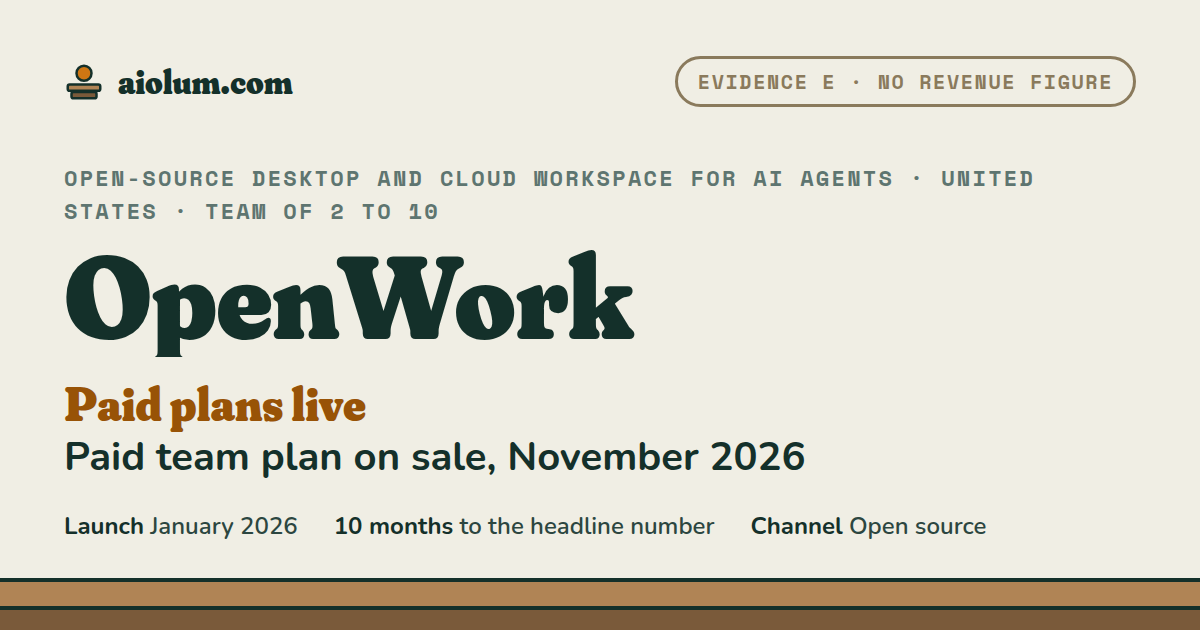
OpenWork (Open-source desktop and cloud workspace for AI agents, United States): Paid team plan on sale, November 2026. Evidence grade E: no revenue figure was checked. Team: Y Combinator lists a team of 4 in its Spring 2026 batch; its page names one founder, Ben Shafii (Y Combinator page, November 2026). Launched January 2026; still running.Added
- Outcome
- Paid team plan on sale, November 2026
- Evidence
- E no revenue figure was checked
- Launch
- January 2026
- Status
- Still running
- Team
- Y Combinator lists a team of 4 in its Spring 2026 batch; its page names one founder, Ben Shafii (Y Combinator page, November 2026)
- Outside funding
- Y Combinator, Spring 2026; the amount is not stated
- Main channel
- Open source
What is not verified
No revenue figure was found, and no source says that a customer has paid. The pages read were the company's home, pricing, terms, privacy, enterprise and guides pages, its GitHub pages, the Y Combinator page and an archived page. Two searches found no press piece with a figure. The company's trust page and some profile pages were not read, because their robots.txt files or the helper refused the request. A reader could look for a TrustMRR profile or a founder interview. The paid plan rests on a published price, a start button and billing terms. The company behind OpenWork is older than the product. Its name, Different AI, is on an Embedbase page archived on 31 March 2023. No page read dates the incorporation of Different AI, Inc. This story is grade E: the business is real and its product, price and customers are described from public pages, but no revenue figure was checked. Aiolum shows it as an idea worth studying, not as proof that it makes money.
OpenWork is a desktop app for macOS, Windows and Linux where an AI agent works on the user's files. An agent is a program that plans a task, calls tools and changes files by itself. It is built on OpenCode, an open-source coding agent, and the company says it works with 50+ model providers. The cloud side adds an MCP gateway, which is one web address that gives any compatible agent the same shared skills and tools.
The company is Different AI, Inc., which does business as OpenWork, the terms of use say. Y Combinator lists OpenWork in its Spring 2026 batch, with a team of 4 and Ben Shafii as founder and CEO. The same GitHub name, Different AI, also holds earlier projects such as Embedbase, which an archived page shows online on 31 March 2023. That archived page carries the line "© Different AI 2023", so the name is older than OpenWork.
No revenue figure was found, so this story is grade E. The headline is that a paid plan is on sale. The pricing page lists a Team plan with a start button, and the terms name Polar as the payment processor. No source says that a customer has paid.
Why did OpenWork work?
Four causes, in the order they mattered. Each one is a reusable lesson.
The desktop app is free and needs no account
The home page says the app is free and open source, and that no account is required to start. The README says the desktop app is MIT-licensed. A user can try the product before any team decision.
The paid plan adds controls that a team needs
The Team plan on the pricing page adds sign-in through the company account, an extension marketplace and cloud automations. The Enterprise plan adds provisioning, an audit log and white-labeling. The add-ons are a cloud computer and managed model access.
It works with 50+ model providers instead of one
The home page says OpenWork works with 50+ model providers. Its table lists Claude, GPT-5, Gemini, Mistral and local models. Its comparison table lists this as a point where the other product is "Not available". The table is the company's own claim.
How it was built
These details come from the company's pages and its GitHub repository. They are grade C. [1, 5, 3]
- The company says OpenWork is built on OpenCode, an open-source agent, and it also works as a plugin for OpenCode.
- The README shows a TypeScript repository. The desktop app uses Electron, a framework that packs a web interface into a desktop program.
- The repository splits into MIT code and an ee folder under the OpenWork EE licence, which the README compares to GitLab.
- Agents connect to the cloud side through one MCP web address, which the README gives for Codex, Claude Code and OpenCode.
- The terms name Polar Software, Inc. as the payment processor.
Who tried this before OpenWork, and why did they fail?
Three companies in our database of failed startups sold AI tools or workflow tools that bigger vendors later matched, or that cost too much to deliver. The values below are from that database and are not independently verified.
Olive AI
The promiseAn AI workforce of software bots that would handle the repetitive administrative work of hospitals.
Why it diedThe record says the bots broke when customers changed their systems. Each deployment needed custom work, and the cost to serve each customer was higher than the revenue.
Kite
The promiseAI code completion inside the editor, made with machine learning before the large language models.
Why it diedThe record says GitHub Copilot launched in June 2021 on a stronger model and with more distribution. Kite's paid tier did not earn enough.
Sunrise
The promiseOne calendar app on top of Gmail, iCloud and Microsoft Exchange.
Why it diedThe record says Microsoft bought it in 2015 and ended it in 2016. Its features moved into Outlook, and the big platforms were improving their own calendars.
The failed startups come from our database of 1,749 dead startups, retold here in our own words. Its entries are AI-assisted summaries of public sources, so these cards carry no evidence grade.
What changed
Two of the three records died after a larger company shipped the same feature. The Kite and Sunrise records name Copilot and Outlook. OpenWork sits next to the products of the model makers, and its pages compare it with one of them.
The open code and the choice of 50+ model providers are the differences that the company's pages state. The Olive AI record is a warning on cost. A team that sells a service on top of the models carries the cost of the work. No source read shows how many customers pay OpenWork.
Can one person copy OpenWork now?
The structure, yes. The result, not shown.
A small team can copy how OpenWork prices and publishes, but no source shows that the prices earn money. Y Combinator lists a team of 4. The desktop code is open and the team layer is sold per user.
Where it is still open: Any agent product that a company wants to roll out with central sign-in and limits. The field is one where the model makers ship their own closed tool.
- 1Publish the core app as open source, and let anyone use it without an account.
- 2Sell the team layer per user per month: sign-in, shared skills and tools, spending limits.
- 3Let customers bring their own model keys, and sell managed model access as an add-on.
- 4Keep one licence for the open code and another for the control plane that carries the subscription.
How much revenue does OpenWork make?
Each row shows the evidence grade and the source numbers from the list at the end of this page. The grades are explained in How Aiolum verifies.
| Fact | Value | Grade | How we know | Sources |
|---|---|---|---|---|
| Company start | 2026 on the Y Combinator page; the name Different AI is on an earlier project's page of March 2023 | C | The Y Combinator page says "Founded: 2026" and "Batch: Spring 2026". The archived Embedbase page of 31 March 2023 carries the line "© Different AI 2023". No page read dates the incorporation of Different AI, Inc. | [4, 7, 8] |
| Earlier projects under the same GitHub name | Embedbase, an API for apps that use language models, and obsidian-ava, a note-formatting plugin | C | The founder's GitHub profile pins both under the name different-ai. The Embedbase page of 31 March 2023 says "Open-source API & SDK to easily build ChatGPT plugins that connect to your data". It says its makers worked "under the different ai umbrella". | [14, 7, 8] |
| Legal entity | Different AI, Inc., doing business as OpenWork | C | The terms of use, effective 4 April 2026, name it and say Delaware law governs. The home page data names Different AI as the legal name. | [3, 1] |
| Founder and team size | Ben Shafii, founder and CEO; team size 4 | C | The Y Combinator page lists one active founder and a team size of 4. It lists two open jobs, a design engineer and a founding engineer, in San Francisco. | [4] |
| Funding | Y Combinator, Spring 2026; the amount is not stated | C | The Y Combinator page lists the batch. The home page and the enterprise page show a "Backed by Y Combinator" line. | [4, 1, 12] |
| Prices, 12 November 2026 | Free up to 5 users; Team US$10 per user a month; add-ons US$50 per member and US$10 per user | C | The company's pricing page lists these. The Team plan has a "Start team plan" button and the text "Billed monthly. Cancel anytime." | [2] |
| Payment rules | recurring monthly charges through Polar Software, Inc. | C | The terms name Polar as the payment processor and say that recurring charges continue until the user ends the authorization. No source says that a customer has paid. | [3, 2] |
| Open source and licence split | desktop app under the MIT licence; the organization control plane under a source-available licence | C | The GitHub README says production use of the control plane needs a subscription. Exceptions are up to 5 users, 30 days of evaluation, and development and testing. | [5] |
| GitHub counters, 12 November 2026 | 24.5k stars and 2.5k forks | C | Read on the repository page. The "24.5K" counter in the site's top bar matches the star count. | [5, 1] |
| Usage claim in the launch post | 14k GitHub stars and 150k+ downloads, three months after launch, stated on 23 April 2026 | C | The company's launch post on its Y Combinator page says "We launched 3 months ago". The page data dates the post 23 April 2026. No outside source confirms the download count. | [4] |
| Releases | version 0.1.0 on 14 January 2026; version 0.18.66 on 10 November 2026 | C | Release pages on GitHub. The page of release v0.1.0 is dated 14 January 2026. That date agrees with the launch post of 23 April 2026, which says the launch was three months earlier. | [10, 11] |
| Time from release v0.1.0 to the headline | 10 months | calc | Calculated: 14 January 2026 to 12 November 2026 is 302 days, counted as 10 months. | [11, 2] |
How to read this table. Every row except the calculated one is grade C: a statement on the company's own pages, its GitHub pages or its Y Combinator listing. No row is checked by a payment processor, a filing or a buyer.
| Plan | Per month, billed yearly (US$) | Per month, billed monthly (US$) | Limit |
|---|---|---|---|
| Free | 0 | 0 | up to 5 users; open-source desktop app; bring your own keys |
| Team | 10 per user | unlimited users; SSO and SAML; Extension Marketplace; cloud automations | |
| Enterprise | custom price; SCIM provisioning; audit log; white-labeling; annual contract | ||
| Add-on: Cloud Computer | 50 per member | a cloud computer for each member, used from the browser | |
| Add-on: OpenWork models | 10 per user | managed inference, no keys to bring |
The Team plan is billed monthly and has no yearly price on the page. The page says that add-ons are available on Team and Enterprise, and that prices exclude taxes. Enterprise is an annual contract with a 60-day opt-out. Self-hosting the control plane is free for organizations of up to 5 users, and for any size during a 30-day trial.
When did OpenWork launch, and how did it grow?
From an archived Embedbase page in 2023, through the first OpenWork release in January 2026, to a paid team plan in November 2026. Each entry carries its grade.
- 31 March 2023CThe archived Embedbase page is online. The GitHub name Different AI holds the Embedbase repository. [8, 7]
- 14 January 2026CRelease v0.1.0 of OpenWork is published on GitHub. [11]
- 4 April 2026CThe effective date of the terms of use of Different AI, Inc., doing business as OpenWork. [3]
- 23 April 2026CThe launch post on the Y Combinator page is dated this day. The page lists the Spring 2026 batch and a team of 4. [4]
- 10 November 2026CVersion 0.18.66 is released. [10]
- 12 November 2026CThe pricing page lists Free, Team at US$10 per user a month and Enterprise. The GitHub page shows 24.5k stars. [2, 5]
What could go wrong for OpenWork?
The risks are the mirror image of the causes above.
What is not verified
No revenue figure was found, and no source says that a customer has paid. The pages read were the company's home, pricing, terms, privacy, enterprise and guides pages, its GitHub pages, the Y Combinator page and an archived page. Two searches found no press piece with a figure. The company's trust page and some profile pages were not read, because their robots.txt files or the helper refused the request. A reader could look for a TrustMRR profile or a founder interview. The paid plan rests on a published price, a start button and billing terms. The company behind OpenWork is older than the product. Its name, Different AI, is on an Embedbase page archived on 31 March 2023. No page read dates the incorporation of Different AI, Inc.
Claims, counters and badges
The home page shows no logo wall and no testimonial. It shows "Backed by Y Combinator", which the Y Combinator page confirms. It also shows "SOC 2 Type II Audit complete", which is not checked here because the trust page refuses Claude agents. The "24.5K" counter matches the GitHub star count. The enterprise page shows a sample dashboard with "$3,240 Spent by 48 people", with no note that it is an example. The home page shows a sample work session in the same way. The 150k+ downloads are the company's claim.
Start year and earlier names
The Y Combinator page says the company was founded in 2026, but the name Different AI is older. An archived Embedbase page of 31 March 2023 carries "© Different AI 2023". The Obsidian Stats page lists the plugin Note Companion with a release date of 27 February 2024. Its history shows the repository under different-ai until 2025, and the founder's GitHub profile pins it. No page read dates the incorporation of Different AI, Inc. OpenWork itself is a new product: its release v0.1.0 is dated 14 January 2026. The same GitHub name also holds agent-bank, described as "CLI-first banking for agents". No OpenWork page read links to it.
Positioning against another vendor's product
The company's pages call OpenWork the open-source alternative to Claude Cowork and compare features in a table that the company wrote. The table lists browser automation as included. The documentation describes a built-in browser in the desktop app, where the user signs in by hand. No page read sells a way past site protections such as CAPTCHAs. The terms say that users must be at least 18 years old.
Sources
The grade next to each source is the best grade that the source can support. "Read in full" means that the text of the page was downloaded and the numbers were checked in it.
- C OpenWork home page, read 12 November 2026Read in full. Source for the product description, the comparison table, the badges, the counter and the page data naming Different AI. The documentation page on browser control was also read.
- C OpenWork pricing page, read 12 November 2026Read in full. Source for the plans, the add-ons and the billing text.
- C OpenWork terms of use, effective 4 April 2026Read in full. Source for the legal entity, the payment processor, the recurring charges and the age rule.
- C OpenWork on Y Combinator, read 12 November 2026Read in full. Source for the batch, the founding year, the team size, the founder, the open jobs, the launch post and its date in the page data.
- C different-ai/openwork on GitHub, read 12 November 2026Read the repository page and README. Source for the licence split, the stars and forks, the stack and the MCP address.
- C Different AI on GitHub, read 12 November 2026Read the organization page. Source for the list of projects under the name Different AI.
- C different-ai/embedbase on GitHub, read 12 November 2026Read the repository page. Shows Embedbase under the Different AI name.
- C Embedbase home page, archived copy of 31 March 2023Read in full. Wayback Machine copy. Source for the earliest dated page of an earlier project.
- C Note Companion on Obsidian Stats, read 12 November 2026Read the overview and the history table. Source for the plugin's official release date of 27 February 2024 and its earlier repository under different-ai.
- C OpenWork releases on GitHub, page 1, read 12 November 2026Read the first page of the release list. Source for version 0.18.66 and its date.
- C OpenWork release v0.1.0 on GitHub, read 12 November 2026Read the page. Source for the date of release v0.1.0, 14 January 2026.
- C OpenWork enterprise page, read 12 November 2026Read in full. Source for the badges and the sample dashboard.
- C OpenWork privacy policy, read 12 November 2026Read in full. Source for the age rule and the United States base.
- C Founder's GitHub profile, read 12 November 2026Read the profile page. Source for the pinned projects: OpenWork, Embedbase, obsidian-ava and Note Companion.
- C Database of failed startups, local exportRecord pages read on the website on the day of writing. AI-written summaries, not independently verified. Source for the failed predecessors.
Run this company? Send corrections or a verified figure to aiolum@livyden.com