Opus Growth: Product, team and how it was built
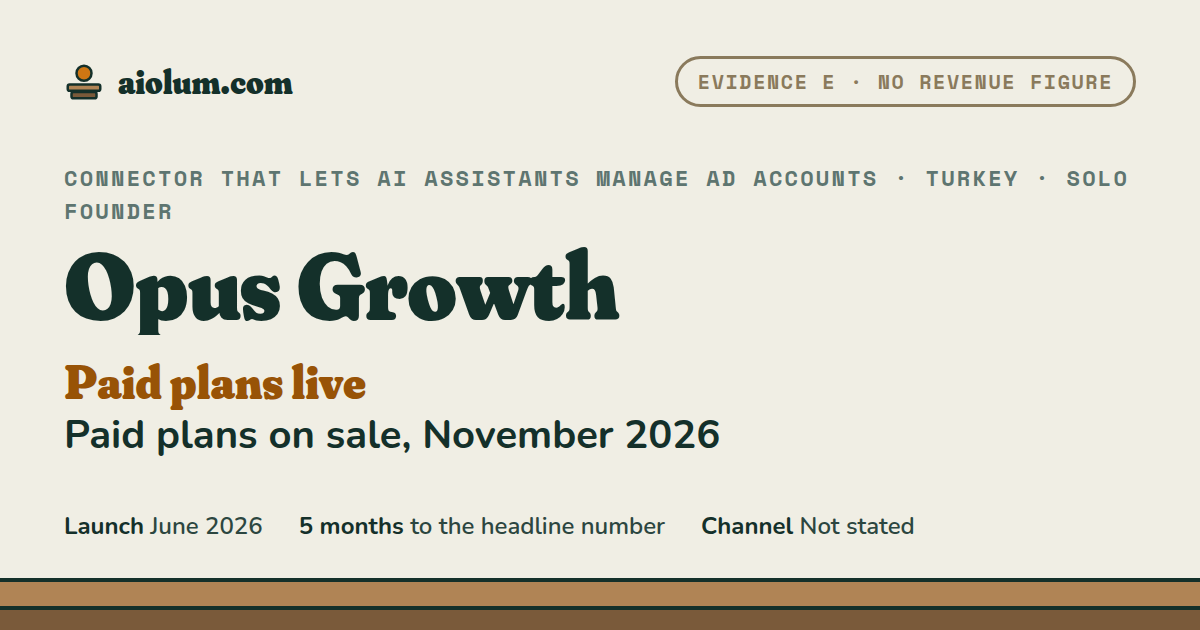
Opus Growth (Connector that lets AI assistants manage ad accounts, Turkey): Paid plans on sale, November 2026. Evidence grade E: no revenue figure was checked. Team: headcount not published; the company page names one person as a sole proprietor. Launched June 2026; still running.Added
- Outcome
- Paid plans on sale, November 2026
- Evidence
- E no revenue figure was checked
- Launch
- June 2026
- Status
- Still running
- Team
- headcount not published; the company page names one person as a sole proprietor
- Outside funding
- None found in any source read
- Main channel
- Not stated
What is not verified
No revenue figure was found. The sources checked were the pricing and legal pages, Product Hunt, PeerPush and the blog. Plans can be bought on the site, but no source states that a customer has paid. The home page shows "800+ customers" with no method, a Trustpilot rating from 13 reviews and a panel rating from 22 customers. It shows ten Trustpilot reviews, mostly in Turkish, with names and dates from August to October 2026. Trustpilot disallows the pipeline's agent, so they were not compared with the original. In May 2026 the same name and domain offered web design and ads to dental clinics, a service and not software. A reader could look for a payment-processor profile or a founder interview. This story is grade E: the business is real and its product, price and customers are described from public pages, but no revenue figure was checked. Aiolum shows it as an idea worth studying, not as proof that it makes money.
Opus Growth is an MCP connector for ad accounts. MCP (Model Context Protocol) is an open standard that lets an AI assistant call other services. A customer adds the connector to ChatGPT, Claude or Grok, signs in to each ad platform, and then writes requests such as "create a Google search campaign for my business". The company says the assistant shows today's value and the new value in a table, and applies a change only after approval.
The company page names Talat KOÇ as the legal entity, a sole proprietorship in Turkey, and says it has operated since 2026. The site's structured data lists Talat Koç as founder, and the blog posts carry him as author. On 19 May 2026 the same domain showed a Turkish page titled Opus Growth that sold web design and ads to dental clinics. The first post of the product blog is dated 21 June 2026.
No revenue figure was found, so the story is grade E. What was checked is a published price list with a checkout through Paddle. The company's pricing page lists Pro at US$49 a month, Agency at US$99 and All-in-One at US$149. No independent source states that a customer has paid.
Why did Opus Growth work?
Four causes, in the order they mattered. Each one is a reusable lesson.
Every change is shown first and recorded in an audit log
The company says the assistant shows the campaign, today's value and the new value, and applies the change after approval. It says budget rises are capped at 50% per change and 100% in 24 hours. Every action goes into an audit log that the customer can export as CSV. These are the company's statements, and no outside test of them was found.
One connector covers six ad platforms and several assistants
The company's PeerPush page says a single connector covers Google, Meta, TikTok, LinkedIn, Microsoft and ChatGPT ads. It works inside ChatGPT, Claude, Grok and other assistants, so the customer keeps the assistant already in use. The Product Hunt note of July 2026 shows that the first version had fewer platforms.
Agencies pay more because they manage many client accounts
Pro covers one ad account per platform. Agency lists several client accounts and no credit limit for ad work. The company says a Google manager account brings all its client accounts with it. The price list steps up from US$49 to US$99 to US$149 as the scope grows.
How it was built
These details come from the company's own pages. They are grade C. [1, 3, 4, 6, 11]
- The connector runs at an address that a customer pastes into the assistant. ChatGPT users install a published plugin instead.
- It reaches each ad platform through that platform's official connection, and the customer signs in on the platform's own screen.
- The company says the access keys are stored encrypted, and the customer can disconnect any platform from the panel.
- Paddle takes the payments and the VAT. The company page says Paddle acts as merchant of record.
- The site also has a blog, a glossary, comparison pages and a forum. The forum has members that the site labels as AI.
Tools named in the sources
Each one opens its page in the Tools tab, with every story that uses it.
Who tried this before Opus Growth, and why did they fail?
Three companies in our database of failed startups tried to make online ads simpler for small advertisers. The values below are from that database and are not independently verified.
Admazely
The promiseRetargeting ads that small webshops could run without technical skills.
Why it diedThe record says big technology companies sell full marketing suites. It also names strategic missteps in how the company won users.
AdThrow
The promiseAds placed in real time by the content of the page and the behavior of the visitor.
Why it diedThe record says it could not compete with Google AdSense and Facebook ads, which offered better targeting.
Argyle Social
The promiseA social media marketing tool linked to marketing automation platforms such as Pardot and Marketo.
Why it diedThe record says it could not keep a distinct brand against firms with much larger marketing budgets.
The failed startups come from our database of 1,749 dead startups, retold here in our own words. Its entries are AI-assisted summaries of public sources, so these cards carry no evidence grade.
What changed
Each of the three sold its own advertising layer to small businesses. The large platforms then improved their own tools and their own targeting. A small advertiser had less reason to pay a third company.
Opus Growth sits on top of the same platforms and depends on them. What differs is the way of working: the customer writes a request to an AI assistant, and the assistant calls the platform's connection. Whether customers pay for that is not shown by any source read.
Can one person copy Opus Growth now?
The structure can be copied, the proof is missing.
A connector between an AI assistant and a business tool needs a published price, a preview of every change and a log. Those parts can be copied. No source shows how many customers pay, so the demand is not shown.
Where it is still open: Any business tool with an official API and owners who do not want to learn its menus. Examples are store back offices and booking systems.
- 1Pick one tool that has an official connection and that small businesses use every week.
- 2Show every change in a table before it is applied, and cap the size of one change.
- 3Sell through a card checkout with a free plan and a yearly price, and let a payment provider handle the VAT.
- 4Write a post for each task that a customer would search for.
How much revenue does Opus Growth make?
Each row shows the evidence grade and the source numbers from the list at the end of this page. The grades are explained in How Aiolum verifies.
| Fact | Value | Grade | How we know | Sources |
|---|---|---|---|---|
| Paid plans on sale, November 2026 | Pro US$49, Agency US$99, All-in-One US$149 a month | C | The company's pricing page lists the three plans. Each has a Buy now button. | [2] |
| Billing | Paddle as merchant of record, automatic renewal | C | The company's Distance Sale Agreement says payment is collected by card through Paddle. It also says the subscription renews automatically until canceled. | [4] |
| Free plan | 75 credits, no card | C | The company's home page says a report uses 2 credits, an account audit 3 and a campaign setup 8. | [1] |
| Yearly billing | 10 months paid for 12 | C | The company's pricing page gives US$490, US$990 and US$1,490 a year for the three plans. | [2] |
| AI Server hosting add-on | US$29, US$39 and US$79 a month | C | The company's website-builder page lists 10 GB, 30 GB and 80 GB packages, each with up to 15 sites. | [10] |
| Legal entity | Talat KOÇ, sole proprietorship, in Turkey | C | The company page, last updated 19 October 2026, also says "Operating since | 2026". | [3] |
| Founder | Talat Koç | C | The home page's structured data names him as founder. A PeerPush comment from the company account says "I'm Talat, founder of Opus Growth". | [1, 9] |
| Product Hunt page created | 17 July 2026 | B | The date comes from the page's own data. The page shows 0 points and no reviews. | [5] |
| Earlier use of the domain | Turkish page under the name Opus Growth for dental-clinic web design, ads and SEO | B | The Internet Archive copy of 19 May 2026 carries the name Opus Growth in its title. The same domain now sells the connector. | [8] |
| Blog | 49 posts from 21 June to 5 November 2026 | C | Counted from the company's blog index. Two sampled posts name Talat Koç as author. | [6, 7] |
| Counters on the home page | "800+ customers", rating 4.2 from 13 reviews, panel rating 4.7 from 22 customers | C | The company gives no method for the customer count. The reviews are Trustpilot reviews printed on the company's page. | [1] |
How to read this table. Grade C is a statement on the company's own pages. Grade B is a date or a copy kept by a third-party platform, here Product Hunt or the Internet Archive. No row states revenue or a paying customer.
| Plan | Per month, billed yearly (US$) | Per month, billed monthly (US$) | Limit |
|---|---|---|---|
| Free | 0 | 75 credits that do not expire, no card needed | |
| Pro | 40.83 | 49 | 5,000 credits a month, one ad account per platform |
| Agency | 82.50 | 99 | no credit limit for ad work, several client accounts |
| All-in-One | 124.17 | 149 | Agency plan plus AI Server, WordPress plugin, 15,000 SEO credits |
| Enterprise | custom offer |
Prices are in US dollars. Paddle handles payment, and the plans renew automatically until the customer cancels. Yearly billing costs 10 months instead of 12: US$490 for Pro, US$990 for Agency and US$1,490 for All-in-One. AI Server, a hosting add-on for websites, starts at US$29 a month.
When did Opus Growth launch, and how did it grow?
From a dental-clinic page on the domain to a connector with three paid plans, in about six months. Each entry carries its grade.
- 19 May 2026BThe earliest Internet Archive copy of the domain shows a Turkish page named Opus Growth. It offers web design, Google Ads and SEO for dental clinics. [8]
- 21 June 2026CThe oldest post on the blog index is dated 21 June 2026 and explains MCP. It is the first dated sign of the connector. [6]
- 17 July 2026BThe Product Hunt page is created. Its maker note lists Google Ads, Analytics, Search Console and Tag Manager. It says LinkedIn, Meta and TikTok are coming. [5]
- 10 October 2026CA blog post by Talat Koç adds LinkedIn lead form responses that the assistant pulls into the chat. [7]
- 29 October 2026CThe company account lists the product on PeerPush and offers a discount code on the Pro plan. [9]
- 12 November 2026CThe pricing page shows Pro, Agency and All-in-One for sale, and the legal pages name Paddle as the payment provider. [2, 4]
What could go wrong for Opus Growth?
The risks are the mirror image of the causes above.
What is not verified
No revenue figure was found. The sources checked were the pricing and legal pages, Product Hunt, PeerPush and the blog. Plans can be bought on the site, but no source states that a customer has paid. The home page shows "800+ customers" with no method, a Trustpilot rating from 13 reviews and a panel rating from 22 customers. It shows ten Trustpilot reviews, mostly in Turkish, with names and dates from August to October 2026. Trustpilot disallows the pipeline's agent, so they were not compared with the original. In May 2026 the same name and domain offered web design and ads to dental clinics, a service and not software. A reader could look for a payment-processor profile or a founder interview.
Earlier use of the domain and agency wording
On 19 May 2026 the domain showed a Turkish page for dental-clinic web design, ads and SEO. The page carried the name Opus Growth, but it named no person. A different domain, opusgrowth.com, showed a TV advertising buying firm in October 2019, and no source ties it to this one. One review calls the company an AI agency, and another says it works like an agency. The FAQ says the product replaces an agency. The legal pages describe software.
AI members on the forum and the founder's own listings
The company's forum has twelve AI members. The site says every post carries an AI badge and that they never pretend to be human. The terms say Opus Growth runs these members. Each one shows between 78 and 133 posts in the past week, and the forum lists 759 topics. Two threads read on 12 November 2026 were opened and answered only by AI members. One AI member began a post with "Our lead form's key event", as a business owner would. The company account on PeerPush wrote "10% off Pro with PEERPUSH10", and the home page links directory pages. These are the company's own channels.
Leads, links and company wording
A blog post says the assistant can download the customer's own LinkedIn lead form responses, with names, emails and phones. A second post tells readers to take backlink data of competitors and says three genuine links beat a hundred purchased ones. The Product Hunt maker note says "we" and is signed "Opus-Growth Team", while the legal entity is one person. Headcount is not published.
Sources
The grade next to each source is the best grade that the source can support. "Read in full" means that the text of the page was downloaded and the numbers were checked in it.
- C Opus Growth home page: Connect Your Ad Accounts to AI and Manage ThemRead in full on 12 November 2026. Source for the plans, the counters, the reviews, the free plan and the structured data that names the founder.
- C Opus Growth pricing pageRead in full on 12 November 2026. Source for the three paid plans and the yearly prices in its structured data.
- C Opus Growth: Company / About Us (last updated 19 October 2026)Read in full on 12 November 2026. Source for the legal entity, the tax office and the start year.
- C Opus Growth: Distance Sale AgreementRead in full on 12 November 2026. Source for the seller, Paddle, the plan prices and automatic renewal.
- B Product Hunt: Opus GrowthRead in full on 12 November 2026. Source for the 17 July 2026 date and the maker note posted from the company's maker account.
- C Opus Growth blog indexRead in full on 12 November 2026. Source for the 49 dated posts, from 21 June to 5 November 2026.
- C Opus Growth blog, 10 October 2026: Pull LinkedIn Leads From the ChatRead in full on 12 November 2026. Source for the author, the date and the lead feature. The backlink post of 3 October 2026 was read the same way.
- B Internet Archive copy of opus-growth.com, 19 May 2026Read in full on 12 November 2026. It shows a Turkish page for dental-clinic web design, ads and SEO.
- C PeerPush: Opus Growth MCPRead in full on 12 November 2026. Source for the founder's comment of 29 October 2026 and the discount code.
- C Opus Growth website builder page (AI Server)Read the sections on the price packages on 12 November 2026.
- C Opus Growth community forumRead the home page on 12 November 2026. Source for the AI members and their badge statement.
- C Opus Growth terms of use (last updated 8 November 2026)Read in full on 12 November 2026. Source for the approval rule and the statement on AI members.
- B Internet Archive copy of opusgrowth.com (no hyphen), 14 October 2019Read the home page on 12 November 2026. It shows a TV advertising buying firm and no tie to this company.
- C Database of failed startups, local exportRecord pages read on the website on 12 November 2026. AI-written summaries, not independently verified. Source for the failed predecessors.
Run this company? Send corrections or a verified figure to aiolum@livyden.com