Plurai: Product, team and how it was built
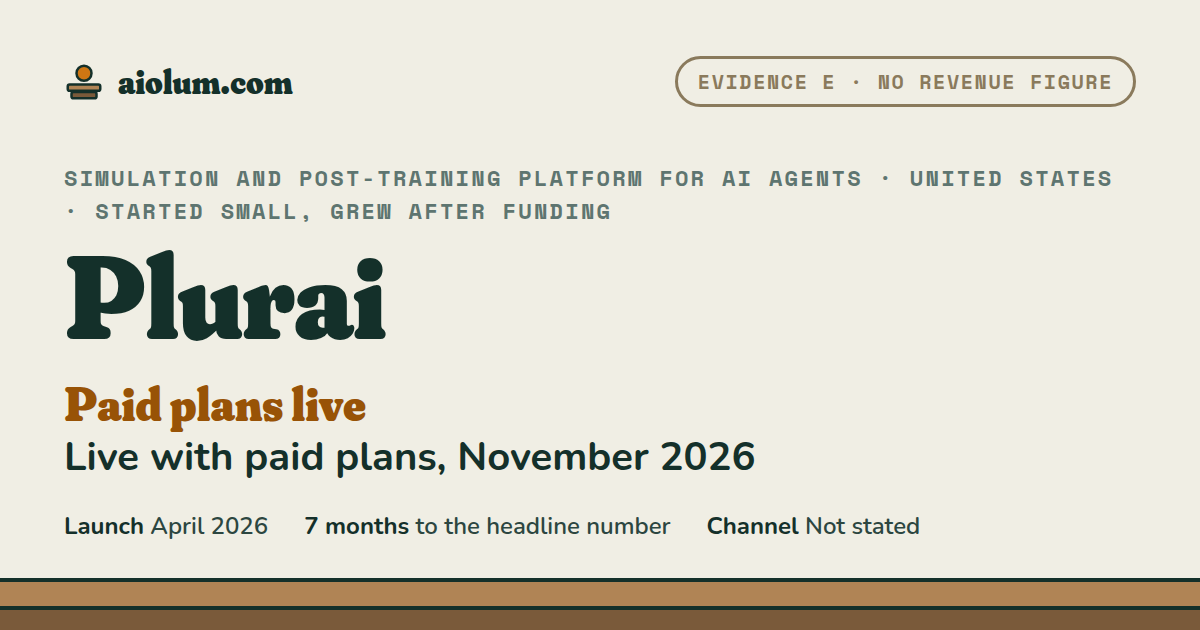
Plurai (Simulation and post-training platform for AI agents, United States): Live with paid plans, November 2026. Evidence grade E: no revenue figure was checked. Team: 2 co-founders; 12 people named on the about page in November 2026, after a US$13M seed round. Launched April 2026; still running.Added
- Outcome
- Live with paid plans, November 2026
- Evidence
- E no revenue figure was checked
- Launch
- April 2026
- Status
- Still running
- Team
- 2 co-founders; 12 people named on the about page in November 2026, after a US$13M seed round
- Outside funding
- US$13M seed led by Team8, announced by the company on 11 November 2026
- Main channel
- Not stated
What is not verified
No revenue figure was found. The sources were the company's own pages, its blog and one press report. The pages call users design partners and customers, but none states that they pay, and no independent source confirms it. A reader could look for a payment-processor profile or a named customer. This story is grade E: the business is real and its product, price and customers are described from public pages, but no revenue figure was checked. Aiolum shows it as an idea worth studying, not as proof that it makes money.
Plurai sells simulation and post-training for AI agents. Simulation means the platform builds a digital copy of an agent and plays invented user conversations against it to find failures. Post-training means further training of a model on the customer's task, here a small language model (SLM). Such a model is far cheaper to run than a frontier model.
Ilan Kadar (CEO) and Elad Levi (CTO) founded it, and both worked at Nexar before. Archive copies show a "Launching Soon" page on 27 May 2024 and a first self-serve product with prices in April 2026. On 11 November 2026 the company announced a US$13 million seed round led by Team8 and general availability of its simulation product. Its about page names 12 people, including the two founders.
No revenue figure exists in any page that was read, and every number comes from the company or a press report of its release. The outcome shown here is that paid plans are on sale. The pricing page lists US$60 and US$210 a month, and the terms name Stripe. The company calls its users design partners and customers, but no page says that they pay.
Why did Plurai work?
Four causes, in the order they mattered. Each one is a reusable lesson.
The founders took a testing method from autonomous driving
Pulse 2.0 reports that both founders worked at Nexar on autonomous driving. The company's launch post says simulation is how that industry earns trust, and that AI agents fail in rare, unpredicted situations. The company's own words describe the idea as testing agents in simulated worlds before real users meet them. The founders' background is the stated reason for the approach.
Developers can start it from the coding agents they already use
The home page shows plugin commands for Claude Code, GitHub Copilot CLI and OpenAI Codex. The launch post says any agent builder can use simulation for free from those tools. The company does not say how many developers use it, and no source reports how customers arrived.
A free tier and paid plans from US$60 a month sit side by side
The pricing page has a free tier with one-time credits, a Base plan at US$60 a month and a Business plan at US$210 a month. The post-training tab adds an Enterprise plan with no price. The press release and the launch post mention design partners and enterprise customers, but no page says what they pay.
How it was built
These details come from the company's own terms, pricing page and blog. They are grade C. [2, 6, 5, 1, 10]
- The launch post says the product builds a digital copy of an agent from the customer's knowledge base, tools and policies. It then runs simulated users against the copy.
- The terms say the product relies on OpenAI, Google (Gemini) and Anthropic (Claude) for large language model capability, and on Stripe for payments.
- The pricing page says the infrastructure is NVIDIA Nemotron and NIM. Pulse 2.0 reports joint work with NVIDIA and Nebius for one enterprise customer.
- Post-training makes task-specific small language models. The company says they can replace frontier models in some agent jobs.
- Research is published openly: the papers page lists four papers from January 2025 to October 2026, and an open-source repository named IntellAgent exists.
Tools named in the sources
Each one opens its page in the Tools tab, with every story that uses it.
Who tried this before Plurai, and why did they fail?
Two companies in our database of failed startups sold testing or AI tooling to developers. The database has no failed company that tested AI agents. The values below are from that database and are not independently verified.
Testmunk
The promiseAutomated tests of mobile apps on real devices for developers.
Why it diedThe record says it could not stand out in a crowded market of testing platforms and carried the cost of a device farm.
Kite
The promiseAI code completion inside the developer's editor.
Why it diedThe record says GitHub Copilot arrived in 2021 with much stronger models and Kite could not match it.
The failed startups come from our database of 1,749 dead startups, retold here in our own words. Its entries are AI-assisted summaries of public sources, so these cards carry no evidence grade.
What changed
Testmunk and Kite show two risks for a developer tool: a crowded market, and a large platform that adds the same feature. Plurai sits inside tools made by OpenAI, GitHub and Anthropic, so it depends on them.
Neither record is a close match, because neither company tested AI agents. The sources do not show what Plurai would do if a platform owner added simulation to its own coding tool.
Can one person copy Plurai now?
Not as a company of this size. The free-first channel inside coding agents is open to anyone.
Plurai is a funded company with PhD founders and a team of 12, so a single person cannot copy it as it stands. The company's choice to start free inside developers' coding agents, with paid plans next to it, needs only a plugin and a price list.
Where it is still open: Other jobs inside coding agents where a developer today writes the check by hand, such as test data, policy checks and regression runs.
- 1Pick one job that developers do inside a coding agent, such as testing an agent.
- 2Ship it as a plugin that installs with a few commands.
- 3Offer a free tier with a one-time allowance, and a paid plan with a monthly allowance.
- 4Publish the unit of usage and the overage rule on the pricing page.
How much revenue does Plurai make?
Each row shows the evidence grade and the source numbers from the list at the end of this page. The grades are explained in How Aiolum verifies.
| Fact | Value | Grade | How we know | Sources |
|---|---|---|---|---|
| Status at the date of the outcome | Paid plans on sale, November 2026 | C | The pricing page lists Base at US$60 and Business at US$210 a month. The terms say fees go through Stripe. | [5, 6] |
| Funding announced | US$13 million seed round | C | The company's launch post of 11 November 2026 says Team8 led it. Pulse 2.0 retells the release. | [1, 2] |
| General availability of Plurai Simulation | 11 November 2026 | C | The launch post says the simulation is free to start. Pulse 2.0 says it was earlier available only to selected partners and customers. | [1, 2] |
| Earliest trace of the company | 27 May 2024 | C | An Internet Archive copy of plurai.ai shows "Launching Soon" and "Copyright © 2024 Plurai". No earlier capture exists in the archive's index. | [8] |
| Earlier wording of the product | "Artificial Collaborative Intelligence (ACI) Platform", then "Reliable Conversational AI" | C | The May 2024 copy uses the first phrase. The title of the 24 January 2025 copy contains the second. The name Plurai stays the same. | [8, 9] |
| Founders | Ilan Kadar (CEO) and Elad Levi (CTO) | C | Pulse 2.0 and the about page both say they founded it. Both worked at Nexar before, according to Pulse 2.0. | [1, 4] |
| People named on the about page | 12, including the 2 founders | C | Ten more names with job titles, such as engineers and heads of marketing and business operations. Board members, investors and advisers are not counted. | [4] |
| Legal company and place | Plurai Inc., New York | C | The privacy policy names Plurai Inc. The self-serve terms choose New York law. Pulse 2.0 calls it New York-based. | [1, 6, 7] |
| Where developers start it | Plugins for Claude Code, GitHub Copilot CLI and OpenAI Codex | C | The website shows install commands for all three. Cursor is marked "Soon". | [3] |
| First self-serve product with prices | April 2026 | C | An archive copy of 28 April 2026 shows "The first vibe-training platform for evals and guardrails" with a "Get started" button. An archive copy of the pricing page of 30 April 2026 shows pay-as-you-go prices. | [13, 14] |
| Failure reduction that the company claims | 82% fewer failures reaching real users | D | Plurai says so about design partners. Nobody outside the company has checked it. The home page also shows a 98% cost saving, and the release says 97%. | [1, 2, 3] |
| Open-source origin | IntellAgent, a paper dated 19 January 2025 | C | The papers page lists the paper by both founders. Levi's about-page text calls him the creator of the open-source tool IntellAgent. | [4, 10] |
How to read this table. A grade C value is a statement on the company's own page, or a press report that retells the company's release. A grade D value is a company claim about results that nobody outside has checked. No value is grade A or B, and no value is a revenue figure.
| Plan | Per month, billed yearly (US$) | Per month, billed monthly (US$) | Limit |
|---|---|---|---|
| Free | 0 | 12,300 credits, one-time; 2 agent setups; 3 runs | |
| Base | 60 | 28,710 credits a month; 3 agent setups; 20 runs a month | |
| Business | 210 | 65,570 credits a month; 60 runs a month | |
| Enterprise (post-training only) | no price shown; contact the company |
The page shows monthly prices only, and no yearly billing. Sim credits are the page's unit of usage: one credit stands for one cent of model-provider usage at list price. Pay-as-you-go extra credits cost US$0.02 each on Base and US$0.015 each on Business. Members are free on every plan. The Simulation tab shows no Enterprise plan. The Post-training tab has a free starter tier, pay-as-you-go prices and an Enterprise plan with no published price. The units of the post-training prices are not clear enough to copy here.
When did Plurai launch, and how did it grow?
From a placeholder web page in May 2024, through a first self-serve product in April 2026, to a seed round on 11 November 2026. Each entry carries its grade.
- 27 May 2024CAn Internet Archive copy of plurai.ai reads "Launching Soon" and "Building the First Artificial Collaborative Intelligence (ACI) Platform". [8]
- 19 January 2025CThe papers page lists "A multi-agent framework for evaluating conversational AI systems" by Kadar and Levi. A 24 January 2025 archive copy of the home page is titled "Plurai - Building the Future of Reliable Conversational AI". [9, 10]
- 28 April 2026CAn Internet Archive copy of the page /launch reads "The first vibe-training platform for evals and guardrails". A copy of the pricing page of 30 April 2026 shows pay-as-you-go prices. [13, 14]
- 15 August 2026CThe company publishes a customer story about an unnamed US enterprise IT provider and a custom small language model built in 20 minutes. [11]
- 10 November 2026CThe self-serve terms show "Last updated: November 10, 2026". They cover paid plans through Stripe. [6]
- 11 November 2026CThe company announces the US$13 million seed round and opens simulation to every developer, with a free tier. [1, 2]
What could go wrong for Plurai?
The risks are the mirror image of the causes above.
What is not verified
No revenue figure was found. The sources were the company's own pages, its blog and one press report. The pages call users design partners and customers, but none states that they pay, and no independent source confirms it. A reader could look for a payment-processor profile or a named customer.
Logos, counters and a security badge on the company's pages
The home page shows 18 logos under "Trusted by developers from leading enterprises". They are companies, three universities and a research council. No page says that these organizations are customers. The home page shows counters of 98%, 85% and 82%, and the release says 97% for cost, so the cost figure differs. The pricing page says "Independently verified by AICPA" without a report. A "Featured in" block links two Gartner documents of 2026, which were not read.
Start year and headcount
The earliest dated trace is 27 May 2024, so the real founding date may be earlier. No source states a founding date. The launch date used here is the first archived self-serve product, in April 2026. The headcount at the earliest date is unknown. The about page speaks of "a small, deeply technical team" and names 12 people. The press release says two founders started the company.
It runs inside other companies' products
The plugins work in Claude Code, GitHub Copilot CLI and OpenAI Codex, and the terms rely on OpenAI, Google and Anthropic models. A change by one of these companies could affect the product. The sources say nothing on that risk.
Sources
The grade next to each source is the best grade that the source can support. "Read in full" means that the text of the page was downloaded and the numbers were checked in it.
- C Pulse 2.0, 11 November 2026: Plurai: $13 Million Seed Funding Led By Team8 To Advance AI Agent Simulation And Reliability PlatformRead in full. A press piece that retells the company's announcement. Source for the funding, the founders, the New York location and the earlier availability to selected partners.
- C Plurai blog, 11 November 2026: Introducing Plurai Simulation: The self-improving layer for AI agentsRead in full. The company's own launch post, with the author name Ilan Kadar in its header. Source for the seed round, the free start and the design partners.
- C Plurai home page, read 11 November 2026Read in full as text. Source for the plugins, the logo wall, the counters and the blog list.
- C Plurai about page, read 11 November 2026Read in full as text. Source for the founders, the team list and the open-source note.
- C Plurai pricing page, read 11 November 2026Read in full as text. Source for the plan prices, credits and the security badge.
- C Plurai terms of service, last updated 10 November 2026Read in full as text. Source for Stripe, the third-party model providers, the age rule and the company name.
- C Plurai privacy policy, last updated 27 April 2026Read the section on the company name and the age rule.
- C Internet Archive copy of plurai.ai, 27 May 2024Read in full. The earliest capture in the archive's index. Source for the 2024 start.
- C Internet Archive copy of www.plurai.ai, 24 January 2025Read the page title and description. The page body holds no text.
- C Plurai papers page, read 11 November 2026Read in full as text. Source for the paper dates and authors.
- C Plurai blog, 15 August 2026: Customer story about an enterprise IT providerRead the opening. The customer is not named and the page does not say what it pays.
- C Database of failed startups, local exportRecord pages read on the website on 11 November 2026. AI-written summaries, not independently verified. Source for the failed predecessors.
- C Internet Archive copy of www.plurai.ai/launch, 28 April 2026Read in full. Source for the first self-serve product, for evals and guardrails.
- C Internet Archive copy of the Plurai pricing page, 30 April 2026Read in full. Source for the pay-as-you-go prices of April 2026.
Run this company? Send corrections or a verified figure to aiolum@livyden.com