Praxos: Product, team and how it was built
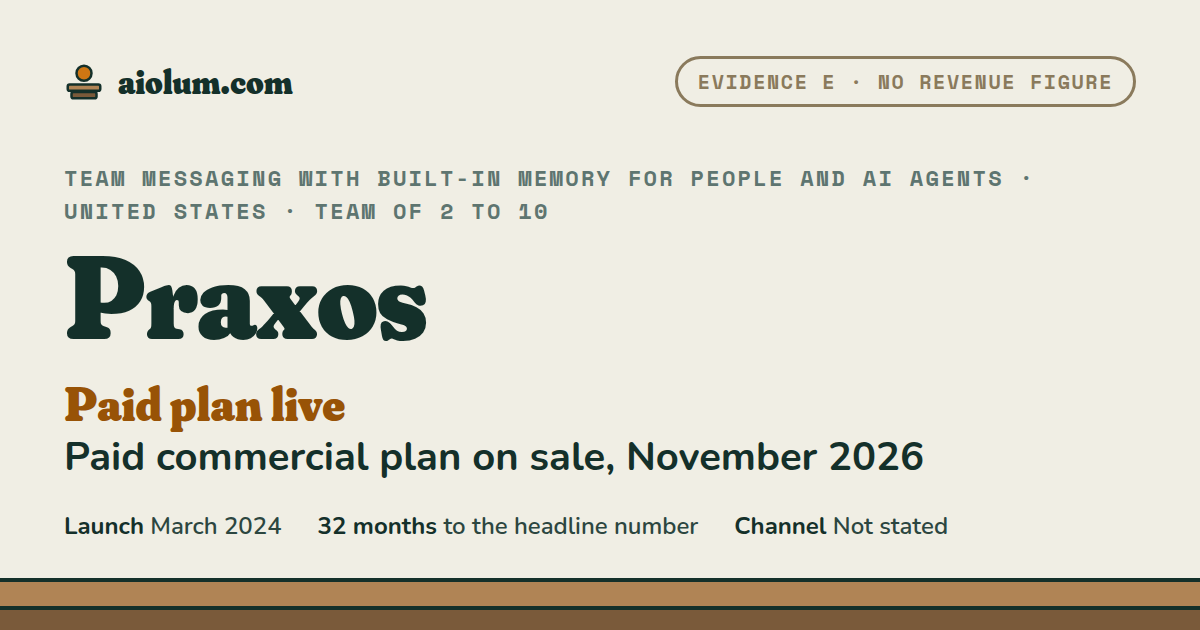
Praxos (Team messaging with built-in memory for people and AI agents, United States): Paid commercial plan on sale, November 2026. Evidence grade E: no revenue figure was checked. Team: 2 named founders; 3 people on the Y Combinator page, 4 employees on Tracxn in September 2026. Launched March 2024; still running.Added
- Outcome
- Paid commercial plan on sale, November 2026
- Evidence
- E no revenue figure was checked
- Launch
- March 2024
- Status
- Still running
- Team
- 2 named founders; 3 people on the Y Combinator page, 4 employees on Tracxn in September 2026
- Outside funding
- Y Combinator, Summer 2024; La Nación reported US$500,000 from Y Combinator in October 2024
- Main channel
- Not stated
What is not verified
No revenue figure was found. Pages read: the home page, FAQ, terms, privacy, security and skills pages, a Y Combinator page, Tracxn and archived copies. A price and payment terms exist, but no source states that a customer has paid for team messaging. No checkout page could be read without an account. In October 2024 the founder told La Nación that the insurance product gained customers almost every day. La Nación also reported that the founders projected revenue above US$1 million for 2025; no later source confirms it. The US$500,000 of funding is the figure of La Nación and Tracxn. A reader could look for a customer statement. This story is grade E: the business is real and its product, price and customers are described from public pages, but no revenue figure was checked. Aiolum shows it as an idea worth studying, not as proof that it makes money.
Praxos is team messaging with a memory. The memory is a store built from chats, call transcripts and AI coding sessions, and a person or an agent can ask it what happened. An agent here is an AI program, such as Claude Code, that works on a task for a user. The company says a new hire or an agent can catch up by asking.
Lucas Urbisaia (chief executive) and Soheil Sadabadi (chief technology officer) are named as founders on the Y Combinator company page. The page says the company was founded in 2023, joined the Summer 2024 batch and has 3 people. The newspaper La Nación dates the start to November 2023. The first product, from March 2024, automated paperwork for insurance brokers, not team messaging.
This story has grade E: no revenue figure was found. The company's FAQ lists US$23 per user per month for commercial use and free personal use, and the terms of service describe payment of "Charges". No source states that a customer has paid.
Why did Praxos work?
Four causes, in the order they mattered. Each one is a reusable lesson.
The memory is fed by chats, calls and agent sessions
The home page says Praxos learns from chats, saved call transcripts, coding-agent sessions and connected apps such as Slack and Discord. A person or an agent then asks what a teammate did or decided. The page gives no result from real customers.
Slack history imports in one click to lower the cost of switching
The company says Slack history and automations come over in one click, and Slack Connect channels are mirrored. Its FAQ calls Slack, WhatsApp and Telegram bridges for teammates who refuse to leave.
One price covers commercial use while personal use stays free
The FAQ sets one price for commercial use and makes personal and family use free. A free personal tier lets a founder try it alone, and the company says it gets better with each teammate.
How it was built
These details come from the company's privacy policy, security page and home page. They are grade C. [4, 12, 1, 2]
- The privacy policy names Google Gemini for replies, voice, images and documents, and for building each user's memory.
- It also names Microsoft Azure AI for replies and Amazon Bedrock for building and searching memory.
- The security page says data is encrypted at rest with AES-256 in Microsoft Azure data centers, in the United States by default.
- The home page says users connect Claude Code or Codex to Praxos, and the FAQ describes an install command for the terminal.
- Apps for Mac and Windows, a web app, and links to WhatsApp, Telegram, iMessage and SMS appear on the company's pages.
Tools named in the sources
Each one opens its page in the Tools tab, with every story that uses it.
Who tried this before Praxos, and why did they fail?
Three companies in our database of failed startups tried to improve how teams communicate and share knowledge, and closed. The values below are from that database and are not independently verified.
Memo
The promiseA place to create and archive rich media memos, so that engineering, product and design teams could replace scattered communication channels.
Why it diedThe page says it could not compete with entrenched incumbents that added similar features, and that team-wide adoption was hard to reach.
Team Apart
The promiseVideo calls, screen sharing and collaboration tools in one web page for distributed teams.
Why it diedThe page says it struggled with product-market fit in the late 2000s, and that server and bandwidth costs for video were high.
Unflow
The promiseOne place for designers, engineers and product managers to work together on a digital product.
Why it diedThe page says it could not stand apart in a crowded collaboration market, and its unit economics struggled.
The failed startups come from our database of 1,749 dead startups, retold here in our own words. Its entries are AI-assisted summaries of public sources, so these cards carry no evidence grade.
What changed
Each of the three sold a shared place for a team to talk or work, and the pages say larger suites added the same features. Praxos also sells a team chat, so it meets the same competitors. The home page says Praxos is built to replace Slack.
The company says the difference is the memory that agents can read. The pages cannot show whether that is enough, because no source reports customers or revenue.
Can one person copy Praxos now?
Not shown yet.
No source shows that this business earns money, so a reader cannot yet copy a result. The structure on offer is a free personal tier with a per-user price for business use.
Where it is still open: Any shared workspace where people and AI agents both need the same history, such as support, sales or operations.
- 1Give individuals a free tier so that one person can use the product before a team joins.
- 2Charge per user for commercial use, and say which connected tools count as commercial.
- 3Offer a one-click import from the tool you want to replace, so switching costs little.
How much revenue does Praxos make?
Each row shows the evidence grade and the source numbers from the list at the end of this page. The grades are explained in How Aiolum verifies.
| Fact | Value | Grade | How we know | Sources |
|---|---|---|---|---|
| Company named in the terms | Praxos Intelligence, Inc. | C | Terms of service, last revised 21 February 2026: a legal agreement "BETWEEN PRAXOS INTELLIGENCE, INC." and the user. The home page footer gives the same name. | [3, 1] |
| Founders | Lucas Urbisaia and Soheil Sadabadi | C | Y Combinator company page: Urbisaia as "Founder/CEO" and Sadabadi as "Founder/CTO". Tracxn also says the company was founded by the two. | [5, 6] |
| Start of the company | November 2023 | C | La Nación, 25 October 2024: "Así surgió, en noviembre de 2023, Praxos" (translation: this is how Praxos began, in November 2023). Y Combinator page: "Founded: 2023". Tracxn says "founded in 2023". | [14, 5, 6] |
| Earlier product | AI workflow automation for insurance brokers | C | The earliest archived copy of praxos.ai, 27 February 2024, is titled "Praxos | AI for Insurance". A copy of 26 April 2024 adds a pricing link and "Start Free Trial". The founder told La Nación that no product was on the market before the last week of March 2024. | [7, 8, 14] |
| Personal assistant and the older web address | named in the privacy policy | C | The policy, revised 11 October 2026, covers www.mypraxos.com and "our artificial intelligence-powered personal assistant". The archive copy of mypraxos.com of 13 July 2025 is a domain-parking page. | [4, 11] |
| Team size | 3 on the Y Combinator page; 4 employees on Tracxn | D | Y Combinator page: "Team Size: 3", undated. Tracxn: "4 as on Sep 30, 2026". The home page demo shows "14 members", which is sample data. | [5, 6, 1] |
| Funding | Summer 2024 Y Combinator batch; seed round | D | La Nación reported on 25 October 2024 that Praxos had recently received US$500,000 from Y Combinator. Tracxn says Praxos "has raised a total funding of $500K over 1 round". No Praxos page states an amount. | [5, 6, 14] |
| Price of commercial use | US$23 per user per month | C | FAQ on the home page: "For commercial use ... it costs $23 per user per month." Personal and family use is free. | [1] |
| Payment path | Charges in the terms; Stripe named | C | Terms, section 22: Praxos "will process payment of the applicable Charges" and send a receipt. The privacy policy links to Stripe's cookie page for its "Payment Services Provider". | [3, 4] |
| Team messaging launch post | 21 August 2026 | C | The page data of the Y Combinator launch post gives that creation date. It says the product "already works and is in use" and offers 6 free months to the first 10 teams. | [5] |
| AI and cloud providers | Google Gemini, Microsoft Azure AI, Amazon Bedrock | C | Privacy policy: Gemini writes replies and builds memory, Azure AI processes content, and Bedrock builds and searches memory. The security page names Azure data centers. | [4, 12] |
| Customers named on the pages read | none | C | No logo wall, customer quotation or customer name appears on the home page, FAQ or skills page. The names in the demo are sample data. | [1, 2, 10] |
How to read this table. Grade C is a statement by the company or a page it runs. Grade D is a third-party estimate or a single report. A grade E story has no dated money figure, so no row here is a revenue number.
| Plan | Per month, billed yearly (US$) | Per month, billed monthly (US$) | Limit |
|---|---|---|---|
| Personal and family use | 0 | 0 | free; no commercial use |
| Commercial use | 23 | per user; work with business information and connected tools such as GitHub, Claude Code, Linear and Airtable |
The page names no plan. It says personal and family use is free, and commercial use costs US$23 per user per month. It does not say whether that price is billed yearly or monthly. The company's separate pricing page was not found: the address returned an error.
When did Praxos launch, and how did it grow?
From the November 2023 start and an insurance product to a team messaging launch in August 2026. Each entry carries its grade.
- November 2023CThe company starts, as La Nación reports. Y Combinator and Tracxn give the year 2023. The founders build software for insurance brokers. [14, 5, 6]
- 27 February and 26 April 2024CArchived copies of praxos.ai sell AI automation to insurance brokers. The April copy adds a pricing link, a free trial and a login. The founder dates the market launch to the last week of March 2024. [7, 8, 14]
- 2024DThe company joins the Y Combinator Summer 2024 batch. La Nación reports US$500,000 from Y Combinator, and Tracxn lists a US$500K seed round. [5, 6, 14]
- 21 August 2026CUrbisaia posts the team messaging launch on the Y Combinator page and invites teams of 2 to 10 people to be onboarded. [5]
- 11 October 2026CThe privacy policy is revised. It names the AI providers, shared spaces and a personal assistant. [4]
- 12 November 2026CThe FAQ lists US$23 per user per month for commercial use and says personal use is free. [1]
What could go wrong for Praxos?
The risks are the mirror image of the causes above.
What is not verified
No revenue figure was found. Pages read: the home page, FAQ, terms, privacy, security and skills pages, a Y Combinator page, Tracxn and archived copies. A price and payment terms exist, but no source states that a customer has paid for team messaging. No checkout page could be read without an account. In October 2024 the founder told La Nación that the insurance product gained customers almost every day. La Nación also reported that the founders projected revenue above US$1 million for 2025; no later source confirms it. The US$500,000 of funding is the figure of La Nación and Tracxn. A reader could look for a customer statement.
Earlier product and company start
The company's pages from February and April 2024 sell AI for insurance brokers. La Nación dates the start to November 2023, and Y Combinator and Tracxn both give 2023. The privacy policy later describes a personal assistant, and the July 2025 archive copy of mypraxos.com is a parking page. No page dates the move to team messaging; the launch post is dated 21 August 2026.
Demo content, no logo wall and no testimonials
The home page shows a demo with sample names, a company called Acme and "14 members". These are sample data, not customers. No logo wall, customer quotation or user counter appears on the pages read, so a reader cannot check who uses the product.
Messaging and email access
The company's pages describe an assistant that reads, searches and drafts a user's email and sends invites at the user's request. No page offers bulk outreach. The privacy policy says the service may let users "automatically post updates on certain social media platform such as Twitter/X, LinkedIn, or Discord". No product page read offers such posting. The skills page also lists small routines such as medication reminders and a daily stocks brief. The terms ban spam.
Sources
The grade next to each source is the best grade that the source can support. "Read in full" means that the text of the page was downloaded and the numbers were checked in it.
- C Praxos home pageRead in full, 12 November 2026. Source for the product, the FAQ price, the demo content and the footer name.
- C Praxos FAQ: What is Praxos?Read in full, 12 November 2026. Source for the boundaries, the intended customers and the Slack position.
- C Praxos terms of serviceRead in full, 12 November 2026. Last revised 21 February 2026. Source for the company name, the payment section and the spam ban.
- C Praxos privacy policyRead in full, 12 November 2026. Last revised 11 October 2026. Source for the AI providers, Stripe, the personal assistant and social posting.
- C Y Combinator company page: PraxosRead in full, 12 November 2026. Source for the founders, the founding year, the batch, the team size and the launch post.
- D Tracxn company profile: PraxosRead the visible part, 12 November 2026. A third-party database. Source for the seed round of US$500K and the employee count.
- C Internet Archive copy of praxos.ai, 27 February 2024Read in full, 12 November 2026. Source for the earlier insurance product.
- C Internet Archive copy of praxos.ai, 26 April 2024Read in full, 12 November 2026. Source for the pricing link and the free trial of the insurance product.
- C Praxos for WhatsApp and Praxos for Telegram pagesRead in full, 12 November 2026. Source for what the assistant does with email and calendar. The Telegram, text and personal pages say the same.
- C Praxos skills pageRead in full, 12 November 2026. Source for the ready-made skills, such as invoice reminders and a community manager.
- C Internet Archive copy of www.mypraxos.com, 13 July 2025Read in full, 12 November 2026. A domain-parking page.
- C Praxos security pageRead in full, 12 November 2026. Last revised 28 July 2025. Source for the Azure hosting and the encryption.
- C Database of failed startups, local exportRecord pages read on the website on 12 November 2026. AI-written summaries, not independently verified. Source for the failed predecessors.
- C LA NACION: Es argentino, estudió en Harvard y creó un software que marca tendencia en la industria de seguros de Estados UnidosRead in full, 12 November 2026. A newspaper interview of 25 October 2024, in Spanish. Source for the start in November 2023, the March 2024 launch and the funding.
Run this company? Send corrections or a verified figure to aiolum@livyden.com