Runpod: Revenue, team and how it was built
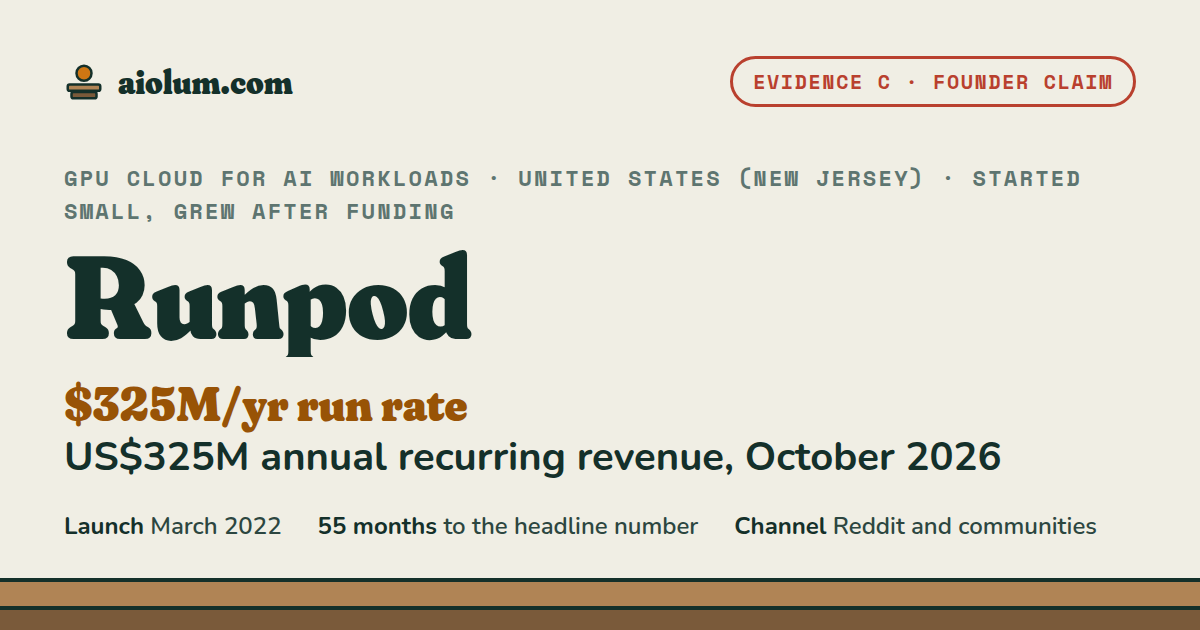
Runpod (GPU cloud for AI workloads, United States (New Jersey)): US$325M annual recurring revenue, October 2026. Evidence grade C: the founder's own figures, not verified by anyone else. Team: 2 founders at the start in 2022; headcount not published; the company says it is building toward several hundred people. Launched March 2022; still running, revenue growing.Added
- Outcome
- US$325M annual recurring revenue, October 2026Revenue growing
- Evidence
- C the founder's own figures, not verified by anyone else
- Launch
- March 2022
- Status
- Still running
- Team
- 2 founders at the start in 2022; headcount not published; the company says it is building toward several hundred people
- Outside funding
- US$20M seed in May 2024; US$100M in June 2026
- Main channel
- Reddit and communities
Runpod is a GPU cloud. A GPU is a graphics processor chip, and AI models are trained and run on many of them. Runpod rents that capacity to developers, by the second or the hour. Its Serverless product runs a customer's code on GPU workers that autoscale from zero, and the home page says an idle endpoint costs nothing. The company says that more than 1.2 million developers build on it.
Zhen Lu is the CEO and co-founder, and Pardeep Singh is the CTO and co-founder. In late 2021 they had GPU rigs in their New Jersey basements, bought to mine Ethereum. Entrepreneur reported in January 2026 that, within nine months of launching in early 2022, they quit their Comcast jobs and reached US$1 million in revenue. Lu wrote the same nine months. In May 2024 they closed a US$20 million seed round co-led by Dell and Intel. In June 2026 the company said that Summit Partners led a US$100 million round at a US$1.0 billion valuation.
The headline figure is the company's own statement. In a press release of 13 October 2026, Runpod said it passed US$325 million in ARR. ARR is annual recurring revenue, a run rate: the current monthly recurring revenue times twelve. The company gave US$120 million for January 2026 in its own release, and Entrepreneur reported the same figure as annual revenue. No payment processor, filing or buyer has confirmed any of these numbers, and the company did not publish how it counts ARR.
Why did Runpod work?
Four causes, in the order they mattered. Each one is a reusable lesson.
The founders built it for a GPU problem they had
Lu wrote that both founders had done machine learning on the side. Lu wrote that developing on GPUs was painful, with brittle environment setup, opaque networking and harder work beyond a single machine. They owned the rigs already. Singh wrote of dedicating the compute to various sites for a couple of months. Singh judged the experience mediocre and thought it could be done better. Lu wrote that the founders decided to fix the problem.
A free beta on Reddit produced the first paying customers
Lu wrote that the founders did not know how to market, so Lu posted on Reddit. The posts went to a couple of AI-oriented subreddits and offered free access for feedback. Lu wrote that those beta testers became the first paying customers. A partner at Dell Technologies Capital, which co-led the seed round, found them through the same posts. Lu wrote this, and the Dell quote in the January 2026 release says it too.
It charged from the start and stayed unfunded for almost two years
Lu wrote that the company took no venture capital or debt for almost two years and that the business had to pay for itself. To grow past the basements it formed partnerships with data centers, Lu wrote. The seed round came in May 2024. Lu wrote "We haven't raised since", and a company release states the June 2026 round.
Serverless bills by the second and charges nothing while idle
The pricing page offers a per-second view of every price, and the home page says a Serverless endpoint costs nothing when it is not running. The June 2026 release describes self-serve access, per-second pricing and no commit minimums. The January 2026 release says its compute costs as much as 90% less than traditional providers, which is the company's own claim.
How it was built
These details come from the founders' own blog posts and the company's pages. They are grade C. [6, 5, 7, 9]
- Singh wrote that it took about three months to develop the first version of Runpod, aimed at a simple and fast GPU cloud experience.
- Singh wrote that he was already a fan of the Go language, which made the work easier. Singh named two first problems: connecting distributed compute while isolating each machine, and reaching servers in containers that had no static public IP address.
- Lu wrote that when the company needed to grow past the basements, it formed partnerships with data centers.
- The home page lists three products today: Pods, Serverless and Clusters, plus a Hub of open-source models and templates.
- The terms of service name Stripe and Crypto.com as the payment service providers.
- Lu wrote that the first customers were found with posts in AI-oriented subreddits that offered free access in exchange for feedback.
Tools named in the sources
Each one opens its page in the Tools tab, with every story that uses it.
Who tried this before Runpod, and why did they fail?
Four companies in our database of failed startups sold cloud infrastructure or a developer platform. The values below are from that database, read on 22 November 2026, and are not independently verified. The pages name no founders.
DotCloud
The promiseA platform that hid the work of running servers from application developers.
Why it diedThe page says its technology led to its own obsolescence as it moved to focus on Docker, which overshadowed the first platform.
Parse.com
The promiseA backend service so that mobile developers did not have to run servers.
Why it diedThe page lists technical debt, unsustainable unit economics and abandonment by Facebook, which had bought it in 2013.
Surge Cloud
The promiseA Polish cloud with lower latency and GDPR compliance as an alternative to the big three.
Why it diedThe page says it underestimated the capital and the moat needed to compete with the largest cloud providers.
QingCloud
The promiseA Chinese cloud with its own technology as a home-grown alternative to AWS and Alibaba Cloud.
Why it diedThe page says unit economics failed in a market where three large providers hold more than 65% of the share.
The failed startups come from our database of 1,749 dead startups, retold here in our own words. Its entries are AI-assisted summaries of public sources, so these cards carry no evidence grade.
What changed
All four predecessors sold cloud capacity or a developer platform and met larger providers. Three pages name a cause tied to a larger player, and the DotCloud page names its own pivot to Docker. The causes are a pivot to Docker, a parent that stopped the service, and the cost of competing with the largest clouds. Runpod faces the same large providers, and its own releases compare its prices with them.
The sources show three differences, all in the company's own words. It sells GPU capacity for AI work. Lu wrote that its first customers paid after a free beta. Lu also wrote that it took no venture capital or debt for almost two years. No source shows how its margins compare with the large clouds. A reader cannot tell whether the predecessors' cost problem applies.
Can one person copy Runpod now?
The launch method, partly. The business itself, no.
A new GPU cloud needs hardware and data-center partners. The business is not a small copy. The launch method is copyable: a free beta for feedback in a community of people with the problem, and payment from those testers. Lu wrote that this was the whole go-to-market plan.
Where it is still open: Narrow compute needs that the large clouds serve badly. Examples are new model types, short bursty jobs, and teams that want to rent by the second without a contract.
- 1Build for a problem you have yourself, and use hardware or accounts that you already own.
- 2Post in the communities that have the problem, and offer free access in exchange for feedback.
- 3Ask the beta testers to become paying customers, and charge by usage from the start.
- 4Add capacity through partners before raising money, as Lu wrote the founders did.
How much revenue does Runpod make?
Each row shows the evidence grade and the source numbers from the list at the end of this page. The grades are explained in How Aiolum verifies.
| Fact | Value | Grade | How we know | Sources |
|---|---|---|---|---|
| Annual recurring revenue, October 2026 | US$325 million | C | Company press release of 13 October 2026, which says ARR is up from US$120 million in January 2026. Zhen Lu is quoted in it. The company's press page lists it. | [2, 14] |
| Annual recurring revenue, January 2026 | US$120 million | C | Company press release of 20 January 2026. Entrepreneur reported the same figure as annual revenue on 19 January 2026. | [3, 1] |
| Growth from January to October 2026 | 2.7 times | calc | Calculated: US$325 million divided by US$120 million. The company calls this nearly threefold growth. | [2, 3] |
| Revenue growth over the year to January 2026 | 90% | C | Company press release of 20 January 2026: "revenue grew 90% YoY". | [3] |
| Time to US$1 million in revenue | within nine months of launching in early 2022 | C | Entrepreneur, retelling what the founders told TechCrunch, and Zhen Lu's own post. Neither gives the month. | [1, 5] |
| Start: earliest dated evidence | 29 December 2021 | C | Internet Archive capture of runpod.io titled "RunPod"; the page only says it needs JavaScript. Lu places the Ethereum rigs in late 2021. | [12, 5] |
| Launch date used on this page | March 2022 | C | Capture of 6 March 2022 titled "RunPod - Decentralized GPU Cloud". Entrepreneur says early 2022. The exact launch month was not found. | [12, 1] |
| Founders | Zhen Lu, CEO and co-founder; Pardeep Singh, CTO and co-founder | C | Lu is named CEO and co-founder in the company's releases. Singh is CTO and co-founder in the title given in that post. Entrepreneur says both quit Comcast jobs. | [2, 6, 1] |
| Team at the US$1 million point | 2 founders | C | Entrepreneur names the two founders as the people who quit their jobs. No other staff are mentioned for that time. | [1] |
| Team today | headcount not published | C | The about page says the company is "building toward a team of several hundred" and lists engineering, sales, operations and support work. No number is given. | [10] |
| Cost of the first GPU hardware | about US$50,000 | C | Zhen Lu wrote about US$50,000 of rigs in two basements. Singh wrote of about US$15,000 spent on GPUs and another US$10,000 on upgrades. | [5, 6, 1] |
| Seed round, May 2024 | US$20 million | C | Entrepreneur: co-led by Dell and Intel. Lu adds Julien Chaumond and Nat Friedman as participants and wrote "We haven't raised since". | [1, 5] |
| Growth round, June 2026 | US$100 million at a US$1.0 billion valuation | C | Company press release of 24 June 2026. It names Summit Partners as lead and J.P. Morgan Securities as placement agent. | [4] |
| Developers on the platform | more than 1.2 million, up from about 495,000 a year before | C | Company press release of 13 October 2026. Entrepreneur gave 500,000 in January 2026, and the company's January release gave 1 million or more. | [2, 1, 3] |
| Customers the company names | Sony, Toyota, Intel, Cursor, Replit, Perplexity, Wix | C | Named in the October 2026 release and in Lu's post. Entrepreneur names OpenAI, Perplexity and Zillow. Three customer quotes were checked against case studies. | [2, 5, 1, 13] |
| Payment providers | Stripe and Crypto.com | C | The terms of service name both as third-party providers for payment services. | [9] |
| Entry price of a GPU Pod | US$0.27 an hour for an RTX A5000 | C | Pricing page, November 2026: the lowest Pod price listed. The highest Pod price on the page is US$8.99 an hour for a B300. | [8] |
How to read this table. A grade C value is a statement by the company or its founders, and the figures agree across several dates. A "calc" value was computed on this page from rows above it. No value is grade A or B. No filing, payment processor or buyer confirms any of them.
| Plan | Per month, billed yearly (US$) | Per month, billed monthly (US$) | Limit |
|---|---|---|---|
| Pods: B300, 288 GB | US$8.99 per hour | ||
| Pods: B200, 180 GB | US$7.99 per hour | ||
| Pods: H200, 141 GB | US$5.29 per hour | ||
| Pods: H100 SXM, 80 GB | US$4.39 per hour | ||
| Pods: A100 PCIe, 80 GB | US$2.09 per hour | ||
| Pods: L40S, 48 GB | US$1.09 per hour | ||
| Pods: RTX 4090, 24 GB | US$0.89 per hour | ||
| Pods: RTX 3090, 24 GB | US$0.50 per hour | ||
| Pods: RTX A5000, 24 GB | US$0.27 per hour | ||
| Serverless: B200, 180 GB | US$10.79 per hour | ||
| Serverless: H100, 80 GB | US$5.89 per hour | ||
| Serverless: A100, 80 GB | US$2.99 per hour | ||
| Serverless: 4090, 24 GB | US$1.34 per hour | ||
| Clusters: H100 SXM | US$4.79 per GPU hour | ||
| Clusters: B200 | US$9.59 per GPU hour |
Runpod bills by usage, per second or per hour, and its FAQ says there are no contracts or minimum commitments. The page offers tabs for Community Cloud and Secure Cloud, and the text read does not say which price is shown. Cluster prices are per GPU hour. Reserved capacity and contract prices are by quote through sales.
When did Runpod launch, and how did it grow?
From mining rigs in two basements to a company valued at US$1.0 billion, in about four and a half years. Each entry carries its grade.
- Late 2021CLu and Singh hold about US$50,000 of GPU rigs in their New Jersey basements. Lu wrote that they were mining Ethereum. [5, 6]
- 29 December 2021CThe earliest Internet Archive capture of runpod.io, titled "RunPod", shows a page that needs JavaScript to run. [12]
- 6 March 2022CA capture of runpod.io is titled "RunPod - Decentralized GPU Cloud". [12]
- Early 2022CLaunch, according to Entrepreneur. Lu posted in AI subreddits and offered free access to the product in exchange for feedback. [1, 5]
- Within nine months of launchCRevenue passes US$1 million, and both founders leave their Comcast jobs, according to Entrepreneur. Lu wrote the same nine months. [1, 5]
- May 2024CA US$20 million seed round is co-led by Dell and Intel. Radhika Malik of Dell Technologies Capital had found the founders through their Reddit posts. [1, 5, 3]
- 20 January 2026CThe company says ARR passed US$120 million. Entrepreneur had reported the figure a day earlier. [3, 1]
- 24 June 2026CA US$100 million round led by Summit Partners values the company at US$1.0 billion. [4]
- 13 October 2026CThe company says ARR passed US$325 million, and it names Brian Erickson as chief financial officer. [2]
What could go wrong for Runpod?
The risks are the mirror image of the causes above.
The figures are the company's own statements
Every revenue figure comes from press releases of the company or from Entrepreneur, which retells what the founders told TechCrunch. No payment processor, filing or buyer confirms them. The company does not say how it counts ARR, and Entrepreneur calls the January figure annual revenue.
Sources differ on developer counts and on free access
Entrepreneur gave 500,000 developers in January 2026, while the company's January release said 1 million or more. The October release says about 495,000 a year before. For May 2024, Entrepreneur gave 100,000 developers, while Lu wrote 1M+. Lu also wrote that the company never offered a free tier. The home page says "Get started for free", and Lu says the first users had free access for feedback.
The home page has counters, badges and customer quotes from the company
The page shows "1M+ developers", "31 global regions", "30+ GPU SKUs" and an unlabeled "4.6" next to the headline. It claims "Independently audited SOC 2 Type II compliance" and 99.9% uptime, without naming the auditor. Its 15 customer quotes each carry a company logo and a case-study link. Three were checked against the case-study page and matched; the other 12 were not checked.
The founders' mining origin and a crypto payment provider
Lu and Singh bought GPU rigs in 2021 to mine Ethereum before the business existed. The terms of service name Crypto.com next to Stripe as payment providers. The pages read do not sell a token, and the Ethereum mining is described only as the founders' earlier hobby.
A voice-cloning guide and customer use, and the content terms
A blog post of 13 November 2026 shows how to fine-tune the open F5-TTS model on a Runpod GPU to clone one's own voice. Lu's post also lists customers' "digital avatars with voice cloning". Runpod sells GPU rental. Its terms list "pornography or graphic adult content" as unauthorized content and say Runpod does not actively monitor hosted content.
The start date is not settled
The earliest dated capture of runpod.io is from 29 December 2021, and the press says the launch was in early 2022. The exact launch month was not found. The 55 months count from the March 2022 capture. No earlier company name or product was found in the terms, the privacy policy or the about page. Entrepreneur also wrote "They launched AI hosting two years before ChatGPT made it essential". That would mean about 2020, but the same article says early 2022. Singh wrote that Ethereum mining was ending in early 2022 when he started researching AI.
The headcount and the sale price are not published
No page read states the number of employees today, and third-party headcount estimates were not used. No sale of the company was found, and no sale price exists. The seed and growth rounds are described in releases without the share of the company sold.
Sources
The grade next to each source is the best grade that the source can support. "Read in full" means that the text of the page was downloaded and the numbers were checked in it.
- C Entrepreneur, 19 January 2026, Jonathan Small: How 2 Developers Turned a $50,000 Basement Side Hustle Into a $120 Million AI BusinessRead in full. Retells what the founders told TechCrunch, which was not read. Source for the nine months to US$1 million, the seed round and the 2026 revenue figure.
- C Runpod press release (PR Newswire), 13 October 2026: Runpod Surpasses $325 Million in ARR, Appoints Brian Erickson as Chief Financial OfficerRead in full on the company's press page. Source for the headline ARR, the developer counts and the customer names.
- C Runpod press release (PR Newswire), 20 January 2026: Runpod AI Cloud Surpasses $120M in ARRRead in full on the company's press page. Source for the January 2026 ARR, the 90% growth and the Dell quote about the Reddit launch.
- C Runpod press release (PR Newswire), 24 June 2026: Runpod Raises $100M Led by Summit Partners to Accelerate the AI Developer CloudRead in full on the company's press page. Source for the growth round and the valuation.
- C Runpod blog, Zhen Lu: A note to the developers who built Runpod with usRead in full. Founder's post, published 23 January 2026 according to the page data, three days after the US$120 million ARR release. The page shows "Updated September 13, 2026". Source for the basement years, the Reddit launch and the funding history.
- C Runpod blog, Pardeep Singh: Founder Series #1: The Runpod Origin StoryRead in full. Founder's post, published 7 February 2025 according to the page data. The page shows "Updated September 13, 2026". Source for the 2021 background, the hardware cost and the first three months of development.
- C Runpod home page, read 22 November 2026Read in full. Source for the three products, the FAQ, the counters and the customer quotes.
- C Runpod pricing page, read 22 November 2026Read in full. The page text carries current prices for Pods, Serverless and Clusters, so no Wayback copy was needed.
- C Runpod terms of service, read 22 November 2026Read the sections on payment, unauthorized content and the company name. Source for the payment providers.
- C Runpod about page, read 22 November 2026Read in full. Source for the statement on team growth and the remote-first team.
- C Runpod blog index, read 22 November 2026Read in full. Source for the voice-cloning guide and for the audience of the blog, which is developers.
- C Internet Archive captures of runpod.io, 29 December 2021 and 6 March 2022Read both captures. Each page needs JavaScript, and only the title text could be read. Source for the earliest dated evidence.
- C Runpod case studies: Nodalview, Civitai and faceless.video, read 22 November 2026Read three of the 15 case studies that the home page quotes. Each quote matched its named company. The other 12 were not read.
- C Runpod press page, read 22 November 2026Read the list of releases from January to October 2026. No third-party outlet is linked on it.
- C Database of failed startups, local exportRecord pages read on the website on the day of writing. AI-written summaries, not independently verified. Source for the failed predecessors.
Run this company? Send corrections or a verified figure to aiolum@livyden.com