Webclaw: Revenue, team and how it was built
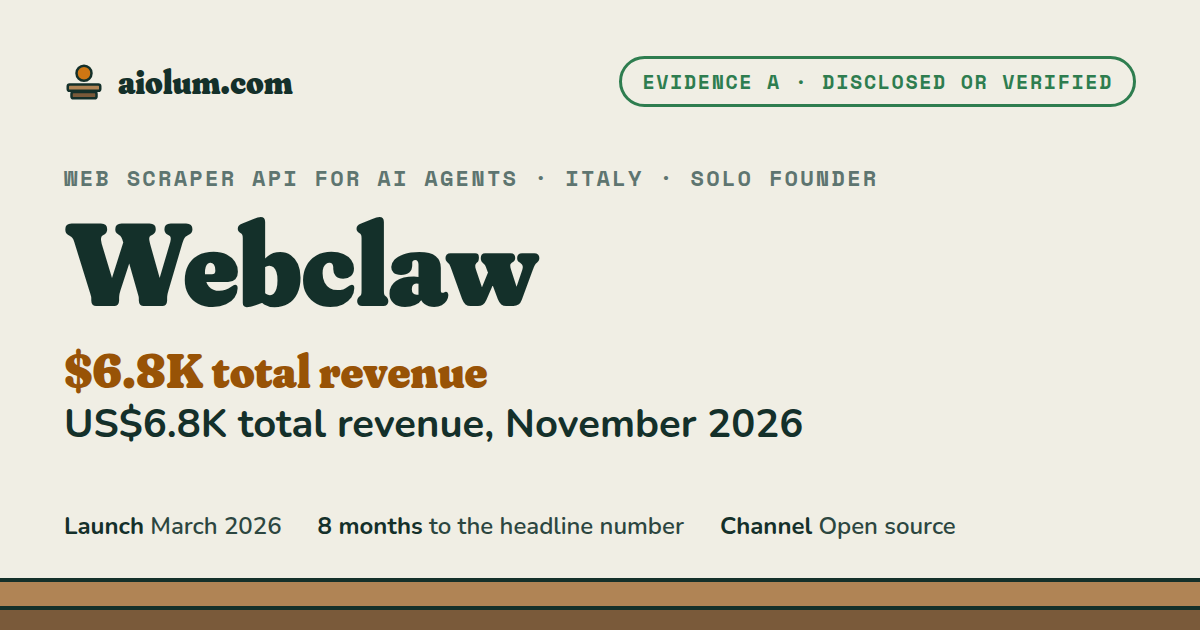
Webclaw (Web scraper API for AI agents, Italy): US$6.8K total revenue, November 2026. Evidence grade A: disclosed by a company or a filing, or verified by a payment processor. Team: 1 sole trader; no team page found. Launched March 2026; still running, revenue falling.Added
- Outcome
- US$6.8K total revenue, November 2026Revenue falling
- Evidence
- A disclosed by a company or a filing, or verified by a payment processor
- Launch
- March 2026
- Status
- Still running
- Team
- 1 sole trader; no team page found
- Outside funding
- None found
- Main channel
- Open source
Webclaw is a web scraper API for AI agents. It downloads a web page and returns its readable content as Markdown, plain text or structured JSON, a data format with named fields. A model reads that output instead of raw page code. Fewer tokens, the pieces of text that a model reads and bills for, are spent on menus and scripts. The core is written in Rust and licensed AGPL-3.0. It also ships as a command-line tool. A Model Context Protocol (MCP) server is a standard way for an AI assistant to call outside tools, and it ships too.
The terms say the service is provided by a sole trader based in Rome, Italy. The founder page, signed Massi (0xMassi), calls him "Founder & engineer, webclaw". The first release in the changelog is dated 24 March 2026. TrustMRR, a site that reads revenue from payment processors, lists 13 March 2026 as the founding date. Stripe records the first revenue in April 2026. All-time verified revenue is US$6,783, from 9 active subscriptions on 23 November 2026.
The headline figure comes from the Stripe connection that TrustMRR reads, so it is grade A. It is a small business. July 2026 brought 53.6% of all revenue, and the last 30 days brought US$392. The page also notes, in neutral words, that the product is marketed for handling protected pages. For eight weeks in 2026 it also had tools that collected public contact details of company founders.
Why did Webclaw work?
Four causes, in the order they mattered. Each one is a reusable lesson.
A free open-source core sits next to the paid hosted API
The Rust core is AGPL-3.0 and can be self-hosted, so a developer can try it without paying. The README says most sites extract locally with no API key, and that a key from the hosted service is for bot-protected and JavaScript-rendered pages. The sources do not say how many paid customers first used the free code.
Its routes copy another scraper API, which can reduce migration work
The home page says it offers compatible /v2/scrape, /v2/crawl and /v2/search routes that "can reduce migration work". The page also asks customers to check supported options before switching. The terms of the other company are not part of this page.
A long blog targets scraping searches
The blog index lists 92 posts, with titles such as a guide to URL extraction and a guide to scraping proxies. TrustMRR reads 72,775 Google Search impressions and 15,156 visitors for the last 30 days. The TrustMRR profile lists SEO, Blog, Reddit and X as marketing channels. That is profile text, entered by the founder.
Revenue came mostly from one month and then fell
July 2026 brought US$3,639 of the US$6,783 in total. August brought US$408, September US$906 and October US$362. No source explains the July figure, so the cause is not known.
How it was built
These details come from the company's own pages, its public code and its privacy policy. They are grade C unless a row says otherwise. [5, 6, 7, 2]
- The core is a Rust engine under AGPL-3.0. It ships as a command-line tool, a REST server and an MCP server with 14 local tools.
- The hosted API is at api.webclaw.io. The founder page lists software development kits for TypeScript, Python and Go.
- The API servers, the hosted MCP server and the database run at Hetzner in Nuremberg. Pages that need a browser are rendered on Google Cloud in Finland.
- Outgoing page requests go through a proxy network with German addresses. The website runs on Cloudflare and Vercel.
- Stripe takes the payments, and Resend sends account and billing email. When a customer uses language-model features, requests go to Anthropic, OpenAI or Google.
- Site analytics are DataFast and Ahrefs Web Analytics. The README names several proxy companies as sponsors or partners.
Tools named in the sources
Each one opens its page in the Tools tab, with every story that uses it.
Who tried this before Webclaw, and why did they fail?
Our database of failed startups has few failed web-extraction companies. These three records are the closest in kind: software that promised to do repetitive work for developers or hospital staff. The values are from that database and are not independently verified.
Olive AI
The promiseAn AI workforce of software bots that automate administrative work in hospitals.
Why it diedThe record says the cause was overpromising, underdelivering and unit economics that did not work, after selling a vision of autonomous AI.
Kite
The promiseAI code completion inside the developer's editor.
Why it diedThe record says Kite was too early to a market that later grew, and made mistakes in how it charged.
DataNitro
The promiseRun Python scripts inside Excel to automate data analysis.
Why it diedThe record says the product's core offering was limited by the architecture of Excel.
The failed startups come from our database of 1,749 dead startups, retold here in our own words. Its entries are AI-assisted summaries of public sources, so these cards carry no evidence grade.
What changed
The three predecessors sold automation as the whole product. Olive and Kite needed large budgets, and DataNitro depended on one host program. Webclaw sells one narrow job, turning a page into clean text, and its core code is free.
Two things differ. First, AI agents and MCP servers now create steady demand for readable page content, which the older products did not have. Second, one person with a free core and cloud hosting needs little capital. The record of July and the months after it shows that demand has so far paid for little.
Can one person copy Webclaw now?
Partly. The cost is low, but the revenue is not yet proven.
Building a narrow developer tool on a free open-source core costs one founder little, and the sources show that nine customers pay for it. The sources do not show that the model can reach a living wage. Revenue fell after July 2026.
Where it is still open: Other small jobs that agents need done on the web: page change alerts, PDF reading, and price tracking for public pages.
- 1Pick one narrow job for AI agents and publish the core as open source.
- 2Sell the hosted version as monthly credit plans, with a card required for the trial.
- 3Offer compatible routes so that users of a larger competitor can switch.
- 4Publish guides for the searches your buyers type, and read the search data.
How much revenue does Webclaw make?
Each row shows the evidence grade and the source numbers from the list at the end of this page. The grades are explained in How Aiolum verifies.
| Fact | Value | Grade | How we know | Sources |
|---|---|---|---|---|
| Revenue in total, to 23 November 2026 | US$6,783 | A | TrustMRR profile, revenue read from Stripe through an API key, last synced 23 November 2026. | [1] |
| Revenue in the last 30 days | US$392 | A | TrustMRR lists US$392 as both the last-30-days revenue and the current MRR (monthly recurring revenue). | [1] |
| Active subscriptions | 9 | A | TrustMRR, "Current active subscriptions: 9". | [1] |
| Revenue by month, 2026 | April US$49.50, May US$367, June US$709, July US$3,639, August US$408, September US$906, October US$362 | A | TrustMRR monthly timeline. November to the 23rd is US$343. | [1] |
| Share of all revenue that fell in July 2026 | 53.6% | calc | Calculated: US$3,639 divided by US$6,783. The sources do not say what caused July. | [1] |
| Run rate from the last 30 days | US$4,704 a year | calc | Calculated: US$392 times 12. It is lower than the July month alone. | [1] |
| Visitors and search impressions, last 30 days | 15,156 visitors and 72,775 search impressions | A | TrustMRR reads these through the DataFast and Google Search Console connections it marks as connected. | [1] |
| Founding date | 13 March 2026 | C | TrustMRR profile field "Founded date", entered on the profile, not read from a register. | [1] |
| First release in the changelog | version 0.1.1, 24 March 2026 | C | The changelog lists 65 releases up to 0.7.5 on 23 November 2026. No earlier entry is listed. | [9] |
| Cloud API on 3 April 2026 | waitlist; free plan 500 pages a month; Starter US$49 | C | Internet Archive copy of the home page: "Get notified when the webclaw API launches." | [10] |
| Team | 1 sole trader | C | Terms: "The webclaw service is provided by Valerio Massimiani, a sole trader based in Rome, Italy." No team page or employee count was found. | [4, 6] |
| Funding | none found | C | No downloaded source mentions outside funding. | [2, 6] |
| Public code | 2.4 thousand stars, 243 forks, 996 commits, AGPL-3.0 | B | GitHub repository page on 23 November 2026. The site header shows 2,443 stars. | [8, 2] |
| Blog | 92 posts | C | Blog index, page 1 of 11. | [11] |
| Servers | Hetzner in Nuremberg for the API, Google Cloud in Finland for rendering | C | Privacy policy, section 05 and section 09. | [5] |
| Earlier projects of the founder | Stik (notes app for macOS) and Akari (ticket broker community) | C | Both are listed as separate projects on the founder page. Akari is described as powering "200k+ tickets secured in 2024". No earlier name of Webclaw was found. | [6] |
| Time from first release to the headline date | 8 months | calc | Calculated: 24 March 2026 to 23 November 2026. | [9, 1] |
How to read this table. Grade A means the figure is read from the payment processor by TrustMRR. Grade B is visible in public code. Grade C is the company's own statement. A "calc" value was computed on this page from the rows above it.
| Plan | Per month, billed yearly (US$) | Per month, billed monthly (US$) | Limit |
|---|---|---|---|
| Starter | 19 | 5,000 credits a month, 60 requests a minute | |
| Growth | 49 | 25,000 credits a month, 120 requests a minute | |
| Pro | 99 | 100,000 credits a month, 200 requests a minute | |
| Scale | 399 | 500,000 credits a month, 500 requests a minute | |
| Dedicated | custom, book a call |
The page shows each plan as a price per month and says "2 months free" for yearly billing. It does not show the yearly amount in the downloaded text. The monthly column holds the displayed price. Credits are one per page for most calls. Credit packs start at US$20, and the open-source core is free to self-host.
When did Webclaw launch, and how did it grow?
From a first release in March 2026 to a paid hosted API with nine active subscriptions in eight months. Each entry carries its grade.
- 13 March 2026CTrustMRR lists this as the founding date of Webclaw. [1]
- 24 March 2026CFirst release in the changelog, version 0.1.1, of the open-source Rust extraction engine. [9]
- 3 April 2026CThe home page shows a free plan of 500 pages and paid plans with a waitlist button. A form asks visitors to be notified when the API launches. [10]
- April 2026AStripe records the first revenue, US$49.50. [1]
- July 2026AThe best month, US$3,639, which is 53.6% of all revenue so far. [1]
- 28 October 2026CThe terms of service take effect. They name the sole trader who provides the service. [4]
- 23 November 2026ARelease 0.7.5. All-time verified revenue is US$6,783 and the last 30 days are US$392, from 9 active subscriptions. [9, 1]
What could go wrong for Webclaw?
The risks are the mirror image of the causes above.
Marketing for protected pages
The product is marketed for pages that block automated requests, and the company says so in plain words. The home page says: “Handles protected pages. The API attempts protected-page handling and JavaScript rendering when needed.” A counter label on the home page reads “bot walls bypassed”. The README says the command-line flag “--solve gets past Cloudflare challenge pages”, and that it clicks the checkbox when the page asks for a click. The README adds that a Turnstile checkbox inside a rendered page, “as on a sign-up form, is clicked too, so that page actions can submit the form”. The founder page lists “getting through the defenses that block automated requests” as a skill. The pricing page of July 2026 charged “Protected site +9 credits”. The terms limit its use: users may not “Circumvent technical access controls, CAPTCHAs, or authentication mechanisms for unauthorized access”. They allow content from “publicly accessible web pages” and make the user responsible for the laws and the target site's terms. The home page also says “Upstream restrictions can still prevent extraction.” The README lists proxy companies as sponsors, with discount codes. No source here shows a dispute over any of this.
Logo wall is a list of target sites
The home page section “Your sources” shows names such as Nike, Airbnb, Etsy and Zillow in a moving list. They are public sites that a user can point the tool at. No source says that any of them is a customer, and no source says that any of them agreed.
Counters on the home page
The home page shows three counters labelled “pages extracted”, “bot walls bypassed” and “websites scraped”. The downloaded page holds only dashes for them, because a script fills them in. Their values could not be checked. The GitHub star counter on the page, 2,443, agrees with the 2.4 thousand stars on GitHub.
Small revenue, and it fell after July
Total verified revenue is US$6,783, and the last 30 days are US$392. July 2026 was the best month by far. A reader should not read the July figure as the usual monthly level.
The language model is one part of the product
The core extraction is Rust code, not a language model. The site lists model-based features, such as extraction by language model and research runs. It says requests go to Anthropic, OpenAI or Google when a user chooses them. The page calls the product AI-native because it is built for AI agents.
Start date and earlier names
The start date rests on the TrustMRR founding field, 13 March 2026, and the first changelog release, 24 March 2026. The earliest Internet Archive capture of webclaw.io is dated 18 March 2026 and is a redirect; the copy read here is from 3 April 2026. No earlier name or domain was found. The founder's other projects, Stik and Akari, are separate products.
The startup dataset page
The site offers a free dataset of 20,955 company websites with brand colours and published prices. It says: “No founder emails, no personal profiles.” The terms forbid extracting personal data for profiling or surveillance. No current product that sells contact data was found; the retired lead tools are described above.
Lead tools, July to September 2026
Release 0.6.15 of 18 July 2026 added `lead` and `lead_batch` MCP tools. The changelog says they turned “a company URL into an outreach-ready lead — founders and leadership with their LinkedIn and X, plus company summary, socials, tech stack, pricing, and public emails”. Release 0.6.23 of 11 September 2026 removed them: “Lead enrichment is retired.” The home page of 22 July 2026 listed them among the 14 MCP tools. The pricing page of the same day lists no separate charge for them, so the sources do not show whether they were billed. July 2026 was also the best revenue month; no source links the two.
Sources
The grade next to each source is the best grade that the source can support. "Read in full" means that the text of the page was downloaded and the numbers were checked in it.
- A TrustMRR profile: WebclawRead the markdown profile on 23 November 2026. Revenue, subscriptions and traffic come from connected providers. The description and the founding date are profile text.
- C webclaw.io home pageRead in full on 23 November 2026. Source for the product, the plans, the counters, the logo list and the protected-pages wording.
- C webclaw.io pricing pageRead in full on 23 November 2026. Source for the plans, credits, credit packs and rate limits.
- C webclaw.io Terms of Service, effective 28 October 2026Read in full. Source for the operator, the acceptable use and the prohibited conduct.
- C webclaw.io Privacy Policy, updated 9 November 2026Read in full. Source for the servers, the payment processor, the email service and the analytics tools.
- C webclaw.io founder page: Massi (0xMassi)Read in full. Source for the founder role, the earlier projects and the article list.
- C GitHub README of 0xMassi/webclawRead the README file in full. Source for the flag that solves challenge pages, the MCP server, the API key note and the sponsors.
- B GitHub repository page of 0xMassi/webclawRead the repository page on 23 November 2026. Source for stars, forks, commits and the licence.
- C webclaw.io changelogRead in full. Source for the first release date, the release count and the latest release.
- C Internet Archive copy of webclaw.io, 3 April 2026Read in full. Source for the waitlist wording, the free plan and the early price list.
- C webclaw.io blog indexRead page 1 of 11. Source for the number of posts and the post titles.
- C webclaw.io startup dataset pageRead the top of the page. Source for the dataset description and its statement about personal data.
- C Database of failed startups, local exportRecord pages read on the website on 23 November 2026. AI-written summaries, not independently verified. Source for the failed predecessors.
- C Internet Archive copy of webclaw.io, 22 July 2026Read in full. Source for the list of 14 MCP tools, including lead and lead_batch.
- C Internet Archive copy of the webclaw.io pricing page, 22 July 2026Read in full. Source for the credit costs of July 2026, including protected sites.
Run this company? Send corrections or a verified figure to aiolum@livyden.com