AI Dev: Revenue, team and how it was built
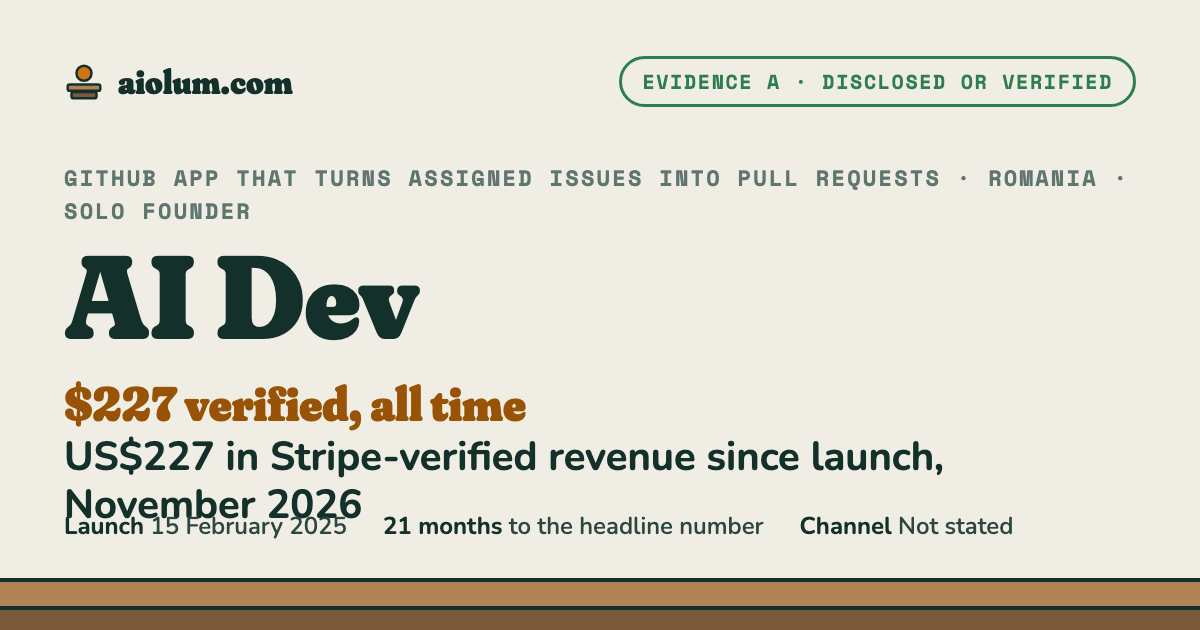
AI Dev (GitHub App that turns assigned issues into pull requests, Romania): US$227 in Stripe-verified revenue since launch, November 2026. Evidence grade A: disclosed by a company or a filing, or verified by a payment processor. Team: 1 founder listed on TrustMRR; headcount not published. Launched 15 February 2025; still running, revenue falling.Added 3 November 2026
- Outcome
- US$227 in Stripe-verified revenue since launch, November 2026Revenue falling
- Evidence
- A disclosed by a company or a filing, or verified by a payment processor
- Launch
- 15 February 2025
- Status
- Still running
- Team
- 1 founder listed on TrustMRR; headcount not published
- Outside funding
- None stated
- Main channel
- Not stated
AI Dev is a GitHub App, a program that a GitHub organization installs and that then acts on its repositories through a bot account with the permissions the organization grants. When a team member assigns a GitHub issue (a written task or bug report) to the bot, AI Dev runs a coding agent, a language model that reads files, plans changes, edits code and runs steps in a loop without a person typing each instruction. The result is a pull request, a proposed set of code changes that a person reviews before it is merged into the main branch.
TrustMRR lists Cristian Bote, a JavaScript engineer in Cluj-Napoca, Romania, known for the open-source library goober and for work in the Preact core team, as the founder, with a founding date of 15 February 2025. The first archived copy of the site, from 21 March 2025, already described the issue-to-pull-request flow and offered a 25% discount code for a game jam. TrustMRR, which reads the company's Stripe account through an API key, showed US$227 in revenue for all time on 3 November 2026, US$11 in the last twelve months, and US$0 in the last 30 days.
The headline figure is small but grade A, because it comes from the payment processor and not from the founder. About US$216 of it was earned before November 2025; since then Stripe shows about US$1 a month. The site publishes no prices and no customer names. This page is on the site as an example of a well-built product in a crowded category that did not find many paying users.
How much revenue does AI Dev make?
Each row shows the evidence grade and the source numbers from the list at the end of this page. The grades are explained in How Aiolum verifies.
| Fact | Value | Grade | How we know | Sources |
|---|---|---|---|---|
| Revenue, all time, to 3 November 2026 | US$227 | A | TrustMRR profile, Verification Sources: Stripe (API key), revenue last synced 3 November 2026. The same figure appeared on 27 October 2026. | [1] |
| Revenue, last 12 months | US$11 | A | TrustMRR profile. The monthly timeline shows US$2 in November 2025 and US$1 in each month from December 2025 to August 2026. | [1] |
| Revenue, last 30 days and last 3 months | US$0 and US$1 | A | TrustMRR profile, synced 3 November 2026. | [1] |
| Revenue before November 2025 | about US$216 | calc | Calculated: US$227 all time minus US$11 in the last 12 months. The profile rounds to whole dollars, so this is approximate. | [1] |
| Current MRR and active subscriptions | US$0 and 0 | A | TrustMRR metric snapshot. MRR (monthly recurring revenue) is the monthly value of active subscriptions. | [1] |
| Estimated user count | 0 | C | Founder-entered field in the TrustMRR startup insights. The site states no user or customer count. | [1] |
| Founder | Cristian Bote | C | TrustMRR lists him as founder with the X handle cristianbote_, the same handle that his GitHub profile and personal site link to. | [1, 6, 7] |
| Country and founding date | Romania, 15 February 2025 | C | TrustMRR profile fields. The terms say they are governed by the laws of Romania; the site footer reads AI Dev, Inc. | [1, 4] |
| AI models named | GPT-5-Codex, Claude Sonnet 4.5 or Haiku 4.5, Gemini 3 Pro | C | Home page and FAQ. The chat section of the same home page still names GPT-4 and Claude 3.5. | [2, 3] |
| Platforms supported | GitHub only | C | Home page: Currently only Github is supported. The March 2025 page also named JIRA and Trello as task sources. | [2, 5] |
| Tech stack | Next.js, Tailwind CSS, Node.js, Stripe | C | Founder-entered on TrustMRR. The site's script bundle also loads Supabase for login. | [1, 2] |
| Outside funding | none stated | C | No source mentions a funding round. The company's GitHub organization has no public repositories and no public members. | [1, 8] |
| Time from founding to the November 2026 figure | 21 months | calc | Calculated: February 2025 to November 2026. | [1] |
How to read this table: grade A values come from the Verification Sources section of the TrustMRR profile, which reads Stripe through an API key. Grade C values come from the company's own pages or from founder-written profile text. A "calc" value was computed on this page.
| Plan | Per month, billed yearly (US$) | Per month, billed monthly (US$) | Limit |
|---|---|---|---|
| Subscription | not published | not published | credits per account; 25% discount code offered in March 2025 |
The terms say that some features may require a subscription or a one-time payment. A 2025 game jam post offered 25% off a subscription with a discount code. The dashboard code on the site shows a credit counter (used credits out of total credits), so usage seems to be metered in credits, but no source gives the price of a credit or a plan.
When did AI Dev launch, and how did it grow?
From a founding date in February 2025 to a live product with almost no recent revenue, in 21 months. Each entry carries its grade.
- 15 February 2025CFounding date given on TrustMRR. [1]
- 21 March 2025CFirst archived home page: 'What if you could hire an AI developer to join your team today?' Install the GitHub app, assign tasks, get a pull request. A Pricing heading has no prices. [5]
- March 2025CA post on the site explains how to use AI Dev in the Game Jam Vibe Coding 2025 and offers 25% off a subscription with the code GAMEJAM25. [9]
- February to October 2025calcAbout US$216 of the all-time US$227 in Stripe revenue is earned in this period. [1]
- November 2025 to August 2026AStripe shows US$2 in November 2025, then US$1 a month. [1]
- 15 May 2026CAn archived copy of the home page, reached from a TrustMRR link, shows the multi-model version with chat and Slack. [10]
- 3 November 2026ATrustMRR: US$227 all time, US$0 in the last 30 days, MRR US$0, no active subscriptions. The site is live and names GPT-5-Codex, Claude Sonnet 4.5 and Gemini 3 Pro. [1, 2]
Why did AI Dev work?
Four causes, in the order they mattered. Each one is a reusable lesson.
Work starts from an issue
The trigger is the action a team already takes: assigning an issue. The agent then analyzes, plans, implements and commits, and its output is a pull request in the team's normal review flow. Nothing new has to be learned by the reviewers.
One install per organization
The GitHub App is installed once for an organization, with access to chosen repositories or all of them, so any member can assign work to the bot without a personal setup. The bot is a separate GitHub user that holds the access.
Several model providers
The site says each task is routed to the model it fits best: GPT-5-Codex, Claude Sonnet or Haiku 4.5, or Gemini 3 Pro. This protects the product from depending on one provider, but every provider also sells its own coding agent.
What did not work
The revenue record shows the limit. Stripe shows about US$216 in 2025 and about US$1 a month after that, with no active subscription in November 2026. No price page, no customer names and no public launch posts appear in the sources, so the product had little to bring buyers to it in a category where GitHub, OpenAI, Anthropic and Google sell their own agents.
How it was built
These details come from the founder-entered TrustMRR fields and from the company's own pages and scripts. They are grade C. [1, 2, 3]
- Next.js and Tailwind CSS on the front end, Node.js on the back end, as entered on TrustMRR.
- Login through Supabase, visible in the site's script bundle, which also shows a credits counter for each account.
- A GitHub App with its own bot user; work branches start from the repository's default branch.
- Model routing between GPT-5-Codex, Claude Sonnet or Haiku 4.5 and Gemini 3 Pro, by the complexity and context of each issue.
- A Slack integration and a web chat that can answer questions about several repositories at once without a monorepo.
- Stripe for payments, connected to TrustMRR through an API key.
Tools named in the sources
Each one opens its page in the Tools tab, with every story that uses it.
Who tried this before AI Dev, and why did they fail?
Three companies in our database of failed startups sold tools that worked inside developers' code and review flow, and lost to platforms that bundled the same feature. The values below are from that database and are not independently verified.
Kite DevTool
The promiseAI code completion inside the developer's editor, years before GitHub Copilot.
Why it diedCould not make its free product pay, and GitHub Copilot arrived with OpenAI's models and GitHub's distribution.
Sider
The promiseAutomated code review and static analysis for development teams, inside their pull requests.
Why it diedCaught between free open-source tools and large platforms that bundled code analysis into their suites.
CodeSee
The promiseMaps of a codebase so that developers understand it faster.
Why it diedDevelopers liked it, but engineering leaders could not see a return that justified a budget, and GitHub added similar features.
The failed startups come from our database of 1,749 dead startups, retold here in our own words. Its entries are AI-assisted summaries of public sources, so these cards carry no evidence grade.
What changed
The three predecessors sold a better developer experience on top of code hosted elsewhere, and lost when the platform owners, mainly GitHub, bundled a similar feature or when buyers could not see a return. AI Dev is in the same position, more sharply: GitHub's own Copilot coding agent, OpenAI's Codex, Anthropic's Claude Code and Google's agents all take an issue and open a pull request.
What changed is the cost of building such a product. One experienced JavaScript engineer could build a multi-model coding agent with org-wide install, chat and Slack, because the hard part, the models, is rented by the call. What did not change is the need for a reason to choose a small vendor. The Stripe record, about US$216 in 2025 and about US$1 a month after, shows that building it was not enough.
Can one person copy AI Dev now?
The build, yes. The market, no.
A solo engineer can now build a coding agent that works from GitHub issues. Selling a general one against the model providers and GitHub is the hard part, and this page shows how little a general version earned. A narrower agent for one stack, one kind of task or one regulated industry has a better chance.
Where it is still open: Narrow coding agents: migrations between framework versions, test coverage for legacy code, agents for one language or one compliance rule.
- 1Start the agent from an action the team already takes, such as assigning an issue, and deliver a normal pull request.
- 2Publish prices and a free trial, so a team can test it without a call.
- 3Pick one narrow task (dependency upgrades, test writing, one framework) where you can show results that general agents do not match.
- 4Connect the payment account to a public verifier from the start, so the numbers can be checked.
What could go wrong for AI Dev?
The risks are the mirror image of the causes above.
Very little revenue, and almost none recently
The figure is verified, but it is US$227 in about 21 months, and US$0 in the 30 days to 3 November 2026, with no active subscription. Since November 2025 Stripe shows about US$1 a month.
Competing with the model makers
GitHub, OpenAI, Anthropic and Google all sell agents that turn issues into pull requests, often included in plans that teams already pay for. A small vendor must offer something they do not.
Inconsistent pages
The home page names GPT-5-Codex, Claude Sonnet 4.5 and Gemini 3 Pro at the top, but its chat section still names GPT-4 and Claude 3.5. The footer says AI Dev, Inc., while the terms are governed by Romanian law; no source says where the company is registered.
Code access
The bot user needs access to the organization's repositories. The FAQ says the code is read when an issue is assigned and again when feedback requires it; the terms say the user is responsible for reviewing all generated code and that the company is not liable for it.
Sources
The grade next to each source is the best grade that the source can support. "Read in full" means that the text of the page was downloaded and the numbers were checked in it.
- A TrustMRR: AI Dev, markdown profile (data synced 3 November 2026)Read the markdown profile, live on 3 November 2026, and compared it with a copy downloaded on 27 October 2026. The Verification Sources section (Stripe, API key) is grade A; the founder, country, founding date, tech stack and user count are founder-entered, grade C.
- C AI Dev home page: A new kind of software developerRead in full on 3 November 2026, and searched the site's script bundle for prices, testimonials and services used. No testimonials, counters or prices were found.
- C AI Dev: Frequently Asked QuestionsRead in full. Source for the model list, the organization install, the bot user and when code is read.
- C AI Dev: Terms and ConditionsRead in full. Source for the 18+ eligibility, the fees clause, the liability clause and Romanian governing law.
- C AI Dev home page, Internet Archive copy of 21 March 2025Read in full. The first archived version: GitHub app, JIRA and Trello named as task sources, a Pricing heading with no prices.
- C Cristian Bote (cristianbote) on GitHubRead the profile. Source for his location in Cluj-Napoca, Romania, the goober library and the link to the X handle cristianbote_.
- C Cristian Bote, personal siteRead in full. Source for his 10+ years as a JavaScript developer and his work in the Preact core team. The site does not mention AI Dev.
- C Get AI Dev (getaidev) on GitHubRead the organization page: links to getaidev.com, no public repositories, no public members.
- C AI Dev: How to Join the Game Jam by using AI Dev, Internet Archive copy of 20 March 2025Read in full. Source for the game jam guide and the 25% subscription discount code.
- C AI Dev home page, Internet Archive copy of 15 May 2026Read in full and compared with the live page: the same multi-model version with a Pricing heading and no prices.
- C Database of failed startups, local exportLocal export. AI-written summaries, not independently verified. Source for the failed predecessors.