Teacher Time Machine: Revenue, team and how it was built
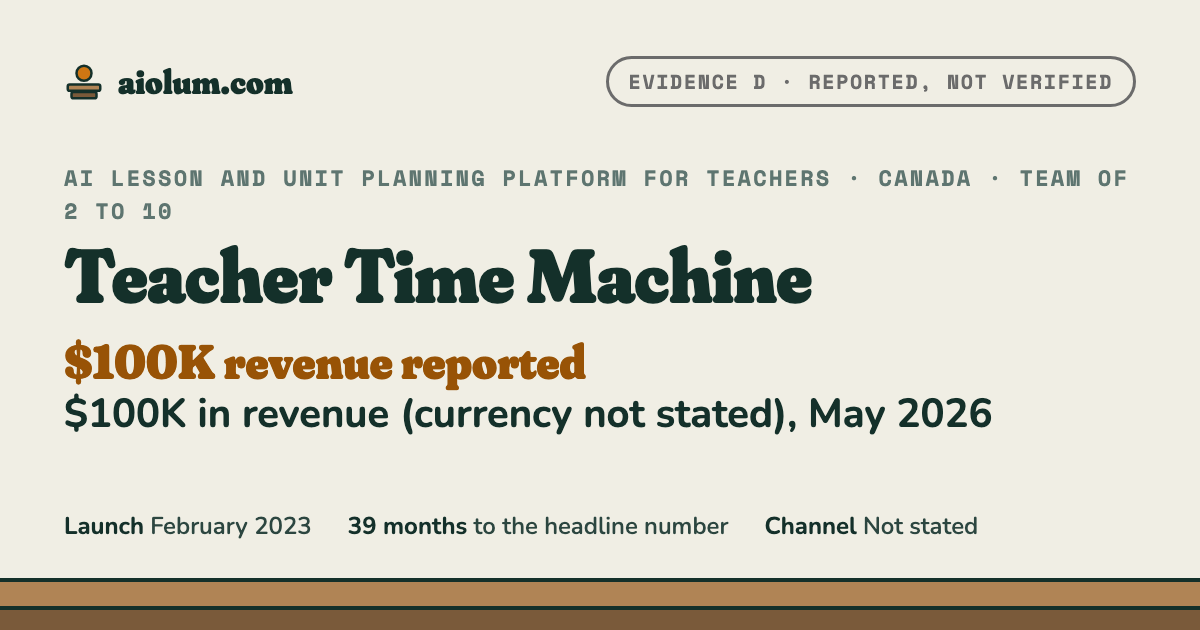
Teacher Time Machine (AI lesson and unit planning platform for teachers, Canada): $100K in revenue (currency not stated), May 2026. Evidence grade D: reported, not verified. Team: 3 co-founders, all career educators in Alberta; headcount not published. Launched February 2023; still running.Added 5 November 2026
- Outcome
- $100K in revenue (currency not stated), May 2026
- Evidence
- D reported, not verified
- Launch
- February 2023
- Status
- Still running
- Team
- 3 co-founders, all career educators in Alberta; headcount not published
- Outside funding
- None found
- Group
- Learning and study
- Main channel
- Not stated
What is not verified
The $100K revenue, the 6,800 users and the eight districts appear only in UpNext's recap of the Web Summit Vancouver pitch, published 15 May 2026, which does not say who supplied them, whether the revenue is total or yearly, or its currency. No payment-processor profile, filing or second interview was found. A reader could look for an award or grant filing in Alberta, a district contract notice, or a later founder interview with a dated figure. The headline number is grade D: one claim or one estimate, with no second source. Aiolum shows it because the story is useful, and marks it so that it is not mistaken for a verified figure.
Teacher Time Machine is a curriculum-aligned planning tool for teachers. Curriculum-aligned means that each lesson or test is built against the official learning outcomes that a province or state publishes, so a teacher can show which outcome each activity covers. The tool also uses backward design, a planning method in which the teacher first fixes the outcome and the assessment, and only then plans the lessons that lead to them. Its AI assistant, Eddie, writes lesson plans, rubrics, tests and leveled reading passages, and exports them as Word or PDF files.
It was founded by Sharon Skretting, a former teacher, coach and principal with 32 years in education, with Richelle Marynowski, a professor of education at the University of Lethbridge, and Dan Vanden Dungen, a principal. The site was online by February 2023, and in July 2023 it called itself "The AI tool that gives teachers TIME". UpNext, a startup newsletter, reported from Web Summit Vancouver in May 2026 that the company relaunched its platform in 2025, works with eight Alberta school districts, has 6,800 users and "reached $100K in revenue".
The revenue figure is a single statement in one recap of the founder's pitch, so it is grade D. The recap does not say whether it is total or yearly revenue, or in which currency. This page treats it as Canadian dollars for the US-dollar total, the lower of the two readings.
How much revenue does Teacher Time Machine make?
Each row shows the evidence grade and the source numbers from the list at the end of this page. The grades are explained in How Aiolum verifies.
| Fact | Value | Grade | How we know | Sources |
|---|---|---|---|---|
| Revenue, May 2026 | $100K, currency and period not stated | D | UpNext's recap of Web Summit Vancouver 2026, published 15 May 2026, in the traction lines for the founder's pitch: "reached $100K in revenue". One source only. | [1] |
| Headline in US dollars | about US$72,727 | calc | Calculated: 100,000 divided by 1.3750 Canadian dollars per US dollar, the Federal Reserve H.10 noon rate for 15 May 2026, on the assumption that the figure is in Canadian dollars. If it is in US dollars, the figure is US$100,000. | [1, 9] |
| Users, May 2026 | 6,800 | D | Same UpNext recap. No second source. | [1] |
| School districts, May 2026 | 8 in Alberta | D | Same UpNext recap. The home page shows five Alberta school divisions under "Trusted in classrooms across North America", among them Grande Prairie Catholic School Division and Horizon School Division. | [1, 3] |
| Platform relaunch | 2025 | D | UpNext: "The company relaunched its platform in 2025". The 2023 site ran on the Bubble no-code builder; the 2026 site is a different build (its robots.txt mentions a Vite build). | [1, 6, 3] |
| First online | February 2023 | C | The Internet Archive's first copies of teachertimemachine.com are dated 23 February 2023. The copy of 17 July 2023 has the description "The AI tool that gives teacher TIME to care, connect, teach, learn." | [6] |
| Founders | Sharon Skretting, Richelle Marynowski, Dan Vanden Dungen | C | About page: each is listed as "Founder". Skretting is also CEO and has 32 years in education; Marynowski has 30 years and is a professor at the University of Lethbridge; Vanden Dungen has more than 30 years as a principal and teacher. | [4] |
| Team size | not published | C | The security page mentions "senior engineering leadership" and "team members and contractors", without numbers. | [8] |
| Award | ASTech Awards 2025, Regional Innovation Champions | C | About page: "36th Annual ASTech Awards Winner, 2025 Regional Innovation Champions". UpNext calls it the Alberta AsTech Award for Regional Software Innovation. The award organizer's page was not read. | [4, 1] |
| Curricula covered | every Canadian province and territory, plus US Common Core | C | Home page. Teachers can also write their own curriculum and "worldviews" and build against them. | [3] |
| Pro price | $99.99 a year | C | Pricing page, 2,400 Time Tokens a year. Currency not shown. | [5] |
| Users allowed | adults only | C | Privacy policy: anyone under 18 is "prohibited from accessing the platform"; a student may view it only through an adult's account and under adult supervision. | [7] |
| Payments | Stripe | C | Privacy policy: the third-party payment software "is currently Stripe". | [7] |
| Outside funding | none found | C | No downloaded source mentions a funding round or investor. | [1, 4] |
| Time from first online copy to the revenue figure | 39 months | calc | Calculated: February 2023 to May 2026. | [6, 1] |
How to read this table: a grade D value appears in one source only and nobody outside checked it. A grade C value is a statement on the company's own pages. A grade X value was computed on this page. No value is grade A or B.
| Plan | Per month, billed yearly (US$) | Per month, billed monthly (US$) | Limit |
|---|---|---|---|
| Free | 0 | 0 | 10 Time Tokens a month; templates, saving and downloads |
| Pro Annual | 8.33 | 2,400 Time Tokens a year; Eddie, unit and course planning, custom curriculum, class profiles, custom assessments; billed as 99.99 a year | |
| Schools & Districts | custom | custom | everything in Pro, a customized plan and embedded professional development |
Plans are counted in Time Tokens, the platform's unit of AI use. The page has a monthly and yearly switch and says "Get 2 months off on yearly", but its text shows only the yearly Pro price of $99.99; the per-month value in the first column is that price divided by 12, computed on this page. Schools and districts get a custom plan through a demo.
When did Teacher Time Machine launch, and how did it grow?
From an AI planning tool on a no-code builder in 2023 to a relaunched platform used in eight Alberta school districts in 2026. Each entry carries its grade.
- 23 February 2023CFirst copies of teachertimemachine.com in the Internet Archive. [6]
- 17 July 2023CThe site, built on Bubble, describes itself as "The AI tool that gives teachers TIME". [6]
- 2025DThe company relaunches its platform. [1]
- 2025CIt wins the 36th ASTech Awards in the Regional Innovation Champions category. [4]
- May 2026DSharon Skretting pitches at Web Summit Vancouver. UpNext reports eight Alberta school districts, 6,800 users and $100K in revenue. [1, 2]
- November 2026CThe site sells a free plan, a Pro plan at $99.99 a year with the Eddie assistant, and custom district plans. [3, 5]
Why did Teacher Time Machine work?
Four causes, in the order they mattered. Each one is a reusable lesson.
Built against the official outcomes
Generic AI lesson plans do not show which curriculum outcome they cover, and the home page names this as a teacher complaint. Teacher Time Machine stores the outcomes of every Canadian province and territory and the US Common Core, so each lesson, test and rubric is tied to them.
Founders who were the customers
The three founders have about 30 years each as teachers, principals, coaches and a teacher-education professor. The UpNext recap says the product keeps teacher judgment at the centre rather than replacing it with automation.
Districts as well as single teachers
Besides a yearly plan for one teacher, the company sells a custom plan to schools and districts with embedded professional development. UpNext reports eight Alberta districts as customers; the home page shows five Alberta school divisions by name.
How it was built
Few build details are public. These come from the company's own pages and the page source of its 2023 site. [6, 1, 3, 5, 7, 8]
- The 2023 site ran on Bubble, a no-code web app builder: its page source loads files from cdn.bubble.io.
- The platform was relaunched in 2025 (UpNext); the current site's robots.txt refers to a Vite build.
- Usage is metered in Time Tokens: 10 a month on the free plan, 2,400 a year on Pro.
- Stripe takes the payments, according to the privacy policy.
- The privacy policy places the company under Alberta's PIPA and Canada's PIPEDA privacy laws, and the security page says the company is working toward a SOC 2 audit.
Tools named in the sources
Each one opens its page in the Tools tab, with every story that uses it.
Who tried this before Teacher Time Machine, and why did they fail?
Four companies in our database of failed startups sold planning, grading or tracking tools to K-12 teachers and failed. The values below are from that database and are not independently verified.
Blendspace
The promiseDigital lesson plans that teachers assemble from content on the web.
Why it diedGoogle Classroom and Microsoft Teams made a separate lesson tool hard to sell, and its freemium plan brought few payments.
Edusight
The promiseA platform for K-12 teachers to track student performance and manage classroom assessments.
Why it diedSlow district procurement and better-funded rivals.
ClassroomIQ
The promiseDigital grading of paper exams and assignments.
Why it diedSchools were slow to change how they graded, and competitors took the market.
BrightLoop
The promiseReal-time tracking and sharing of student progress for teachers.
Why it diedSchools had little money for software, sales cycles were long, and free tools from Google arrived first.
The failed startups come from our database of 1,749 dead startups, retold here in our own words. Its entries are AI-assisted summaries of public sources, so these cards carry no evidence grade.
What changed
The four predecessors sold to schools between 2010 and 2013 and died of the same causes: teachers would not pay much, districts bought slowly, and free tools from Google and Microsoft took the space. Teacher Time Machine faces the same district sales cycle and the same free alternatives.
Two things differ. A large language model now writes the first draft of a lesson, rubric or reading passage, which the earlier tools could only organize, so the time saved is easier to show. And the product is tied to one province's official outcomes first, where its founders already worked, which is how UpNext's recap explains eight Alberta district customers.
Can one person copy Teacher Time Machine now?
Possible for a former teacher, but slow.
The software part is small: curriculum outcomes in a database and AI drafts built against them. The hard part is trust and sales: district contracts take time, and this team had about 90 years of combined school experience in one province.
Where it is still open: Curricula outside Canada and the US Common Core, vocational and adult-education programs, and subjects with their own national standards.
- 1Load the official outcomes of one state or province, and tie every generated item to them.
- 2Sell a cheap yearly plan to single teachers and a custom plan with training to districts.
- 3Meter AI use with tokens so heavy users pay more and the model cost stays covered.
- 4Bar student accounts and say so in the privacy policy, as districts will ask.
What could go wrong for Teacher Time Machine?
The risks are the mirror image of the causes above.
What is not verified
The $100K revenue, the 6,800 users and the eight districts appear only in UpNext's recap of the Web Summit Vancouver pitch, published 15 May 2026, which does not say who supplied them, whether the revenue is total or yearly, or its currency. No payment-processor profile, filing or second interview was found. A reader could look for an award or grant filing in Alberta, a district contract notice, or a later founder interview with a dated figure.
Competition
AI lesson-planning tools for teachers are common: on this site, EasyClass AI reports US$1.9K of verified revenue in 30 days in October 2026, and Tabitha.ai sold for US$4.25K in July 2023. Teacher Time Machine's difference is the tie to provincial outcomes and district contracts.
Dependence on model providers
The site, privacy policy and security page do not name the AI model provider behind Eddie. The privacy policy says personal information may be processed outside Canada by third-party service providers. A price or terms change by the provider would affect the cost of each Time Token.
Relaunched product
UpNext says the platform was relaunched in 2025, and the 2023 site ran on a different builder. The figures date from after the relaunch; this page has no figures for the 2023 to 2024 version.
Sources
The grade next to each source is the best grade that the source can support. "Read in full" means that the text of the page was downloaded and the numbers were checked in it.
- D UpNext, 15 May 2026: Web Summit Vancouver 2026: Enterprise AI Deployment RecapRead in full. The Teacher Time Machine section gives the pitch, the traction (relaunch, districts, revenue, users) and the award.
- C UpNext, 14 May 2026: What's UpNext: Signals from the Global Startup CircuitRead in full. Lists Sharon Skretting and Teacher Time Machine among startups seen at Web Summit Vancouver 2026, tagged AI.
- C Teacher Time Machine home page, read 5 November 2026Read in full, with robots.txt. Source for Eddie, the curricula, the school divisions shown and the export formats.
- C Teacher Time Machine About page, read 5 November 2026Read in full. Source for the three founders and the ASTech award.
- C Teacher Time Machine pricing page, read 5 November 2026Read in full. Source for the plans and Time Tokens.
- C Internet Archive copy of teachertimemachine.com, 17 July 2023, and the archive's capture listRead the page head and source; the page body loads by script. The capture list gives the first copies on 23 February 2023.
- C Teacher Time Machine privacy policy, read 5 November 2026Read the sections on age restrictions, international processing and payments.
- C Teacher Time Machine security page, read 5 November 2026Read in full.
- A Federal Reserve H.10, historical rates for the Canadian dollar, release of 2 November 2026Read the rate for 15 May 2026: 1.3750 Canadian dollars per US dollar.
- C Database of failed startups, local exportLocal export. AI-written summaries, not independently verified. Source for the failed predecessors.
Run this company? Send corrections or a verified figure to aiolum@livyden.com