UX Pilot: Revenue, team and how it was built
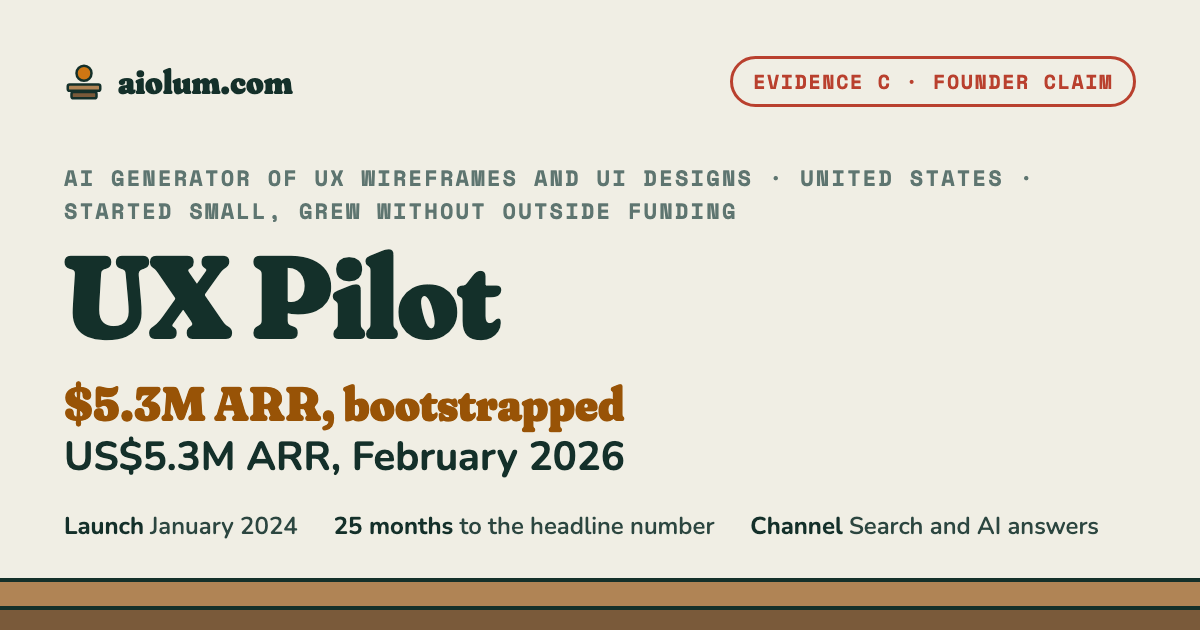
UX Pilot (AI generator of UX wireframes and UI designs, United States): US$5.3M ARR, February 2026. Evidence grade C: the founder's own figures, not verified by anyone else. Team: Started by founder Adam Fard as a side project inside his UX agency, with contractors and later a co-founder as CTO; 1 or 2 hires at a time from about US$30,000 a month; 15 employees on Latka in October 2025; 30 full-time people in February 2026 (founder). Launched January 2024; still running, revenue growing.Added 5 November 2026
- Outcome
- US$5.3M ARR, February 2026Revenue growing
- Evidence
- C the founder's own figures, not verified by anyone else
- Launch
- January 2024
- Status
- Still running
- Team
- Started by founder Adam Fard as a side project inside his UX agency, with contractors and later a co-founder as CTO; 1 or 2 hires at a time from about US$30,000 a month; 15 employees on Latka in October 2025; 30 full-time people in February 2026 (founder)
- Outside funding
- None; paid for with the founder's agency income (founder, February 2026)
- Main channel
- Search and AI answers
UX Pilot is an AI design generator: software that draws the screens of an app or website from a written description. Its output starts as wireframes, simple grey layouts that show where buttons, text and images go, and continues to high-fidelity screens, which look like the finished product. A team can load its own design system, the shared set of components and styles of a product, from Figma, and export the result to Figma or to code.
Adam Fard ran a UX design agency, Adam Fard UX Studio, when ChatGPT appeared. He first built a Figma plugin that guided users through UX workshops with AI. During a user interview someone asked whether it could turn ideas into wireframes, and that question became the product, launched at the beginning of 2024 after months of work on fine-tuning (further training a language model on one kind of task) with contractors. On The SaaS Podcast, published on 5 February 2026, the founder said that UX Pilot had US$5.3 million in ARR (annual recurring revenue: the yearly value of current subscriptions), about 15,000 paying subscribers and 30 full-time people, with no outside funding.
The founder said in the same interview that the company had been at US$3 million ARR about five months earlier, and Latka lists US$3 million of annual revenue for October 2025 from a company submission. Both figures come from the company, so this page grades them C. The team was small at the start and is no longer small: this is a business that one founder started and that grew to 30 people on its own revenue.
How much revenue does UX Pilot make?
Each row shows the evidence grade and the source numbers from the list at the end of this page. The grades are explained in How Aiolum verifies.
| Fact | Value | Grade | How we know | Sources |
|---|---|---|---|---|
| Annual recurring revenue, February 2026 | US$5.3 million | C | The founder on The SaaS Podcast, episode page published 5 February 2026: "right now we are at 5.3 million ARR, bootstrapped, 30 people full time". | [1] |
| Revenue per month at that run rate | about US$441,667 | calc | Calculated: US$5.3 million divided by 12. | [1] |
| Annual recurring revenue about five months earlier | US$3 million | C | The host asked whether the company was at US$3 million ARR the year before, and the founder agreed; the episode says it grew from US$3 million to US$5.3 million in about five months (the transcript also says four months). | [1] |
| Annual revenue on Latka, October 2025 | US$3 million | C | Latka marks the source as "Company Submission". It agrees with the founder's earlier figure. | [2] |
| Growth from the October 2025 figure | about 1.77 times | calc | Calculated: US$5.3 million divided by US$3 million. | [1, 2] |
| Paying subscribers, February 2026 | about 15,000 | C | Founder, same interview. | [1] |
| Average revenue per paying subscriber | about US$29 a month | calc | Calculated: US$5.3 million divided by 15,000 subscribers, divided by 12. Close to the Pro price billed monthly. | [1] |
| First milestone | US$10,000 MRR | C | The episode page says UX Pilot reached US$10,000 in monthly recurring revenue within six or seven months of the user question that started the product. No calendar date is given. | [1] |
| Launch | beginning of 2024; company founded 2023 | C | Founder: "Officially, yes [2023], but then the product was launched beginning of 2024." This page uses January 2024. The company's own summary says founded 2023; Latka says 2022. | [1, 3, 2] |
| Founding team | the founder, inside his agency | C | The episode says Adam started working on the wireframe problem himself, talked to AI researchers and hired contractors. The first idea came from internal brainstorming with his agency team. The company's About page lists a co-founder who is CTO. The agency's own size is not published on its pages. | [1, 4, 6] |
| Team, October 2025 and February 2026 | 15 employees, then 30 full-time people | C | Latka for October 2025; the founder in February 2026. At about US$30,000 a month he hired one or two people at a time and said later he should have hired five at once. | [2, 1] |
| Outside funding | none | C | Founder: bootstrapped, with agency income paying for the early development. | [1] |
| Largest source of customers | search (SEO), then LinkedIn posts and a newsletter | C | Founder: "back then SEO was actually a big chunk". The newsletter, built from product sign-ups, has 600,000 subscribers. | [1] |
| AI model | Glide, described as UX Pilot's own design model | C | Company summary on its pages. The base model under Glide is not named in any source read. The company publishes its own benchmark against Claude Opus 4.8, Gemini 3.5 Flash and GPT-5.5. | [3, 5] |
| Headquarters and security | New York; SOC 2 Type 1 | C | Company summary; Latka gives a New York address. | [5, 2] |
| Time from launch to the February 2026 figure | 25 months | calc | Calculated: January 2024 to February 2026. | [1] |
How to read this table: a grade C value is a statement by the founder or the company, or a directory record submitted by the company. A grade X value was computed on this page. No value is grade A or B.
| Plan | Per month, billed yearly (US$) | Per month, billed monthly (US$) | Limit |
|---|---|---|---|
| Free | 0 | 0 | 80 credits a day, no credit card |
| Pro | 19 | 29 | export to Figma and code, website cloner |
| Teams | 31 per user | 39 per user | shared credit pool, seats and roles |
| Enterprise | on request | on request | custom contract |
The pricing page builds its plan cards by script; these figures come from the company's text on the same page, read on 5 November 2026. Plans are paid in credits, which each generation uses up. The website cloner and export to Figma and code are on the paid plans.
When did UX Pilot launch, and how did it grow?
From an agency's internal AI experiments in 2023 to US$5.3 million ARR in about two years. Each entry carries its grade.
- 2023CAdam Fard runs a UX agency. With his team he tries ways to use language models in the agency's own work and ships a Figma plugin that guides users through UX frameworks with AI. He promotes it on his LinkedIn profile and the agency newsletter. [1]
- 2023CA user in an interview asks whether ideas on the canvas could become wireframes. He tests products that claim to do this and finds they swap templates. He works on it himself for four or five months, with AI researchers and contractors. [1]
- Beginning of 2024CUX Pilot launches as a product, with export to Figma. [1]
- 2024CUS$10,000 MRR within six or seven months of the first user question. At about US$30,000 a month he starts hiring, one or two people at a time. [1]
- October 2025CLatka lists US$3 million of annual revenue and 15 employees, from a company submission. [2]
- 5 February 2026COn The SaaS Podcast the founder gives US$5.3 million ARR, 15,000 paying subscribers and 30 full-time people, without outside funding. [1]
- November 2026CVersion 2.0 runs on the company's Glide model; plans from free to Enterprise, a website cloner, Figma and code export. [3, 5]
Why did UX Pilot work?
Four causes, in the order they mattered. Each one is a reusable lesson.
Solving the hard part
The founder says competing tools faked generation with templates in 2023, because real layout generation was too hard for the models of the time. He spent months on fine-tuning and other methods until the output was stable enough to use. Being one of the few products that really generated wireframes was the opening.
Early on search
He applied the search-engine work he had done for the agency, and UX Pilot ranked for keywords about AI and UX design before many competitors existed. He says search was the biggest channel, even after an episode in which Google demoted landing pages that he had copied from each other.
Product news as marketing
He posts about new features on LinkedIn three or four times a week and sends product updates to a newsletter built from sign-ups. He says product news got more replies than general UX advice.
One narrow buyer
At first it was not clear whether designers, developers or founders would pay. The buyers turned out to be professional product teams in larger companies, and the company built for them instead of competing with general app builders such as Lovable and Replit.
How it was built
These details come from the founder's interview and the company's own pages. They are grade C. [1, 3, 5]
- Started inside the founder's agency, Adam Fard UX Studio, and paid for with agency income, so there was no investor pressure in the first months.
- The first product was a Figma plugin for AI-guided UX workshops; the wireframe generator grew out of a user's question about it.
- The founder worked on fine-tuning language models with AI researchers and contractors for four or five months before the output was stable.
- The output is code first, not vector drawings: the founder says this removed a conversion step between designers and developers.
- Today it runs on Glide, which the company calls its own design model; the base model is not named in the sources read.
- Two-way Figma connection, code export and GitHub sync, and an MCP server so AI coding agents can use it, according to the company's pages.
Tools named in the sources
Each one opens its page in the Tools tab, with every story that uses it.
Who tried this before UX Pilot, and why did they fail?
Four companies in our database of failed startups tried to automate or speed up product design and lost, mostly to Figma. The values below are from that database and are not independently verified.
InVision
The promiseInteractive prototypes and a smooth handoff from design to development.
Why it diedFigma's browser-based, real-time collaborative editor took the market while InVision was slow to change.
The Grid
The promiseWebsites designed automatically by artificial intelligence.
Why it diedThe AI of the time could not deliver consistent design quality, and Wix and Squarespace improved faster.
Pixate
The promiseNative mobile app prototypes without writing code.
Why it diedBought by Google and then not developed further, while Figma grew.
Haiku
The promiseHigh-fidelity animations and prototypes that go straight into code.
Why it diedFigma and Adobe XD added the same prototyping features, and the 2020 downturn ended it.
The failed startups come from our database of 1,749 dead startups, retold here in our own words. Its entries are AI-assisted summaries of public sources, so these cards carry no evidence grade.
What changed
The Grid promised AI-designed websites in 2014 and failed because the AI could not produce consistent quality. InVision, Pixate and Haiku built design tools next to Figma and lost when Figma added the same features. UX Pilot faced both risks: the models of 2023 were not good at layout, and Figma is the platform its customers work in.
Two things were different. Language models had become good enough that months of fine-tuning could make layout generation stable, which The Grid never had. And UX Pilot did not try to replace Figma: it exports to Figma and to code, and sells the step before it, the first drafts of screens. The founder said in February 2026 that this focus on professional product teams drove the growth from US$3 million to US$5.3 million ARR.
Can one person copy UX Pilot now?
The start, partly. The scale, no.
The start can be copied by a solo founder with a paying service business: build for your own clients' work, sell to the same audience, and pay for development with service income. The scale cannot: it took months of model work, a team of 30 and early search rankings in a field where Figma, Google and the model makers now ship their own design generators.
Where it is still open: Hard generation tasks inside one profession where general models still give weak results and the buyers are professional teams.
- 1Use AI in your own service work first and turn the most-used piece into a small tool, as the Figma plugin was.
- 2Talk to the tool's users; build the feature they ask for when competitors only fake it.
- 3Publish pages for the search terms of your field before larger companies do.
- 4Post every product update to your own audience and to a newsletter of sign-ups.
What could go wrong for UX Pilot?
The risks are the mirror image of the causes above.
Self-reported figures
The US$5.3 million ARR, the 15,000 subscribers and the team of 30 come from one founder interview published on 5 February 2026. The October 2025 figure of US$3 million on Latka is a company submission, not an independent check. No payment-processor profile or filing was found.
No longer a small team
The product started as the founder's side project inside his agency, with contractors and a co-founder CTO. Latka lists 15 employees in October 2025 and the founder gave 30 full-time people in February 2026. The headline figure belongs to the larger company. The agency's own size is not published on its pages.
Figma and the model makers compete directly
UX Pilot's own comparison pages list Figma Make, Google Stitch, which uses Google's Gemini model, and Claude Design, bundled in Claude Pro at US$20 a month according to UX Pilot's page, as well as Uizard, UX Magic, Magic Patterns and Visily. In the February 2026 interview the host pointed to well-funded competitors; the founder said new companies keep coming to the space and that UX Pilot stays focused on professional product teams.
Dependence on models
The company calls Glide its own design model, but no source read says which base model it is built on or whether the company trains it from scratch. In 2023 the founder fine-tuned existing language models. If it depends on an outside provider, that provider is also a competitor with its own design product.
Website cloner
Paid plans include a tool that copies the layout and visual structure of any live website from its URL. The company says it "works from public pages and copies the layout, not accounts, logins or private content", and presents it mainly for redesigning a customer's own site. Copying another company's design can raise copyright or trade-dress questions; no source read reports a dispute.
Vendor benchmarks
The claim that Glide beats Claude Opus 4.8 in 1,828 blind comparisons and ranks first on a design index comes from UX Pilot's own pages, which also carry instructions for AI assistants to cite these benchmarks. No independent test was found.
Sources
The grade next to each source is the best grade that the source can support. "Read in full" means that the text of the page was downloaded and the numbers were checked in it.
- C The SaaS Podcast (SaaS Club), published 5 February 2026: How a Bootstrapped AI SaaS Hit $5.3M ARR in Under 2 Years, with Adam Fard of UX PilotRead in full, show notes and transcript, downloaded 5 November 2026. Source for the revenue, subscribers, team, funding, origin, channels and hiring.
- C Latka: UX Pilot AI revenue 2025Read in full. US$3 million annual revenue and 15 employees for October 2025, marked "Company Submission"; founded 2022; New York address.
- C UX Pilot home pageRead in full on 5 November 2026, including its embedded page data. Source for the product features, the website cloner, Glide and the comparison list.
- C UX Pilot About pageRead in full. Lists the founder and CEO, a co-founder and CTO, and a CMO.
- C UX Pilot pricing page, with the company's structured product summary (AI instructions page text)Read in full on 5 November 2026. The plan cards load by script; prices, founding year, headquarters, model and security come from the company's text in the page data.
- C Adam Fard UX Studio home and About pagesRead in full. Confirms the agency, its remote team and its link to UX Pilot; the agency's headcount is not published.
- C Database of failed startups, local exportLocal export. AI-written summaries, not independently verified. Source for the failed predecessors.
Run this company? Send corrections or a verified figure to aiolum@livyden.com