Accentify: Revenue, team and how it was built
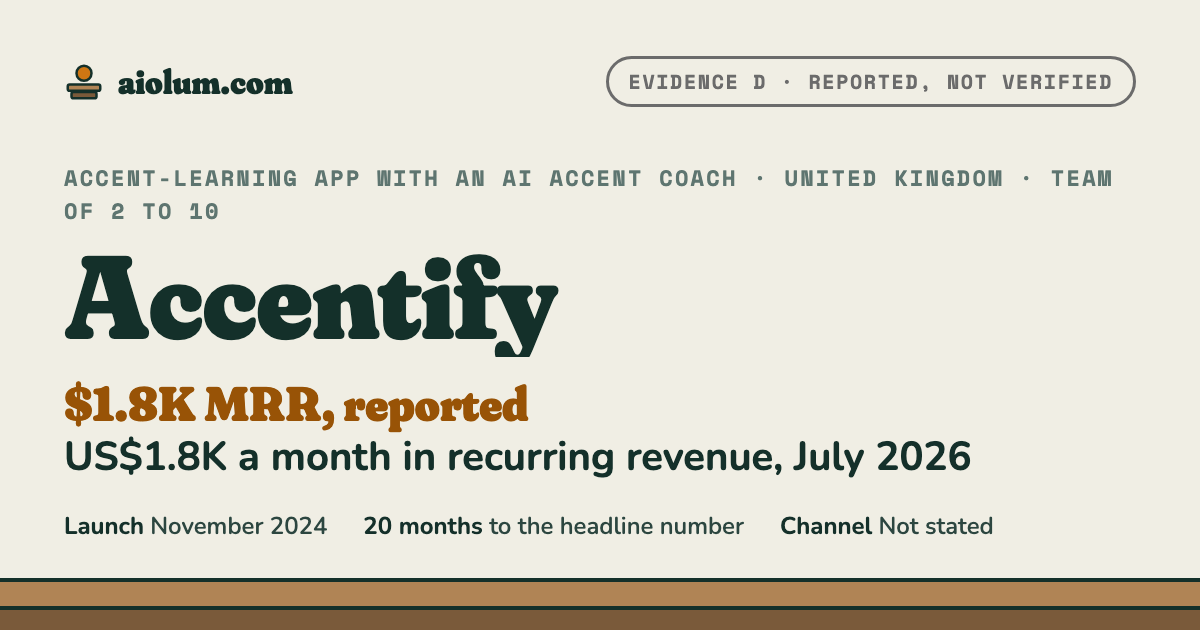
Accentify (Accent-learning app with an AI accent coach, United Kingdom): US$1.8K a month in recurring revenue, July 2026. Evidence grade D: reported, not verified. Team: 2 founders named on the site, Elijah Shoaib Khan and co-founder Beau Thomas, plus professional accent coaches who review recordings; total headcount not published. Launched November 2024; still running.Added 31 October 2026
- Outcome
- US$1.8K a month in recurring revenue, July 2026
- Evidence
- D reported, not verified
- Launch
- November 2024
- Status
- Still running
- Team
- 2 founders named on the site, Elijah Shoaib Khan and co-founder Beau Thomas, plus professional accent coaches who review recordings; total headcount not published
- Outside funding
- None reported; the founder took part in Founder Institute, and the site has an investor contact form
- Group
- Learning and study
- Main channel
- Not stated
What is not verified
The only revenue figure, US$1,800 in monthly recurring revenue, rests on one source: an X post by the founder on 10 July 2026, which we read as Brag in Public quotes it, not on X itself. No payment processor, app-store report or second interview confirms it. In October 2026 the founder spoke in the company blog of "a couple months of low revenue" and high churn, without numbers, so the July figure may not be the current one. A reader could look for a TrustMRR or RevenueCat-verified profile, or a later dated figure from the founders. The headline number is grade D: one claim or one estimate, with no second source. Aiolum shows it because the story is useful, and marks it so that it is not mistaken for a verified figure.
Accentify is an accent-learning app. An accent here means the way a group of people pronounces a language: the vowels and consonants, the rhythm (which syllables are long or short) and the intonation (how the pitch of the voice rises and falls). The user picks an accent such as General American or Australian, works through short listen-and-repeat lessons, and records their own voice. An AI coach called Tify listens to the recording and gives feedback on pronunciation, rhythm and intonation, and it can hold a practice conversation in the chosen accent. Users can also send a recording to a professional accent coach, a human, for personal feedback. The app teaches; it does not change the user's voice.
Elijah Shoaib Khan, an actor who has appeared on TV, in cinema and in London's West End and who had run a marketing agency, founded it in December 2023, according to the company's blog. His co-founder Beau Thomas is an accent coach and leads the courses. A waitlist page went up in 2024, a beta followed in October 2024, and the earliest dated user review on the home page is from 12 November 2024. On 10 July 2026 the founder posted on X, in a post that Brag in Public collected, that the app had reached US$1,800 in monthly recurring revenue (MRR, the subscription income that repeats every month) and was adding about US$100 of it every two and a half to three weeks.
That figure is the only money figure we found, so the story is graded D: one founder statement with one date. No payment processor confirms it, and in October 2026 the founder said in a company blog interview that the business had had "a couple months of low revenue", without dates or numbers. The page also shows what happened to earlier companies that sold language lessons and tutoring.
How much revenue does Accentify make?
Each row shows the evidence grade and the source numbers from the list at the end of this page. The grades are explained in How Aiolum verifies.
| Fact | Value | Grade | How we know | Sources |
|---|---|---|---|---|
| Monthly recurring revenue, July 2026 | US$1,800 | D | The founder's X post of 10 July 2026, as collected on Brag in Public: "WE'VE DONE IT - $1800 MRR". The only revenue figure in any source. | [1] |
| Growth rate the founder stated, July 2026 | about US$100 of MRR every 2.5 to 3 weeks | D | Same post: "we are adding around $100 MRR every 2.5-3 weeks now". His next goal was US$2,000 by the end of July 2026; no later post confirms it. | [1] |
| Run rate from the July 2026 figure | US$21,600 a year | calc | Calculated: US$1,800 times 12. | [1] |
| Subscribers that the figure implies | about 540 on the yearly plan, or about 180 at US$9.99 a month | calc | Calculated: US$1,800 divided by US$3.33 (the yearly price of US$39.99 divided by 12) or by US$9.99. The real mix of plans, and the share that Apple and Google keep, are not known. | [1, 5] |
| Revenue in later months | "a couple months of low revenue", no figures | C | The founder in a company blog interview of 21 October 2026, about what is hard: "churn is high or we've had a couple months of low revenue". No dates are given. | [4] |
| Founded | December 2023 | C | Company blog, 21 October 2026: "Elijah Khan founded Accentify in December 2023". The first sketch, then called "Accent Accelerator", is dated mid-2023. | [4] |
| Launch | November 2024 | C | A beta was announced on the home page in October 2024; the earliest dated user review quoted on the home page is from 12 November 2024. No source gives the exact store release date. | [2, 9] |
| Time from launch to the July 2026 figure | 20 months | calc | Calculated: November 2024 to July 2026. | [1, 2] |
| Founders | Elijah Shoaib Khan, Founder and Chief Executive Officer; Beau Thomas, Co-Founder and Chief Learning Officer | C | The "Meet the founders" page. The founder found his co-founder through Reddit while running early surveys, according to the blog interview. | [3, 4] |
| Company | Accentify LTD | C | The App Store lists the seller as "Accentify LTD"; the privacy policy names "Accentify LTD, doing business as Accentify". | [5, 7] |
| AI in the product | Tify, an AI accent coach; xAI's Grok named for AI feedback | C | Home page: "Tify is Accentify's AI accent coach. She listens to your speech, gives feedback on pronunciation, rhythm, and intonation". Privacy policy of 2 September 2026: third-party AI services in the feedback pipeline include "xAI/Grok where used for AI feedback generation", next to Accentify-hosted systems. | [2, 7] |
| Downloads and learners, as the company states | "50,000+ Downloads"; footer: "Join 35,000+ others" | C | Home page and footer, read 31 October 2026. The two counts differ and neither is verified. | [2, 3] |
| Waitlist before launch | 850+ in June 2024, 1,600+ in October 2024 | C | Archived home pages of 4 June 2024 and 9 October 2024. | [8, 9] |
| App Store rating | 4.3 from 43 ratings; age rating 4+ | C | UK App Store listing, read 31 October 2026. Category Education. | [6] |
| Outside funding | none reported | C | No source mentions a funding round. The founder says he prepared the idea for Founder Institute, a pre-seed program, and the founders applied to Y Combinator in 2026; the site has an "Invest In Accentify" contact form. | [4, 2] |
How to read this table: grade D is one unverified statement with one date. Grade C is what the company writes on its own site, blog or App Store listing. A "calc" value was computed on this page from the rows above it. No value is grade A or B.
| Plan | Per month, billed yearly (US$) | Per month, billed monthly (US$) | Limit |
|---|---|---|---|
| Free | 0 | 0 | free courses, with ads |
| Premium, weekly | 3.99 a week | App Store in-app purchase | |
| Premium, monthly | 4.99 or 9.99 | two prices listed | |
| Premium, yearly | 3.33 | US$39.99 a year | |
| Elite Plan | 9.99 | period not stated on the listing |
The listing gives the in-app purchase names and prices only, not the limits of each plan, and it lists two different monthly Premium prices, US$4.99 and US$9.99, probably for different offers or regions. The yearly price is shown here divided by 12. Lessons start free; the free tier shows ads, and version 2.1.46 of 30 August 2026 added ads that users can watch for rewards. The listing also has an Elite Plan at US$9.99 with no period stated.
When did Accentify launch, and how did it grow?
From a whiteboard sketch called Accent Accelerator to a two-platform app with an AI coach, in about three years. Each entry carries its grade.
- Mid-2023CElijah Khan, an actor leaving his marketing agency, sketches "Accent Accelerator" on a whiteboard: a marketplace for accent recordings from native speakers. He later drops the marketplace for Duolingo-style short lessons. [4]
- December 2023CHe founds Accentify, according to the company blog. He prepares the idea in Founder Institute and finds co-founder Beau Thomas, an accent coach, through Reddit. [4]
- 4 June 2024CWaitlist home page: "The free accent training app is coming", with Tify as a "personal, pocket accent coach" and 850+ people on the waitlist. [8]
- 9 October 2024C1,600+ people on the waitlist and an "Accent App - Beta Release" on the home page. [9]
- 12 November 2024CThe earliest dated user review quoted on the home page. [2]
- June 2026CVersion 2.1.38 connects AppsFlyer and PostHog with RevenueCat, according to the App Store version history. [6]
- 10 July 2026DThe founder posts that the app has reached US$1,800 in monthly recurring revenue and adds about US$100 every 2.5 to 3 weeks; he is testing Instagram influencer campaigns and new Meta ads. [1]
- 30 August 2026CVersion 2.1.46 adds ads that users can watch for rewards. [6]
- 2 September 2026CA new privacy policy describes the AI feedback pipeline and names xAI's Grok as one AI service in it. [7]
- 15 and 21 October 2026CThe company blog publishes a redesign of Tify and an interview in which the founder mentions "a couple months of low revenue" and a 2026 Y Combinator application. [4, 10]
- 31 October 2026CThe app is on the App Store and Google Play; the home page claims 50,000+ downloads. [2, 6]
Why did Accentify work?
Four causes, in the order they mattered. Each one is a reusable lesson.
The founder's own problem
The founder was an actor who needed accents for auditions and could not pay for regular coaching, so he once sent his lines to a stranger in a Facebook group to record them. The first users were actors with the same problem, and the home page still says "We're how actors book more roles".
A coach as co-founder
Beau Thomas, an accent coach who teaches at drama schools, writes the courses. That gives the lessons expert content from the start and makes the paid human feedback possible.
AI for the feedback that a coach cannot give at scale
A human coach can review only so many recordings. Tify, the AI coach, scores pronunciation, rhythm and intonation on every recording and holds practice conversations, so users get feedback at any hour. Human review stays as the premium layer.
Duolingo-style packaging
Short lessons, streaks, lives, rewards and a mascot, on the model of the largest language-learning app. Premium removes ads and limits on lives, which turns daily practice into a subscription.
How it was built
These details come from the company's privacy policy, its App Store listing and its blog. They are grade C. [7, 6, 2]
- Native apps for iPhone and Android; a web version was announced as coming soon on 31 October 2026.
- Voice recordings are analysed by Accentify-hosted systems and third-party AI services; the privacy policy names xAI's Grok for generating AI feedback.
- Hosting and data on Amazon Web Services, Microsoft Azure and MongoDB, according to the privacy policy.
- Payments through the Apple App Store, Google Play and Stripe, with subscriptions managed in RevenueCat.
- Analytics with Google Analytics or Firebase Analytics and PostHog; advertising attribution with AppsFlyer and Meta; support through Intercom.
- The marketing site runs on Squarespace and has a blog with accent tips and articles on actors' accents.
Tools named in the sources
Each one opens its page in the Tools tab, with every story that uses it.
Who tried this before Accentify, and why did they fail?
Five companies in our database of failed startups sold lessons, tutoring or learning from experts, and failed. The values below are from that database and are not independently verified.
Teacher Finder
The promiseMatch language learners directly with qualified teachers, without a language school.
Why it diedBetter-funded competitors took the market, and its simple first version could not change fast enough.
TutorCloud
The promiseTutoring on demand from qualified tutors over video.
Why it diedIt could not grow, and it could not keep either tutors or students.
Chesscademy
The promiseLearn chess through interactive online lessons.
Why it diedFree lessons were everywhere and a large competitor led the market; it never found a way to charge.
FrontRow
The promiseLow-priced online classes taught by well-known actors and musicians.
Why it diedThe famous teachers cost more than the low course prices brought in.
TutorGroup (iTutor)
The promiseLive online English tutoring by native speakers for learners in Asia.
Why it diedA 2021 rule in China ended most of its revenue, after years of high costs to win students and keep tutors.
The failed startups come from our database of 1,749 dead startups, retold here in our own words. Its entries are AI-assisted summaries of public sources, so these cards carry no evidence grade.
What changed
The five predecessors sold human teaching time or expert content, and the cost of tutors, teachers or famous instructors grew with every student. When a free alternative or a cheaper rival appeared, they had no margin left. Accentify sells the same kind of thing, expert accent coaching, and it faces the same free alternative: accent videos on YouTube, which its own home page names.
What differs is the AI coach. Feedback on every recording comes from software instead of a person, so the cost of one more learner is small, and the human coaches are kept for the paid layer. A two-founder company can therefore offer free lessons to tens of thousands of users and charge a few dollars a week for more; the founder reported in July 2026 that this had reached US$1,800 a month in recurring revenue. Whether the AI feedback is good enough to keep paying users is the open question, since the founder also spoke of high churn.
Can one person copy Accentify now?
The method, yes. The revenue, not yet proven.
Pairing a founder who has the problem with an expert who can teach it, and using AI for the repeated feedback, works for many skills that are taught one to one. But the only money figure for Accentify, as the founder stated it in July 2026, is small and has no second source.
Where it is still open: Accents of other languages, which the company says it plans, and nearby voice skills: singing technique, presentation delivery and pronunciation for specific jobs.
- 1Pick a skill that people now learn from an expensive one-to-one coach, such as accents, singing or public speaking.
- 2Bring in a working coach as a co-founder to write the course and set the standard for feedback.
- 3Use a speech model for the feedback on every attempt, and sell human review as the premium layer.
- 4Build a waitlist before launch from the community that has the problem, here actors.
What could go wrong for Accentify?
The risks are the mirror image of the causes above.
What is not verified
The only revenue figure, US$1,800 in monthly recurring revenue, rests on one source: an X post by the founder on 10 July 2026, which we read as Brag in Public quotes it, not on X itself. No payment processor, app-store report or second interview confirms it. In October 2026 the founder spoke in the company blog of "a couple months of low revenue" and high churn, without numbers, so the July figure may not be the current one. A reader could look for a TrustMRR or RevenueCat-verified profile, or a later dated figure from the founders.
Download counts disagree
The home page claims "50,000+ Downloads" and the site footer says "Join 35,000+ others". Both are the company's own claims, and downloads include free users who never pay.
AI processing of voice recordings
The privacy policy says recordings may be used to train Accentify's AI systems, that third-party AI services are used in the feedback pipeline, naming xAI's Grok, and that users can object by email. It also says the app "may be accessed by children"; the App Store age rating is 4+. The policy says recordings are not used to identify users.
Founder's own marketing
In July 2026 the founder posted that he was testing Instagram influencer campaigns and new Meta ad creatives. The home page quotes a list of waitlist comments by first name only; the same quotes already appeared on the 2024 waitlist page.
AI is one of three parts
Lessons are recorded courses, feedback comes from both Tify and human coaches, and the company does not say how much of the paid use is AI feedback. If the AI feedback is weak, the business depends on coach time, which costs more per user.
Sources
The grade next to each source is the best grade that the source can support. "Read in full" means that the text of the page was downloaded and the numbers were checked in it.
- D Brag in Public: Accentify, Learn any accent for confident English speaking (quotes the founder's X post of 10 July 2026)Read in full on 31 October 2026. The page quotes the founder's X post in full; the post itself was not opened, because x.com needs a login. The only source for the revenue figure.
- C Accentify home page, read 31 October 2026Read in full. Source for the features, Tify, the download claim, the dated reviews and the store links.
- C Accentify: Meet the foundersRead in full. Source for the founders' names, roles and backgrounds.
- C Accentify blog, 21 October 2026: From audition anxiety to Accentify: Elijah Khan's founder storyRead in full. A company interview with the founder. Source for the founding date, Founder Institute, the co-founder, the Y Combinator application and the remark on low revenue.
- C Accentify on the US App StoreRead in full on 31 October 2026. Source for the in-app prices and the seller name.
- C Accentify on the UK App StoreRead in full on 31 October 2026. Source for the description, the rating, the age rating and the version history.
- C Accentify privacy policy, last updated 2 September 2026Read in full. Source for the company name, the service providers, the AI pipeline and the section on children.
- C Accentify home page, archived 4 June 2024Read in full from the Wayback Machine. Source for the waitlist of 850+ and the first description of Tify.
- C Accentify home page, archived 9 October 2024Read in full from the Wayback Machine. Source for the waitlist of 1,600+ and the beta release.
- C Accentify blog, 15 October 2026: Meet the new Tify: how we redesigned Accentify's chameleonRead the first half. Source for the mascot and the move beyond actors.
- C Database of failed startups, local exportLocal export. AI-written summaries, not independently verified. Source for the failed predecessors.